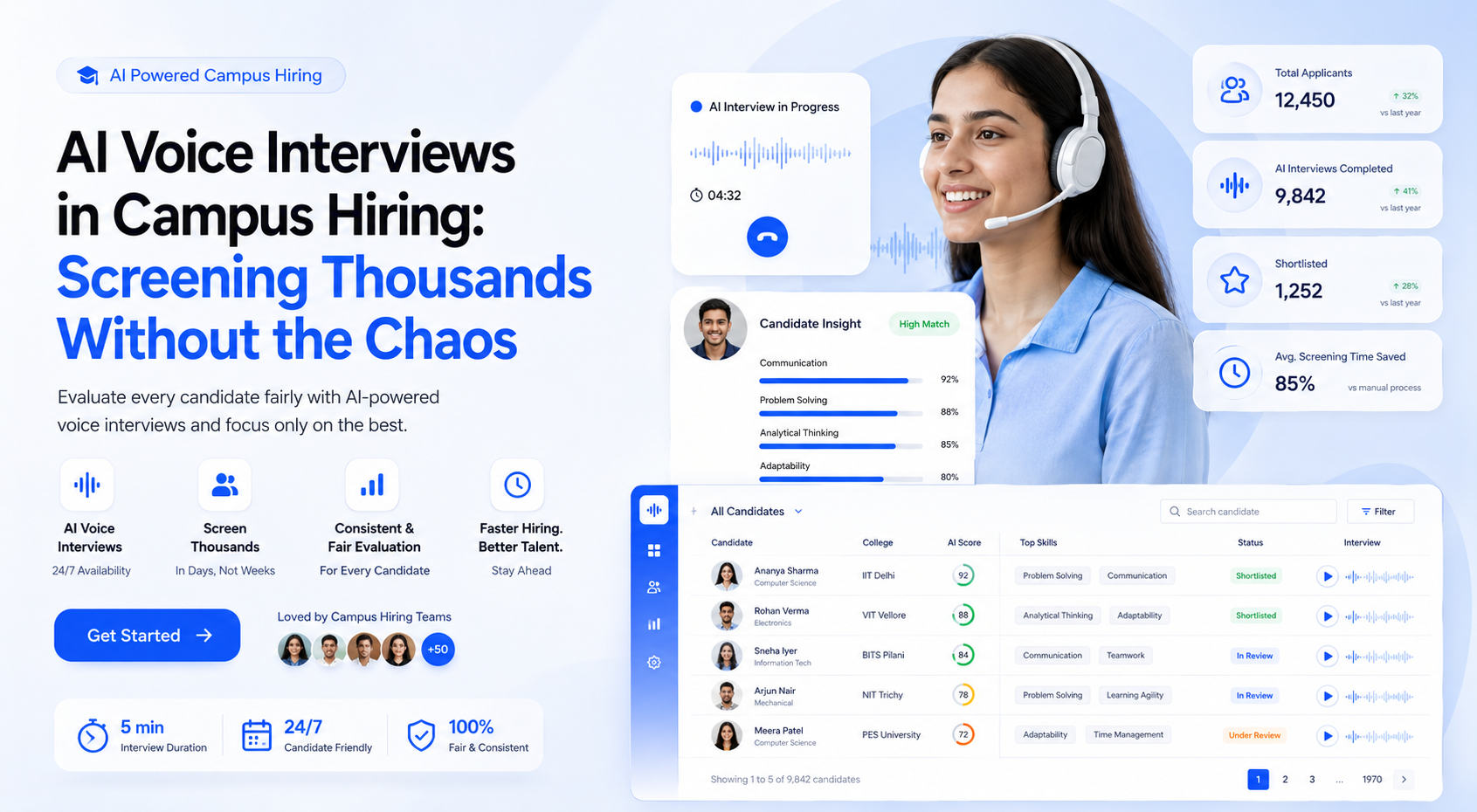
Every year, campus hiring teams across the world face the same structural challenge. A large employer visiting a top-tier engineering college might attract 2,000 to 5,000 applicants for 50 to 100 open positions. A financial services firm running a national campus program across 30 colleges will process tens of thousands of applications in a hiring window that lasts no more than six to eight weeks. A fast-growing technology company with an aggressive campus strategy may need to screen 20,000 or more students between September and December to fill its incoming cohort. These are not unusual numbers. They represent the normal operating reality of campus recruitment at any organization that takes campus hiring seriously, and they create a screening bottleneck that no amount of additional recruiter headcount can fully resolve.
Why Campus Screening Is Fundamentally a Volume Problem
The campus hiring pipeline is structurally different from lateral or experienced-hire recruitment in ways that make volume the dominant challenge. In experienced hiring, the recruiter typically works with a manageable number of applicants per requisition, often between 30 and 100, and the screening process benefits from the informational richness of the candidate’s work history, LinkedIn profile, and professional track record. In campus hiring, every candidate starts from approximately the same baseline. They are all students. They all have similar educational credentials from the same institution. Their resumes contain internship experiences, academic projects, and extracurricular activities that, while valuable, do not provide the kind of differentiated professional signal that a recruiter can
use to quickly prioritize candidates. The resume alone is rarely sufficient to separate the top 10 percent from the rest, which means the screening process must rely heavily on direct conversation, behavioral assessment, and competency evaluation.
The volume challenge is compounded by timing constraints. Campus hiring operates on an unforgiving calendar. Recruitment events happen in concentrated windows — the fall placement season in India, the fall and spring OCR cycles in the United States, the milk-round season in the United Kingdom. Employers who are slow to screen, slow to shortlist, and slow to extend offers lose the best candidates to faster-moving competitors. A student who receives an offer from Company A in October is unlikely to still be available when Company B finally finishes its screening process in November. This time pressure means that screening speed is not just an operational convenience in campus hiring. It is a direct competitive factor that determines whether the organization attracts top talent or settles for the candidates that faster competitors left behind. According to LinkedIn’s talent trends research, the average time-to-hire for campus positions at competitive employers has decreased by 25 percent over the past five years, driven entirely by the pressure to extend offers before rival employers complete their own evaluation cycles.
The third dimension of the campus volume problem is fairness. When recruiters are under immense time pressure to screen thousands of students, the quality and depth of each screening conversation inevitably varies. A recruiter who has conducted 40 phone screens in a single day is not evaluating the 40th candidate with the same rigor and attention as the first. Some candidates get thorough, thoughtful conversations. Others get rushed, perfunctory screens where the recruiter is checking boxes to get through the queue. This inconsistency is not just an operational problem. It is a fairness problem that affects the organization’s employer brand, its relationship with the college’s placement office, and its ability to attract diverse talent. Students talk to each other. When word spreads that the screening process for a particular employer was inconsistent, superficial, or unfair, the damage to the employer’s campus reputation is lasting and difficult to repair.
What AI Voice Interviews Actually Measure in Campus Contexts
The competency framework for campus AI voice interviews differs meaningfully from the framework used for experienced hires, and understanding this distinction is critical for effective deployment. Campus candidates do not have years of professional experience to draw on. They cannot describe how they led a cross-functional team through a complex organizational transformation or how they managed a P&L during a downturn. What they can describe is their approach to learning, their problem-solving process in academic and project contexts, their teamwork and communication skills, and their motivation and career orientation. These are the dimensions that predict on-the-job success for early-career hires, and they are exactly the dimensions that a well-designed AI voice interview is built to evaluate.
The first evaluation dimension is communication clarity and articulation. Can the
student express their thoughts in a structured, coherent manner? Can they explain a technical concept or a project outcome in a way that a non-specialist would understand? In business-facing and client-facing roles, this skill matters from day one, and a five-minute voice conversation provides a far more reliable assessment than a resume review ever could. The second dimension is structured thinking. When the AI asks a behavioral question — “Tell me about a time you faced a significant challenge in a team project. What was your role, and what was the outcome?” — the student’s response reveals whether they can organize their thoughts logically, provide specific details rather than vague generalities, and connect their actions to measurable results. These are the foundational skills of professional communication, and they are remarkably consistent predictors of early-career performance across industries and functions.
The third dimension is learning agility and intellectual curiosity. Campus candidates who can articulate what they learned from a failure, how they pursued knowledge outside their curriculum, or why they chose a particular academic project over alternatives demonstrate the kind of growth mindset that organizations value in early-career hires. The fourth dimension is motivation and cultural alignment. Why does the student want to join this specific company? What do they know about the role and the industry? Are they genuinely interested in the work, or are they applying because it is a prestigious name on their resume? The AI evaluates these dimensions through the substance and specificity of the candidate’s responses, not just through keyword matching. SHRM’s research on early-career hiring has found that structured pre-screening assessments that evaluate communication, problem-solving orientation, and motivation are significantly more predictive of first-year performance and retention than GPA or academic ranking alone, particularly when the assessment captures the candidate’s own voice rather than their written application materials.
The Logistics Nightmare: How AI Eliminates Scheduling Chaos
Anyone who has managed a campus hiring program knows that the operational logistics are often more challenging than the screening itself. Scheduling thousands of phone screens across multiple colleges, multiple time zones, and the busy schedules of both recruiters and students is a coordination challenge that consumes an enormous amount of administrative time. Recruiters spend hours each day sending scheduling emails, following up on no-shows, rescheduling missed calls, and updating spreadsheets that track which candidates have been screened and which have not. Students, many of whom are juggling classes, exams, and multiple interview processes simultaneously, frequently miss scheduled calls or request reschedules, creating a cascading delay that pushes the entire screening timeline further and further behind. The result is a process that feels chaotic to everyone involved — recruiters, candidates, and hiring managers alike.
AI voice interviews eliminate the scheduling bottleneck entirely. Instead of coordinating a live phone call between a recruiter and a student at a specific time, the student receives a link to complete their AI screening conversation at any time that is convenient for them. They can do it late at night after studying, between classes, or on a weekend. If
something interrupts them, most AI voice interview platforms allow them to pause and resume. The recruiter does not need to be present for the screening. The AI conducts the conversation, evaluates the responses, and generates a scorecard that is available for review whenever the recruiter has time. This asynchronous model converts a sequential, scheduling-dependent process into a parallel one, where every student in the pipeline can complete their screening simultaneously rather than waiting for an available recruiter slot. Gartner’s HR research has identified asynchronous AI screening as one of the top three operational innovations in campus hiring, noting that organizations using it report a 50 to 70 percent reduction in screening-cycle time and a significant decrease in candidate no-show rates, since candidates are no longer constrained to a specific appointment time.
The logistical benefits extend beyond just the initial screening. When every candidate has a completed AI scorecard, the shortlisting process becomes data-driven rather than intuition-driven. Recruiters can filter and rank candidates based on specific competency scores, compare candidates across colleges using a common evaluation framework, and present hiring managers with shortlists that are backed by consistent, comparable assessment data rather than the subjective notes of different recruiters who may have asked different questions and applied different standards. This is a fundamental shift in the quality of campus hiring decisions, and it is one that pays compounding returns over time as the organization builds a track record of which assessment dimensions best predict success for specific roles and programs.
Fairness, Bias, and the Case for Standardized Campus Evaluation
Fairness in campus hiring is not just a compliance requirement. It is a talent acquisition imperative. The students who perform best in unstructured, inconsistent screening processes are not necessarily the students who will perform best on the job. They are often the students who are most comfortable in unstructured conversation, who have had the most exposure to professional interview settings through family connections or previous internships, or who happen to have been screened by a recruiter who asked questions that aligned well with their strengths. Conversely, talented students from non-traditional backgrounds, students who are first-generation college graduates, and students whose communication style differs from the cultural norm of the recruiting organization may underperform in inconsistent screening settings despite having the cognitive ability, work ethic, and growth potential that the role demands.
AI voice interviews, when designed with structured competency-based questions and standardized evaluation criteria, provide a more level playing field. Every candidate is asked the same questions. Every candidate is evaluated against the same rubric. Every candidate has the same amount of time and the same opportunity to articulate their experience and perspective. The AI does not know the candidate’s college, their GPA, their family background, or their appearance. It evaluates only the content and quality of their verbal responses. This does not eliminate bias entirely — no screening tool can claim that — but it dramatically reduces the variability and subjectivity that characterize unstructured human
screening. Organizations that have measured the impact of standardized AI screening on campus hiring diversity report meaningful improvements in the representation of underrepresented groups in their shortlists and final offers. As noted in Recruiting Compliance Differences: India vs. USA vs. UK, the regulatory landscape for AI in hiring is evolving rapidly, and campus recruitment programs that adopt structured, auditable AI screening processes now will be better positioned to meet compliance requirements as they tighten across jurisdictions.
Candidate Experience: Why Gen Z Students Actually Prefer AI Screening
There is a persistent assumption in campus recruitment that students will resist AI screening because they want to talk to a real person. The evidence from organizations that have deployed AI voice interviews at scale tells a different story. When implemented with clear communication about the process, transparent instructions, and a modern user interface, AI voice interviews consistently receive higher candidate satisfaction scores than traditional phone screens. The reasons are practical. Students value the convenience of completing the screening on their own schedule. They appreciate the ability to think before responding, which reduces the performance anxiety of a live phone call. They prefer the consistency of knowing that every candidate faced the same process, which reduces the suspicion that the outcome was influenced by the recruiter’s subjective impression. And they respect employers who use modern technology, which signals that the organization is innovative and forward-thinking — qualities that matter to Gen Z candidates when evaluating potential employers.
EY’s workforce research has found that early-career candidates rank the quality and fairness of the hiring process among the top three factors influencing their decision to accept an offer, alongside compensation and role clarity. A process that is perceived as chaotic, inconsistent, or arbitrary actively damages the employer brand among the very talent pool the organization is trying to attract. Conversely, a process that is structured, transparent, and respectful of the candidate’s time strengthens the employer brand and generates positive word-of-mouth on campus — which is the most powerful recruiting channel available, as the next hiring cycle’s applicants rely heavily on the experiences of their peers who went through the process in previous years. The Talent Board CandE Awards research consistently shows that candidates who report a positive screening experience are 38 percent more likely to refer peers and 28 percent more likely to accept an offer, making candidate experience a direct driver of both recruitment quality and recruitment cost efficiency.
Campus at Scale Needs Campus-Ready AI Infrastructure
The case for AI voice interviews in campus hiring is strong on every dimension — volume handling, evaluation consistency, fairness, logistics simplification, and candidate experience. But the platform that delivers these benefits in a campus context must be designed for the specific demands of campus recruitment, not simply adapted from a
general-purpose hiring tool. Campus hiring has requirements that differ from experienced-hire recruitment in several important ways: the need to manage hiring across dozens of colleges simultaneously, the requirement for college-specific reporting and analytics, the integration with campus placement portals and student communication channels, and the ability to configure assessment frameworks that are appropriate for early-career candidates rather than experienced professionals. A platform that excels at screening mid-career software engineers may be poorly suited to evaluating fresh graduates, and vice versa.
Huntlo was built with the flexibility to handle both. Its AI voice interview system supports custom competency frameworks that can be configured for campus-specific evaluation dimensions — communication clarity, structured thinking, learning agility, and motivation — alongside the professional-level frameworks used for experienced-hire screening. Its sourcing engine covers 50+ platforms, including the job boards and campus-specific channels where students actively search for opportunities. Its multi-channel outreach reaches candidates via SMS, WhatsApp, and email, matching the communication preferences of the mobile-first student demographic. And its workflow management provides the college-by-college pipeline visibility, batch shortlisting, and comparative analytics that campus recruitment teams need to manage a national or global campus program effectively. As explored in Do AI Recruiting Tools Work for Niche or Technical Roles?, the effectiveness of any AI hiring tool depends on how well its assessment framework matches the specific candidate population and role requirements. Campus candidates are not simply less experienced versions of professional hires. They require a tailored evaluation approach, and Huntlo’s configurable framework delivers exactly that.
The practical impact for campus recruitment teams is significant. A team of five recruiters managing a campus program across 25 colleges can screen the entire applicant pool in days rather than weeks, with every candidate evaluated against the same competency framework and every scorecard available for data-driven shortlisting. The recruiters spend their time on the activities where human judgment is irreplaceable — conducting in-depth interviews with shortlisted candidates, building relationships with placement officers, coaching hiring managers on candidate evaluation, and making the final selection decisions that determine the quality of the incoming cohort. The AI handles the volume, the logistics, and the consistency. The humans handle the judgment, the relationships, and the decisions. That is not a compromise. It is the optimal allocation of effort for campus hiring at scale. For organizations still relying on spreadsheets, back-to-back phone screens, and manual scheduling to manage their campus programs, the question is no longer whether AI voice interviews can improve the process. The question is how much competitive ground they are willing to lose to the employers who have already made the shift.
Related Topics:
Should Recruiters Worry About AI Replacing Their Jobs?
More Tools, Same Hiring Problems
Why Do Some AI Recruiting Tools Have Outdated Candidate Data?