White-collar hiring occupies a middle ground in the AI voice interview conversation that is often overlooked. At one end, blue-collar and frontline roles are well-served by high-speed, high-volume AI screening where the evaluation focuses on communication clarity, reliability, and basic problem-solving. At the other end, senior executive roles are appropriately served by human-led assessment where adaptive conversation and strategic depth are irreplaceable. But the vast territory between these extremes — the professional, managerial, and knowledge-worker roles that make up the majority of white-collar hiring — presents a different set of requirements. The applicant pools are smaller but more competitive. The competencies are more nuanced. The evaluation needs to go deeper than a surface check, but it does not need the full exploratory depth of an executive assessment. AI voice interviews, when configured for this specific context, deliver a kind of evaluation that traditional phone screens struggle to match: structured, consistent, competency-specific, and detailed enough to transform the recruiter’s follow-up conversation from a broad screening call into a targeted, informed discussion.
The White-Collar Competency Landscape
The competencies that predict success in white-collar roles are more layered and interdependent than those that predict success in frontline positions. A marketing manager needs not just communication clarity but the ability to think strategically about positioning, to translate data into narrative, and to influence stakeholders across functions. A financial analyst needs not just quantitative accuracy but the ability to communicate complex findings to non-technical audiences and to exercise professional judgment about when to flag
risks versus when to investigate further. A software engineering manager needs technical depth combined with people management skills, project prioritization ability, and the capacity to represent the engineering function in cross-functional discussions where trade-offs between speed, quality, and scope are negotiated in real time.
These competency profiles share a common characteristic: they require the candidate to demonstrate not just knowledge but the ability to apply that knowledge in complex, ambiguous situations. The interview questions that elicit this kind of evidence are inherently open-ended. They ask candidates to describe how they handled a specific challenge, what trade-offs they considered, how they communicated their decision, and what they learned from the outcome. These are precisely the kinds of questions that AI voice interviews evaluate effectively, because the natural language processing layer is designed to assess the specificity, coherence, and relevance of behavioral responses. A candidate who provides a detailed, structured response that addresses the situation, the actions taken, the reasoning behind those actions, and the measurable outcome is demonstrating the kind of structured thinking and communication that predicts white-collar performance. A candidate who provides vague generalizations or who cannot articulate their decision-making process is revealing a gap, even if their resume lists all the right keywords.
Why Traditional Phone Screens Fall Short for White-Collar Roles
The traditional phone screen for a white-collar role typically lasts 20 to 30 minutes and covers a mix of resume verification, behavioral questions, and candidate selling. The recruiter asks about the candidate’s current role, why they are looking, their salary expectations, and perhaps one or two behavioral questions before moving to a description of the opportunity. This conversation serves multiple functions simultaneously — evaluation, relationship building, and selling — which means no single function receives the depth it deserves. The behavioral evaluation, in particular, is often shallow. The recruiter asks one or two competency-related questions, receives the candidate’s response, makes a brief mental assessment, and moves on. The result is an evaluation that is heavily influenced by the candidate’s resume, their conversational energy, and the recruiter’s subjective impression, rather than by a systematic assessment of the competencies that predict success in the role.
The consequence is inconsistency across candidates and recruiters. When three different recruiters screen candidates for the same marketing manager position, each one asks different questions, weighs different competencies, and brings different biases to the evaluation. One recruiter might be particularly impressed by candidates from well-known brands, while another focuses on communication style, and a third prioritizes specific campaign experience. The resulting shortlists reflect the recruiter’s preferences more than the role’s requirements. This is not the recruiter’s fault. It is a structural consequence of unstructured human evaluation, and its impact on hiring quality is well documented. Research from the Society for Industrial and Organizational Psychology has found that the variability in evaluation quality across different interviewers is one of the largest sources of noise in the hiring process — noise that AI voice interviews eliminate by applying identical evaluation criteria to every candidate, producing comparable data that the hiring manager can
actually use to make informed decisions.
There is also a candidate pool effect that makes inconsistent screening particularly costly in white-collar hiring. Professional and managerial candidates typically have multiple opportunities in progress simultaneously. A candidate who is genuinely strong but receives a superficial, unstructured phone screen may not demonstrate their full capabilities in the limited time, receives a generic rejection, and accepts an offer from a competitor who evaluated them more thoroughly. The cost of this miss is not just one unfilled position — it is the loss of a high-caliber hire to a competitor, compounded by the additional time and sourcing expense required to find a replacement of comparable quality. LinkedIn’s talent solutions research has found that the average white-collar candidate considers two to three opportunities simultaneously and makes their decision based primarily on the quality and speed of the hiring process, not on compensation differentials. Inconsistent screening that fails to identify and advance the best candidates is a competitive disadvantage that compounds across every hiring cycle.
Configuring AI Voice Interviews for White-Collar Depth
The key to effective AI voice interviews in white-collar hiring is configuration depth. A generic screening interview with five standard questions will produce generic results. White-collar roles require interview configurations that probe the specific competencies relevant to the role family, with questions designed to differentiate strong evidence from weak evidence. The most effective approach is to build role-family-specific interview templates that assess four to five core competencies with two questions each, producing a scorecard that evaluates eight to ten dimensions of the candidate’s capabilities.
For a product management role, the competency framework might include strategic thinking, stakeholder management, data-driven decision-making, communication clarity, and execution orientation. Each competency is assessed through at least one behavioral question that requires the candidate to describe a specific situation, their actions, their reasoning, and the outcome. The scoring criteria for each question define what strong, adequate, and weak evidence looks like. Strong evidence for strategic thinking might include describing a situation where the candidate identified a market shift, developed a strategic response, secured cross-functional buy-in, and measured the business impact. Weak evidence might include describing a general approach to strategy without a specific example, measurable outcome, or evidence of the candidate’s personal contribution. This level of specificity in the scoring criteria is what transforms the AI evaluation from a surface-level assessment into a meaningful data point that guides downstream hiring decisions. As explored in Do AI Recruiting Tools Work for Niche or Technical Roles?, the quality of AI screening output is directly proportional to the quality of the configuration input, and this is especially true for roles where the competencies are complex and interdependent.
The AI’s natural language processing evaluates each response against these criteria by analyzing the specificity of the examples provided, the logical structure of the response, the presence or absence of measurable outcomes, and the candidate’s ability to articulate
their reasoning process. These linguistic features are not arbitrary measurement points. They are grounded in decades of research on behavioral assessment methodology, which has established that the specificity and structure of a candidate’s behavioral examples are among the strongest predictors of job performance across professional roles. The AI automates the measurement of these features at a consistency level that human evaluators cannot sustain across large candidate pools.
From Screening to Intelligence: Using Scorecards for Smarter Follow-Ups
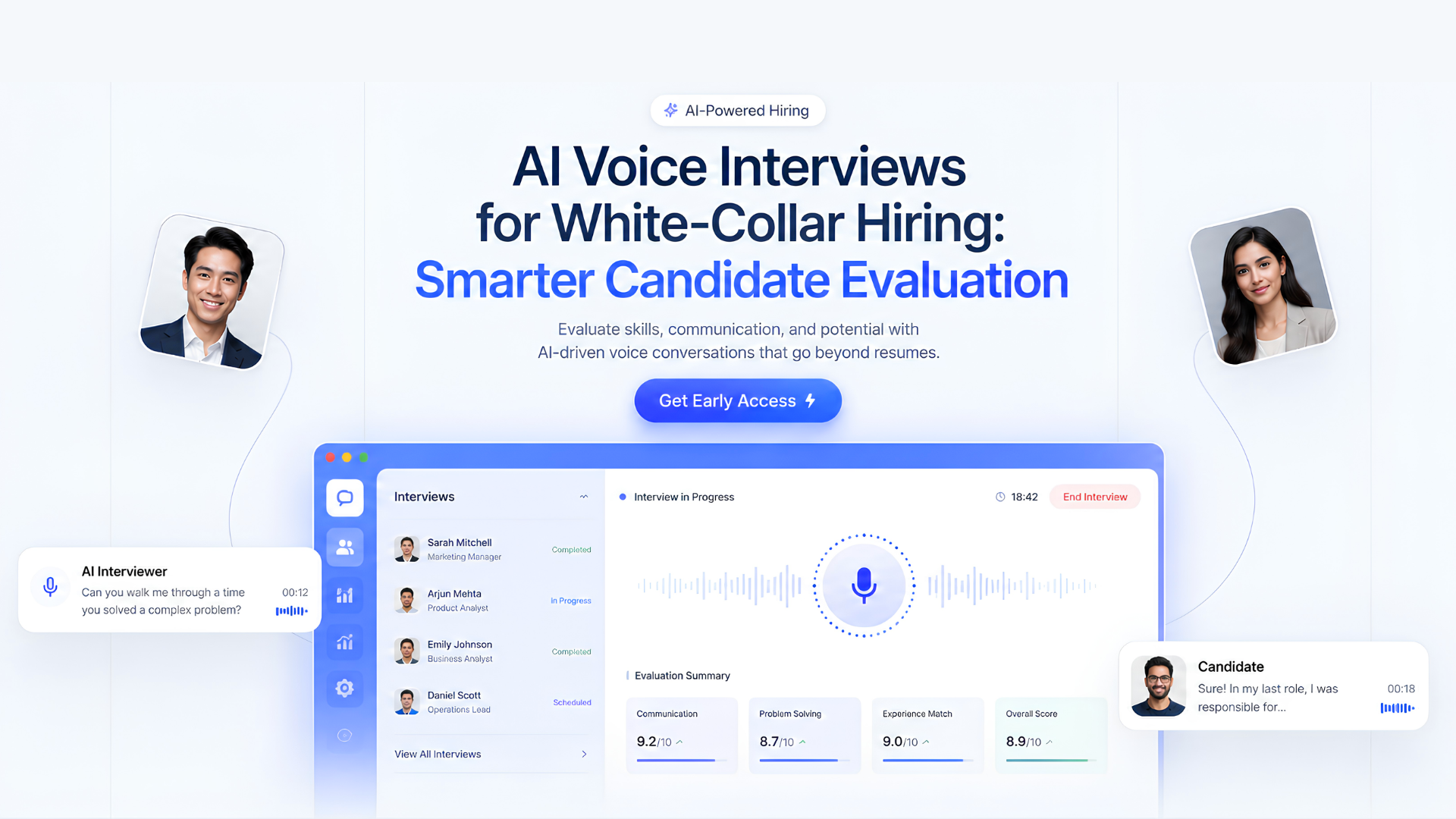
The most impactful use of AI voice interviews in white-collar hiring is not the screening decision itself — which candidates to advance — but how the evaluation data transforms the recruiter’s subsequent human interactions. When a recruiter reviews a multi-dimensional scorecard before a follow-up conversation, they approach that conversation with a precision that is impossible without the data. They know that the candidate demonstrated strong strategic thinking and communication but showed limited evidence of cross-functional collaboration and had difficulty articulating their career motivation. The follow-up conversation is designed to probe the gaps and verify the strengths, making every minute of the recruiter’s time productive.
This shift from screening to intelligence has a measurable impact on hiring outcomes. Organizations that use AI-generated scorecards to prepare for recruiter follow-ups report that the follow-up conversations produce significantly more useful information than unprepared phone screens, because the recruiter is building on a foundation of structured evaluation data rather than starting from zero. The hiring manager receives a shortlist accompanied by detailed competency assessments, enabling them to design panel interviews that focus on the dimensions most relevant to their specific team and context. The entire downstream process benefits from the data richness of the AI evaluation, and that data richness is the direct result of configuring the interview for white-collar depth rather than using a generic screening template. Heidrick & Struggles’ leadership advisory research has found that the quality of the shortlist data provided to the hiring manager is the single strongest predictor of hiring satisfaction, regardless of whether the role is mid-level or senior.
This intelligence-driven approach also addresses one of the most persistent complaints hiring managers make about the recruiting function: the quality of the shortlist narrative. When a recruiter advances a candidate based on a phone screen, the hiring manager typically receives a brief summary — “strong communication, good experience, seemed motivated” — that provides minimal decision-making value. When a recruiter advances a candidate based on an AI scorecard, the hiring manager receives a competency-specific assessment with evidence-based justifications. The conversation between the hiring manager and the recruiter shifts from “why did you advance this person?” to “what should we focus on in the panel interview?” — a fundamentally more productive discussion that leads to better interview design and better hiring decisions. This is the practical difference between a recruiting function that processes candidates and one that provides intelligence.
Why White-Collar AI Screening Needs a Unified Hiring Platform
The value of AI voice interviews in white-collar hiring is real, but it is amplified significantly when the screening capability operates within an integrated platform. White-collar candidates are typically sourced through professional networks, LinkedIn, referral programs, and targeted job postings — channels that differ from the job boards and classified platforms that dominate blue-collar sourcing. The outreach is often more personalized, requiring a different communication approach. The screening evaluation needs to feed directly into a workflow where the recruiter can review, follow up, and advance candidates without manual data transfer between disconnected systems. And the hiring manager needs visibility into the evaluation data that informs their interview design.
Huntlo provides this integrated environment. AI sourcing across 50+ platforms identifies and engages white-collar candidates through the channels where they are most active. Multi-channel outreach delivers personalized, branded communication that reflects the professionalism candidates in this segment expect. AI voice interviews, configured with role-family-specific competency frameworks, produce the detailed scorecards that transform follow-up conversations. And the entire workflow — from sourcing to screening to recruiter review to interview scheduling — operates within a single system where data flows between stages without manual intervention. The recruiter reviews the AI evaluation, identifies the candidates who deserve a deeper conversation, and conducts that conversation with full context from the screening stage. The hiring manager receives a shortlist backed by structured assessment data. The candidate experiences a process that is efficient, professional, and respectful of their time. This end-to-end integration is what agentic AI recruiting platforms deliver, and it is why organizations using unified platforms see dramatically better results from AI voice interviews than those deploying standalone screening tools. The evaluation intelligence is the same. The platform determines whether that intelligence reaches the people and the decisions it is meant to inform.
Related Topics:
The ATS Mistake Companies Keep Repeating