The Recruiter's Paradox: A People Profession Drowning in Process
Ask any recruiter why they entered the profession and the answer is almost always the same: they wanted to work with people. They wanted to understand careers, match talent with opportunity, build relationships, and help people make decisions that shape their professional lives. It is fundamentally a human profession — built on conversation, empathy, judgment, and interpersonal connection.
Yet the daily reality of most recruiters tells a radically different story. A landmark 2024 SHRM study of 2,400 corporate recruiters across North America and Europe found that the average recruiter spends only 35% of their working time on activities that involve direct human interaction with candidates or hiring managers. The remaining 65% is consumed by process administration: scheduling interviews, sending reminders, documenting evaluation notes, entering data into ATS systems, generating scorecards, coordinating between multiple stakeholders, and managing the logistical machinery of the hiring pipeline.
This is not a minor inefficiency — it is a structural inversion of the recruiter's value proposition. The activities that recruiters are uniquely qualified to perform — understanding candidate motivations, assessing cultural alignment, coaching candidates through the process, advising hiring managers on talent strategy, and building the kind of trusted relationships that attract passive talent — are the activities that get squeezed when process administration dominates the calendar. The Gallup State of the Global Workplace 2024 report found that recruiters who spend more than 50% of their time on process tasks are 3.2 times more likely to report burnout symptoms and 2.7 times more likely to be actively searching for a new job.
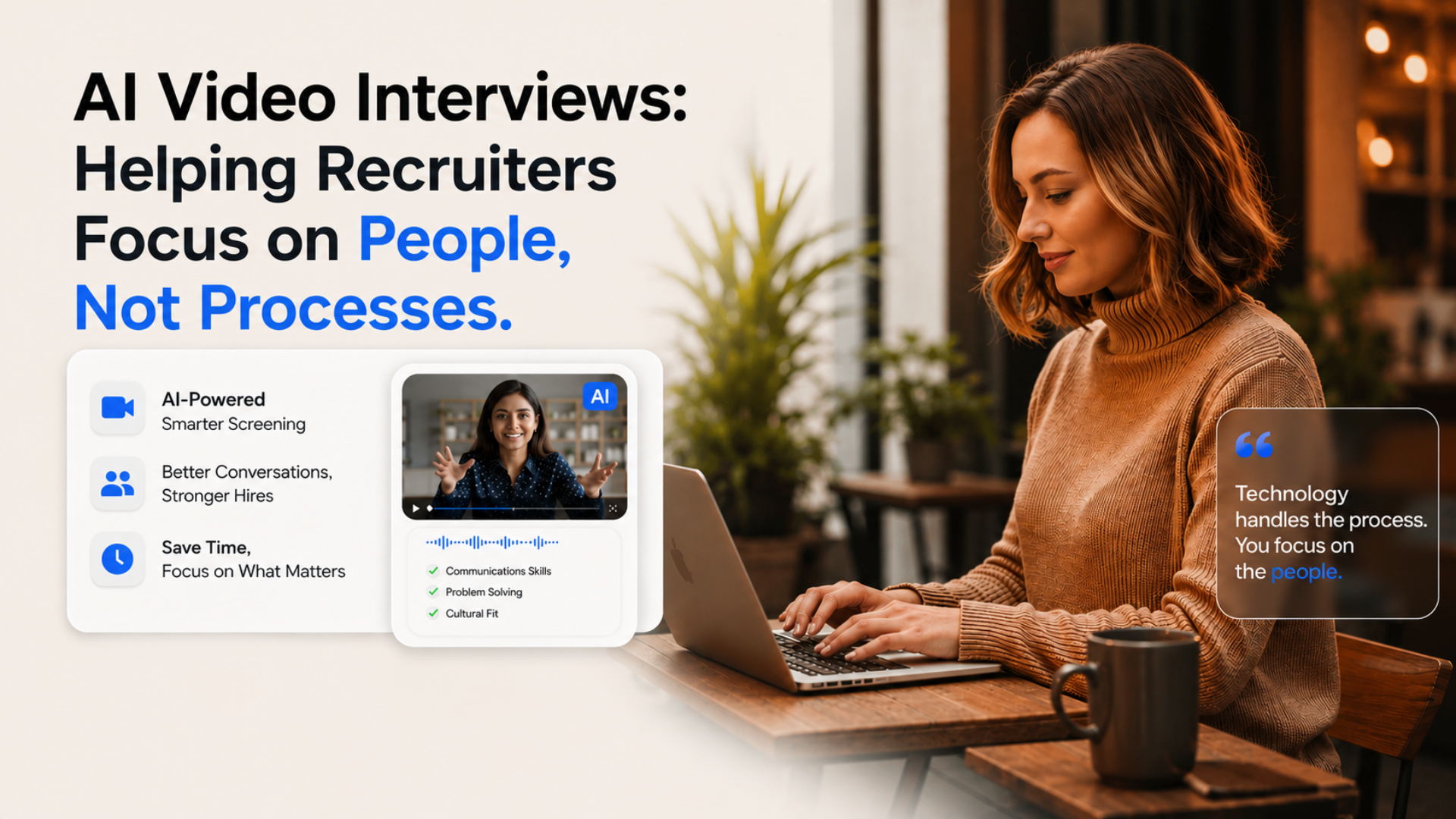
AI video interviews represent a structural intervention in this dynamic. By automating the most process-intensive, repetitive, and time-consuming layer of the interview workflow — the initial screening interview — AI video interviews redistribute recruiter time from process administration back to human interaction. This article examines how that redistribution works, why it matters for hiring outcomes, and how enterprises can implement AI video interviews in a way that genuinely empowers recruiters rather than merely extracting more efficiency.
The Process Burden: Quantifying What Recruiters Actually Do All Day
To understand why AI video interviews are so consequential for recruiter effectiveness, it is necessary to quantify the process burden in detail. The SHRM study referenced above broke down the average recruiter's 40-hour work week into activity categories, and the results are revealing.
Scheduling and logistics — coordinating interview times across multiple calendars, sending confirmations, handling rescheduling requests, managing time-zone differences — consumed an average of 8.2 hours per week, or 20.5% of total working time. For enterprises hiring across multiple geographies, this figure rose to 11.4 hours. The administrative overhead of scheduling is disproportionately high because it involves asynchronous coordination between multiple parties, each with their own calendar constraints, and each rescheduling event triggers a cascade of new coordination tasks.
Conducting initial screening interviews — the first-round conversations designed to verify basic qualifications, assess communication skills, and determine whether the candidate should advance — consumed an average of 10.6 hours per week, or 26.5% of working time. Screening interviews are the single largest time allocation for most recruiters, and they are also among the most process-heavy: the same questions are asked repeatedly, the same evaluation criteria are applied, and the same documentation is generated for every candidate. The content is human, but the structure is mechanical.
Documentation and data entry — writing evaluation summaries, entering candidate notes into the ATS, updating pipeline status, generating scorecards, and maintaining hiring records — consumed 7.8 hours per week, or 19.5%. This is pure process administration with zero direct human value: the candidate is not present, the hiring manager is not present, and the recruiter is performing data entry that could be automated.
When these three categories are combined, process-related activities consume 26.6 hours per week out of 40 — leaving only 13.4 hours for the relationship-driven, judgment-intensive, human-value activities that define great recruiting: candidate relationship building, hiring manager consultation, offer negotiation, talent market intelligence, employer brand representation, and strategic workforce planning.
The What Recruiters Actually Use AI Sourcing Tools For (Survey Insights) article on the Huntlo blog provides additional data on how recruiters currently allocate their time across sourcing, screening, and engagement activities — and where they report the greatest pain points.
How AI Video Interviews Reclaim Recruiter Time
AI video interviews address the process burden at its largest single point: the initial screening interview. By automating the delivery, evaluation, and documentation of screening conversations, AI video interviews eliminate the most time-consuming and repetitive element of the recruiter's week while actually improving the quality and consistency of the screening output.
The time savings are substantial. A Gartner analysis of AI interview deployment at 15 enterprise organizations found that AI video interviews reduced recruiter time spent on initial screening by an average of 72%. For a recruiter who previously spent 10.6 hours per week on screening, this represents a recovery of approximately 7.6 hours — nearly a full additional workday that can be redirected to higher-value activities.
But the time savings extend beyond the interview itself. AI video interviews also eliminate or dramatically reduce the scheduling burden associated with screening. When candidates complete AI video interviews asynchronously — on their own schedule, through their preferred channel — the complex calendar coordination that consumes 8+ hours per week for many recruiters becomes largely unnecessary for the screening stage. Huntlo.ai's multi-channel delivery (email, LinkedIn, WhatsApp, AI voice) allows candidates to complete screening interviews through whatever channel is most convenient, further reducing the scheduling friction that dominates recruiter calendars.
The documentation burden is similarly reduced. AI video interview platforms generate structured evaluation data automatically — dimensional scores, competency assessments, response transcripts, and evaluation summaries — eliminating the 7.8 hours per week that recruiters spend on manual documentation. This data flows directly into the ATS through webhook integration, removing the manual data entry that is both time-consuming and error-prone.
In aggregate, AI video interviews can recover 15-20 hours per recruiter per week from process administration — time that can be reinvested in the human activities that drive hiring quality and candidate experience. The How to Reduce Recruiter Burnout With Workflow Automation article on the Huntlo blog explores how this time recovery translates into measurable reductions in recruiter burnout and turnover.
What Recruiters Do When They Are Freed From Process
The critical question is not just how much time AI video interviews save, but what recruiters do with the time they recover. The evidence from organizations that have successfully deployed AI video interviews reveals a consistent pattern: recovered time flows primarily to four high-value activities that were previously starved for attention.
Deeper candidate relationship building. When recruiters are not rushing through 15 screening calls per day, they have the bandwidth to have fewer but more meaningful conversations with the candidates who matter most. This means more thorough preparation before candidate calls, more insightful questions about candidate motivations and career goals, more responsive follow-up after interviews, and more effective coaching of candidates through the later stages of the hiring process. A LinkedIn Global Talent Trends 2025 report found that candidates who experienced "high-touch" recruiter engagement — characterized by thorough preparation, personalized communication, and proactive follow-up — were 43% more likely to accept an offer and 28% less likely to renege after accepting.
More effective hiring manager partnership. Hiring managers frequently complain that recruiters function as administrative coordinators rather than strategic talent advisors. When recruiters are freed from process burden, they have the time to invest in understanding the hiring manager's business context, team dynamics, and specific talent needs — and to provide informed counsel on candidate evaluation, market conditions, and hiring strategy. A Korn Ferry study found that hiring managers who described their recruiter relationship as "strategic partnership" rather than "administrative support" were 2.1 times more likely to rate their new hires as "exceptional" or "above expectations" at the 12-month mark.
Proactive talent pipeline development. The most impactful recruiting activity is the one that most recruiters never have time for: building relationships with potential candidates before a specific role opens. When AI video interviews handle the reactive screening burden, recruiters can invest time in proactive pipeline building — engaging passive candidates, attending industry events, building professional network relationships, and creating the kind of talent community that fills roles faster and with higher-quality candidates when they do open. McKinsey's 2024 Talent Strategy report found that organizations where recruiters spent more than 20% of their time on proactive pipeline development filled positions 34% faster than organizations where recruiters spent less than 5% of their time on pipeline activities.
Strategic workforce planning contribution. When recruiters operate at the process-administration level, their organizational contribution is limited to filling individual roles. When they are freed to operate at the strategic level, they can contribute to workforce planning: analyzing hiring trends, identifying emerging skill gaps, advising on build-versus-buy decisions, and helping the organization anticipate talent needs rather than simply reacting to them. Deloitte's 2025 High-Impact HR research identified recruiter participation in workforce planning as one of the strongest predictors of overall talent acquisition effectiveness.
The Screening Quality Paradox: AI Does the Repetitive Part Better
A common concern among recruiters is that automating screening interviews will reduce evaluation quality — that the human judgment applied during a live screening call is superior to AI evaluation. The evidence suggests the opposite: for the specific task of structured screening — asking standardized questions, evaluating responses against competency criteria, and generating consistent scores — AI actually outperforms individual human evaluators.
The reason is rooted in the nature of screening interviews. Screening is not a relationship-building exercise. It is a structured assessment designed to verify baseline qualifications, evaluate core competencies, and determine whether the candidate merits investment of further hiring manager time. This is precisely the kind of repetitive, criteria-driven evaluation where AI excels and where human evaluators are most vulnerable to the cognitive biases documented extensively in industrial-organizational psychology research.
A 2024 meta-analysis in Personnel Psychology found that AI screening systems achieved inter-rater reliability coefficients of 0.82-0.89 for structured competency evaluation, compared to 0.45-0.61 for individual human evaluators. This means that AI screening produces more consistent, more reliable, and more bias-resistant evaluation than the human screening calls it replaces. The AI is not replacing human judgment — it is handling the repetitive, mechanical part of the evaluation so that human judgment can be reserved for the complex, nuanced, relationship-intensive decisions where it actually adds value.
The How Does AI Interview Screening Score Candidates? article on the Huntlo blog provides a detailed technical explanation of how NLP-powered scoring works and why it produces more consistent results than human evaluation for structured screening tasks.
From Gatekeeper to Talent Advisor: The Evolving Recruiter Role
The redistribution of time enabled by AI video interviews is not merely a productivity improvement — it represents a fundamental shift in the recruiter's role within the organization. When process administration dominates the recruiter's day, the recruiter functions as a gatekeeper: controlling access to hiring managers, filtering candidates through a bureaucratic process, and serving primarily as an administrative intermediary between the talent market and the organization.
When AI handles the screening layer, the recruiter's role evolves from gatekeeper to talent advisor. The talent advisor role is defined by three capabilities that are impossible to exercise when 65% of the workday is consumed by process.
First, informed candidate advocacy. A talent advisor does not simply pass along screening results — they bring context, nuance, and human insight that the AI cannot provide. They can explain why a candidate with a slightly lower AI score might still be an exceptional fit based on factors the screening interview did not capture: career trajectory, learning agility, team compatibility, or unique experiences that align with the organization's strategic needs. This kind of informed advocacy requires the deep candidate understanding that only emerges from relationship-driven conversations — the conversations recruiters can now afford to have.
Second, hiring manager coaching. Many hiring managers are not skilled interviewers. They ask legally risky questions, evaluate candidates based on gut instinct rather than evidence, and make decisions that reflect their own biases rather than the role's requirements. A talent advisor with time to invest in the hiring manager relationship can coach managers on interview technique, help them interpret AI screening data, and ensure that later-stage evaluations build on the structured foundation that the AI screening interview has established. Harvard Business Review research found that hiring managers who received regular coaching from their recruiter partner made 24% fewer "regret hires" — hires that the manager wished they had not made within the first year.
Third, candidate experience ownership. In a process-heavy recruiting model, candidate experience is an afterthought — something that happens in the gaps between administrative tasks. In a talent advisor model, the recruiter has the time to own the candidate experience intentionally: providing thorough briefings before each interview stage, offering constructive feedback after rejections, maintaining communication during long hiring processes, and ensuring that every candidate — including those who are not hired — leaves the process with a positive impression of the organization. A Talent Board CandE Benchmark report found that recruiter responsiveness and personal attention were the two strongest predictors of positive candidate experience, accounting for more variance than any other factor including compensation, role attractiveness, or brand reputation.
The Candidate Experience Dimension: How Recruiters With More Time Create Better Experiences
The relationship between recruiter time availability and candidate experience is direct and well-documented. When recruiters are overwhelmed by process burden, candidates experience the consequences: slow response times, generic communication, lack of preparation before interviews, and minimal feedback after rejections. These negative experiences translate directly into employer brand damage and lost talent.
A 2024 Glassdoor analysis of 2 million interview reviews found that the single most common complaint in negative reviews — appearing in 31% of all negative feedback — was "poor communication from the recruiter." Candidates did not complain about the AI technology, the interview format, or the evaluation criteria. They complained about feeling ignored, uninformed, and treated as a transaction rather than a person.
AI video interviews address this problem by freeing recruiters to communicate more frequently, more personally, and more substantively. When the screening layer is automated, the recruiter can focus their human interaction on the touchpoints that matter most to candidates: the initial outreach that demonstrates genuine interest in their background, the pre-interview briefing that helps them prepare effectively, the post-interview debrief that provides meaningful feedback, and the offer conversation that addresses their specific concerns and motivations.
The How to Run Multi-Channel Outreach Without Sounding Like Spam article on the Huntlo blog explores how AI-automated outreach, combined with recruiter-led relationship building, creates a candidate experience that is both efficient and genuinely personal.
Recruiter Burnout: The Crisis That Process Automation Can Help Solve
Recruiter burnout is not a metaphor — it is a measurable, accelerating, and strategically consequential workforce crisis. The 2024 Recruiter Sentiment Report from SHRM found that 76% of corporate recruiters reported feeling burned out, with 42% describing their burnout level as "high" or "very high." The annual recruiter turnover rate in enterprise TA organizations has risen to 35% — meaning that the average enterprise loses more than a third of its recruiting capacity every year to voluntary departure.
The primary driver of recruiter burnout is not the volume of hiring or the difficulty of the talent market. It is the process burden. The same SHRM study found that "administrative workload" was the most frequently cited burnout driver, selected by 68% of burned-out recruiters — ahead of "difficult hiring managers" (54%), "candidate ghosting" (47%), and "unrealistic hiring targets" (44%). Recruiters are not burning out because recruiting is inherently stressful. They are burning out because the process infrastructure forces them to spend the majority of their working hours on activities that provide no intellectual stimulation, no human connection, and no sense of professional accomplishment.
AI video interviews directly attack the primary burnout driver. By automating the screening and documentation layers, AI video interviews remove the most repetitive, least fulfilling, and most time-consuming elements of the recruiter's workday. The The Role of AI in Reducing Recruiter Workload by 2030 article on the Huntlo blog provides a comprehensive analysis of how AI-driven automation across the hiring funnel is projected to reshape recruiter workloads over the remainder of the decade.
The impact on recruiter satisfaction is significant. Organizations that have deployed AI video interviews report measurable improvements in recruiter engagement and retention. A Gallup study of AI-augmented recruiting teams found that recruiters using AI screening tools reported 28% higher job satisfaction, 34% lower burnout scores, and 41% lower turnover intent compared to recruiters in equivalent roles without AI support. These improvements were driven primarily by the shift from process administration to relationship-driven work — confirming that the recruiter experience improves not despite AI automation but because of it.
Will AI Replace Recruiters? The Evidence Says No — But It Will Redefine the Role
The fear of AI replacing recruiters is pervasive and understandable. A 2024 Pew Research Center survey found that 62% of recruiting professionals expressed concern about AI eliminating some or all of their job functions within the next decade. This anxiety can create resistance to AI adoption that delays or undermines implementation.
The evidence, however, consistently points in a different direction. AI video interviews are not replacing recruiters — they are redefining what recruiters do. The Should Recruiters Worry About AI Replacing Their Jobs? article on the Huntlo blog provides a detailed analysis of which recruiting tasks are genuinely exposed to automation and which human capabilities will become more valuable as AI handles the process layer.
The pattern that emerges from the evidence is clear: AI automates the tasks that are structured, repetitive, and criteria-driven — screening, scoring, scheduling, documentation. It does not automate the tasks that are relational, judgment-intensive, and context-dependent — relationship building, candidate coaching, hiring manager advising, offer negotiation, and strategic talent consulting. Rather than eliminating the recruiter role, AI is elevating it from process administration to strategic talent advisory.
This elevation has a skills implication: the recruiters who will thrive in an AI-augmented environment are those who invest in the human capabilities that AI cannot replicate — deep listening, emotional intelligence, business acumen, negotiation skill, and the ability to build genuine trust with both candidates and hiring managers. The recruiters who will struggle are those whose value proposition is primarily process execution: scheduling interviews, reading resumes, and administering checklists.
For TA leaders managing this transition, the key is to frame AI video interviews as a recruiter-enablement tool rather than a recruiter-replacement tool, and to invest in upskilling programs that help recruiters develop the advisory capabilities that the post-automation role requires. The Role of AI in Reducing Recruiter Workload by 2030 projects that AI-augmented recruiters will spend 60% of their time on relationship and advisory activities by 2030, compared to 35% today — a near-complete inversion of the current process-dominated workload.
How Huntlo.ai's Platform Enables the People-First Recruiter Model
Huntlo.ai's platform is designed around the principle that AI should handle the process so that recruiters can focus on people. Every element of the platform architecture supports this principle.
The conversational AI screening engine handles the structured, repetitive layer of the interview process: delivering standardized questions through video, voice, and text channels; evaluating responses against configurable competency frameworks; generating dimensional scores and structured evaluation summaries; and flowing all evaluation data directly into the talent pool and ATS through webhook integration. The recruiter does not need to schedule screening calls, conduct repetitive interviews, or manually document evaluation notes. The AI handles all of it.
The platform's integration with 50+ sourcing platforms ensures that candidates enter the standardized evaluation pipeline from every relevant sourcing channel, eliminating the manual sourcing-to-screening handoff that consumes additional recruiter time. Multi-channel outreach — email, LinkedIn, WhatsApp, AI voice — allows candidates to engage through their preferred communication channel, reducing the back-and-forth coordination that dominates recruiter calendars.
The talent pool management capabilities give recruiters a structured, searchable, and analytically rich view of their candidate pipeline — replacing the spreadsheets, notes, and mental models that many recruiters currently rely on. When a hiring manager says "I need someone with experience in cloud infrastructure and team leadership," the recruiter can query the talent pool, identify matching candidates with pre-existing AI screening data, and present qualified candidates immediately rather than starting a sourcing process from scratch.
The flat pricing model — $99 per seat per month with no usage caps — is specifically designed to encourage recruiter time recovery rather than rationing. When AI interview tools are priced per-candidate or per-interview, organizations face a financial incentive to limit automation to a narrow subset of candidates, forcing recruiters to continue conducting manual screenings for the rest. Huntlo.ai's uncapped model removes this incentive entirely, allowing recruiters to automate screening for every candidate in the pipeline and redirect all of the recovered time to relationship-driven activities.
The Hiring Manager Relationship: How Recruiter Time Recovery Improves Hiring Decisions
The hiring manager relationship is one of the most undervalued dimensions of recruiting effectiveness. Most hiring managers are not trained interviewers. They do not design structured questions, apply consistent scoring criteria, or calibrate their evaluations against objective benchmarks. They rely on gut instinct, cultural familiarity, and personal chemistry — the same factors that research from the Journal of Applied Psychology has shown are among the weakest predictors of job performance.
When recruiters are consumed by process administration, they have no capacity to improve this situation. They submit candidate packets, receive cursory feedback, and move on to the next administrative task. The hiring manager's evaluation process remains unexamined and unimproved.
When AI video interviews free recruiter time, the hiring manager relationship can deepen in ways that materially improve hiring decisions. Recruiters can prepare hiring managers for candidate conversations, providing context from the AI screening data that helps managers ask more targeted and relevant questions. They can debrief with managers after interviews, helping them distinguish between evidence-based and impression-based evaluations. They can provide calibration data — showing managers how their evaluations compare to the AI scoring and to other managers' evaluations of similar candidates — creating accountability and improvement loops that are impossible in a process-overloaded model.
A 2024 Korn Ferry study of hiring manager effectiveness found that managers who received regular coaching and data-driven feedback from their recruiting partner were 31% more likely to make hiring decisions that aligned with structured competency criteria, and their new hires were 22% more likely to be rated as "exceeding expectations" at the 12-month performance review. These improvements were driven entirely by the quality of the recruiter-manager relationship — which in turn was enabled by the recruiter having sufficient time to invest in that relationship.
Measuring the Impact: Metrics That Matter When Recruiters Focus on People
When AI video interviews automate the process layer, the metrics that define recruiting success shift from process efficiency to relationship effectiveness. Enterprises should track both categories of metrics during and after implementation to quantify the impact of the transition.
Process efficiency metrics — time-to-screen, screening completion rates, documentation accuracy, scheduling efficiency — should improve immediately and dramatically with AI video interview deployment. These are the "quick wins" that demonstrate the automation is working. Huntlo.ai's analytics capabilities provide real-time visibility into these metrics across the entire hiring pipeline.
Relationship effectiveness metrics — candidate satisfaction scores, hiring manager satisfaction scores, offer acceptance rates, early attrition rates, recruiter engagement scores — should improve over a longer time horizon as recruiters redirect recovered time to human-facing activities. These metrics are more meaningful indicators of strategic impact but require patience and consistent measurement.
Business outcome metrics — new hire performance ratings, time-to-productivity, quality-of-hire indices, and hiring-related cost savings — represent the ultimate value proposition of the people-first recruiter model. These metrics typically improve within 6-12 months of AI video interview deployment, as the compounding effects of better candidate relationships, stronger hiring manager partnerships, and more strategic talent advisory begin to manifest in hiring outcomes.
The Human-Centered Implementation Approach
Implementing AI video interviews as a recruiter-enablement tool requires a human-centered implementation approach that prioritizes recruiter adoption, trust, and skill development. The following principles, drawn from Prosci change management methodology and SHRM technology adoption research, guide successful implementations.
Involve recruiters in the design process. Recruiters who are included in the design of AI interview templates, competency frameworks, and evaluation criteria develop ownership of the system rather than feeling subjected to it. The best implementations create recruiter-led design committees that bring frontline insight to the configuration process.
Communicate the enablement narrative, not the efficiency narrative. Frame AI video interviews as a tool that gives recruiters more time for the human work they value — not as a cost-cutting measure that reduces headcount. Harvard Business Review research on technology adoption consistently shows that enablement framing produces 2.3 times higher user adoption rates than efficiency framing.
Provide upskilling for the advisory role. Not all recruiters are prepared to transition from process administration to strategic talent advisory. Invest in training programs that develop the consultation, coaching, and relationship-building skills that the post-automation role requires.
Maintain human oversight and override authority. The AI should inform hiring decisions, not make them. Recruiters must retain the authority and the confidence to override AI recommendations when their human judgment suggests a different course. This maintains recruiter agency and ensures that the AI is perceived as a tool rather than a replacement.
Measure and celebrate the relationship outcomes. Track and publicize improvements in candidate satisfaction, hiring manager satisfaction, and recruiter engagement — not just time and cost savings. This reinforces the people-first narrative and demonstrates the strategic value of the transition.
The Future of Recruiting: Human Connection Amplified by AI
The recruiting profession is at an inflection point. The process burden that has consumed the majority of recruiter time for decades is now automatable — not incrementally, but comprehensively. AI video interviews, AI sourcing, AI outreach, and AI-powered workflow orchestration can handle the structured, repetitive, and data-intensive layers of the recruiting process at a scale and consistency that human recruiters cannot match.
This does not diminish the recruiter's value. It amplifies it. By removing the process burden, AI creates the conditions for recruiters to do what they entered the profession to do: work with people, build relationships, exercise judgment, and help both candidates and organizations make better decisions. The recruiters who embrace this transition — who develop the advisory capabilities that AI cannot replicate and who leverage AI-generated data and insights to inform their human judgment — will become the most valuable and most strategically impactful members of their organizations' talent functions.
The recruiters who resist the transition — who cling to process execution as their primary value proposition — will find their roles increasingly automated and their strategic influence diminishing. The choice is not between AI and human recruiters. It is between recruiters who use AI to become more human in their work and recruiters who are replaced by AI because they insisted on competing with it on process execution.
AI video interviews are the most concrete and immediately deployable expression of this future. They automate the screening layer today, freeing recruiter time for relationship-driven work tomorrow, and laying the data foundation for the increasingly autonomous, AI-augmented recruiting systems of the coming decade. For recruiters and TA leaders who are ready to make the shift from process to people, the technology is available, the evidence is compelling, and the competitive advantage is real.
Related Topics
How to Reduce Recruiter Burnout With Workflow Automation — A practical guide to identifying and automating the specific workflow bottlenecks that drive recruiter burnout, including screening, documentation, and scheduling.
Should Recruiters Worry About AI Replacing Their Jobs? — An evidence-based analysis of which recruiting tasks AI will automate, which human capabilities will become more valuable, and how the recruiter role is evolving.
The Role of AI in Reducing Recruiter Workload by 2030 — A forward-looking analysis of how AI-driven automation across sourcing, screening, outreach, and workflow orchestration will reshape recruiter workloads over the rest of the decade.