Recruiting has never been more demanding.
Across staffing agencies, enterprise talent acquisition teams, startups, and Global Capability Centers (GCCs), recruiters are managing more open roles, larger candidate pipelines, and increasingly complex hiring processes.
Yet despite advances in recruiting technology, many recruiters still spend most of their day on repetitive operational tasks rather than strategic hiring activities.
They send outreach messages.
They follow up with candidates.
They coordinate interviews.
They update systems.
They chase hiring managers.
They manage spreadsheets and status reports.
The result is a growing productivity challenge.
As organizations look toward 2030, the question is no longer whether AI will influence recruiting.
The question is:
How much recruiter workload can AI eliminate while improving hiring outcomes?
The answer may be far more significant than many expect.
The future of recruiting is not about replacing recruiters.
It is about giving recruiters the ability to operate at dramatically higher capacity by automating execution-heavy work.
Why Recruiter Workload Is Increasing
Recruiting teams today face pressures that did not exist at the same scale a decade ago.
More Open Roles Per Recruiter
Many organizations expect recruiters to manage larger requisition loads without proportional increases in headcount.
Recruiters are often responsible for:
Multiple hiring teams
Simultaneous open positions
High-volume candidate pipelines
Cross-functional coordination
As hiring demand grows, recruiter bandwidth becomes a critical constraint.
Candidate Expectations Are Rising
Candidates increasingly expect:
Faster responses
Personalized communication
Transparent processes
Flexible scheduling
Meeting these expectations manually requires significant recruiter effort.
Administrative Burden Continues to Grow
Much of a recruiter's day is spent on work that does not directly contribute to hiring decisions.
Examples include:
Scheduling interviews
Sending reminders
Updating systems
Tracking candidate progress
Coordinating stakeholders
These tasks create operational overhead that limits recruiter productivity.
How Recruiters Spend Their Time Today
One of the biggest misconceptions in recruiting is that recruiters spend most of their time finding candidates.
In reality, sourcing is only one part of the process.
Outreach
Recruiters invest substantial time contacting potential candidates and managing responses.
This often involves:
Personalized messages
Multi-channel outreach
Response tracking
Follow-up campaigns
Follow-Ups
Follow-ups are among the most time-consuming recruiting activities.
Candidates often require multiple touchpoints before responding or progressing.
Without automation, recruiters spend hours each week managing reminders.
Scheduling
Interview coordination remains one of the most manual recruiting functions.
Recruiters frequently coordinate:
Candidate availability
Hiring manager schedules
Panel interviews
Rescheduling requests
Reporting
Recruiters also spend time maintaining records and generating hiring updates for stakeholders.
While necessary, these activities contribute little direct value to candidate conversion.
What AI Can Already Automate
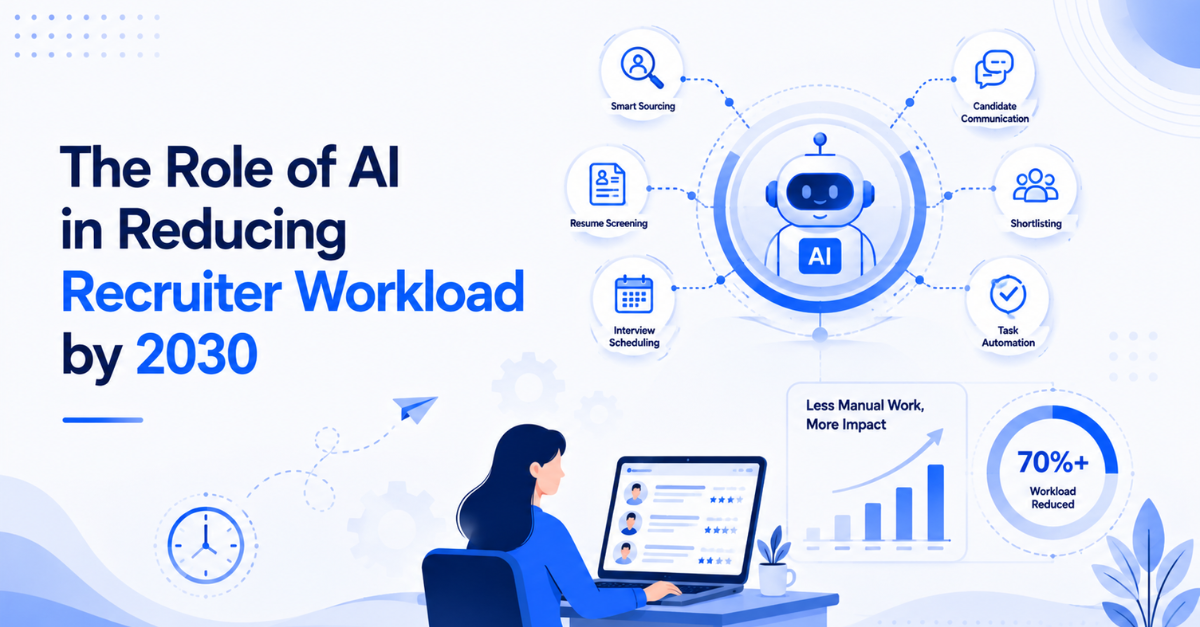
Today's AI recruiting software can already automate many repetitive recruiting tasks.
Candidate Sourcing
AI sourcing tools help recruiters:
Discover talent faster
Search larger candidate pools
Improve candidate matching
Reduce manual search effort
This was the first major wave of AI adoption in recruiting.
Candidate Engagement
Modern platforms increasingly automate:
Initial outreach
Follow-up sequences
Candidate communication
Response tracking
This helps recruiters maintain engagement without manually managing every interaction.
Interview Coordination
Scheduling automation can:
Identify availability
Coordinate calendars
Send reminders
Handle rescheduling
Tasks that once required hours can now occur automatically.
The Biggest Productivity Gains by 2030
The next generation of recruiting technology will move beyond task automation.
Instead of assisting recruiters with isolated activities, AI will increasingly manage entire recruiting workflows.
Automated Qualification
AI systems will be able to:
Conduct preliminary candidate assessments
Gather missing information
Validate basic requirements
Route qualified candidates appropriately
Recruiters will spend less time on repetitive screening conversations.
Workflow Orchestration
By 2030, recruiting platforms will increasingly coordinate entire hiring processes.
AI will manage:
Candidate progression
Communication sequences
Workflow triggers
Process compliance
This reduces operational friction across the recruiting lifecycle.
Intelligent Follow-Ups
Future recruiting systems will understand:
Candidate responsiveness
Communication preferences
Engagement patterns
Timing optimization
Rather than recruiters manually deciding when to follow up, AI will manage engagement automatically.
Tasks Recruiters Will Still Own
Despite rapid automation, recruiters will remain essential.
The highest-value recruiting work depends on human judgment, relationships, and strategic thinking.
Relationship Building
Successful recruiting remains fundamentally human.
Recruiters will continue to:
Build trust
Understand motivations
Manage negotiations
Strengthen employer brands
AI can facilitate conversations but cannot replace authentic relationships.
Strategic Hiring Decisions
Hiring decisions involve nuance, context, and organizational priorities.
Recruiters will continue to guide:
Candidate evaluation
Hiring recommendations
Workforce planning
Talent strategy
Stakeholder Management
Internal alignment remains a critical recruiting responsibility.
Recruiters will continue acting as advisors to:
Hiring managers
Leadership teams
HR partners
Business stakeholders
AI Sourcing vs Agentic AI Recruiting
Understanding the difference between sourcing and recruiting automation is critical.
Finding Talent
AI sourcing tools focus primarily on candidate discovery.
Their goal is to answer:
Who might be a good candidate?
This remains valuable but represents only one stage of recruiting.
Moving Talent Through the Funnel
The greater challenge is execution.
Recruiters must:
Engage candidates
Qualify candidates
Coordinate interviews
Manage communication
Drive hiring decisions forward
This is where Agentic AI Recruiting begins to create value.
The distinction is important:
AI sourcing finds candidates.
Agentic AI Recruiting helps hire candidates.
The Rise of Recruiting Operations Automation
The largest productivity gains over the next decade will likely come from recruiting operations automation.
Workflow Management
AI systems will increasingly manage workflow execution across:
Candidate pipelines
Hiring stages
Team coordination
Process governance
Candidate Communication
Future recruiting platforms will automate significant portions of candidate engagement.
This includes:
Outreach
Follow-ups
Status updates
Scheduling communication
Hiring Process Optimization
AI will continuously identify inefficiencies such as:
Candidate drop-offs
Interview delays
Bottlenecks
Workflow gaps
This enables recruiting teams to improve performance without expanding headcount.
What Talent Leaders Should Automate First
Organizations preparing for the future do not need to wait until 2030.
Many productivity improvements are available today.
Outreach
Automating candidate communication can dramatically reduce recruiter workload.
Qualification
Early-stage screening workflows are ideal candidates for automation.
Scheduling
Interview coordination remains one of the highest-return automation opportunities.
Follow-Ups
Consistent follow-ups improve candidate conversion while eliminating manual effort.
These areas often generate the fastest productivity gains.
Preparing Your Recruiting Team for 2030
The future of recruiting will not arrive through technology alone.
Organizations must rethink how recruiting work gets done.
Technology Adoption
Recruiting leaders should evaluate platforms that support:
Workflow automation
Candidate engagement automation
Recruiting operations automation
AI-assisted execution
Process Redesign
Automating inefficient processes rarely delivers optimal results.
Teams should simplify workflows before introducing AI.
Human-AI Collaboration
The most successful recruiting teams will combine:
Human judgment
Relationship-building skills
Strategic decision-making
with:
Automated workflows
Intelligent systems
Operational execution
This partnership will define the future recruiter.
The Future Belongs to More Productive Recruiters
Many discussions about AI focus on job displacement.
Recruiting is likely to follow a different path.
The greatest impact of AI will not be replacing recruiters.
It will be removing the operational bottlenecks that prevent recruiters from doing their most valuable work.
The recruiting teams that succeed by 2030 will not necessarily have larger teams.
They will have better systems.
Historically, recruiting technology evolved through three major phases:
Phase 1: The ATS Era
Applicant Tracking Systems organized recruiting data.
Phase 2: The AI Sourcing Era
AI sourcing tools improved candidate discovery.
Phase 3: The Agentic AI Recruiting Era
The next generation of recruiting technology focuses on execution.
These systems automate:
Candidate engagement
Qualification workflows
Follow-ups
Interview scheduling
Workflow orchestration
Recruiting operations
The future of recruiting is not fewer recruiters.
It is more productive recruiters supported by intelligent systems.
Organizations that embrace this shift early will be able to handle more hiring demand, improve candidate experience, and increase recruiter capacity without continuously increasing headcount.
That is the real promise of AI in recruiting by 2030.
Frequently Asked Questions
Will AI replace recruiters by 2030?
No. AI is more likely to automate repetitive recruiting tasks while allowing recruiters to focus on relationship-building, strategic hiring decisions, and stakeholder management.
How does AI reduce recruiter workload?
AI automates tasks such as sourcing, candidate engagement, follow-ups, scheduling, qualification, and workflow coordination.
What recruiting tasks can AI automate?
AI can automate candidate outreach, interview scheduling, follow-ups, qualification workflows, pipeline management, and reporting activities.
Can AI automate candidate communication?
Yes. Modern recruiting platforms can automate outreach campaigns, follow-ups, reminders, status updates, and engagement workflows.
How much time can recruiters save with AI?
Results vary by organization, but automation can significantly reduce time spent on administrative and coordination tasks.
What is recruiting workflow automation?
Recruiting workflow automation uses technology to manage recruiting processes, communications, scheduling, and pipeline progression with minimal manual effort.
What is candidate engagement automation?
Candidate engagement automation helps recruiters communicate consistently with candidates through automated outreach, follow-ups, and personalized messaging workflows.
What is Agentic AI recruiting?
Agentic AI recruiting refers to AI systems that actively execute recruiting workflows rather than simply providing recommendations or candidate matches.
How will talent acquisition change by 2030?
Talent acquisition is expected to become increasingly automated, with AI managing operational tasks while recruiters focus on strategy, relationships, and hiring decisions.
What should recruiters automate first?
Most organizations see the greatest immediate impact from automating outreach, qualification workflows, interview scheduling, and candidate follow-ups.