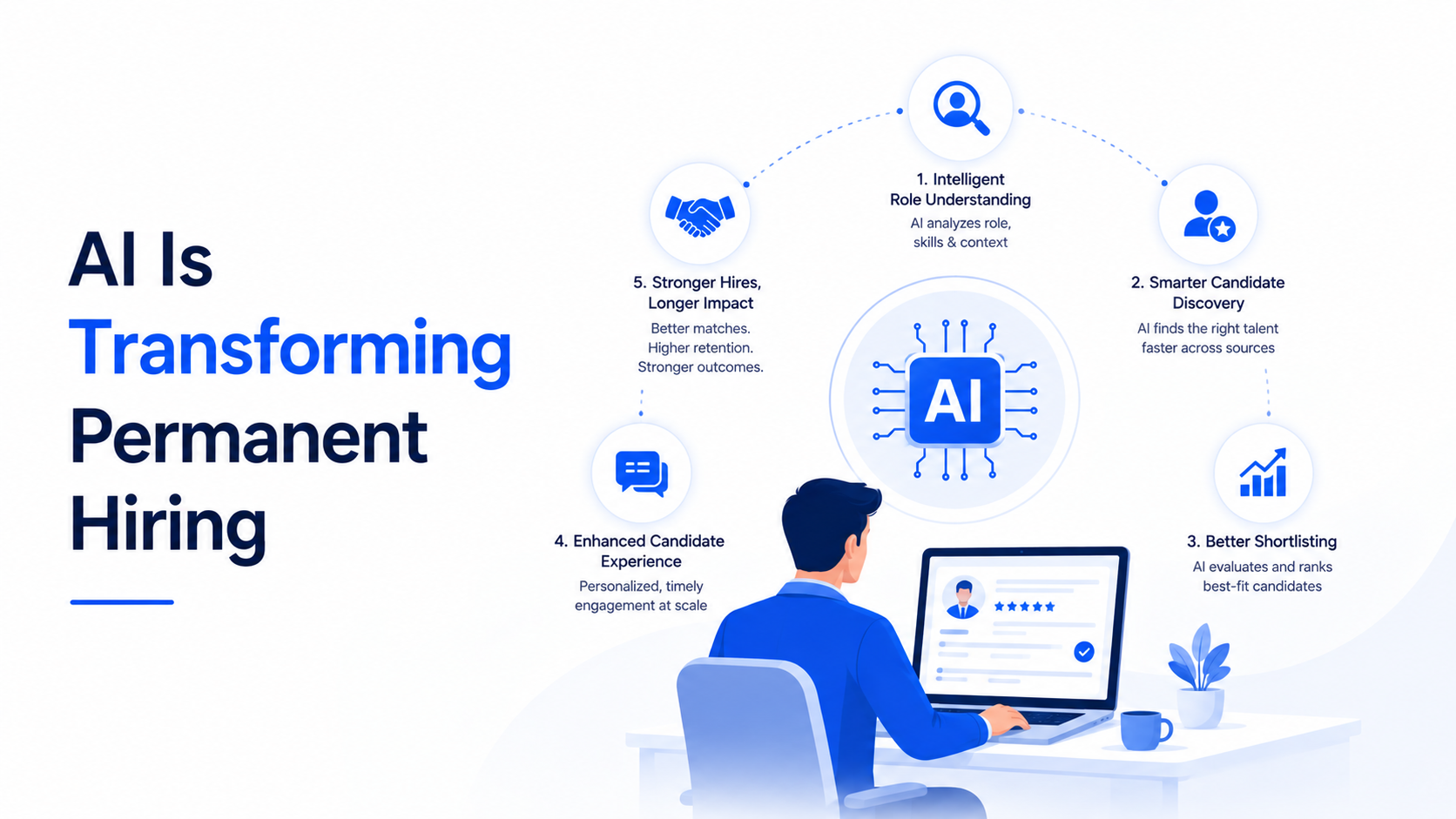
David Chen led talent acquisition for a manufacturing company in Nashville that hired roughly two hundred permanent employees per year across engineering, operations, and corporate functions. His team of nine recruiters followed a process that had not changed meaningfully in a decade: post the job, review applications, phone screen the most promising candidates, schedule panel interviews, collect feedback, make an offer, and hope the new hire stayed beyond the first year. The process was slow, averaging fifty-two days from requisition to offer acceptance, and inconsistent, because each recruiter applied slightly different screening criteria and the quality of hire varied significantly depending on which recruiter managed the search. David had heard about AI recruiting tools for years but assumed they were designed for high-volume contingent staffing rather than the more deliberative, relationship-intensive process of permanent hiring. That assumption was challenged when a colleague at a similar-sized manufacturer shared that her team had reduced time-to-fill by thirty-eight percent and improved first-year retention by eighteen percent using an AI platform that enhanced rather than replaced every stage of their permanent hiring process. David realized that permanent hiring, not just contract staffing, was being fundamentally reshaped by AI, and that his team's reluctance to engage with these tools was putting his company at a growing competitive disadvantage in the talent market.
From Resume Screening to Predictive Success Modeling
The most visible transformation AI brings to permanent hiring is the shift from resume screening to predictive success modeling. Traditional permanent hiring evaluates candidates based on their past credentials, the roles they have held, the skills they list, and the education they have completed. This backward-looking approach assumes that past qualifications predict future performance, an assumption that is reliable enough to be useful but that misses
important predictors of success that are not captured on a resume. AI success models analyze not just what candidates have done but how they have done it, the trajectory of their career progression, the complexity and scope of the challenges they have handled, the patterns of their job transitions, and the signals in their professional activities that indicate adaptability, initiative, and growth potential. A candidate who has progressively taken on larger scopes of responsibility, contributed to cross-functional projects, or demonstrated thought leadership in their domain may be a stronger candidate for a permanent role than someone with more impressive titles but a flatter growth trajectory, yet traditional resume screening would likely favor the candidate with better titles while missing the candidate with better trajectory.
Predictive success modeling also incorporates organizational context in ways that resume screening cannot. The model does not just assess whether a candidate is qualified for a role in the abstract. It assesses whether the candidate is likely to succeed in this specific role at this specific organization, given the team dynamics, reporting structure, growth challenges, and cultural attributes that define the position. This contextual matching is possible because AI models can be trained on an organization's own historical hiring data, learning which candidate attributes predict success in the organization's unique environment rather than relying on general industry patterns. A candidate who thrives in a fast-moving, ambiguity-tolerant startup culture may struggle in a more structured, process-driven enterprise environment, and vice versa. AI models that have been trained on an organization's own outcome data can identify these contextual fit factors and weight them appropriately in the matching process. According to McKinsey, organizations using AI-powered success prediction models for permanent hiring report twenty to thirty percent higher new-hire performance ratings at the one-year mark compared to traditional screening methods, because the models consider a broader range of success predictors and calibrate them to the organization's specific context.
The transition from screening to predictive modeling requires organizations to invest in the data infrastructure that makes model training possible. AI models improve with outcome data, meaning the organization must systematically track new-hire performance, retention, and engagement over time and feed this data back into the model. Organizations that do not have mature people analytics functions often lack this outcome data, which limits the AI model's ability to learn and improve. The most effective approach is to implement the AI platform with a plan for outcome data collection from day one, even if the initial model relies on general patterns rather than organization-specific data. As the organization accumulates its own hiring outcome data, the model becomes progressively more accurate and more tailored to the organization's unique hiring dynamics. This compounding improvement is one of the most powerful features of AI in permanent hiring, because each hire makes every subsequent hire more likely to succeed. how to evaluate an AI sourcing tool provides guidance on assessing whether an AI hiring platform supports the outcome data collection and model retraining capabilities that permanent hiring organizations need, because platforms that cannot learn from organizational hiring outcomes will produce static recommendations that do not improve over time.
Candidate Experience as a Competitive Advantage
In permanent hiring, candidate experience matters more than in any other hiring segment, because permanent candidates are making a long-term career decision and they evaluate potential employers as carefully as employers evaluate them. A candidate considering a permanent move is not just assessing whether the role is a good fit. They are assessing whether the organization is a place where they want to build a multi-year career, and the hiring process is their first direct experience of how the organization operates. Slow response times, generic communications, and opaque processes signal organizational dysfunction that makes candidates question whether they want to commit years of their career to that employer. AI transforms the candidate experience in permanent hiring by enabling the speed, personalization, and transparency that candidates expect from organizations that take their talent seriously. AI-powered communication tools send personalized updates at each stage of the process, answer candidate questions in real time, and provide clear timelines that reduce the anxiety and uncertainty that cause candidates to withdraw from consideration.
The competitive impact of candidate experience in permanent hiring is measurable and significant. Candidates for permanent roles typically interview with multiple employers simultaneously, and the employer that provides the best hiring experience gains a decisive advantage in competing for top talent. According to LinkedIn, sixty percent of candidates who have a positive permanent hiring experience with an employer accept the offer when extended, compared to thirty-eight percent of candidates who report a negative experience, a gap that directly affects the organization's ability to hire its first-choice candidates. AI enables the kind of responsive, personalized hiring experience that creates this advantage. AI scheduling tools eliminate the back-and-forth coordination that delays interviews. AI communication tools maintain engagement between stages so candidates do not feel forgotten. AI assessment tools provide candidates with clear feedback on where they stand in the process, reducing the uncertainty that drives candidates to accept competing offers. These capabilities do not just improve the candidate's experience. They improve the employer's ability to close their top candidates before competitors who provide a slower, less responsive experience can make competing offers.
The candidate experience advantage extends beyond the hiring process into the employer brand. Candidates who have a positive hiring experience become brand ambassadors, sharing their experience with their professional networks and on public platforms. Candidates who have a negative experience do the same, but in the opposite direction. In permanent hiring, where the stakes are high and candidates are often well-connected professionals, the employer brand impact of hiring experience is amplified. AI enables organizations to deliver a consistently positive experience across all permanent hiring processes, ensuring that every candidate, whether they receive an offer or not, leaves the process with a positive impression of the organization. This consistency is difficult to achieve with manual processes, because the quality of the candidate experience in a manual environment depends on the individual recruiter's
communication skills, workload, and attention to detail, all of which vary. AI standardizes the experience while preserving personalization, because the AI can personalize communications based on candidate context while maintaining consistent response times and process transparency. how many follow-ups one hire needs demonstrates how AI-powered follow-up systems maintain candidate engagement throughout permanent hiring processes that can span four to eight weeks, because the extended timeline of permanent hiring makes consistent communication especially critical for keeping candidates engaged and preventing the drop-off that occurs when candidates feel ignored between stages.
Reducing the Cost of Bad Permanent Hires
The most compelling economic argument for AI in permanent hiring is the reduction of bad hire costs. A bad permanent hire is one of the most expensive mistakes an organization can make. The direct costs include recruitment expenses for the failed hire, onboarding and training investment that is lost when the employee departs, severance and exit costs, and the recruitment expenses for the replacement hire. Indirect costs include productivity loss during the vacancy, team morale impact, management time consumed by performance management and termination processes, and the opportunity cost of delayed projects and initiatives. Conservative estimates put the total cost of a bad permanent hire at thirty to fifty percent of the employee's first-year compensation for mid-level roles, and one hundred to two hundred percent for senior roles. For a senior engineering manager earning one hundred fifty thousand dollars annually, a bad hire can cost the organization between one hundred fifty thousand and three hundred thousand dollars in total direct and indirect costs. These costs are large enough to justify significant investment in any technology that can reliably reduce the bad hire rate.
AI reduces bad hire costs through three mechanisms. First, AI matching models consider a broader range of candidate attributes than manual screening, including behavioral patterns, career trajectory signals, and contextual fit factors that predict long-term success more accurately than credential-based evaluation alone. Second, AI assessment tools provide structured, consistent evaluation that reduces the variability and bias that cause manual assessment to miss important candidate attributes or overweight irrelevant ones. In a manual process, the quality of assessment depends on which interviewer evaluates the candidate, how much time they spend, and what questions they choose to ask. AI assessment applies consistent criteria and scoring across all candidates, producing evaluations that are more reliable and more comparable. Third, AI-powered reference checking and background verification can validate candidate claims more thoroughly and efficiently than manual processes, reducing the risk of hiring based on misrepresented qualifications. According to Gartner, organizations using AI-enhanced permanent hiring processes report twenty to twenty-five percent reductions in first-year turnover, translating directly into avoided bad-hire costs that typically exceed the annual investment in AI hiring technology by a factor of three to five.
The economic impact of bad hire reduction compounds over time because the savings from avoided bad hires fund further improvements in the hiring process. An organization that
reduces its bad hire rate from fifteen percent to ten percent on two hundred annual permanent hires avoids ten bad hires per year. If the average cost of a bad hire is one hundred thousand dollars, the annual savings is one million dollars, a sum that can fund significant additional investment in hiring technology, process improvement, and recruiter development. This reinvestment further improves hiring quality, creating a virtuous cycle where each improvement in the hiring process produces savings that fund the next improvement. Organizations that achieve this compounding advantage build a hiring capability that becomes increasingly effective and increasingly efficient over time, while organizations that continue with manual processes remain at a static level of hiring performance. The strategic implication is that the economic gap between AI-enabled and manual permanent hiring widens over time, because the compounding effect of continuous improvement is available only to organizations that have the data infrastructure and AI capabilities to capture and act on hiring outcome data. agentic AI platforms vs automated ones explains why the most effective permanent hiring platforms use agentic AI that coordinates matching, assessment, and engagement to optimize for long-term hire success rather than just filling the current requisition, because the agentic approach considers the full lifecycle impact of each hiring decision rather than optimizing for speed or volume at the expense of quality.
Internal Mobility: The Permanent Hiring Advantage Most Organizations Overlook
When organizations think about AI and permanent hiring, they typically focus on external hiring, bringing new people into the organization. But for most organizations, the largest pool of potential permanent hires already works inside the company. Internal mobility, the movement of employees from one role to another within the organization, is one of the highest-ROI hiring strategies available, because internal hires have lower recruitment costs, faster time-to-productivity, higher first-year retention, and deeper organizational knowledge than external hires. Despite these advantages, most organizations' internal mobility processes are even less sophisticated than their external hiring processes. Employees learn about internal opportunities through informal networks, word of mouth, and sporadic internal job postings that are difficult to discover and even more difficult to navigate. AI transforms internal mobility by systematically matching employees to internal opportunities based on their skills, career aspirations, performance history, and development trajectory, making visible the internal candidates who are qualified for open roles but who would never have known about or applied for those roles through the traditional informal process.
AI-powered internal mobility platforms create an employee experience that mirrors the best external job search platforms while leveraging data that external platforms cannot access. The platform knows each employee's complete performance history, their manager's assessment of their readiness for the next level, their training and development activities, and their stated career aspirations. This internal data enables matching precision that external AI platforms cannot achieve, because the platform is not limited to the information a candidate chooses to
include on their resume or LinkedIn profile. An employee who has been quietly developing skills in data analysis through coursework and project contributions, but who has not updated their internal profile to reflect these skills, can still be matched to internal data roles because the AI detects the skill development signals in their training records and project assignments. According to Deloitte, organizations with AI-powered internal mobility platforms fill thirty to forty percent of open roles internally, compared to fifteen to twenty percent for organizations without such platforms, because the AI makes visible internal candidates who would otherwise remain hidden and enables HR to proactively suggest career moves rather than waiting for employees to discover and apply for opportunities on their own.
The retention impact of AI-powered internal mobility is perhaps its most valuable but least discussed benefit. Employees who see clear internal career paths and who experience a responsive internal mobility process are significantly less likely to leave for external opportunities. When an employee can see that their organization has a data-driven understanding of their skills and aspirations and is actively matching them to growth opportunities, the psychological contract between employee and employer strengthens. The employee perceives that the organization is invested in their career development, which increases engagement and commitment. This retention benefit has direct economic value because reducing external turnover eliminates the recruitment, onboarding, and productivity loss costs associated with replacing departing employees. For an organization with two thousand employees and fifteen percent annual turnover, reducing turnover by even two percentage points through improved internal mobility saves the cost of replacing forty employees, a significant economic impact that pays for the AI platform many times over. should recruiters worry about AI replacing jobs explores why internal mobility powered by AI reduces the anxiety that drives employees to consider external opportunities, because employees who see that their organization can and will match them to growth roles are less likely to look outside for the career advancement they desire.
Building the AI-Enhanced Permanent Hiring Function
For talent acquisition leaders ready to transform their permanent hiring process with AI, the implementation should follow a structured approach that builds capability incrementally while demonstrating value at each stage. The first priority is deploying AI-powered candidate sourcing and matching for the highest-volume permanent role categories. These roles offer the largest data sets for model training and the most immediate productivity gains, because the time savings from automated sourcing and screening are multiplied across a large number of searches. Starting with high-volume roles also allows the organization to accumulate outcome data quickly, because more hires means more performance and retention data flowing back into the model. Within three to six months of deployment, the organization should have measurable improvements in time-to-fill and cost-per-hire for the targeted role categories, providing evidence to support expanding the AI capabilities to additional role types.
The second priority is integrating AI assessment and predictive success modeling into the
hiring process for the initial role categories. This requires training hiring managers on how to interpret AI-generated candidate assessments, establishing feedback loops so that hiring outcomes are captured and used to refine the models, and defining the governance framework that determines when AI recommendations are followed and when human judgment takes precedence. The integration of AI assessment is more organizationally complex than AI sourcing because it changes the decision-making process, not just the efficiency of existing activities. Hiring managers who are accustomed to relying on their own interview assessments may resist AI-generated evaluations, particularly when the AI recommends candidates the manager would not have selected or flags concerns about candidates the manager favored. Managing this resistance requires clear communication about the AI's role as a decision support tool, not a decision-making tool, and visible leadership commitment to using data-driven insights alongside human judgment. According to SHRM, the most successful AI implementations in permanent hiring are those where the talent acquisition leader personally champions the initiative and models the behavior of using AI insights to inform rather than replace human judgment, because visible leadership adoption accelerates organizational buy-in and reduces the resistance that slows or undermines technology implementations.
The third priority is extending AI capabilities to internal mobility and succession planning, creating a unified talent intelligence platform that supports both external and internal permanent hiring. This integration is where the most strategic value of AI in permanent hiring emerges, because the organization gains a comprehensive view of its talent landscape that encompasses both internal capabilities and external availability. When a permanent role opens, the AI can simultaneously evaluate internal candidates and external candidates, providing hiring managers with a complete picture of their options and enabling data-driven decisions about whether to fill from within or hire from outside. This unified approach to permanent hiring optimizes the balance between internal development and external infusion, ensuring that the organization develops its existing talent while importing fresh capabilities where internal candidates are not available. AI sourcing vs AI recruiting explains why the distinction between sourcing and recruiting is particularly relevant for permanent hiring, because the AI's ability to identify the best candidates, whether internal or external, must be matched by the organization's ability to attract, evaluate, and close those candidates through a process that reflects the significance of a permanent employment decision for both the candidate and the employer.