Angela Torres managed high-volume recruitment for a logistics company in Memphis that hired over three thousand warehouse associates, delivery drivers, and customer service representatives annually across twelve distribution centers. Her team of twenty-two recruiters and six coordinators processed an average of eighty-five thousand applications per year to fill those positions, and the operational demands were relentless. Every day brought new requisitions, thousands of applications to review, scheduling conflicts to resolve, and candidate no-shows to manage. The work was high-speed, repetitive, and left almost no time for the kind of thoughtful candidate assessment that might improve the sixty-eight percent ninety-day retention rate her team was achieving. Angela had tried every efficiency tactic available, from template messaging to bulk scheduling tools, but the fundamental constraint remained: human recruiters processing thousands of applications per month could not give each candidate meaningful attention, and the screening decisions they made under time pressure were inconsistent and often inaccurate. When a peer at a competing logistics company mentioned that her team had reduced their recruiter headcount by thirty percent while improving retention by fifteen points using an AI platform built for high-volume hiring, Angela recognized that the problem was not her team's effort or skill but the fundamental mismatch between human processing capacity and the scale of high-volume recruitment.
The Scale Problem That Broke Traditional Recruiting
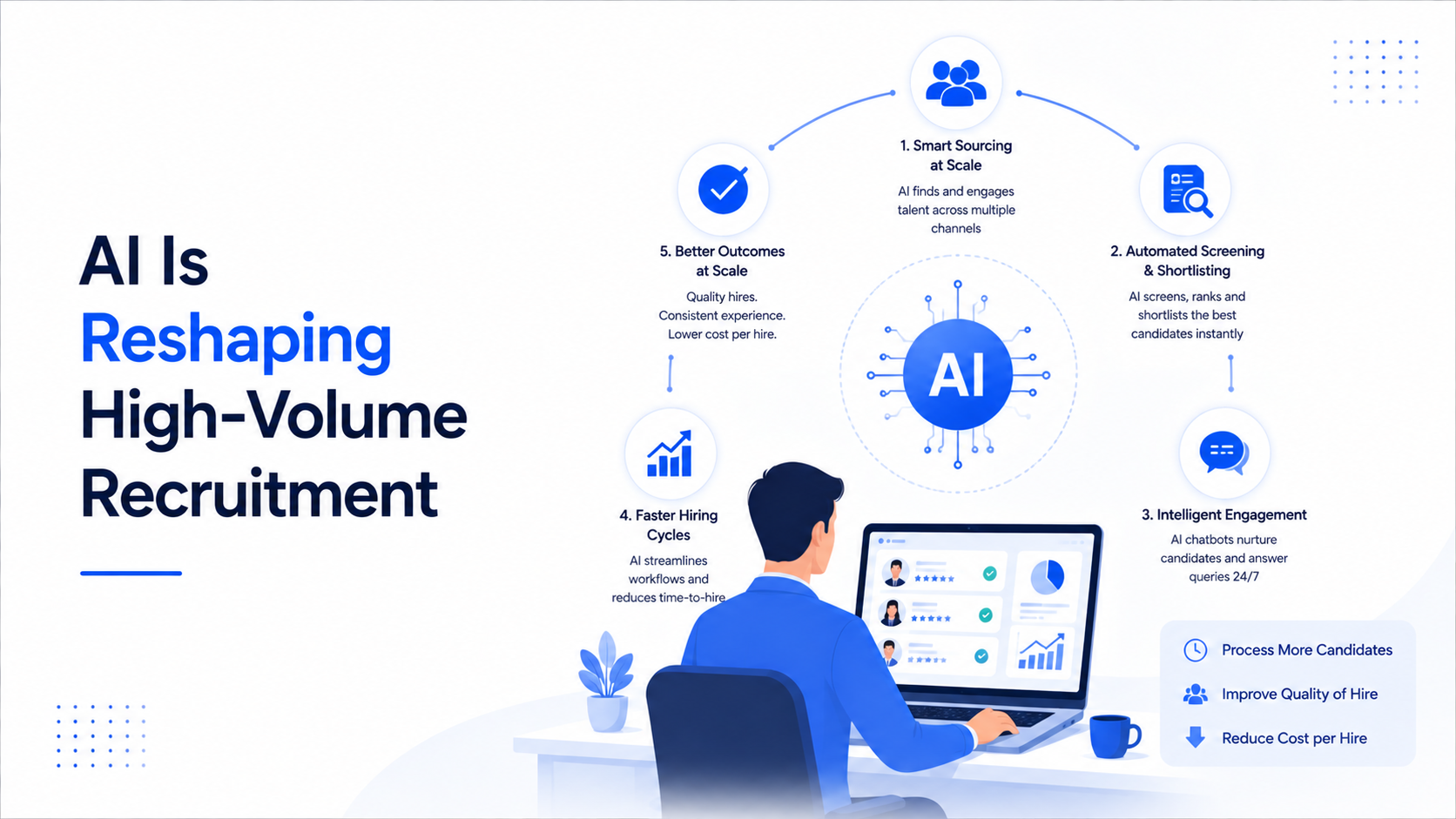
High-volume recruitment operates under constraints that do not exist in professional or executive hiring, and these constraints make it the segment where AI delivers the most immediate and dramatic impact. When an organization needs to hire three hundred warehouse associates in a quarter, the recruiting process must handle an application volume that would be inconceivable for individual recruiter attention. Each position may receive fifty to two hundred
applications, generating fifteen thousand to sixty thousand applications that need screening, evaluation, and response management within a compressed timeline. Human recruiters working at maximum capacity can thoroughly review perhaps forty to fifty applications per day, meaning a team of twenty recruiters working full-time on screening can process eight hundred to one thousand applications daily. At that rate, screening sixty thousand applications would take sixty to seventy-five working days, far longer than the hiring timeline allows. The inevitable result is that screening quality degrades as volume pressure increases, with recruiters spending seconds rather than minutes on each application, relying on keyword matching and quick visual scanning rather than the thoughtful evaluation that each candidate deserves.
The quality degradation caused by volume pressure has measurable consequences. In high-volume environments, screening consistency, the degree to which different recruiters apply the same criteria to similar candidates, drops significantly because each recruiter under time pressure develops their own shortcuts and heuristics. One recruiter may focus primarily on work experience while another prioritizes availability or location. This inconsistency means that equally qualified candidates receive different screening outcomes depending on which recruiter happens to review their application, a form of arbitrary discrimination that undermines both hiring quality and fairness. AI screening eliminates this inconsistency by applying the same criteria and scoring methodology to every candidate, producing evaluations that are reliable, repeatable, and auditable. The AI does not get tired, does not take shortcuts under pressure, and does not apply different standards at different times of day. According to McKinsey, organizations using AI screening for high-volume roles report thirty to forty percent improvements in screening consistency and twenty to twenty-five percent improvements in screening accuracy compared to manual processes, because the AI evaluates every candidate against the same structured criteria without the variability that human reviewers introduce under time pressure.
The scale problem also manifests in candidate engagement, where the gap between candidate expectations and recruiter capacity creates a poor experience that damages the employer brand. In high-volume hiring, the majority of candidates who apply will not be selected, and many will receive no response at all because the recruiting team does not have the capacity to communicate with every applicant. This silence is not just rude. It is strategically harmful, because candidates who are rejected without acknowledgment share their negative experience with their networks, and in high-volume hiring segments like logistics, retail, and hospitality, these networks overlap significantly with the employer's potential future applicant pool. AI engagement tools can automatically acknowledge every application, provide status updates at each stage, and deliver personalized rejection messages that treat every candidate with respect regardless of the outcome. This scalable communication capability transforms the candidate experience from a brand liability into a brand asset, even for candidates who are not hired. how many follow-ups one hire needs highlights how AI-powered communication ensures that no candidate in a high-volume pipeline falls silent between stages, because the automated follow-up system maintains engagement consistently across thousands of candidates while freeing human recruiters to focus on the smaller number of candidates who require
personal attention.
AI Screening at Scale: Beyond Keyword Matching
AI screening for high-volume recruitment has evolved far beyond the keyword matching that characterized early automated screening tools. First-generation screening tools used simple rule-based filters, such as requiring a high school diploma, a minimum number of years of experience, or specific certifications. These filters were fast but crude, rejecting qualified candidates who met the criteria but described their qualifications using different terminology, and advancing unqualified candidates who included the right keywords on their resume without the underlying competency. Modern AI screening uses natural language processing to understand the substance of a candidate's experience rather than just scanning for specific words. A candidate who describes themselves as having managed a team of fifteen people in a fast-paced warehouse environment is recognized as having supervisory experience even if they never use the word supervisor. A candidate who lists forklift operation as a daily responsibility is identified as having the required certification even if they did not explicitly name the certification in their application. This semantic understanding dramatically improves screening accuracy, particularly for high-volume roles where candidates often have non-traditional backgrounds, varied educational credentials, and inconsistent resume formatting.
The most advanced AI screening systems for high-volume recruitment incorporate predictive retention modeling alongside qualification matching. In high-volume hiring, the most important screening question is not whether the candidate can do the job but whether the candidate will stay in the job. Historical data from high-volume hiring programs consistently shows that the majority of turnover in roles like warehouse associates, delivery drivers, and call center representatives occurs within the first ninety days, and that this early turnover is driven by factors that are identifiable during the screening process but that traditional screening methods do not evaluate. Commute distance, work schedule fit, previous job tenure patterns, and the gap between the candidate's wage expectations and the offered compensation are all strong predictors of early attrition that AI can assess systematically while manual screeners under time pressure cannot. An AI model trained on an organization's own attrition data can score each candidate not just on qualification fit but on predicted retention probability, enabling recruiters to prioritize candidates who are both qualified and likely to remain. According to Gartner, organizations using AI retention-predictive screening for high-volume roles report fifteen to twenty percent improvements in ninety-day retention rates, because the screening process identifies and prioritizes candidates whose profiles indicate a higher likelihood of sustained employment.
The operational impact of AI screening at scale extends beyond individual hiring decisions to workforce planning and operational efficiency. When AI screens candidates in real time as applications arrive, the recruiting team has continuous visibility into the quality and volume of the candidate pipeline rather than waiting for periodic screening batches to complete. This real-time visibility enables proactive pipeline management, where recruiters can adjust
sourcing strategies, modify job postings, or increase compensation if the AI's pipeline analysis indicates that the current candidate flow will not produce sufficient qualified hires by the target date. This shift from reactive to proactive pipeline management is transformative for high-volume operations, where hiring shortfalls have direct operational consequences, such as understaffed warehouses that cannot meet shipping deadlines or understaffed stores that cannot serve customers during peak hours. The AI's ability to provide real-time pipeline analytics alongside individual candidate screening creates a dual capability that manual processes cannot match at high volume. why AI tools have outdated candidate data explains why real-time data processing is essential for high-volume recruitment, because candidate availability and market conditions change rapidly, and screening systems that rely on static data or batch processing produce decisions based on information that may no longer be current by the time the candidate is contacted.
Automated Scheduling and the End of the No-Show Problem
In high-volume recruitment, interview scheduling is one of the most time-consuming and error-prone activities in the entire hiring process. Each candidate must be scheduled for an interview at a time that matches the candidate's availability, the interviewer's availability, and the hiring location's capacity. For organizations hiring thousands of people across multiple locations, this scheduling complexity generates a massive coordination burden that consumes recruiter and coordinator time and produces frequent errors, double bookings, and communication gaps. AI scheduling tools eliminate this burden by automatically matching candidate availability with interviewer and location capacity, sending confirmation and reminder messages at optimal intervals, and dynamically rescheduling when conflicts arise. The AI can schedule hundreds of interviews per day across multiple locations, a volume that would require dozens of human coordinators working simultaneously, and it does so with fewer errors and higher candidate satisfaction because the scheduling is instant, transparent, and responsive to the candidate's preferences.
The no-show problem is one of the most costly and frustrating challenges in high-volume recruitment. Candidates who schedule interviews but fail to appear waste interviewer time, delay the hiring pipeline, and increase the cost per hire because the organization must invest additional sourcing and screening effort to replace the no-show with another candidate. No-show rates in high-volume hiring typically range from twenty to forty percent depending on the role, the market, and the organization's hiring process. AI reduces no-show rates through multiple mechanisms. Automated reminders sent at strategic intervals before the interview keep the appointment top-of-mind for the candidate. AI analysis of candidate engagement patterns, such as email open rates, message response times, and application completion behavior, generates a no-show risk score that allows recruiters to proactively reconfirm candidates flagged as high-risk or prepare backup candidates who can fill the slot if a no-show occurs. AI scheduling systems can also overbook interview slots based on predicted no-show rates, ensuring that interviewer time is fully utilized even when some candidates do not appear. According to EY, organizations using AI-powered scheduling and no-show prediction
for high-volume hiring report thirty to forty percent reductions in interview no-show rates and twenty percent improvements in interviewer utilization, because the AI ensures that scheduling capacity is optimized based on predicted attendance rather than assumed attendance.
The scheduling automation also extends to onboarding, which in high-volume environments is itself a high-volume process that must accommodate dozens or hundreds of new hires starting on the same day or within the same week. AI onboarding systems automate the preparation of onboarding schedules, the assignment of training modules, the coordination of equipment and access provisioning, and the communication of start-day logistics to new hires. This automation ensures that every new hire receives a consistent onboarding experience regardless of when they start or which location they join, eliminating the variability that occurs when onboarding is managed manually by coordinators who are juggling multiple start dates simultaneously. The consistency of AI-automated onboarding has a direct impact on new-hire retention, because research consistently shows that structured, well-organized onboarding improves new-hire confidence and commitment during the critical first weeks when attrition risk is highest. more tools same hiring problems illustrates why organizations that try to manage high-volume onboarding with disconnected manual tools and spreadsheets consistently underperform compared to those with AI-automated onboarding systems, because the complexity of coordinating hundreds of simultaneous onboarding activities exceeds human management capacity and creates the kind of disorganized experience that drives early attrition.
Retention Prediction: The Metric That Matters Most
In high-volume recruitment, the single most important metric is not time-to-fill or cost-per-hire but new-hire retention. An organization that hires three thousand warehouse associates at a cost of five hundred dollars per hire but loses forty percent of them within ninety days is spending six hundred thousand dollars on hires that produce no return. Improving ninety-day retention from sixty percent to seventy-five percent eliminates four hundred fifty failed hires, saving two hundred twenty-five thousand dollars in direct hiring costs and far more in indirect costs including training investment, productivity loss, and operational disruption. AI makes retention improvement possible at high volume by providing the data-driven insights that enable the organization to hire candidates who are more likely to stay, to identify retention risks early enough to intervene, and to continuously optimize hiring criteria based on the characteristics that predict long-term employment.
AI retention prediction operates at three stages of the hiring and employment lifecycle. Pre-hire prediction uses application and screening data to estimate each candidate's probability of remaining employed beyond ninety days. Candidates with low predicted retention can be deprioritized in favor of candidates with similar qualifications but higher retention probability, shifting the hiring mix toward candidates who are more likely to become productive, long-term employees. Early-employment prediction uses onboarding completion rates, training performance, early attendance patterns, and initial supervisor feedback to identify new hires
who are showing warning signs of disengagement or intent to leave. These early warnings enable proactive intervention, such as manager check-ins, schedule adjustments, or mentoring assignments, that can address the underlying issues before the new hire decides to leave. Ongoing prediction uses continuous behavioral data, including attendance consistency, performance trends, and engagement survey responses, to monitor retention risk across the entire workforce and identify roles, locations, or teams where systemic retention issues require structural solutions rather than individual interventions. According to Deloitte, organizations using AI retention prediction across all three stages report twenty to thirty percent improvements in first-year retention for high-volume roles, because the comprehensive approach addresses retention risk at every point in the lifecycle rather than focusing exclusively on the pre-hire stage.
The financial impact of AI-driven retention improvement in high-volume hiring is substantial enough to transform the economics of the entire operation. For an organization hiring five thousand high-volume roles annually with a seventy percent ninety-day retention rate, each percentage point of retention improvement represents fifty fewer failed hires and roughly twenty-five thousand dollars in avoided direct costs. A ten percentage point improvement in retention therefore saves two hundred fifty thousand dollars in direct hiring costs and potentially twice that amount in indirect costs, creating a total economic impact of five hundred thousand to seven hundred fifty thousand dollars annually. This financial impact far exceeds the annual cost of the AI platform that enables it, producing a return on investment that is difficult for any other talent acquisition initiative to match. The strategic implication is that organizations investing in AI for high-volume recruitment should measure their success primarily by retention improvement rather than by the efficiency metrics like time-to-fill and cost-per-hire that have traditionally dominated high-volume recruiting dashboards. AI tools for niche technical roles explains how AI retention models must be calibrated to the specific characteristics of different role types, because the factors that predict retention for warehouse associates are different from those that predict retention for delivery drivers or customer service representatives, and organizations that use role-specific models achieve significantly better retention outcomes than those using generic predictions.
The High-Volume Recruiter's New Role
As AI automates the high-volume tasks that have traditionally consumed the majority of a high-volume recruiter's time, the recruiter's role is being redefined in ways that create more interesting, more strategic, and more valuable work. The recruiter of the future in a high-volume environment is not a screener or a scheduler but a workforce operations specialist who uses AI-generated insights to manage the health of the entire hiring pipeline. They monitor AI dashboards that show real-time pipeline strength, candidate quality trends, and retention risk indicators across all active requisitions. They identify locations or role types where the pipeline is underperforming and work with hiring managers and sourcing teams to address the gaps. They manage escalations, candidates who require human attention because their situation falls outside the AI's standard handling, and they provide the strategic judgment that
determines how the organization responds to changing market conditions, competitive wage pressures, and seasonal demand fluctuations. This role is more analytically demanding and strategically important than the traditional high-volume recruiter role, which is why organizations that make this transition often find that they can attract and retain higher-caliber talent for their recruiting teams.
The transition also changes the recruiter's relationship with hiring managers. In traditional high-volume environments, the recruiter-hiring manager interaction is often limited to requisition handoff and candidate submission, with minimal strategic discussion about hiring criteria, workforce planning, or retention strategy. When AI handles the operational burden of screening, scheduling, and communication, the recruiter has time to engage hiring managers in more substantive conversations about what they actually need, what has worked and not worked in past hires, and what operational changes might improve retention for the roles they are filling. This consultative relationship elevates the recruiter from an order-taker to a talent advisor, a shift that increases the recruiter's strategic value and their job satisfaction. Hiring managers who work with AI-enabled recruiters report higher satisfaction with the recruiting function because they receive better candidates, faster responses, and more useful market intelligence than traditional high-volume recruiting teams can provide. According to SHRM, high-volume recruiters who transition to AI-supported advisory roles report thirty-five to forty percent higher job satisfaction and twenty-five percent lower turnover than recruiters who remain in traditional high-volume processing roles, because the advisory role is more intellectually engaging, more professionally rewarding, and less susceptible to the burnout that drives high turnover in traditional high-volume recruiting teams.
For organizations planning to implement AI in their high-volume recruitment operations, the implementation should be approached as a workforce transformation initiative rather than a technology deployment. The technology is necessary but not sufficient. Success requires redefining recruiter roles and performance metrics, redesigning workflows to leverage AI capabilities, investing in training that develops the analytical and consultative skills the new role requires, and communicating clearly to the recruiting team that AI is expanding their role rather than eliminating it. Organizations that implement AI without this organizational transformation typically achieve modest efficiency gains but fail to capture the full strategic value, because the recruiters continue operating in their traditional roles while the AI operates in parallel, creating redundancy rather than synergy. The organizations that achieve the most dramatic results are those that simultaneously deploy the technology and redesign the roles, ensuring that every recruiter's activities are aligned with the capabilities the AI provides and the strategic priorities the organization has set for its high-volume hiring function. AI sourcing vs AI recruiting explains why the distinction between sourcing and recruiting is especially important in high-volume environments, because AI handles the sourcing and screening at scale while recruiters focus on the human judgment and relationship management that determine whether the right candidates are hired and retained.