Dr. Amara Osei, Director of People Analytics at a large retail chain in Chicago, had spent three months preparing a presentation for her executive committee on the fairness of the company's new AI screening tool. She had run the vendor's recommended bias tests, reviewed the documentation, and compiled a dashboard showing equal selection rates across gender and ethnicity. She walked into the meeting confident that the data would put to rest the concerns raised by several hiring managers. Instead, the Chief Legal Officer asked a single question that derailed the entire presentation: have you tested whether the tool penalizes candidates who took career breaks? Amara had not. She had tested the categories the vendor recommended and the categories required by the company's compliance checklist, but career breaks had not been on either list. She left the meeting realizing that her approach to bias testing had been systematically incomplete, not because she lacked diligence, but because she had accepted someone else's definition of what bias means in hiring without questioning whether that definition covered the risks most relevant to her organization's candidates and context.
Myth One: AI Is Inherently More Biased Than Human Recruiters
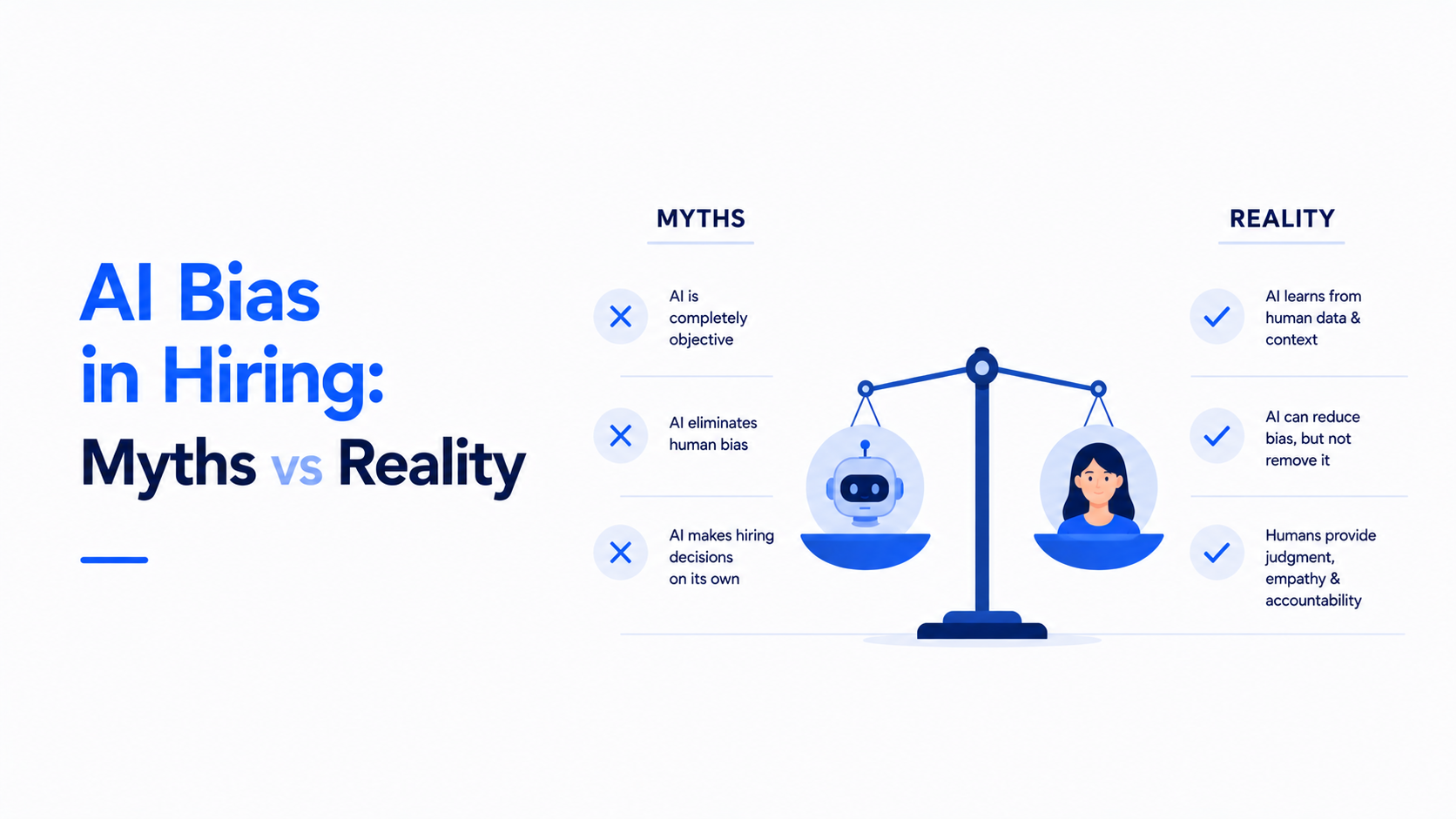
The most persistent myth about AI in hiring is that algorithmic systems are inherently more biased than the human recruiters they replace. This belief rests on a romanticized view of human judgment and an alarmist view of technology. In reality, human recruiters carry unconscious biases that are well documented across decades of social psychology research. Humans favor candidates who resemble themselves, who attended their alma mater, who share their communication style, and who trigger feelings of familiarity or comfort. These biases operate automatically and are resistant to training interventions. According to SHRM, studies using identical resumes with different demographic indicators consistently show that human reviewers favor candidates from majority backgrounds by margins of twenty to thirty
percent, a disparity that has remained remarkably stable across decades of research and intervention efforts.
AI systems, by contrast, do not have feelings, preferences, or unconscious associations. They apply statistical patterns derived from training data. When the training data reflects biased historical outcomes, the AI will reproduce those biases, but this is a data problem, not an inherent property of the algorithm. The critical distinction is that AI bias is auditable, measurable, and correctable in ways that human bias is not. You can test an AI system across thousands of candidate profiles and measure its selection rates for every protected group with precision. You cannot conduct the same measurement on a human recruiter's mental process. According to McKinsey, organizations that replace unstructured human resume review with AI screening and maintain proper oversight report fifteen to twenty percent reductions in demographic disparities in initial screening decisions, because the AI applies consistent criteria while humans apply criteria that shift based on fatigue, mood, and unconscious association.
This does not mean AI is a bias-free solution. It means the comparison between AI and human bias is more nuanced than the myth suggests. The question is not whether AI or humans are more biased in absolute terms but which type of bias is easier to detect, measure, and correct. AI bias is structural and transparent. Human bias is psychological and opaque. Organizations that understand this distinction can make better decisions about where to deploy AI, where to maintain human review, and how to design oversight processes that capitalize on the strengths of each. The goal should not be to choose between AI and human judgment but to combine them in ways that minimize the biases inherent in both. should recruiters worry about AI replacing jobs explores why the narrative that AI will replace human recruiters misses the more important reality, which is that AI and humans have complementary strengths and weaknesses that make oversight essential regardless of how much automation is deployed.
Myth Two: Bias Testing Before Deployment Eliminates the Risk
The second myth is that conducting bias testing before deploying an AI hiring tool is sufficient to ensure fairness going forward. This belief is understandable because most vendors market their tools with bias audit results, and most compliance frameworks require pre-deployment testing. The problem is that pre-deployment testing evaluates the tool in a controlled environment using test data, which is fundamentally different from the production environment where the tool will operate. The candidate pool, the job requirements, the organizational context, and the interaction between the AI and human decision-makers all change when the tool moves from testing to production. A tool that shows no bias in pre-deployment testing may develop significant bias within weeks of going live, not because the algorithm changed but because the data it is processing changed. Gartner has documented that AI hiring tools commonly show fair results in vendor-conducted pre-deployment audits and disparate impact in customer-conducted post-deployment audits, because the vendor's test data does not reflect the specific demographic composition and hiring patterns of each customer
organization.
The mechanisms through which bias emerges after deployment are varied and often invisible without systematic monitoring. An AI screening tool might initially show balanced selection rates across demographic groups, but as it processes more candidates and its recommendations influence which candidates hiring managers actually interview, a feedback loop can develop. If hiring managers disproportionately interview candidates from one demographic group, the AI may learn to weight the characteristics of that group more heavily in subsequent recommendations, even if those characteristics are not genuinely predictive of job performance. This dynamic, where the AI's outputs change the data environment that feeds back into the AI, is called deployment drift, and it cannot be detected by any amount of pre-deployment testing because it only emerges in the interaction between the AI and the live hiring process. why AI tools have outdated candidate data explains how similar feedback dynamics cause AI tools to develop stale and biased candidate profiles over time, because the data the system generates becomes its own input in a self-reinforcing cycle.
Responsible organizations treat pre-deployment bias testing as a starting point, not a destination. They supplement it with continuous post-deployment monitoring that tracks selection rates, advancement rates, and hiring outcomes across protected groups on an ongoing basis. They define thresholds that trigger investigation when disparities exceed acceptable levels. They conduct periodic deep-dive audits that examine not just aggregate statistics but the specific decision pathways that produce disparities. And they maintain the ability to adjust, reconfigure, or deactivate AI tools when monitoring reveals problems that cannot be corrected through parameter adjustments. Deloitte recommends that organizations budget for ongoing bias monitoring at ten to fifteen percent of the total cost of AI hiring tool ownership, because the cost of undetected post-deployment bias, including legal exposure, remediation expenses, and candidate trust damage, far exceeds the cost of monitoring.
Myth Three: Removing Demographic Data Solves the Problem
The third myth is that if you remove demographic data like name, gender, age, and race from candidate profiles before feeding them to an AI system, the system cannot be biased. This approach, sometimes called blind screening, is intuitively appealing and has been adopted by organizations that want a simple solution to a complex problem. Unfortunately, it does not work as well as its proponents believe. The reason is that demographic information is encoded in numerous other data points that remain in the candidate profile. A candidate's name may be removed, but their university, zip code, extracurricular activities, professional associations, and communication style all carry demographic signals that AI systems can detect and use as proxies. Research published by EY has demonstrated that AI systems trained on resumes with names removed can still infer candidate race with over eighty percent accuracy based on educational institution, geographic indicators, and language patterns, meaning that name removal provides only marginal protection against demographic bias.
The proxy problem extends well beyond obvious demographic indicators. An AI system
might learn that candidates who participated in certain collegiate athletic programs, which correlate strongly with socioeconomic background, are more likely to receive high performance ratings from hiring managers who themselves participated in similar programs. It might learn that candidates who list certain professional certifications, which correlate with industry access and career sponsorship patterns, have higher historical hiring rates. It might learn that candidates who use specific communication frameworks in their application materials, which correlate with educational pedigree and professional socialization, produce stronger interview scores. None of these data points are explicitly demographic, but all of them function as proxies for demographic characteristics. The result is a system that appears neutral because it does not consider protected categories directly but produces biased outcomes because it considers data points that are strongly correlated with those categories. how to evaluate an AI sourcing tool provides a framework for assessing whether an AI vendor's proxy detection capabilities are genuine, because many vendors claim to address proxy bias while implementing only superficial measures like name removal.
Effective bias mitigation requires addressing the proxy problem at multiple levels. Feature analysis should identify data points that correlate strongly with protected characteristics and evaluate whether their inclusion adds genuine predictive value or merely introduces proxy bias. Model training should use techniques like adversarial debiasing, which trains a secondary model to detect and penalize demographic prediction in the primary model's outputs. Outcome monitoring should track not just whether the AI treats different groups equally on average but whether specific decision pathways produce disparate impact for particular subgroups. And human reviewers should be trained to recognize when AI recommendations may be influenced by proxy variables that the system's automated checks did not catch. The organizations that take this multi-layered approach report significantly better fairness outcomes than those that rely on any single technique. LinkedIn research on hiring fairness practices found that organizations using three or more complementary bias mitigation strategies report thirty to forty percent smaller demographic disparities than those relying on blind screening alone.
Myth Four: AI Bias Only Affects Protected Demographic Groups
The fourth myth is that AI bias in hiring is exclusively a problem for candidates from legally protected demographic groups defined by race, gender, age, disability, and other protected characteristics. This framing, while legally important, dramatically understates the scope of AI bias and the populations it affects. AI hiring systems can systematically disadvantage candidates based on characteristics that are not legally protected but that are nonetheless unfair and harmful to both candidates and the organizations that reject them. Career changers, candidates with employment gaps, candidates from nontraditional educational pathways, candidates with unconventional career trajectories, and candidates who have worked in industries or geographies that are underrepresented in the training data can all be systematically disadvantaged by AI systems that optimize for historical hiring patterns.
The practical impact of this broader bias is significant for organizations that claim to value diversity of thought, experience, and background. An AI screening system that has been trained on data showing that successful software engineers typically have computer science degrees from a set of well-known universities will systematically disadvantage candidates who learned software engineering through bootcamps, self-directed study, or career transitions from adjacent fields. These candidates may have equivalent or superior skills, but the AI cannot evaluate skills directly. It evaluates proxies for skills, and the proxies it has been trained on reflect the historical pattern of who was hired, not who could succeed. The result is a system that narrows the talent pool rather than expanding it, precisely the opposite of what AI hiring tools are supposed to achieve. AI tools for niche technical roles demonstrates why this form of bias is especially damaging for specialized and technical roles, where the candidate pool is already small and excluding nontraditional candidates can make positions effectively unfillable.
Recognizing that AI bias extends beyond legally protected groups also matters for employer brand and candidate experience. Candidates who believe they were unfairly rejected by an AI system share their experiences on social media, in professional networks, and in conversations with peers, creating a reputational cost that compounds over time. Research by Gartner has found that negative candidate experiences involving AI screening reduce application rates from similar candidates by fifteen to twenty percent, because candidates from the same networks and communities learn about each other's experiences and adjust their behavior accordingly. Organizations that think about AI bias only in terms of legal compliance miss this broader impact and underestimate the cost of biased systems on their ability to attract talent. The most sophisticated organizations define fairness more broadly than the law requires, because they understand that fairness is a candidate experience issue and a business performance issue, not just a legal risk management issue.
The Reality: What Actually Works for Reducing AI Hiring Bias
The reality of AI bias in hiring is messier and more nuanced than any of the myths suggest, but it is also more actionable. Organizations that achieve the best fairness outcomes do not rely on any single technique or test. They implement a sustained governance system that addresses bias at every stage of the AI hiring lifecycle. At the selection stage, they evaluate vendors not just on feature breadth and efficiency metrics but on the maturity of their bias detection and mitigation capabilities, the transparency of their testing methodologies, and the quality of their post-deployment monitoring tools. agentic AI platforms vs automated ones explains why evaluating an AI platform's decision-making architecture matters for fairness, because platforms that operate as autonomous agents require more sophisticated oversight than platforms that function as decision-support tools with human reviewers in the loop.
At the deployment stage, effective organizations conduct bias testing that reflects their actual candidate populations and hiring contexts rather than relying solely on vendor-provided test results. They test for intersectional bias, examining not just whether the system treats men
and women equally on average but whether it treats women over forty, or candidates from specific racial groups with disabilities, equitably. They test for proxy bias by analyzing whether data points that remain in the candidate profile correlate with protected characteristics and whether removing those data points changes selection rates. They establish baseline fairness metrics before deployment so that post-deployment monitoring has a meaningful comparison point. According to McKinsey, organizations that conduct their own independent bias testing before deployment, rather than relying exclusively on vendor audits, detect forty to sixty percent more potential fairness issues before those issues affect real candidates.
At the monitoring stage, the organizations that achieve the best outcomes treat bias monitoring as an ongoing operational discipline, not a one-time compliance exercise. They track selection rate disparities across demographic groups in real time, flag anomalies for investigation, and maintain audit trails that document how bias issues were identified and resolved. They train recruiters and hiring managers to recognize the limitations of AI recommendations and to exercise independent judgment when the AI's output seems inconsistent with a candidate's actual qualifications. They create feedback loops where candidate outcomes, including performance ratings, retention, and promotion rates, are fed back into the evaluation of the AI system's predictive accuracy. And they periodically commission independent third-party audits that provide an external check on their internal monitoring. Deloitte has found that organizations with mature, sustained AI fairness governance programs achieve twenty-five to thirty-five percent smaller demographic disparities in hiring outcomes compared to organizations that treat bias testing as a checkbox exercise completed at deployment. The difference is not a better algorithm or a more diverse training dataset. It is a governance system that treats fairness as a continuous obligation rather than a one-time achievement.