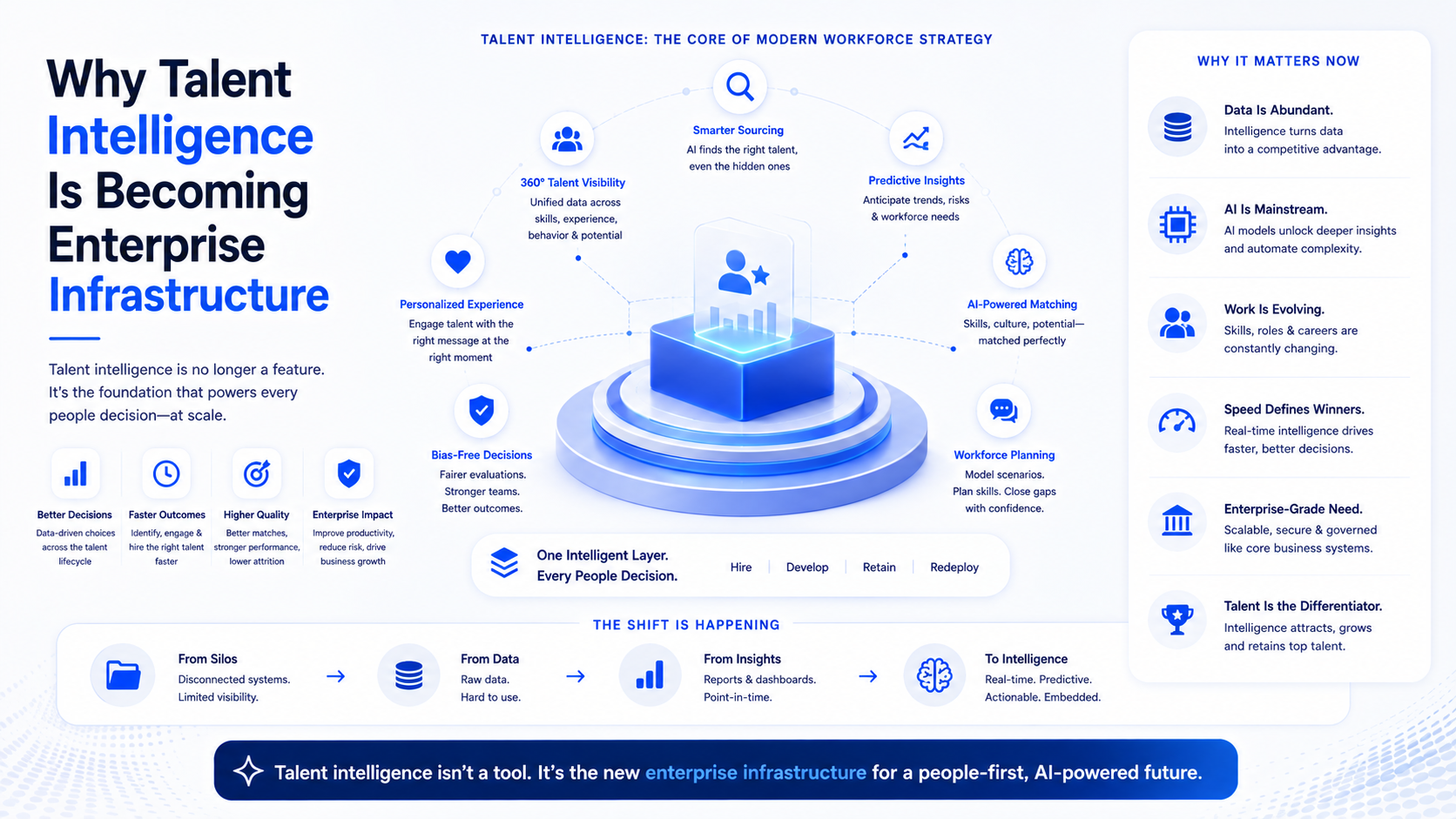
When Rachel Okonkwo was appointed Chief People Officer at NovaTech Industries in early 2024, her first meeting with the CEO lasted fifteen minutes and covered exactly one topic. The CEO, Marcus Webb, had just returned from a board session where directors had asked a question that the HR team could not answer: what is our current capability profile relative to our three-year product roadmap, and where are the gaps? Webb told Okonkwo that this was not an HR question. It was a business question that required talent data, and the fact that HR could not provide it in real time was a strategic vulnerability. Okonkwo spent her first six months not on any traditional HR initiative but on building the data infrastructure that would make talent visible to the business in the same way that financial and operational data were already visible. She did not hire more recruiters or implement a new ATS. She built a talent intelligence function that could answer Webb's question, and dozens like it, with current data and analytical rigor. Her experience is becoming the rule rather than the exception across large enterprises. Talent intelligence is no longer a recruiting tool. It is infrastructure.
From Recruiting Tool to Business System
Talent intelligence as a concept originated in recruiting, where it referred to the use of labor market data, competitive intelligence, and candidate analytics to improve sourcing and hiring decisions. In that context, it was a specialized function used primarily by talent acquisition teams to understand where candidates were, what they wanted, and how to reach them. The tools that supported talent intelligence were recruiting tools: market data dashboards, competitor hiring analysis, and salary benchmarking reports. They were useful within the bounds
of the recruiting function but had limited visibility or relevance to the rest of the business. A hiring manager might see a market compensation report, but the CFO, the product lead, and the operations head did not interact with talent intelligence at all.
The shift from recruiting tool to business system began when enterprise leaders started recognizing that talent data was as strategically important as financial data, customer data, and supply chain data. McKinsey research on organizational capability building shows that companies with the strongest talent market performance are those that treat workforce data as a core input to business planning, not as an HR output. When a company plans to enter a new market, launch a new product, or restructure operations, the availability and location of the talent required to execute that strategy is a primary constraint, yet most organizations plan without systematic talent data. The recognition of this gap has driven talent intelligence out of the recruiting function and into the enterprise planning function, where it can inform decisions that go far beyond hiring.
The evidence of this transition is visible in organizational structure. Talent intelligence teams that once reported to the head of talent acquisition now report to the CHRO, the chief strategy officer, or in some cases directly to the CEO. The research on how many follow-ups one hire needs and candidate engagement optimization illustrates the broader pattern: capabilities that begin as tactical recruiting tools gain strategic value when the insights they generate prove relevant to business decisions beyond hiring. When a talent intelligence team can tell a business unit leader not just how many data engineers are available in a market but how that availability is changing, what competitors are paying, and which skills are becoming scarcest, the team is no longer supporting recruiting. It is supporting strategy.
The Data Foundations of Talent Intelligence
Building talent intelligence as enterprise infrastructure requires a fundamentally different approach to data than what most HR organizations have today. The data foundation for recruiting is relatively simple: candidate profiles, job descriptions, and hiring metrics. The data foundation for enterprise talent intelligence must include internal workforce data covering skills, capabilities, career trajectories, performance patterns, and retention risks across the entire organization, combined with external data covering labor market dynamics, competitor talent movements, skill availability trends, and educational pipeline data. Gartner analysis of HR data maturity consistently finds that most organizations have significant gaps in both the breadth and quality of their talent data, with internal skills data being the most common weakness.
The internal data challenge is compounded by the fact that workforce data is typically fragmented across multiple systems. Recruiting data lives in the ATS, learning data in the LMS, performance data in performance management systems, compensation data in HRIS, and succession data in separate planning tools. Each system has its own data model, its own update cadence, and its own definitions of common terms like skills or job levels. Creating a unified
talent intelligence capability requires either integrating these disparate data sources into a common platform or building a data layer that can query across them and produce coherent insights. Neither approach is trivial, and most organizations underestimate the effort required. LinkedIn enterprise research on workforce data strategies reports that the average large organization uses seven to twelve distinct HR technology systems, each contributing a piece of the talent data puzzle but none providing a complete picture.
External data presents its own challenges. Labor market data is available from multiple sources, including government statistics, online job postings, professional network profiles, and specialized talent intelligence vendors, but the quality, granularity, and timeliness vary significantly. A salary benchmark from a government survey may be eighteen months old by the time it is published. A skills demand signal from online job postings may reflect employer aspirations more than actual hiring activity. Building a reliable external data foundation requires not just aggregating sources but understanding their biases, limitations, and appropriate uses. The organizations that are building the most effective talent intelligence capabilities are those that treat data quality as a continuous discipline rather than a one-time integration project, with dedicated resources for data validation, cleansing, and enrichment.
How Talent Intelligence Connects to Business Strategy
The most significant development in talent intelligence is not technological but strategic: the direct integration of talent insights into business planning and decision-making processes. The problem of why AI tools have outdated candidate data talent data in recruiting systems is symptomatic of a larger issue. When talent data is isolated in recruiting tools, it becomes stale and disconnected from the reality of the business. When talent data is connected to business systems, it is continuously refreshed by the flow of business activity and it directly informs strategic decisions. A product team planning a new AI feature set can query the talent intelligence system to understand whether the organization has the machine learning engineers needed to build it, or whether hiring or training will be required. A finance team modeling a restructuring scenario can incorporate data on the skills and capabilities that would be lost and the cost of replacing them.
This integration is transforming how organizations make decisions. Deloitte case studies of companies with mature talent intelligence capabilities describe scenarios where talent data is a standard input to investment committees, M&A due diligence, and market entry planning. When an organization considers acquiring a company, the due diligence process now routinely includes a talent intelligence assessment of the target's workforce capabilities, retention risks, and skill gaps, alongside the traditional financial and operational analysis. This would have been unthinkable a decade ago, when workforce due diligence consisted of checking org charts and key person dependencies. Today, talent intelligence provides a data-driven assessment of whether the target's talent base aligns with the acquirer's strategic needs.
The competitive implications are significant. EY research on enterprise talent strategy finds
that organizations with integrated talent intelligence make faster and better workforce decisions, from hiring and restructuring to location strategy and capability building. They can identify skill gaps earlier, respond to market changes more quickly, and allocate talent resources more efficiently. The organizations that lack this capability are making the same decisions based on intuition, anecdotal feedback, and periodic surveys, which means they are slower, less accurate, and increasingly disadvantaged. Talent intelligence is becoming a competitive differentiator in the same way that business intelligence and customer analytics became differentiators in previous decades.
The Technology Stack Behind Enterprise Talent Intelligence
The technology required to support enterprise talent intelligence is fundamentally different from traditional HR technology. Legacy HR systems were designed to record and manage HR transactions: hire, promote, transfer, compensate, terminate. They are excellent at maintaining records but were not built for the analytical, cross-functional, and real-time requirements of talent intelligence. McKinsey technology architecture assessments note that building talent intelligence on top of legacy HR systems is analogous to building a real-time analytics platform on top of a general ledger: the underlying system was designed for a different purpose, and adapting it requires significant architectural workarounds that limit performance and flexibility.
The emerging technology stack for enterprise talent intelligence typically includes several layers. At the data layer, organizations need tools that can ingest, normalize, and store both internal workforce data and external labor market data in a unified format. At the analytics layer, they need capabilities for skills inference, workforce modeling, scenario planning, and predictive analytics. At the application layer, they need interfaces that make talent insights accessible and actionable for business leaders, not just HR professionals. The anxiety about should recruiters worry about AI replacing jobs and whether AI will replace recruiters is relevant here because the technology stack for talent intelligence increasingly relies on AI for skills inference, pattern recognition, and predictive modeling, capabilities that are far beyond what traditional HR analytics tools can provide.
The critical component that connects these layers is the skills ontology: a structured, machine-readable representation of the skills that exist in the market, how they relate to each other, and how they map to business capabilities. Without a skills ontology, talent intelligence systems cannot compare internal workforce capabilities to external market data, cannot identify skill adjacencies that enable career mobility, and cannot predict which skills will become more or less valuable. Building and maintaining a skills ontology is one of the most resource-intensive aspects of enterprise talent intelligence, but it is also the foundation that makes everything else possible. Gartner research on skills technology identifies the skills ontology as the single most important technical investment for organizations building talent intelligence capabilities, because it determines the quality and utility of every insight the system produces.
The Organizational Challenge of Scaling Talent Intelligence
The organizational challenges of scaling talent intelligence beyond a pilot team or a single business unit are often more difficult than the technical challenges. LinkedIn surveys of talent intelligence practitioners consistently identify organizational adoption, not technology capability, as the primary barrier to impact. Business leaders who have never had access to real-time talent data do not know how to use it, do not trust it, and do not prioritize it in their decision-making. HR teams that have historically owned workforce data may resist sharing it with business functions that previously had no visibility. And the talent intelligence team itself must develop the business acumen to translate data into strategic recommendations, a skill set that combines data science, HR domain expertise, and business strategy in ways that are rare in any single individual.
The challenge of how to evaluate an AI sourcing tool talent intelligence tools before purchasing extends beyond technical evaluation to organizational readiness assessment. An organization that lacks a data culture, that has not invested in data literacy across its leadership, or that has deeply entrenched data silos will struggle to derive value from even the most sophisticated talent intelligence platform. The most successful implementations are those that pair technology deployment with organizational change management: training business leaders to interpret talent data, establishing governance frameworks that define data ownership and access, and creating feedback loops that ensure the talent intelligence function is continuously aligned with evolving business priorities. Deloitte organizational design research emphasizes that technology implementations fail not because the technology is inadequate but because the organization is not prepared to absorb the change.
Building cross-functional governance is particularly important. Talent intelligence sits at the intersection of HR, IT, finance, and business strategy, and no single function owns all of the data, all of the use cases, or all of the stakeholders. The organizations that scale talent intelligence successfully create governance structures that give each function a clear role while maintaining a unified direction. This typically involves a steering committee that includes representatives from each stakeholder function, a dedicated talent intelligence team that operates as a shared service, and clear data governance policies that define what data is shared, with whom, and under what conditions. Without this governance foundation, talent intelligence risks becoming another fragmented tool that serves one function well but fails to deliver enterprise-wide value.
Building Talent Intelligence Into Your Infrastructure
For organizations ready to invest in talent intelligence as enterprise infrastructure, the starting point is not a technology purchase but a capability assessment. SHRM workforce planning frameworks recommend that organizations begin by mapping their most critical business
decisions to the talent data inputs those decisions require, identifying the gaps between what is available and what is needed. This exercise typically reveals that the organization already has more talent data than it realizes, but that the data is scattered, inconsistent, and not accessible in the formats and timeframes that business decisions demand. The capability assessment creates a clear picture of where to start and what to prioritize, reducing the risk of over-investing in technology before the organization is ready to use it.
The implementation roadmap should proceed in three phases. First, consolidate and clean the talent data that already exists across the organization's HR systems, creating a single source of truth for workforce data that business functions can access. Second, layer external market intelligence on top of the internal data, enabling the organization to compare its internal capabilities against external market conditions. Third, build the analytical and application layers that transform the combined data into actionable insights for business leaders. Each phase builds on the previous one, and organizations that try to skip phases, deploying advanced analytics before they have a reliable data foundation, consistently underperform those that invest the time to build sequentially.
The end state is an organization where talent intelligence is as embedded in business operations as financial intelligence. When a product leader evaluates a new market opportunity, the analysis includes talent availability and cost. When a finance leader models a growth scenario, the model incorporates workforce capability constraints. When a CEO presents a strategic plan to the board, the plan includes a talent capability assessment alongside the financial projections. This is the infrastructure vision that is driving the transformation of talent intelligence from a recruiting function to an enterprise system. The organizations that reach this state first will have a significant and durable competitive advantage in the talent market, because they will be able to see, plan for, and respond to talent dynamics with a speed and precision that their competitors cannot match.