Tom Gallagher sat in his office above a staffing agency in Chicago that his father had founded in 1989, reviewing quarterly numbers that told a story he did not want to believe. Revenue had declined twelve percent year over year. Their largest client, a logistics company that had been sending them search orders for fifteen years, had reduced their contingent workforce spend by forty percent after deploying an AI sourcing platform internally. Two other long-tenured clients had started pilot programs with AI-first hiring tools and were candidly telling Tom that they expected to reduce their agency reliance by at least half within eighteen months. His recruiter headcount was flat, but the revenue per recruiter had dropped because clients were negotiating lower margins on the placements that remained, arguing that AI had reduced the effort required to find candidates. Tom's father had built the agency on relationships and domain expertise, two things that Tom believed were durable competitive advantages. But the numbers suggested otherwise. The clients still valued the relationships, but they no longer believed those relationships justified the margins they had been paying. The domain expertise was still real, but AI tools were giving clients enough of that expertise internally that they needed agencies only for the most specialized searches. Tom realized that his agency was not facing a cyclical downturn but a structural transformation, and that surviving it would require reinventing what the agency did and how it delivered value.
The Structural Threat Is Real, Not Cyclical
The staffing industry is experiencing a structural shift, not a temporary downturn, and the distinction matters enormously for how agency leaders should respond. Cyclical downturns in staffing are driven by macroeconomic conditions that eventually reverse. When the economy
recovers, hiring rebounds and agency revenue recovers with it. Structural shifts are driven by fundamental changes in how the market operates, and they do not reverse. The current pressure on staffing agencies is structural because the underlying reason clients use agencies, the inability to find and evaluate candidates efficiently using internal resources, is being systematically addressed by AI hiring tools. According to McKinsey, the proportion of mid-market and enterprise employers using AI sourcing tools internally has grown from under twenty percent in 2023 to over fifty-five percent in 2026, and the capabilities these tools provide, candidate discovery, initial screening, and engagement, overlap directly with the core services that staffing agencies have historically sold.
The structural nature of the shift is confirmed by the behavior of agency clients themselves. When clients reduce agency spend because of a recession, they re-engage quickly when conditions improve because the underlying need for external recruiting capacity has not changed. When clients reduce agency spend because they have built internal AI capabilities, they do not re-engage because the need has been permanently addressed. The current wave of agency budget cuts is overwhelmingly driven by the second pattern. Organizations that have invested in AI sourcing and screening tools are finding that they can handle a significantly larger portion of their hiring volume internally, reducing their reliance on external agencies for standard roles. Agencies are being pushed toward a smaller but more demanding segment of the market: the specialized, difficult-to-fill, and high-stakes roles where internal AI tools are not yet sufficient. According to Gartner, staffing agencies that rely on volume-based placement models for standard roles will see their addressable market shrink by thirty to forty percent by 2028, while agencies that specialize in complex, high-value searches will see their market opportunity expand.
The structural shift does not mean that staffing agencies will disappear. It means that the agencies that survive and thrive will be fundamentally different from the agencies that dominated the industry over the past two decades. The agencies built on high-volume, low-margin transactional placement are the most vulnerable, because their value proposition, finding candidates that clients could find themselves if they had the time and tools, is the one most directly threatened by AI. The agencies built on deep domain expertise, specialized talent market knowledge, and consultative engagement models have more runway, because their value resides in human capabilities that AI cannot easily replicate. But even these agencies must evolve, because AI will progressively encroach on more complex recruiting tasks, and clients will expect their agency partners to use AI to deliver better results faster than agencies relying on manual processes can match.
Why Automating the Old Model Is Not Enough
The most common response among staffing agencies to the AI threat is to adopt AI tools that automate their existing workflows. Agencies deploy AI sourcing tools to find candidates faster, AI screening tools to rank them more efficiently, and AI communication tools to manage outreach at scale. This automation improves margins in the short term by reducing the
time-per-placement, which is a legitimate efficiency gain. But it does not address the structural problem, because the client's question is no longer how fast the agency can find candidates but why the client needs the agency to find candidates at all. If the agency's only response is that it can find them slightly faster using the same AI tools the client could deploy internally, the client will eventually conclude that the agency's margin is not justified and will bring the capability in-house. Automation without reinvention is a short-term strategy that accelerates long-term obsolescence.
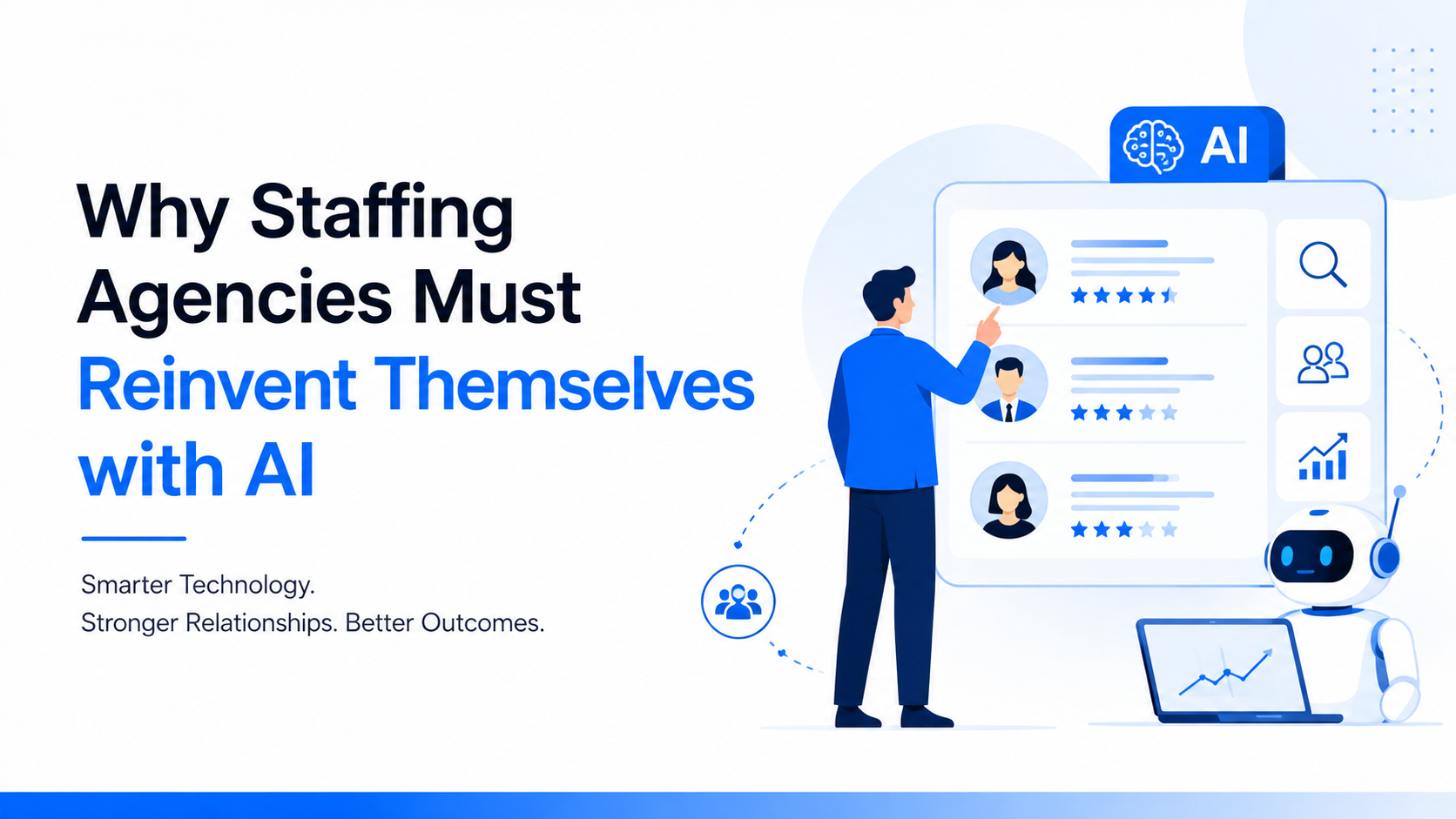
The reinvention that agencies need goes beyond operational efficiency to address the fundamental question of what value the agency provides that clients cannot achieve on their own. This requires agencies to think of themselves not as candidate suppliers but as talent outcomes partners. The distinction is critical. A candidate supplier finds and delivers candidates. A talent outcomes partner takes responsibility for the quality, retention, and performance of the people placed, and delivers services that extend beyond the hire itself. This includes workforce planning, talent market intelligence, compensation benchmarking, candidate pipeline development, and post-hire integration support. These services require a combination of AI capabilities and human expertise that most organizations cannot build internally and that creates a value proposition durable enough to justify agency margins even as AI commoditizes basic sourcing and screening. According to Deloitte, staffing agencies that have successfully transitioned to outcomes-based service models report fifteen to twenty percent higher client retention rates and ten to fifteen percent higher margins compared to agencies still operating on transactional placement models.
The transition from transactional placement to outcomes partnership is not merely a pricing model change. It requires agencies to develop new capabilities, restructure their delivery teams, and invest in AI systems that support consultative engagement rather than just candidate delivery. Agencies must build talent intelligence functions that provide clients with market insights about talent availability, compensation trends, and competitive dynamics. They must develop assessment capabilities that go beyond screening to evaluate candidates for organizational fit, growth potential, and long-term retention likelihood. And they must build the data infrastructure to measure and report on placement outcomes, because outcomes-based pricing requires outcomes-based measurement. more tools same hiring problems illustrates why agencies that embrace AI not just for internal efficiency but as a platform for delivering new client services are finding that AI enables them to offer capabilities, such as real-time talent market dashboards and predictive workforce planning, that were previously impossible to deliver at scale.
Three AI-Powered Business Models for the Next Generation Agency
The agencies that will thrive in the AI era will organize around one or more of three business models. The first is the specialized intelligence agency, which focuses on a specific industry, function, or talent segment and builds deeper expertise and data assets than any client could
justify building internally. A specialized intelligence agency in healthcare technology, for example, maintains a talent graph of every relevant professional in the space, tracks movement patterns and compensation trends, and uses AI to provide clients with insights about talent availability and competitive dynamics that are not available from any public source. The value is not in finding individual candidates, which AI tools can do, but in providing the strategic intelligence that helps clients make better workforce decisions. According to EY, specialized agencies that have built proprietary data assets around their focus areas report twenty to thirty percent higher win rates on competitive searches compared to generalist agencies, because their domain-specific intelligence gives them an informational advantage that clients value and cannot replicate.
The second model is the integrated talent solutions agency, which provides end-to-end talent acquisition services that combine AI-powered efficiency with human-delivered expertise across the entire hiring lifecycle. Rather than competing with client internal teams on sourcing and screening, the integrated solutions agency operates as an extension of the client's talent function, handling the entire process from workforce planning through onboarding while the client's internal team focuses on strategic talent decisions. This model works particularly well for organizations that have fluctuating hiring needs, are entering new markets, or are undergoing rapid scaling where internal capacity is insufficient. The AI component enables the agency to maintain consistent service quality and rapid response times regardless of volume fluctuations, while the human component provides the consultative expertise and relationship management that clients expect from a trusted partner. AI tools for niche technical roles shows how agencies that offer integrated solutions with AI-powered consistency are displacing traditional agencies that offer variable quality dependent on which individual recruiter happens to be assigned to the engagement.
The third model is the talent platform agency, which provides clients with access to AI-powered talent platforms as a service rather than delivering candidates as a product. In this model, the agency does not own the candidate relationship. It owns the technology and the expertise that enables the client to identify, engage, and hire talent more effectively. The client pays a subscription or platform fee rather than a placement fee, and the agency's revenue is recurring rather than transactional. This model addresses the margin compression problem directly, because platform-based revenue is not tied to individual placements and does not decline as clients build internal sourcing capabilities. The agency's competitive advantage in this model is the quality and specialization of its platform, the depth of its data assets, and the quality of the advisory services that help clients use the platform effectively. According to LinkedIn, staffing agencies that have launched platform-based service models report more predictable revenue streams and higher client lifetime value compared to placement-based models, because platform clients engage continuously rather than transactionally.
What Agency Leaders Must Do in the Next Twelve Months
The timeline for reinvention is shorter than most agency leaders recognize. Clients are not
waiting for agencies to adapt. They are deploying AI tools internally, reducing agency budgets, and shifting to vendors who offer more than candidate delivery. Agency leaders who treat the AI transition as a gradual evolution that can be managed over several years will find that their client base has eroded significantly before their transformation is complete. The first action for agency leaders is to conduct an honest assessment of their current business model's vulnerability. Which client relationships are most at risk from internal AI adoption? Which revenue streams depend on services that clients can now perform themselves? Which capabilities represent genuine competitive advantages that AI cannot easily replicate? This assessment should be brutal in its honesty, because the cost of overestimating the durability of legacy revenue streams is far greater than the cost of prematurely investing in new capabilities. SHRM research on industry disruption patterns shows that organizations that honestly assess their vulnerability and act decisively have significantly higher survival rates than those that delay action while waiting for the disruption to clarify.
The second action is to invest aggressively in AI capabilities, not as an efficiency tool but as the foundation for new service offerings. Agencies should evaluate and deploy AI sourcing and screening tools for their own operations, not just to reduce cost-per-placement but to understand these tools well enough to advise clients on their deployment. Agencies that use AI internally develop the expertise to help clients implement AI effectively, creating a consulting service that is itself a valuable offering. The agency that can say to a client, we have deployed these tools ourselves, we understand their strengths and limitations, and we can help you implement them in a way that avoids the pitfalls we encountered, has a value proposition that no technology vendor can match, because the agency offers implementation experience that is grounded in recruiting domain expertise rather than general technology consulting.
The third action is to begin the shift from transactional to relational client engagement immediately, even if the full business model transition will take time. This means proactively offering clients services beyond candidate delivery, such as talent market intelligence reports, compensation benchmarking analyses, and workforce planning support, even if these services are initially offered at no additional cost to demonstrate value. The goal is to change the client's perception of the agency from a vendor that supplies candidates to a partner that provides strategic talent value. Once this perception shift is established, the agency can begin pricing based on outcomes and strategic value rather than per-placement fees. Agencies that wait until their transactional business has declined to begin this transition will find it far more difficult, because declining revenue reduces the resources available for investment and declining client confidence reduces the willingness of clients to engage in new service models. how to evaluate an AI sourcing tool documents how agencies that proactively reposition themselves as AI-enabled talent partners, rather than waiting for clients to force the transition, are capturing market share from slower-moving competitors.
The Agencies That Will Win the AI Era
The staffing agencies that will dominate the next decade share three characteristics. First,
they have embraced AI not as a threat to resist or a cost to cut but as a capability to leverage. They use AI to deliver their services faster, more consistently, and with better outcomes than agencies relying on manual processes. They use AI to develop new service offerings, such as talent intelligence, predictive analytics, and platform-based solutions, that create new revenue streams and deepen client relationships. And they use AI to build proprietary data assets, candidate networks, talent graphs, and outcome databases, that become competitive advantages that compound over time. should recruiters worry about AI replacing jobs explores why the agencies that thrive are not replacing humans with AI but upgrading their people into higher-value roles, because the agencies that invest in both technology and talent create capabilities that neither approach alone can deliver. These agencies do not see AI as replacing what they do. They see AI as enabling them to do things they could never do before, and they have reorganized their businesses around these new capabilities rather than trying to protect their old ones.
Second, they have redefined their value proposition around outcomes and expertise rather than activity and volume. They sell the quality and retention of the people they place, not the speed with which they deliver resumes. They sell strategic talent intelligence, not headcount fulfillment. They sell the depth of their domain expertise, not the breadth of their candidate database. This outcomes-based value proposition commands higher margins and deeper client relationships than the transactional model it replaces, because clients are willing to pay for results but are increasingly unwilling to pay for activities they can perform themselves. According to Deloitte, agencies that have successfully transitioned to outcomes-based pricing report average contract values that are twenty-five to forty percent higher than their previous placement-based contracts, because outcomes-based pricing aligns the agency's incentives with the client's goals and creates a partnership dynamic rather than a vendor relationship.
Third, they have invested in their people as aggressively as they have invested in technology. The agencies that thrive in the AI era are not those that replace recruiters with algorithms but those that upgrade their recruiters into talent consultants who use AI as a tool while providing strategic advisory services that AI cannot deliver. These agencies invest in training their teams to interpret AI-generated insights, to advise clients on talent strategy, and to manage complex, multi-stakeholder hiring processes that require human judgment, negotiation skill, and relationship management. The result is a team that combines the scalability and consistency of AI with the judgment and creativity of experienced recruiting professionals. This combination is extraordinarily difficult for clients to build internally, because it requires both significant technology investment and the development of human expertise that takes years to cultivate. The agencies that achieve it have a value proposition that is durable, defensible, and genuinely valuable in an AI-saturated talent market.