Sarah Nakamura, Director of Talent Acquisition at a global technology company, had been a recruiter for fourteen years and considered herself an expert at Boolean search, candidate pipeline management, and hiring manager relationship building. When her organization deployed an AI-native recruiting platform, she assumed the technology would make her existing skills more efficient. Instead, it made many of them irrelevant within the first quarter. The platform sourced candidates more comprehensively than her manual searches. AI screening produced more accurate candidate rankings than her evaluation frameworks. Automated scheduling eliminated the calendar coordination that had consumed hours of her week. Initially devastated, Nakamura realized the platform had freed her to focus on the aspects of recruiting where she created the most value: advising hiring managers on talent strategy, building relationships with senior candidates who required nuanced engagement, and identifying hiring process improvements that no automated system could detect. Within six months, she had transitioned from a senior recruiter role to a talent strategist role, spending sixty percent of her time on strategic advisory work that had previously been crowded out by operational tasks. Her hiring outcomes improved, her hiring manager satisfaction scores reached career highs, and she described the transition as the most significant professional evolution of her career.
From Workflow Automation to Intelligent Decision Systems
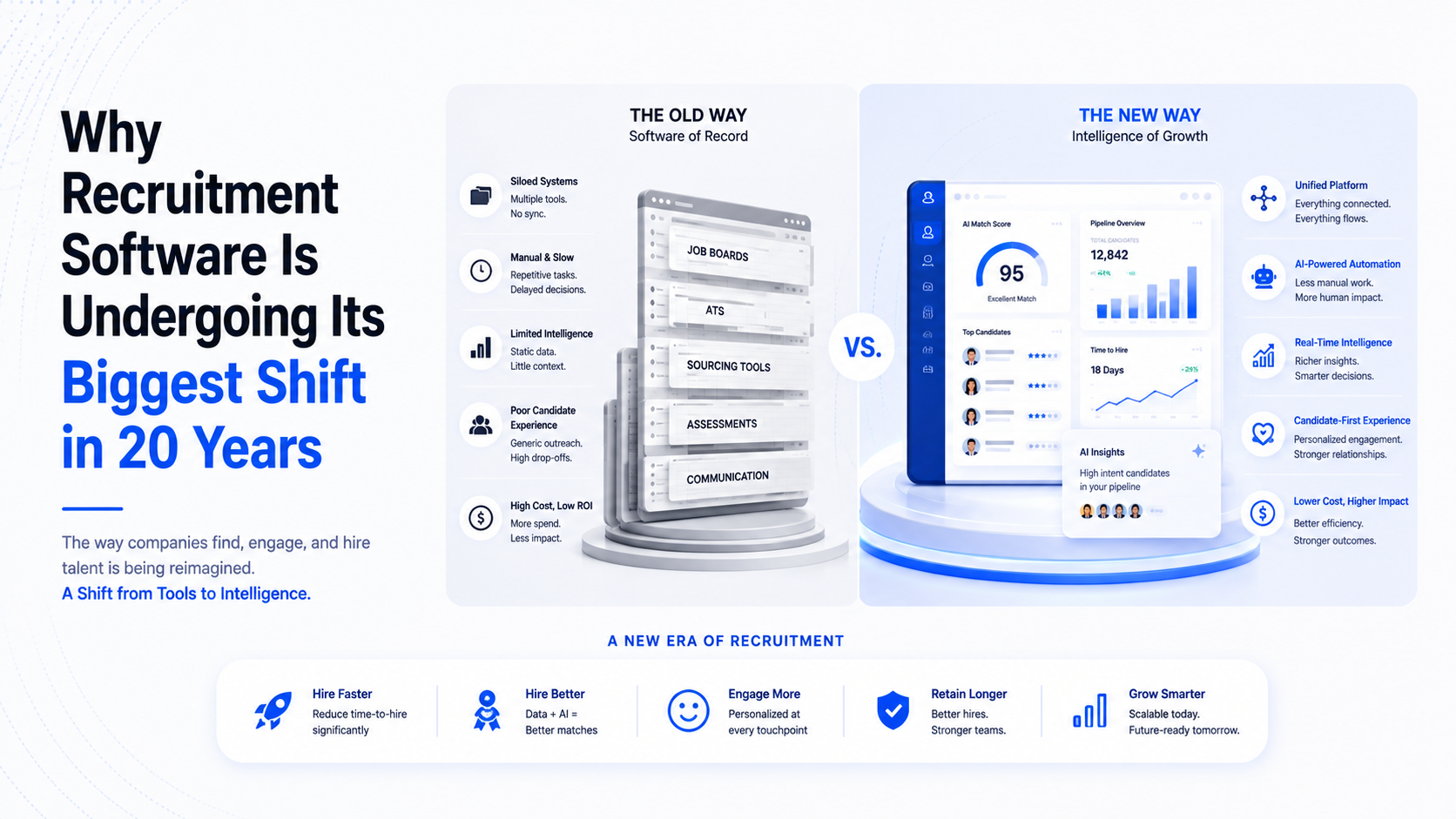
The most significant shift in recruitment software over the past two decades is not the addition of new features but the fundamental change in what the software is designed to do. For
twenty years, recruitment software has been primarily a workflow automation tool: it moves candidates through defined stages, sends notifications, collects feedback, and generates reports on process metrics. The software records what happens during hiring but does not actively improve the quality of hiring decisions. The current generation of recruitment AI is changing this equation by embedding intelligence into every stage of the hiring process, transforming software from a passive record-keeping system into an active decision-support system that continuously learns from outcomes and improves its recommendations. This transition from automation to intelligence is the defining characteristic of the current shift, and it represents a more fundamental change than any feature release or user interface redesign in the past two decades. According to McKinsey, organizations deploying intelligence-native recruiting platforms report twenty to thirty percent higher quality-of-hire scores measured by twelve-month performance ratings, because the software now contributes to decision quality rather than merely recording decisions after they are made.
The shift is visible in how recruiting teams interact with their software daily. In the automation era, recruiters spend their time inputting data, moving candidates between stages, and generating reports. The software serves the recruiter by reducing the administrative burden of managing a hiring process. In the intelligence era, the software presents recruiters with ranked candidate recommendations, predicts which candidates are most likely to accept an offer, identifies pipeline risks before they become problems, and suggests optimal engagement timing based on candidate behavior patterns. The recruiter reviews and directs the software rather than operating it, spending the majority of their time on activities that require human judgment and relationship skills. This role reversal, where the software drives the process and the human provides oversight, is the most consequential change in recruiter-software interaction since the ATS replaced spreadsheets twenty years ago. According to Gartner HR technology adoption research, organizations where recruiters operate in an intelligence-driven model report thirty to forty percent higher recruiter satisfaction and twenty-five to thirty-five percent lower voluntary recruiter turnover compared to organizations where recruiters remain in an automation-driven operational model.
For hiring managers, the shift is equally significant but manifests differently. In the automation era, hiring managers interacted with recruitment software primarily as passive recipients of interview schedules and candidate packets. In the intelligence era, hiring managers receive predictive insights about candidate fit, calibrated compensation recommendations based on real-time market data, and post-interview assessments that incorporate multi-signal evaluation rather than subjective rating scales. The hiring manager experience shifts from receiving information to receiving intelligence, which changes the perceived value of the recruiting function from administrative service provider to strategic talent advisor. This perception shift is critical for organizations that want talent acquisition to have a seat at the strategic planning table, because hiring managers who experience intelligence-driven recruiting develop fundamentally higher expectations for what the talent function can deliver.
The Collapse of the Sourcing-Recruiting Boundary
One of the most visible manifestations of the current shift is the blurring and eventual collapse of the boundary between sourcing and recruiting as distinct activities. For two decades, recruitment software has treated sourcing and recruiting as separate workflow stages: sourcing identifies candidates, recruiting engages and converts them. Different tools often handle each stage, and different team members often perform each function. AI-native platforms are eliminating this boundary by operating across the full candidate lifecycle, from initial discovery through onboarding, within a unified workflow. The practical implication is that the historical distinction between AI sourcing and AI recruiting is becoming operationally irrelevant as platforms coordinate both activities as interconnected components of a single intelligent hiring workflow rather than as separate processes that require different tools and different team specializations.
This boundary collapse has profound implications for recruiting team structure and career development. When sourcing and recruiting are separate functions, recruiters develop deep expertise in candidate relationship management and hiring manager advisory, while sourcers develop expertise in talent market research, Boolean search, and candidate identification. In an AI-native environment, the platform handles much of the technical sourcing work, candidate identification is driven by AI models rather than manual search, and the remaining human work is concentrated on candidate engagement, relationship building, and hiring decision support. This means that the skills that differentiate high-performing recruiters are shifting from technical search capabilities to relationship management, strategic advisory, and AI-collaboration skills. According to Deloitte human capital trends research, organizations that have collapsed the sourcing-recruiting boundary report twenty to thirty percent higher recruiter productivity and fifteen to twenty percent lower cost-per-hire, because the unified workflow eliminates handoff delays and duplication that occur when sourcing and recruiting operate as separate processes.
For talent acquisition leaders, the boundary collapse requires rethinking how recruiting teams are organized, measured, and developed. When the platform coordinates sourcing and recruiting as a unified workflow, team structure should align with the workflow rather than with historical functional boundaries. This may mean organizing recruiters around business units or talent segments rather than around sourcing versus recruiting functions, measuring recruiters on end-to-end hiring outcomes rather than on functional stage metrics, and developing training programs that build the relationship and advisory skills that AI-native platforms make central to the recruiter role. The organizations that make these organizational changes in parallel with the technology shift consistently outperform those that deploy new technology without adjusting team structure, because aligned organization and technology create compounding improvements while misaligned structures create friction that undermines the technology investment. According to EY workforce transformation research, organizations that restructure recruiting teams in parallel with AI platform deployment report forty to fifty percent faster time-to-productivity from the new technology and thirty percent stronger hiring outcome improvements compared to those that deploy technology without organizational restructuring.
From Rules-Based Systems to Learning Systems
The underlying technology architecture of recruitment software is undergoing a fundamental shift from rules-based systems to learning systems, and this architectural change is what enables the transition from automation to intelligence that defines the current era. Rules-based systems operate on predetermined logic: if a candidate meets these criteria, rank them this way. The behavior of the system is determined by the rules that developers program, and the system does not improve unless a developer updates the rules. Learning systems operate on a fundamentally different principle: they build models from data and refine those models continuously as new data becomes available. The behavior of the system improves over time as it processes more hiring outcomes, more candidate interactions, and more feedback signals. This distinction, between agentic platforms and merely automated ones, is the technical foundation of the biggest shift in recruitment software, because learning systems create a compounding improvement dynamic that rules-based systems cannot achieve, regardless of how many rules are added or how frequently they are updated.
The practical impact of this architectural shift is most visible in candidate matching accuracy. Rules-based matching uses keyword filters, Boolean logic, and static scoring rubrics that produce the same results regardless of how many candidates are processed. Learning-based matching uses the outcomes of previous hiring decisions to continuously refine its understanding of what candidate attributes predict success in specific roles. A learning system that has processed ten thousand hires for software engineering roles develops a model of candidate success that incorporates patterns no rules-based system could capture, because the patterns emerge from the data rather than being programmed by developers. This means that the matching accuracy of a learning system improves every quarter, while rules-based systems remain static until a developer manually updates them. According to LinkedIn talent solutions research, organizations using AI learning systems for candidate matching report twenty-five to thirty-five percent higher screening-to-interview conversion rates after twelve months of platform operation compared to rules-based systems, because the learning model continuously incorporates outcome data that improves its recommendations.
For organizations evaluating recruitment software, the learning-versus-rules distinction should be a primary evaluation criterion. Many recruiting tools marketed as AI-powered are actually rules-based systems with some machine learning features bolted on, rather than learning-native architectures where AI is embedded in the core data processing and decision-making logic. The practical test is straightforward: does the system improve its recommendations over time based on the outcomes it observes, or does it produce the same quality of recommendations on day one thousand as it did on day one? Systems that improve are learning-native. Systems that do not are rules-based with AI features. The difference is not incremental but structural, and it determines whether the software investment compounds in value or depreciates over time. According to McKinsey technology investment research, organizations deploying learning-native recruitment platforms report two to three times higher ROI over a three-year period compared to rules-based systems, because the compounding improvement
of learning systems creates expanding value while rules-based systems deliver constant or declining returns.
The Data Foundation That Makes the Shift Possible
The current shift in recruitment software would not be possible without three data infrastructure developments that have matured over the past five years. First, the availability of large-scale hiring outcome datasets that enable AI models to learn what candidate attributes predict success. Second, the development of real-time data processing pipelines that allow AI systems to incorporate new signals immediately rather than waiting for batch updates. Third, the emergence of standardized talent data models that allow AI systems to compare candidates across organizations, industries, and geographies using consistent definitions. Together, these developments provide the data foundation that learning-native recruiting platforms require to deliver on their promise. Without outcome data, AI models cannot learn. Without real-time processing, recommendations cannot adapt to changing conditions. Without standardized data models, comparisons and benchmarks are unreliable. The research on how many follow-ups one hire needs illustrates the importance of outcome data specifically: understanding the relationship between follow-up cadence and hiring success requires tracking both the intervention and the outcome over hundreds or thousands of hiring cycles, which is precisely the kind of data that modern platforms can now collect and analyze systematically.
The data foundation also enables a shift from descriptive to predictive analytics that changes how recruiting leaders manage their function. Descriptive analytics tell you what happened: how many candidates were sourced, how many were screened, how many received offers. Predictive analytics tell you what will happen: which candidates are likely to accept, which pipelines are at risk of stalling, which hiring managers will make decisions fastest. This shift from retrospective to prospective analysis transforms recruiting management from a reporting function into a strategic planning function, because leaders can allocate resources proactively based on predicted outcomes rather than reactively based on historical reports. According to Gartner HR analytics research, organizations using predictive recruiting analytics report twenty to twenty-five percent faster identification of pipeline risks and fifteen to twenty percent more effective resource allocation across open positions, because predictive capabilities enable proactive intervention before problems become visible in retrospective metrics.
The data foundation requirement also creates a new source of competitive advantage in recruiting. Organizations with mature data infrastructures, where hiring outcomes, candidate interactions, and performance data are consistently captured and connected, can train AI models that are proprietary to their specific context. A model trained on three years of your organization hiring data, including which candidates succeeded and which did not, produces recommendations that are calibrated to your culture, your roles, and your hiring manager preferences in ways that no vendor model can replicate. This means that the data investment organizations make today becomes a compounding strategic asset that differentiates their hiring quality from competitors who rely on generic AI models. According to Deloitte data strategy
research, organizations that invest in building proprietary hiring datasets alongside their platform deployments report thirty to forty percent higher AI recommendation accuracy after two years compared to organizations using only vendor-provided models, because the proprietary data captures organizational-specific patterns that generic models cannot incorporate.
What This Shift Means for Recruiter Careers
The biggest shift in recruitment software in twenty years is also the biggest shift in what it means to be a recruiter. As AI-native platforms take over sourcing, screening, scheduling, and routine communication, the recruiter role is being redefined around activities that require human capabilities AI cannot replicate: building trust with candidates and hiring managers, providing strategic advisory on workforce planning, making judgment calls on ambiguous hiring situations, and managing the organizational dynamics that influence hiring decisions. This role evolution is the reason the question of whether AI will replace recruiter jobs misses the point. The role is not being eliminated but transformed, and the recruiters who thrive in the new environment will be those who develop the relationship, advisory, and strategic capabilities that AI-native platforms make central to the function, while those who resist the transformation and cling to operational identities built around tasks that AI now performs better will find their roles increasingly marginal.
The career development implications are significant. Recruiters who want to advance in the intelligence era need to develop three core capabilities that were not traditionally part of the recruiter skill set. First, data literacy: the ability to interpret AI recommendations, understand model confidence levels, and provide meaningful feedback that improves system performance. Second, strategic advisory: the ability to translate hiring data and talent market intelligence into actionable recommendations for hiring managers and business leaders. Third, relationship architecture: the ability to build and maintain candidate and stakeholder relationships at scale using AI tools as force multipliers rather than replacements. These capabilities represent a higher-value, higher-impact version of the recruiter role that commands greater organizational respect and compensation. According to LinkedIn talent solutions research, recruiters who develop these three capabilities report thirty to forty percent higher job satisfaction and twenty-five to thirty percent higher compensation growth compared to recruiters who remain in operationally focused roles, because the strategic capabilities are scarcer and more valued by employers.
For talent acquisition leaders, managing this career transition is as important as managing the technology transition. Organizations that invest in recruiter upskilling alongside platform deployment consistently achieve better outcomes than those that focus exclusively on technology. The practical approach is to pair every technology deployment with a structured capability development program that helps recruiters build data literacy, strategic advisory, and relationship architecture skills through hands-on practice with real hiring scenarios. The organizations that do this create a workforce that is aligned with the intelligence-native operating model, while those that skip the capability investment end up with powerful technology that
is underutilized by recruiters who have not developed the skills to leverage it effectively. According to SHRM talent acquisition development research, organizations that invest in structured recruiter upskilling programs alongside AI platform deployments achieve full platform adoption approximately thirty percent faster and report forty to fifty percent higher recruiter retention rates, because skilled recruiters are more confident, more effective, and more likely to remain with an organization that invests in their professional development.