Priya Sharma ran a contingency recruitment firm in Houston that placed mid-level professionals across oil and gas, healthcare administration, and financial services. Her revenue had grown steadily from four point two million to six point eight million over four years, but her net margin had barely moved, stuck between nine and twelve percent while she watched her largest competitors report margins in the eighteen to twenty-four percent range. Priya knew the problem was not her pricing. Her fees were competitive. The problem was her cost structure. Each placement required her recruiters to spend sixty to seventy percent of their time on activities that generated no direct revenue: sourcing candidates from multiple platforms, screening resumes against job descriptions, sending follow-up messages that went unanswered, scheduling interviews that got rescheduled, and preparing status reports for clients who expected daily updates. These activities were necessary but non-billable, and they consumed the expensive human capacity that Priya was paying for. Her competitors, she learned, had deployed AI tools that automated these non-billable activities, enabling their recruiters to spend seventy percent or more of their time on billable interactions like candidate interviews, client presentations, and offer negotiations. The margin difference between her firm and her competitors was not a pricing problem. It was a productivity problem, and AI was the solution.
The Margin Mechanics of a Recruitment Firm
Understanding why AI improves recruitment margins requires understanding where margins are created and where they are consumed in a typical staffing firm. Revenue in a contingency recruitment firm comes from placement fees, typically fifteen to thirty percent of the placed candidate's first-year compensation. The cost structure has three major components. First, recruiter compensation, including base salary, commission, benefits, and payroll taxes, which
typically represents fifty-five to sixty-five percent of revenue. Second, operating overhead including office space, technology subscriptions, job board access, marketing, and administrative staff, which adds another fifteen to twenty percent. Third, management and business development costs including sales team compensation, client entertainment, and the owner's compensation above what they would earn as a producing recruiter, which adds five to ten percent. The remaining margin, typically eight to fifteen percent of revenue, is the firm's net profit. This thin margin is the reason most recruitment firm owners feel financially stressed even when revenue is growing, because a small shift in any cost category can eliminate the profit entirely.
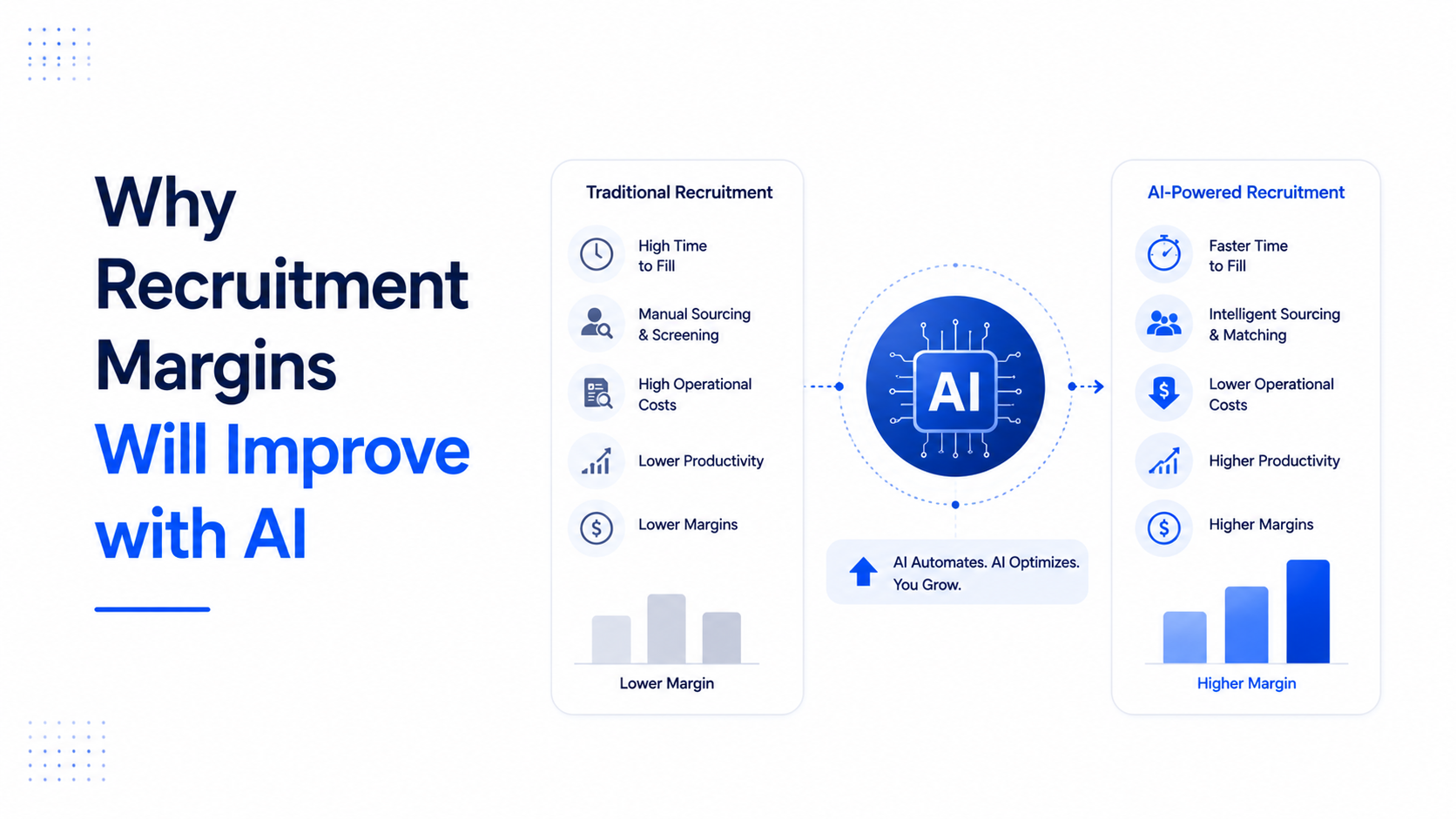
The largest single cost in a recruitment firm is recruiter compensation, and the primary determinant of recruiter compensation cost per dollar of revenue is the ratio of billable time to total time. A recruiter who spends thirty percent of their time on billable activities and seventy percent on non-billable activities generates roughly one third of the revenue they could generate if they spent all their time on billable work. The firm pays for one hundred percent of the recruiter's time but collects revenue from only thirty percent of it. This billable-time ratio is the most important driver of recruitment firm profitability, and it is also the area where AI has the most direct and measurable impact. When AI automates sourcing, screening, scheduling, and routine communication, the recruiter's non-billable time decreases and their billable time increases, improving the billable-time ratio without any change in the recruiter's compensation. Every percentage point improvement in the billable-time ratio translates directly into margin improvement, because the firm generates more revenue from the same fixed cost base.
The second margin lever is placement rate, the percentage of candidate submissions that result in a placed candidate. In a typical contingency firm, recruiters submit three to five candidates per placement, meaning the placement rate ranges from twenty to thirty-three percent. Each submission that does not result in a placement represents sunk cost: the recruiter's time spent identifying, screening, and presenting the candidate, none of which generates revenue. AI improves placement rates by producing better candidate matching, which means fewer submissions per placement and less wasted effort on candidates who will not be selected. When a firm's placement rate improves from twenty-five percent to thirty-five percent, the revenue generated per recruiter hour increases by forty percent because each placement requires fewer non-placing submissions. This improvement flows directly to the bottom line because the cost of generating each placement decreases. According to McKinsey, recruitment firms using AI-powered candidate matching report fifteen to twenty-five percent improvements in placement rates, which translate to ten to fifteen percentage point improvements in net margin because the cost savings from fewer non-placing submissions drop straight to profitability.
Five Ways AI Expands Margins Directly
The first direct margin expansion mechanism is sourcing automation. Sourcing is one of the most time-intensive non-billable activities in recruitment, consuming twenty to thirty percent
of a recruiter's total time. AI sourcing tools identify and rank candidates across multiple data sources in minutes rather than the hours that manual sourcing requires. The time savings per requisition can range from four to eight hours, and when multiplied across the fifteen to twenty active requisitions a typical contingency recruiter manages, the cumulative time savings can reach sixty to one hundred twenty hours per month per recruiter. This is the equivalent of one and a half to three weeks of working time that is freed for billable activities. The margin impact is straightforward: the firm pays the same recruiter compensation but collects revenue from significantly more billable hours. Even a conservative estimate of twenty percent time savings on sourcing translates into a four to six percentage point improvement in net margin for a typical firm, because the freed capacity generates additional placement revenue without additional cost.
The second mechanism is screening acceleration. Manual resume screening is another major time consumer that produces inconsistent results under time pressure. AI screening tools process candidate qualifications against role requirements in seconds, producing ranked shortlists with explanatory scoring. The recruiter's role shifts from conducting the screening to reviewing and refining AI-generated results, a far less time-intensive activity. The margin benefit comes not only from time savings but also from improved screening accuracy, which increases the placement rate by ensuring that only well-matched candidates are advanced to the client submission stage. The third mechanism is engagement automation. Maintaining candidate engagement across a large active pipeline requires constant communication, and AI engagement tools handle this at scale, ensuring that candidates receive timely, personalized messages throughout the hiring process. This automation reduces candidate drop-off, which means fewer candidates are lost from the pipeline and more submissions convert to placements. how many follow-ups one hire needs explains how automated follow-up systems maintain pipeline integrity by ensuring no candidate is lost to communication gaps, because each candidate who drops out due to poor communication represents sunk sourcing and screening cost that reduces the firm's effective margin on the placements that do close.
The fourth mechanism is administrative automation. Status reports, interview scheduling, offer letter preparation, and CRM updates consume ten to fifteen percent of a recruiter's time and generate no revenue. AI tools that automate these activities, including AI-powered scheduling assistants, automated client reporting, and CRM auto-updates, eliminate this overhead entirely for many routine tasks. The fifth mechanism is reduced time-to-fill. AI-accelerated recruiting processes fill roles faster, which means the firm completes more placement cycles per year from the same requisition flow. If a firm's average time-to-fill drops from forty-five days to thirty days, the firm can theoretically complete fifty percent more placement cycles from the same client relationships, because each client engagement concludes faster and the recruiter can move on to the next requisition sooner. In practice, the improvement is somewhat less than the theoretical maximum because not all time savings translate into new placements, but even a ten to fifteen percent increase in placements per recruiter per year produces significant margin improvement. According to Gartner, recruitment firms that deploy AI across all five of these mechanisms report average net margin improvements of eight to twelve percentage points within eighteen months of deployment, because the mechanisms
compound when implemented together rather than producing isolated, additive improvements.
New Revenue Streams That Carry Higher Margins
Beyond improving the margins on existing placement revenue, AI enables recruitment firms to launch new service lines that carry higher margins than traditional contingency placement. The most immediately accessible high-margin service is talent market intelligence. As an AI-powered firm accumulates data on candidate availability, compensation trends, and hiring patterns across its client base, it can package this intelligence into subscription reports and advisory services that clients pay for on a recurring basis. Talent market intelligence services typically carry gross margins of sixty to seventy percent, because the primary cost is the AI platform that generates the analytics, and the platform cost is already being paid for placement operations. The intelligence service therefore generates revenue from existing infrastructure with minimal incremental cost, producing margins that far exceed the fifteen to twenty percent net margins of traditional placement services.
The second high-margin service is predictive workforce planning. Organizations increasingly need forward-looking talent intelligence that helps them anticipate hiring needs, identify emerging skill requirements, and prepare for market shifts. AI-powered recruitment firms are uniquely positioned to provide this service because their data on candidate flow, hiring outcomes, and market dynamics provides the raw material for predictive workforce models. These advisory engagements typically command premium fees because they address strategic business questions rather than operational hiring needs, and they carry high margins because they leverage existing data and AI capabilities rather than requiring additional recruiter capacity. A firm that adds workforce planning advisory to its service portfolio can increase its average revenue per client by thirty to forty percent while improving its blended margin by five to eight percentage points, because the advisory revenue carries higher margins than placement revenue and dilutes the impact of lower-margin placement costs on the firm's overall profitability.
The third high-margin opportunity is talent pool management. Firms that build and maintain AI-curated talent communities around specific skill sets or industries can charge clients for access to pre-qualified candidate pools. The community management is automated by the AI platform, so the marginal cost of serving each additional client is minimal. The community becomes a proprietary asset that grows in value over time as more candidates join and more engagement data accumulates, producing recurring subscription revenue with very high incremental margins. According to Deloitte, recruitment firms that have launched AI-enabled data services report that these services contribute twenty to thirty percent of total revenue within two years while carrying margins that are fifteen to twenty points higher than traditional placement margins, because the services monetize existing data assets rather than requiring proportional increases in recruiter headcount and compensation. more tools same hiring problems explains why firms that leverage their existing AI platform to generate
data-driven services achieve higher margins than firms that try to build these services on separate technology, because the shared platform eliminates duplicate infrastructure costs and enables data flow between placement operations and intelligence services that improves both.
The Compounding Effect: Why AI Margins Improve Over Time
The most important characteristic of AI-driven margin improvement is that it compounds over time rather than plateauing. This compounding occurs for three reasons. First, AI models improve with use. Every placement, every candidate interaction, and every hiring outcome provides training data that makes the AI's matching, screening, and engagement recommendations more accurate. More accurate recommendations produce higher placement rates, and higher placement rates produce better margins. This virtuous cycle means that a firm's margin improvement in year two is not limited to the same level as year one but builds on the data accumulated during year one to produce additional improvement. Second, the firm's data asset grows in value as more hiring activity flows through the platform. The accumulated candidate intelligence, market analytics, and outcome data become a proprietary competitive advantage that enables the firm to win more clients, command higher fees, and launch more lucrative service lines. This growing data asset represents an appreciating strategic resource that does not appear on the balance sheet but drives real margin improvement.
Third, the organizational learning that accompanies AI adoption accelerates over time. In the first year of AI implementation, the firm is learning how to integrate AI into its workflows, how to train recruiters to work alongside AI, and how to manage the transition from manual to AI-enhanced processes. This learning produces inefficiencies that temporarily limit the margin improvement the AI can deliver. By the second and third years, the firm has developed mature workflows, experienced recruiters, and refined processes that extract more value from the AI platform. The recruiters are more skilled at interpreting AI recommendations, the managers are better at allocating AI-enhanced capacity, and the firm as a whole has developed a culture of data-driven decision-making that amplifies the AI's impact. According to EY, recruitment firms report that fifty to sixty percent of their total AI-driven margin improvement materializes in the second and third years after implementation rather than the first year, because the combination of improved AI models and mature organizational practices creates a multiplier effect that the initial implementation cannot achieve.
The compounding nature of AI-driven margin improvement has a profound strategic implication: early adopters build a widening margin advantage over later adopters. A firm that implements AI today and achieves a five percentage point margin improvement in year one, an additional four points in year two, and an additional three points in year three will have a twelve percentage point margin advantage over a firm that delays AI adoption by two years and starts from zero. This margin advantage translates into financial resources that the early adopter can invest in better recruiters, better technology, and better client experiences, further widening the competitive gap. The late adopter, facing thinner margins, has less capital to invest in the AI capabilities that would close the gap, creating a self-reinforcing cycle where
early movers pull ahead and laggards fall further behind. agentic AI platforms vs automated ones describes how agentic AI platforms accelerate this compounding effect by coordinating multiple AI capabilities simultaneously, because the interaction between sourcing automation, screening accuracy, and engagement optimization produces compounding improvements that single-point AI tools cannot match, and the firms that deploy these coordinated capabilities earliest build the largest compounding advantage.
Measuring and Maximizing Margin Impact
For recruitment firm owners who want to realize the margin potential of AI, the first step is establishing a margin accounting framework that identifies exactly where revenue is generated and where costs are consumed at the activity level. Most recruitment firms measure financial performance at the firm level and the individual recruiter level, tracking total revenue, total costs, and net margin. This level of aggregation obscures the specific activities that drive or constrain margin. A more useful framework tracks revenue and cost at the activity level, breaking recruiter time into categories such as sourcing, screening, candidate engagement, client meetings, offer negotiation, and administrative tasks. This activity-level view reveals exactly how much non-billable time each recruiter spends, which activities consume the most non-billable time, and where AI automation will produce the greatest margin impact. Without this granular visibility, the firm is making investment decisions based on intuition rather than data, and the AI implementation is likely to automate the wrong activities or deliver less margin improvement than the technology is capable of producing.
The second step is setting explicit margin improvement targets and tracking progress against them. Rather than implementing AI and hoping for margin improvement, the firm should define specific, measurable targets such as improving the billable-time ratio from thirty percent to forty-five percent, reducing submissions per placement from four to two point five, and increasing net margin from ten percent to eighteen percent within eighteen months. These targets create accountability and enable the firm to identify whether the AI implementation is delivering its expected financial impact. If the billable-time ratio is not improving as expected, the firm can diagnose whether the issue is inadequate AI adoption by recruiters, insufficient AI capability for the firm's specific workflow, or a need for additional process redesign. This target-driven approach ensures that the AI investment is managed as a financial initiative with measurable outcomes rather than a technology project with ambiguous returns. According to LinkedIn, recruitment firms that set explicit margin improvement targets for their AI investments report thirty to forty percent higher actual margin improvements compared to firms that implement AI without specific financial targets, because the targets force the organization to align its AI deployment, process changes, and training efforts toward the activities that will produce the greatest financial impact.
The third step is reinvesting margin improvements to accelerate further improvement. When AI generates margin gains, the temptation is to harvest those gains as profit distribution to the firm's owners. While some profit distribution is appropriate, the most strategically effective
approach is to reinvest a significant portion of the margin improvement back into the capabilities that will generate further improvement. This means investing in upgraded AI capabilities, additional training for recruiters, data infrastructure that improves the AI's training data, and new service lines that monetize the firm's growing data assets. This reinvestment strategy creates a virtuous cycle where each round of margin improvement funds the capabilities that produce the next round, producing compounding returns that far exceed what a one-time profit distribution would provide. Firms that reinvest forty to fifty percent of their AI-generated margin improvements report significantly higher long-term growth and profitability than firms that distribute the majority of the improvement as profit, because the reinvestment builds the data assets, AI capabilities, and organizational expertise that become the firm's most valuable strategic resources. how to evaluate an AI sourcing tool provides a framework for assessing which AI investments will produce the greatest margin improvement, because not all AI tools deliver equal financial impact, and firms that prioritize investments based on projected margin contribution rather than feature lists or vendor marketing claims achieve faster and larger margin improvements with the same total investment.