Jennifer Okafor, Director of Recruiting Operations at a healthcare network with over twenty thousand employees, realized her legacy ATS was holding her team back during a critical hiring surge. When the organization needed to hire three hundred nurses in sixty days, the ATS could track applications but could not help her team find candidates, engage them effectively, or prioritize the most promising applicants. Her recruiters manually searched job boards, copied candidate information into spreadsheets, and sent generic email templates that generated response rates below five percent. Meanwhile, a competing health system using an AI-native hiring platform filled its nursing positions in forty-five days with a twelve percent higher offer acceptance rate. Okafor's experience is playing out across industries as organizations discover that their legacy ATS, designed primarily for compliance tracking and application management, cannot compete with platforms built for intelligent, data-driven hiring. The relevance gap between legacy and modern hiring technology is no longer theoretical. It is measurable, it is growing, and it is directly affecting which organizations win the competition for talent.
The Compliance-First Design Philosophy That No Longer Serves Buyers
The fundamental reason legacy ATS platforms are losing relevance is not that they have stopped working but that they were designed to solve a problem that is no longer the primary challenge in talent acquisition. When the first generation of enterprise ATS platforms was
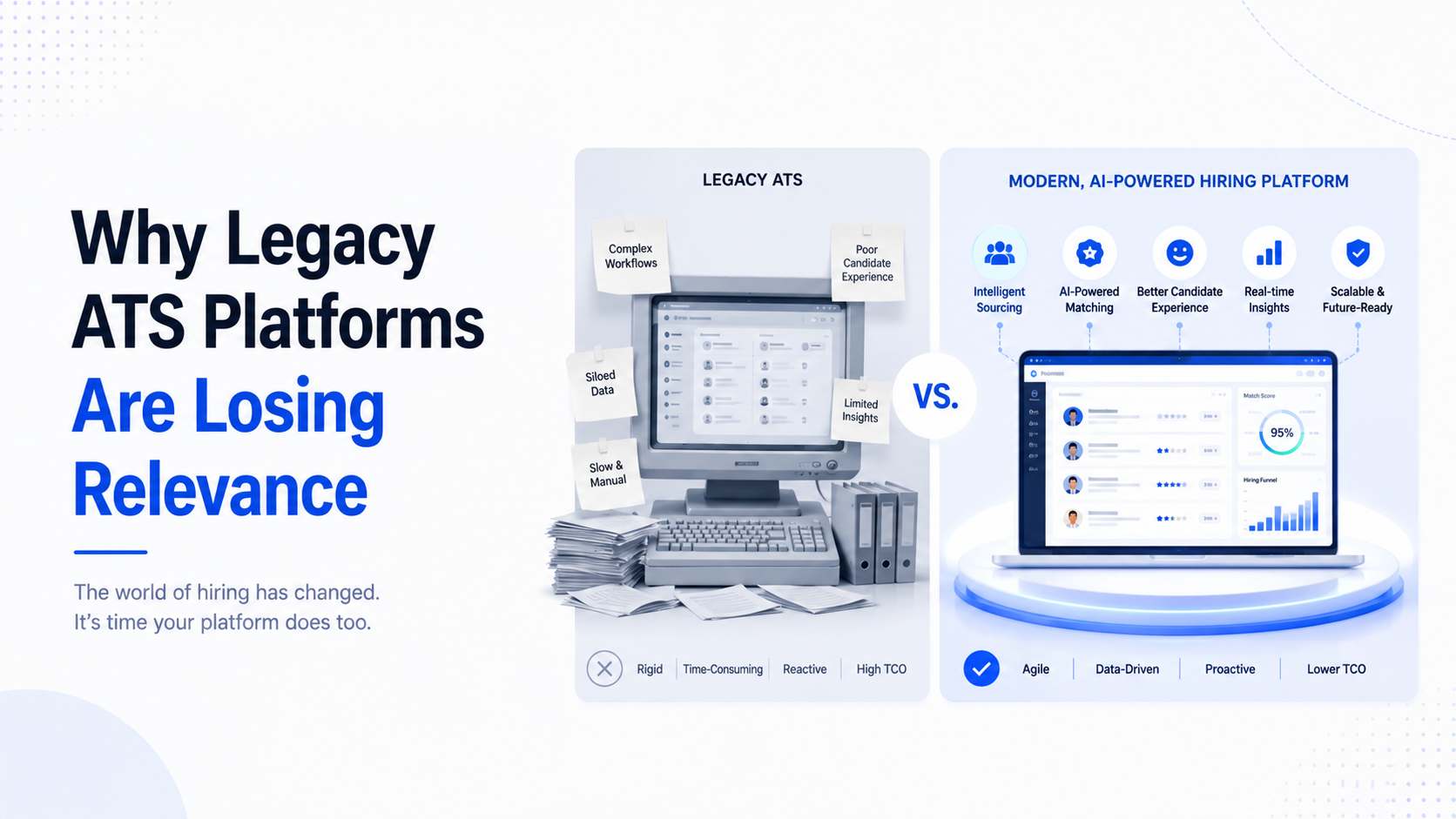
built in the early 2000s, the dominant concern was regulatory compliance: ensuring that hiring processes met EEOC requirements, that candidate data was stored securely, and that audit trails existed for every hiring decision. These platforms excelled at creating structured, auditable workflows around application receipt, status tracking, and offer management. The design philosophy was fundamentally defensive, built to protect organizations from legal risk rather than to help them compete for talent. According to McKinsey, the compliance-first design paradigm produced platforms that were highly effective at documentation but largely passive when it came to candidate identification, engagement, and matching, the activities that actually determine hiring outcomes in competitive talent markets. This design heritage is the root cause of the relevance gap, because no amount of feature addition can fully transform a compliance-first architecture into an intelligence-first platform.
The shift from compliance-first to intelligence-first hiring technology reflects a broader change in how organizations think about talent acquisition. Fifteen years ago, the primary function of an ATS was to receive and process applications from candidates who had already found the organization through job boards, employee referrals, or recruiting agencies. The ATS was the end of the sourcing funnel, not the beginning. In 2026, the hiring process starts much earlier, with proactive identification and engagement of potential candidates who may not be actively searching for jobs. This shift requires platforms that can search talent markets, analyze candidate fit, and initiate personalized outreach, capabilities that were never part of the original ATS design. According to Gartner HR technology evolution research, the percentage of hiring activity that occurs before a candidate formally applies has increased from roughly twenty percent in 2015 to over sixty percent in 2026, meaning that platforms designed primarily for application processing now address less than half of the actual hiring workflow. Legacy ATS vendors have attempted to add sourcing and engagement features, but these additions sit awkwardly on top of an architecture that was not built to support them, resulting in user experiences that feel bolted-on rather than integrated.
The practical consequence for organizations still using legacy ATS platforms is a growing misalignment between what their technology enables and what their hiring strategy requires. Talent acquisition leaders want to be proactive, identifying and engaging candidates before competitors reach them. Their legacy ATS wants them to be reactive, waiting for applications to arrive and then processing them through predefined workflows. This misalignment forces recruiting teams to supplement their ATS with external sourcing tools, spreadsheet-based candidate tracking, and manual communication processes that create data silos and undermine the reporting and analytics capabilities that were the ATS platform's original strength. The result is a hiring technology ecosystem that is more complex, more expensive, and less effective than either the legacy ATS alone or a modern integrated platform would be. Organizations in this position are effectively paying for two systems: the legacy ATS they are contractually committed to and the collection of supplementary tools they actually need to compete for talent.
How AI-Native Architecture Changes the Sourcing Pipeline
The architectural difference between legacy ATS platforms and AI-native hiring systems is most visible in how they handle the sourcing-to-hiring pipeline. Understanding the difference between AI sourcing and AI recruiting is essential for appreciating why legacy platforms cannot compete, even when vendors add AI labeling to their feature descriptions. A true AI-native platform builds machine learning into the core data layer, meaning that every candidate interaction, every hiring outcome, and every market signal feeds into models that continuously improve the platform's recommendations. Legacy platforms that have added AI features typically do so as an additional processing layer on top of their existing data architecture, which means the AI operates on data that was structured for compliance tracking rather than for intelligent matching. According to Deloitte HR technology architecture research, this fundamental difference in where AI sits in the technology stack, embedded in the core data layer versus bolted on as an additional feature, accounts for the majority of the performance gap between AI-native and legacy-extended platforms, because data architecture determines the quality of inputs available to the AI models and therefore the quality of their outputs.
The pipeline impact of AI-native architecture extends across every stage of hiring. In the sourcing stage, AI-native platforms can search broad talent markets simultaneously, apply multi-signal matching that considers skills, experience trajectory, and predicted availability, and rank candidates based on comprehensive fit analysis rather than keyword proximity. In the engagement stage, the platform can personalize outreach based on candidate profile analysis, optimize send timing based on response pattern data, and adapt communication sequences based on real-time candidate behavior. In the evaluation stage, multi-signal assessment replaces the keyword screening that legacy platforms perform, producing more accurate candidate-role fit assessments. In the offer stage, AI-powered compensation benchmarking leverages real-time market data to recommend competitive offer parameters. Each of these capabilities exists because the platform was built on an architecture where data flows continuously across stages and AI models learn from the complete hiring lifecycle. According to EY workforce technology analysis, organizations using AI-native platforms with end-to-end pipeline architecture report thirty to forty percent faster hiring cycles than those using legacy ATS platforms supplemented with standalone AI sourcing tools, because the integrated pipeline eliminates the data transfer gaps that slow down and degrade multi-tool hiring processes.
For organizations evaluating whether to extend their legacy ATS with add-on capabilities or replace it with an AI-native platform, the architectural question should be the deciding factor. Adding AI sourcing tools to a legacy ATS creates a two-system architecture where candidate data must flow between the sourcing tool and the ATS, typically through manual processes or fragile integrations. Each data transfer point introduces latency, inconsistency, and potential error. The AI sourcing tool may identify excellent candidates, but if their data does not transfer cleanly into the ATS workflow, the downstream evaluation and hiring process degrades. AI-native platforms eliminate these transfer points because the entire pipeline operates within a single system with a unified data model. The practical recommendation is straightforward: if your hiring strategy depends on proactive sourcing and intelligent engagement, which it almost certainly does in 2026, then a platform built on AI-native architecture will deliver materially better outcomes than a legacy ATS extended with bolt-on capabilities, regardless of
how impressive those bolt-on features may appear in isolation.
The Data Moat Legacy Platforms Cannot Replicate
One of the most underappreciated advantages of modern hiring platforms over legacy ATS systems is the data moat that accumulates through continuous AI-driven hiring operations. Every hiring cycle on an AI-native platform generates training data that improves the platform's matching accuracy, engagement effectiveness, and process optimization. Candidates sourced, outreach sent, responses received, interviews conducted, offers extended, and hires made, all of these interactions feed into machine learning models that refine the platform's performance over time. The question of how to evaluate an AI sourcing tool before buying now includes assessing the depth and quality of the vendor's accumulated hiring data, because this data asset is a primary determinant of platform performance. According to LinkedIn talent solutions research, platforms that have been operating in AI-native mode for three or more years demonstrate measurably better candidate matching and engagement performance than newer platforms with equivalent algorithmic sophistication but less accumulated operational data, confirming that the data moat is a genuine competitive advantage rather than a marketing claim.
Legacy ATS platforms cannot build this data moat because their architectures were not designed to capture and leverage the rich interaction data that drives AI optimization. A legacy ATS records application submissions, status changes, and hire decisions, but it typically does not capture the granular interaction data that powers modern AI models: candidate engagement patterns, outreach response timing, interview conversation content, and the multi-signal behavioral indicators that predict candidate fit and likelihood to accept an offer. The data model of a legacy ATS is transactional, recording what happened, while the data model of an AI-native platform is behavioral, capturing how candidates and recruiters interact and using those patterns to predict and optimize future interactions. This fundamental difference in data philosophy means that legacy platforms cannot simply add data collection features to catch up. The data moat requires years of consistent operation on an architecture designed from the outset to capture, process, and learn from behavioral hiring data. According to SHRM talent acquisition technology research, organizations using AI-native platforms report that platform performance improves by ten to fifteen percent per year as the accumulated data enhances model accuracy, a compounding benefit that legacy platforms cannot replicate regardless of how many features they add.
The data moat has strategic implications for the timing of platform replacement decisions. Organizations that migrate to AI-native platforms earlier accumulate more operational data, which improves their platform's performance faster, which produces better hiring outcomes, which strengthens the business case for continued investment. This virtuous cycle means that early movers build a compounding data advantage that late adopters cannot quickly replicate. An organization that switches to an AI-native platform in 2026 will have two to three years of accumulated performance data by 2028, while an organization that delays the switch until 2028 will start its data accumulation from zero. The competitive gap created by this timing
difference is significant and durable, because data-driven platform performance improves gradually and consistently, making it extremely difficult for late adopters to close the gap through any means other than time. For talent acquisition leaders, the data moat argument provides an additional urgency dimension to the ATS replacement decision: it is not just about fixing today's limitations but about starting the data accumulation process that will determine hiring performance for years to come.
Why Recruiter Roles Evolve Past What Legacy ATS Supports
The relevance gap between legacy ATS platforms and modern hiring needs is also driven by the evolution of the recruiter role itself. The question of whether recruiters should worry about AI replacing their jobs misses the more important point: AI is not eliminating recruiter roles but fundamentally changing what recruiters do, and legacy ATS platforms were built for the old version of the role. When legacy ATS platforms were designed, the recruiter's primary activities were posting jobs, reviewing resumes, scheduling interviews, and updating candidate statuses in the system. These are largely administrative tasks that involve moving candidates through a predefined workflow. Modern recruiters, working with AI-native platforms, spend the majority of their time on activities that legacy ATS systems were never designed to support: strategic talent advisory to hiring managers, relationship building with high-priority candidates, market intelligence analysis, and process optimization based on data-driven insights. According to McKinsey workforce research, the proportion of recruiter time spent on strategic activities has increased from roughly twenty percent in organizations using legacy ATS to over fifty percent in organizations using AI-native platforms, because automation handles the administrative tasks that previously consumed the majority of the working day.
This role evolution creates a mismatch between recruiter capabilities and legacy ATS functionality that is difficult to resolve without platform replacement. A recruiter who has developed expertise in data-driven hiring strategy, candidate relationship management, and cross-functional talent advisory finds that their legacy ATS provides tools for none of these activities. The platform offers resume screening workflows, status update buttons, and compliance report generators, features that address the recruiter's old responsibilities but not their current ones. The frustration that results from this mismatch is a significant driver of recruiter dissatisfaction and turnover, particularly in competitive talent markets where skilled recruiters have multiple employment options. According to Gartner HR technology and workforce research, organizations using legacy ATS platforms report twenty-five to thirty-five percent higher recruiter turnover than those using AI-native platforms, because recruiters want to work with tools that enhance their strategic capabilities rather than constraining them to administrative tasks. This turnover cost, often overlooked in technology ROI calculations, adds substantially to the total cost of maintaining a legacy ATS.
The broader implication is that legacy ATS platforms are not just technology limitations but talent management liabilities. Organizations that expect their recruiters to compete for top talent using tools designed for a previous era of recruiting are placing their recruiters at a structural disadvantage. The best recruiters, those with the skills and ambition to operate as
strategic talent advisors, will seek employment with organizations that provide them with modern tools that match their capabilities. The organizations that retain legacy ATS platforms will increasingly find themselves with recruiting teams that are proficient at administrative workflow management but lack the strategic capabilities needed to compete in AI-driven talent markets. This talent management dimension of the ATS replacement decision is often underappreciated in technology evaluation processes that focus on features and costs without considering the impact on recruiter effectiveness, satisfaction, and retention. For organizations where talent acquisition is a strategic priority, the recruiter experience should be a first-class evaluation criterion in any platform decision.
The Strategic Cost of Staying With a Legacy ATS
The cumulative strategic cost of maintaining a legacy ATS platform extends well beyond the software license fee and the direct productivity losses that are relatively easy to quantify. There is a growing body of evidence that organizations using legacy hiring technology are experiencing measurable competitive disadvantages in hiring outcomes that affect business performance. The pattern of adding more tools to solve the same hiring problems is a direct consequence of legacy ATS limitations, as organizations layer supplementary sourcing, engagement, and analytics tools on top of their ATS in an attempt to close the capability gap. This tool proliferation creates its own costs: additional license fees, integration maintenance burdens, recruiter training requirements, and the data inconsistency that inevitably results from multiple systems tracking the same candidates with different data models. According to Deloitte HR technology total cost of ownership research, the all-in cost of maintaining a legacy ATS supplemented by three to five additional tools typically exceeds the cost of a single AI-native platform by thirty to fifty percent, while delivering inferior outcomes because the supplementary tools cannot replicate the data integration and AI optimization that a unified platform provides.
The competitive dimension of the strategic cost is perhaps the most compelling reason for organizations to accelerate their ATS replacement timelines. In competitive talent markets, the difference between filling a critical role in thirty days versus sixty days can have direct revenue impact, particularly for customer-facing roles and revenue-generating positions. The difference between identifying the best candidate for a role and settling for an adequate candidate compounds over time through performance and retention differentials. Organizations using AI-native hiring platforms are filling roles faster, making more accurate hiring decisions, and building candidate relationships that create future sourcing advantages. Organizations using legacy ATS platforms are doing none of these things as effectively, and the gap is widening as AI-native platforms accumulate data and learning advantages. According to LinkedIn talent solutions competitive analysis, organizations using AI-native hiring platforms report twelve to eighteen percent higher quality-of-hire scores and twenty to twenty-five percent lower early-attrition rates than those using legacy ATS platforms, differences that translate directly into productivity, revenue, and retention advantages for the organizations that hire better.
For talent acquisition leaders building the business case for legacy ATS replacement, the strategic cost framework provides a comprehensive way to quantify the full impact of delaying the transition. The cost categories include direct technology costs, the premium paid for maintaining legacy infrastructure plus supplementary tools; productivity costs, the recruiter time consumed by administrative tasks and manual workarounds; opportunity costs, the superior hiring outcomes that competitors using modern platforms are achieving; and talent costs, the recruiter turnover and skill stagnation that result from providing outdated tools to a professional workforce that expects better. When these costs are aggregated, the business case for ATS replacement typically becomes compelling within twelve to eighteen months, even before accounting for the compounding data and learning advantages that accrue to early movers. The organizations that recognize the full strategic cost of their legacy ATS and act decisively to replace it will be the ones that build sustainable competitive advantages in talent acquisition, while those that continue to invest in extending legacy platforms will find the cost of eventual replacement rising as their competitive position in the talent market continues to erode.