Sarah Chen, a partner at a late-stage venture capital firm in San Francisco, had spent the last quarter meeting with over forty enterprise software founders. Her thesis was straightforward: find the next wave of B2B infrastructure companies that would become as indispensable as Stripe became for payments or Twilio became for communications. She had looked at compliance infrastructure, data infrastructure, and security infrastructure. But the pattern that kept appearing in her diligence was unexpected. Three of the most capital-efficient companies in her portfolio, each growing net revenue retention above one hundred thirty percent and approaching positive unit economics within eighteen months of launch, were not building generic enterprise infrastructure at all. They were building AI-powered hiring infrastructure, the foundational systems that enable enterprises to source, screen, evaluate, and hire talent at scale using artificial intelligence. When she presented her findings at the firm's annual investment review, the data spoke for itself. The AI hiring infrastructure companies in the portfolio were growing faster, retaining clients better, and approaching profitability sooner than the companies in any other vertical. Her recommendation was clear: AI hiring infrastructure was not a niche recruiting play. It was a fundamental enterprise software category with the kind of market dynamics that produce generational returns.
The Difference Between Hiring Software and Hiring Infrastructure
Understanding why investors are excited about AI hiring infrastructure requires distinguishing between hiring software and hiring infrastructure. Hiring software is what enterprises
have been buying for two decades: applicant tracking systems that manage job postings and applications, recruitment marketing platforms that advertise open positions, and interview scheduling tools that coordinate calendars. These are application-layer products that sit on top of the technology stack and perform specific, bounded functions. They are useful, but they are fundamentally limited by their narrow scope and their dependence on manual data entry and human-driven workflows. When a recruiter uses a traditional ATS, they are using software that records and organizes information but does not think, analyze, or act independently. The software is a tool, and like any tool, its value is proportional to the skill of the person using it.
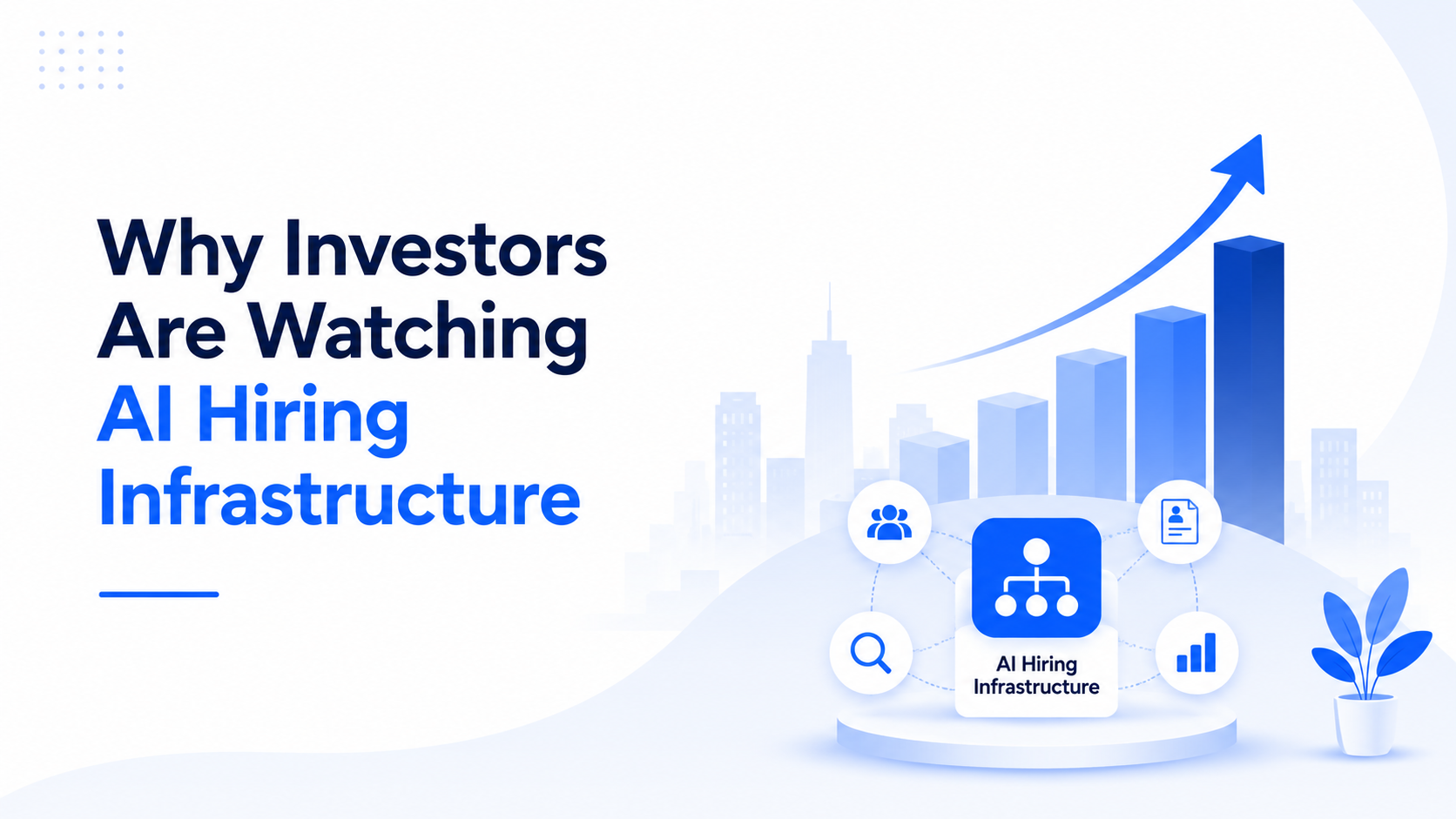
AI hiring infrastructure operates at a fundamentally different level. Rather than performing a single function, it provides the foundational capabilities that enable multiple hiring functions to work together intelligently. Infrastructure includes the data pipelines that ingest and normalize candidate information from hundreds of sources, the machine learning models that evaluate candidate fit and predict hiring outcomes, the communication systems that engage candidates across multiple channels with personalized messaging, the orchestration layer that coordinates scheduling, screening, and evaluation workflows, and the analytics engine that provides real-time visibility into the entire hiring funnel. These are not separate products but interconnected components of a single system that works together to automate and optimize the entire hiring process. The distinction is analogous to the difference between a word processor and an operating system. A word processor performs one function well. An operating system enables hundreds of functions to work together, creating value that is far greater than the sum of its individual components.
This infrastructure distinction matters enormously to investors because infrastructure businesses have fundamentally better economics than application businesses. Infrastructure products become embedded in the operational fabric of the organizations that use them, creating deep switching costs that protect revenue and drive high net retention rates. Application products, by contrast, are more easily replaced because they perform discrete functions that can be replicated by competitors or substituted with alternative solutions. When an enterprise has built its entire hiring operation on top of an AI infrastructure platform, including its data pipelines, its evaluation models, its communication workflows, and its analytics, switching to a competitor requires rebuilding the entire operation, not just swapping one tool for another. This structural stickiness is what transforms a growing software business into a durable, high-value enterprise. According to McKinsey, AI-powered hiring infrastructure platforms exhibit sixty to eighty percent higher net revenue retention rates compared to traditional hiring application software, because the infrastructure layer touches more workflows, accumulates more proprietary data, and creates more operational dependency than any single application can achieve on its own.
Why the Unit Economics Work Better Than Most Enterprise Software
The unit economics of AI hiring infrastructure are unusually attractive for a category that is still in its early stages. The combination of high contract values, low marginal costs, and strong expansion revenue creates a financial profile that compares favorably to the best enterprise software businesses of the previous decade. Enterprise contracts for AI hiring infrastructure typically range from fifty thousand to five hundred thousand dollars annually, depending on the size of the organization and the breadth of capabilities deployed. These contracts are large enough to support meaningful sales and customer success teams, but the infrastructure nature of the product means that the cost of serving each additional client is low. Once the core AI models, data pipelines, and orchestration systems are built, the marginal cost of onboarding a new client is primarily limited to configuration, integration, and training, not to building new product capabilities. This creates the kind of operating leverage that investors look for: revenue grows faster than costs, and the business moves toward profitability as it scales.
The expansion revenue dynamics are particularly compelling. AI hiring infrastructure platforms typically expand within client organizations in two ways. First, they expand horizontally by adding new hiring functions. A company that initially adopts the platform for candidate sourcing will typically expand to use it for screening, interview scheduling, offer management, and analytics within the first twelve to eighteen months. Each additional capability increases the contract value and deepens the integration with the client's operations. Second, they expand vertically by extending to new business units, geographies, and hiring volumes. A platform that proves its value for technical hiring in the engineering department will be adopted by sales hiring, operations hiring, and eventually by every hiring function in the organization. This natural expansion within clients drives net revenue retention rates that routinely exceed one hundred twenty percent, meaning that existing clients are spending more each year even before new clients are added. According to Gartner, AI hiring infrastructure platforms that achieve initial product-market fit report average net revenue retention of one hundred twenty-five to one hundred forty-five percent in their first three years, a figure that exceeds the enterprise software industry average by thirty to forty percentage points.
The gross margin profile of AI hiring infrastructure is also favorable. Traditional hiring software companies that rely on manual services, such as recruitment process outsourcing or agency-style candidate sourcing, have gross margins in the thirty to fifty percent range because human labor is expensive and difficult to scale. AI hiring infrastructure companies, by contrast, automate the functions that previously required human labor, which means their cost of goods sold is dominated by computing infrastructure and data costs rather than people costs. This pushes gross margins toward the seventy to eighty-five percent range that investors expect from top-tier enterprise software companies. The combination of high gross margins and strong net revenue retention creates a business model where each dollar of new revenue is more profitable than the last, because the fixed costs of building the infrastructure are spread across a growing revenue base. agentic AI platforms vs automated ones explains how agentic AI hiring infrastructure achieves these margin advantages by automating the candidate evaluation and engagement workflows that traditional recruiting models staff with
human recruiters, because the AI agents perform these functions at a fraction of the cost while maintaining or improving the quality of outcomes.
The Data Moat That Makes AI Hiring Infrastructure Defensible
The most compelling investment characteristic of AI hiring infrastructure is the data moat that accumulates as the platform processes more hiring interactions. Every candidate that the platform sources, screens, and evaluates generates data that improves the platform's AI models. Every hiring outcome, whether a candidate is hired, performs well, stays with the company, or leaves, provides a training signal that makes the platform's predictions more accurate. This creates a self-reinforcing cycle where the platform gets better at hiring the more it is used, and the better it gets at hiring, the more clients adopt it, which generates more data that makes it even better. This data flywheel effect is the same dynamic that made Google's search engine, Netflix's recommendation system, and Amazon's marketplace so difficult to compete with. In each case, the incumbent's data advantage created a gap that competitors could not close because they lacked the volume and diversity of interactions needed to train equally effective models.
The data moat in AI hiring infrastructure is particularly deep because the data is both proprietary and multi-dimensional. The platform collects data on candidate skills, communication patterns, interview performance, offer acceptance behavior, and post-hire outcomes, creating a rich dataset that no competitor can replicate. This data is proprietary because it is generated through the platform's own interactions with candidates and clients, meaning it cannot be purchased, scraped, or acquired through any channel other than building a competing platform and accumulating equivalent usage. The multi-dimensional nature of the data is important because it enables the AI models to identify complex, non-obvious patterns that single-dimension datasets cannot reveal. A platform that knows not just what skills a candidate has but how they communicate, how quickly they respond, how they perform in different interview formats, and what factors predict their long-term success can make hiring recommendations that are fundamentally more accurate than any system that evaluates candidates on a single dimension. According to LinkedIn, AI hiring platforms that leverage multi-dimensional candidate data across the full hiring lifecycle produce thirty to forty percent better hire quality matches compared to platforms that rely on single-dimension data like resume keywords alone, because the additional data dimensions capture predictive signals that traditional evaluation methods miss entirely.
The data moat also creates a significant barrier to entry for potential competitors. A new entrant to the AI hiring infrastructure market faces a cold-start problem: its AI models are less accurate because they have been trained on less data, which means its hiring recommendations are less valuable, which means it is harder to attract clients, which means it accumulates data more slowly, which perpetuates the accuracy gap. The only ways to overcome this cold-start problem are to spend heavily on acquiring initial data, which is expensive and time-consuming, or to focus on a narrow market segment where the data requirements are lower and
the incumbents are less entrenched. Both strategies require significant capital and time, which gives well-established incumbents a substantial head start. This dynamic is particularly attractive to investors because it means that early leaders in the category can build data advantages that become more durable over time, creating the kind of long-term competitive moat that generates sustained above-market returns. why AI tools have outdated candidate data explains why AI hiring infrastructure platforms that invest early in building comprehensive data pipelines and proprietary training datasets develop advantages that late entrants cannot replicate through better algorithms alone, because the quality of AI hiring predictions depends more on the depth and diversity of training data than on the sophistication of the model architecture.
The Market Timing That Is Driving Capital Deployment
Investor interest in AI hiring infrastructure is not just about the theoretical attractiveness of the business model. It is also about market timing. Several structural shifts are converging to create what venture capitalists call a window of opportunity, a period of several years during which the conditions for building a category-defining company are unusually favorable. The first shift is the maturation of AI technology. Large language models, natural language processing, and machine learning systems have reached a level of capability that makes AI-powered hiring viable at enterprise scale. Three years ago, AI could help with resume screening and keyword matching. Today, AI can conduct nuanced candidate conversations, evaluate soft skills through communication analysis, predict candidate fit with high accuracy, and orchestrate complex multi-step hiring workflows that span weeks or months. This capability leap means that AI hiring infrastructure can now deliver genuine business value rather than marginal efficiency improvements, which makes enterprise buyers willing to invest significant budgets in adoption.
The second timing factor is enterprise buyer readiness. After two years of economic uncertainty, enterprises are actively looking for ways to do more with less in their talent acquisition functions. Hiring teams are being asked to increase hiring volume while reducing cost per hire, improve candidate quality while reducing time to hire, and demonstrate measurable return on investment for every technology dollar they spend. AI hiring infrastructure addresses all of these pressures simultaneously by automating manual work, improving decision quality, and providing the analytics to measure outcomes. The enterprise buying cycle for AI hiring technology has shortened dramatically as a result. What used to require twelve to eighteen months of evaluation and approval now takes three to six months, because the ROI case is clearer, the technology is more proven, and the competitive pressure to adopt AI is more intense. Enterprises that delay adoption risk falling behind competitors who are already using AI to hire faster and better. According to Deloitte, seventy-two percent of enterprise talent leaders now consider AI-powered hiring infrastructure a strategic priority, up from thirty-one percent two years ago, because the combination of budget pressure and competitive urgency has transformed AI hiring from an experimental investment into a core operational requirement.
The third timing factor is the availability of investment capital. Despite broader market uncertainty, venture capital firms have raised record amounts of capital dedicated to AI and enterprise software investments. This capital needs to be deployed, and AI hiring infrastructure represents one of the most attractive deployment opportunities available. The category offers the combination of large market size, strong unit economics, defensible technology, and favorable timing that venture capitalists look for when making large bets. The result is a significant increase in funding for AI hiring infrastructure companies, both at the early stage where new platforms are being built and at the growth stage where proven platforms are scaling. This capital inflow accelerates the development of the category, because well-funded companies can build better technology faster, hire better talent, and invest in the go-to-market capabilities needed to reach enterprise buyers at scale. The capital is also driving consolidation, as well-funded platforms acquire smaller point solutions to expand their capability sets and data assets. more tools same hiring problems explains why the current influx of capital into AI hiring infrastructure is accelerating the shift from fragmented point solutions to integrated platforms, because the funding enables platform companies to build comprehensive capability sets that individual point solution vendors cannot match regardless of how refined their specific products are.
What the Smartest Investors Are Looking For
Not all AI hiring infrastructure companies will generate attractive returns, and the investors who are most active in the category have developed specific criteria for distinguishing between promising platform companies and overhyped application companies. The first criterion is platform breadth. Investors want to see companies that are building horizontal infrastructure that spans multiple hiring functions, not vertical solutions that address a single step in the hiring process. A company that has built an AI system that can source candidates, conduct initial screenings, schedule interviews, and provide hiring analytics is building infrastructure. A company that has built an AI system that only screens resumes is building an application, regardless of how sophisticated its screening algorithm is. The infrastructure company has a larger addressable market, deeper client embedding, and stronger switching costs than the application company, which translates into better long-term economics and a more defensible competitive position.
The second criterion is data advantage. Investors evaluate whether a company's AI models are genuinely differentiated by proprietary data or whether they rely on commodity data that competitors can access equally. A company that has processed millions of candidate interactions and can demonstrate that its models improve with each interaction has a data advantage. A company that trains its models on publicly available datasets and industry benchmarks does not. The distinction is critical because commodity data creates commodity models, and commodity models create commodity products that compete on price rather than value. Investors also look at the trajectory of the data advantage: is the company accumulating data faster than its competitors, and is the data quality improving in ways that create compounding model
accuracy? A company where the data advantage is growing is a company where the competitive moat is deepening, which is the fundamental driver of long-term value creation in AI-powered businesses. how to evaluate an AI sourcing tool provides a framework for assessing the strength of an AI hiring platform's data advantage, because the evaluation examines data volume, data diversity, data recency, and the measurable impact of data accumulation on model accuracy to determine whether a platform has a genuine and growing data moat or merely a temporary first-mover advantage.
The third criterion is operational scalability. AI hiring infrastructure companies must demonstrate that they can serve large enterprise clients without proportional increases in headcount or service costs. The promise of AI infrastructure is that it automates work that previously required humans, and investors want to see evidence that this promise is being realized in the company's unit economics. Companies that require large customer success teams, extensive manual configuration, or significant professional services to deploy and maintain their platforms are not building true infrastructure, they are building software-enabled services with infrastructure marketing. The companies that attract the most investor interest are those that can onboard a new enterprise client with minimal manual intervention, support that client with a lean customer success team, and expand within the client organization through product-led growth rather than sales-led expansion. These operational characteristics indicate that the company has built genuine infrastructure that scales efficiently, which is the foundation for sustained profitability at scale. According to EY, AI hiring infrastructure companies that achieve product-led expansion within enterprise clients, where new departments and business units adopt the platform through internal advocacy rather than direct sales, grow two to three times faster and achieve profitability eighteen to twenty-four months sooner than companies that rely on sales-led expansion, because the product-led model eliminates the marginal cost of sales for each expansion transaction and creates organic growth momentum that compounds over time.