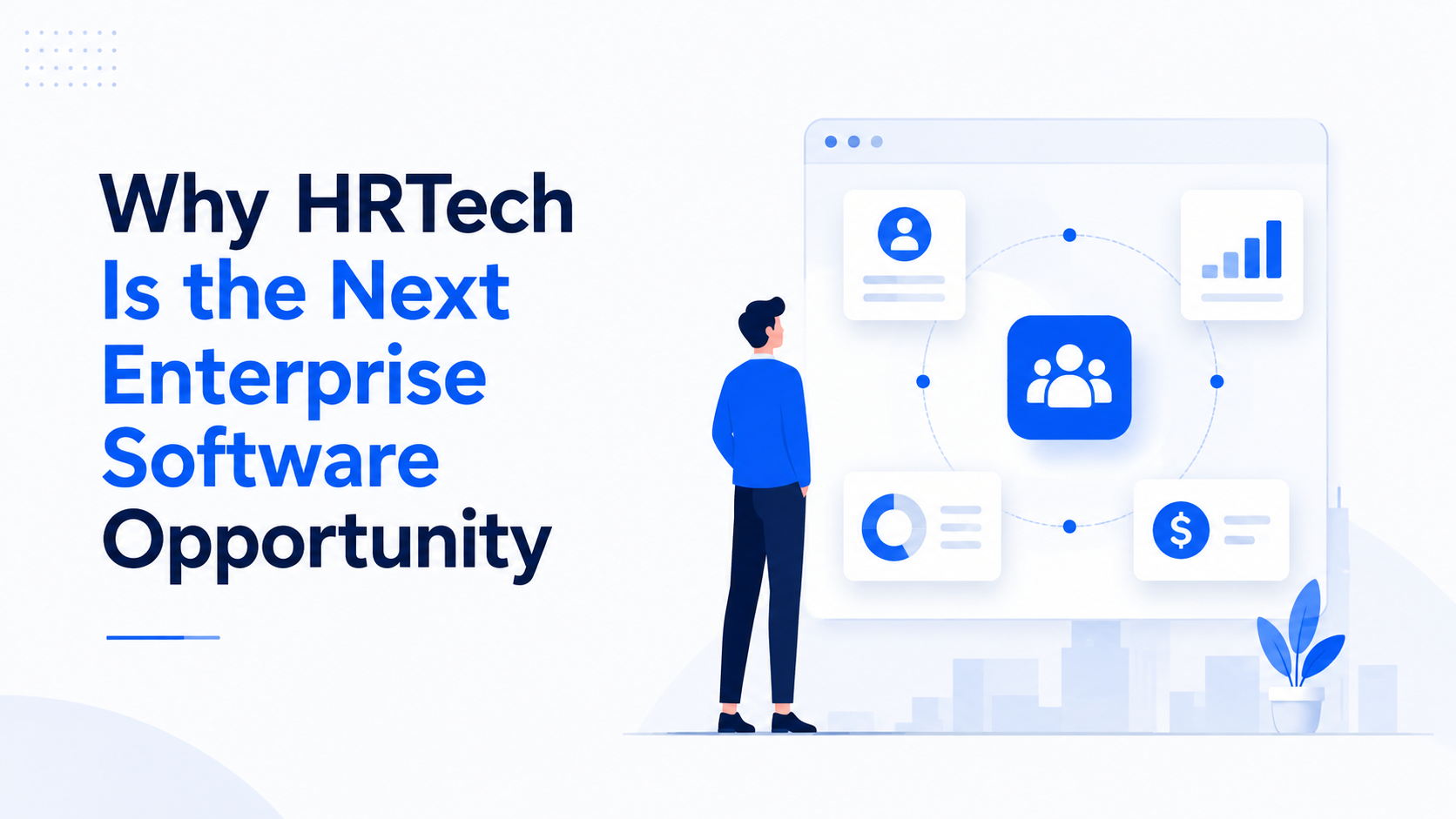
Daniel Park, a technology investment analyst at a sovereign wealth fund in Singapore, had spent the first six months of the year building a detailed comparison of enterprise software market opportunities across verticals. His objective was to identify the next major category that would produce the kind of market-defining companies that CRM, ERP, and cybersecurity had generated over the previous two decades. He analyzed total addressable market size, growth rates, competitive fragmentation, technology disruption potential, and switching cost dynamics across twelve enterprise software categories. When he presented his findings to the investment committee, the conclusion surprised some of his colleagues. The category with the strongest combination of large market size, accelerating growth, high fragmentation, significant technology disruption, and strong switching cost potential was not a new category at all. It was HRTech, specifically the segment of human resources technology that addresses talent acquisition, workforce management, and talent intelligence. The market was massive, exceeding three hundred billion dollars globally when including staffing technology, recruitment platforms, and workforce analytics. It was highly fragmented, with no single vendor holding more than five percent market share in most sub-segments. And it was undergoing a technology-driven disruption driven by AI that was creating the conditions for new platform companies to emerge and consolidate the market.
The Market Conditions That Create Enterprise Software Categories
Enterprise software history follows a consistent pattern. The categories that produce the
largest, most valuable companies share four characteristics. First, a massive total addressable market that supports multiple billion-dollar outcomes. CRM software addressed the universal need of every business to manage customer relationships, creating a market that exceeded eighty billion dollars. ERP addressed the universal need for integrated business process management, creating an even larger market. Cybersecurity addressed the universal need for digital protection in an increasingly connected world. Second, high fragmentation at the time of technology disruption, meaning no dominant vendor has consolidated the market, leaving room for new entrants to capture share. Third, a technology disruption that enables fundamentally better solutions than existing providers can deliver with their legacy architectures. Cloud computing disrupted on-premise CRM and ERP. AI and machine learning are now disrupting every category of enterprise software. Fourth, strong switching costs that protect incumbent vendors once clients have adopted their platforms, creating durable competitive advantages and predictable recurring revenue. When these four conditions converge, the category is primed for the emergence of platform companies that can achieve massive scale and durable market leadership.
HRTech meets all four conditions with unusual strength. The total addressable market for HRTech, encompassing core HR systems, talent acquisition platforms, workforce management tools, learning and development systems, compensation and benefits administration, workforce analytics, and the technology components of the staffing and recruitment industry, exceeds three hundred billion dollars globally. This market is larger than the CRM market at the time of Salesforce's emergence and comparable to the ERP market when cloud-native challengers began disrupting incumbent providers. The fragmentation is extreme. Unlike CRM, where Salesforce achieved early dominance, or ERP, where SAP and Oracle established strong positions before cloud disruption, HRTech has no single vendor holding more than five percent market share in most sub-segments. The market is populated by hundreds of specialized point solutions addressing specific HR functions, with limited integration and no dominant platform. This fragmentation means that a platform company that can deliver integrated, AI-powered solutions across multiple HR functions has an enormous runway for market capture.
The technology disruption in HRTech is being driven by AI that is fundamentally changing what HR technology can do. Traditional HRTech was designed to automate administrative processes: payroll processing, benefits enrollment, time tracking, and compliance reporting. These systems were valuable but limited, because they addressed the transactional aspects of HR while leaving the strategic aspects, talent strategy, workforce planning, performance optimization, and organizational design, largely untouched by technology. AI changes this by enabling HRTech platforms to perform the analytical and predictive functions that were previously the exclusive domain of human judgment. AI can analyze workforce data to predict attrition risk, identify skill gaps, recommend compensation adjustments, forecast hiring needs, and optimize team composition. These capabilities transform HRTech from an administrative cost center into a strategic intelligence platform that directly influences business outcomes. According to McKinsey, HRTech platforms that incorporate AI-driven analytics and
prediction report two to three times higher client engagement and fifty to sixty percent higher net revenue retention compared to traditional administrative HRTech, because the strategic value creates deeper client dependency and broader usage across the organization.
Why HRTech Fragmentation Creates Unusual Opportunity
The fragmentation of the HRTech market is not merely a function of market size. It is a structural characteristic that reflects the historical evolution of the category and that creates unusually favorable conditions for new platform entrants. HRTech evolved as a collection of point solutions because HR functions within organizations developed independently, each with its own processes, data requirements, and vendor relationships. Recruitment bought applicant tracking systems. Compensation bought salary survey tools. Learning and development bought learning management systems. Workforce management bought time and attendance systems. Each function selected the best tool for its specific need with little regard for integration with other HR functions. The result is a typical enterprise HR technology stack that includes ten to twenty separate systems, each addressing a specific HR function, with minimal integration and significant data fragmentation. This fragmentation means that no single vendor has a comprehensive view of the workforce, and no single system can provide the cross-functional analytics and intelligence that modern HR leadership requires.
For new platform entrants, this fragmentation is a structural advantage. A platform that can deliver integrated capabilities across multiple HR functions, unifying data that currently lives in disconnected systems, addresses a pain point that every HR organization experiences but that no existing vendor has solved comprehensively. The enterprise buyer's frustration with fragmented HRTech stacks is intense and well-documented. HR leaders consistently cite system integration and data fragmentation as their top technology challenges. They want a unified platform that provides a single view of the workforce, supports cross-functional analytics, and eliminates the data silos that prevent them from answering basic strategic questions about their talent. A platform that delivers this integration, particularly one built on modern AI-native architecture rather than adapted from legacy systems, has a compelling value proposition that addresses the most pressing need of every enterprise HR organization. This buyer demand for integration creates a natural consolidation dynamic where the platform company can capture share from multiple point solution vendors simultaneously, because each point solution it replaces removes one fragment from the client's stack. According to Gartner, enterprises currently using fragmented HRTech stacks with ten or more vendors report forty to fifty percent higher technology administration costs and thirty to forty percent lower analytical capability than enterprises using integrated platforms, because the fragmentation creates data silos, integration maintenance overhead, and inconsistent user experiences that degrade both efficiency and insight.
The fragmentation also creates opportunity because the existing point solution vendors are individually vulnerable even though they are collectively entrenched. Each point solution vendor has a narrow product focus and a limited data footprint, which means they cannot match
the breadth of capability or the depth of analytical insight that an integrated platform can provide. A standalone applicant tracking system, however good it is at managing the recruiting process, cannot provide the workforce intelligence that comes from combining recruiting data with performance data, compensation data, learning data, and attrition data across the entire employee lifecycle. This limitation becomes increasingly apparent to enterprise buyers as they demand more strategic value from their HRTech investments. The vendors that are most vulnerable are those in the middle of the market, large enough to have significant installed bases but too narrow in scope to deliver the integrated intelligence that buyers increasingly expect. These vendors represent acquisition targets for well-funded platform entrants who can incorporate their functionality and client relationships into a broader platform. agentic AI platforms vs automated ones explains how AI-native HRTech platforms exploit market fragmentation by offering integrated intelligence that spans the full talent lifecycle, because the platform's ability to connect data across recruiting, onboarding, performance, and development creates analytical value that no point solution can match regardless of how refined its individual capabilities are.
The AI Disruption Creating New HRTech Leaders
The AI disruption in HRTech is distinct from previous technology transitions in the category because it changes not just how HR technology is delivered but what it can do. Previous transitions, from mainframe to client-server, from client-server to cloud, and from desktop to mobile, changed the delivery mechanism without fundamentally expanding the capability set. AI changes the capability set itself, enabling HRTech platforms to perform functions that were previously impossible for software to perform. AI can read and analyze unstructured data like employee feedback, performance reviews, and candidate communications, extracting insights that traditional systems cannot process. AI can identify patterns across large workforce datasets that predict outcomes like attrition, performance, and promotion probability with accuracy that surpasses human judgment for many use cases. AI can generate recommendations and suggestions that guide HR professionals and business leaders toward better talent decisions. And AI can automate complex workflows that require judgment, such as candidate evaluation, compensation benchmarking, and career path recommendations, that were previously the exclusive domain of human HR professionals.
This capability expansion creates a new category of HRTech that does not fit neatly into the existing market segments. Traditional HRTech categories like ATS, LMS, and HRIS describe systems that automate specific HR processes. The emerging AI-powered HRTech does not automate a single process but provides cross-functional intelligence that informs multiple processes simultaneously. A talent intelligence platform that predicts attrition risk across the organization, identifies skill gaps that threaten future business capabilities, recommends specific development actions for high-potential employees, and forecasts the hiring needs that will result from projected business growth does not fit into any traditional HRTech category. It is a new type of system that sits above the process level and operates at the strategic intelligence
level, providing the analytical foundation for talent decisions across the organization. This new category of strategic HRTech is where the largest market opportunities are emerging, because it addresses the most valuable and most underserved needs of enterprise HR organizations. According to Deloitte, the strategic HRTech segment, encompassing talent intelligence, workforce analytics, and AI-powered advisory platforms, is growing at twenty-five to thirty-five percent annually compared to eight to twelve percent for traditional process-automation HRTech, because enterprises are shifting their technology investment from administrative efficiency to strategic intelligence.
The competitive dynamics of the AI disruption favor new entrants over incumbents in ways that previous HRTech transitions did not. When the cloud transition occurred, incumbent vendors could adapt by rebuilding their products for cloud delivery while leveraging their existing client relationships and brand recognition. The AI transition is harder for incumbents because it requires not just architectural adaptation but fundamental changes in product philosophy and engineering culture. Building effective AI-powered HRTech requires machine learning expertise, data engineering capability, and a product design philosophy that treats data as the primary asset and AI inference as the primary capability. These competencies are rare in traditional HRTech companies, which were built around workflow automation, form-based data entry, and report generation. The cultural gap between AI-native product development and traditional enterprise software development is significant, and incumbent vendors that attempt to bridge it by bolting AI features onto existing products typically produce inferior results compared to AI-native platforms designed from the ground up to leverage AI capabilities. This incumbent disadvantage creates a window of opportunity for new entrants that will remain open for several years, because the depth of the cultural and architectural transformation required means that even well-resourced incumbents will take years to produce AI capabilities that match those of purpose-built platforms. more tools same hiring problems explains why the AI-native HRTech platforms that will lead the market are those built as integrated intelligence systems rather than as automation tools with AI features added, because the intelligence-first architecture creates fundamentally different and more valuable capabilities than the automation-first architecture with AI bolted on.
The Switching Cost Dynamics That Protect HRTech Platforms
Switching costs are the mechanism that transforms a growing software business into a durable, high-value enterprise, and HRTech platforms have unusually strong switching cost dynamics. The first source of switching cost is data accumulation. As an HRTech platform processes more employee data, more candidate interactions, more performance reviews, and more compensation decisions, it builds a proprietary dataset that improves its analytical accuracy and becomes increasingly valuable to the client. This data accumulates over time and cannot be transferred to a competitor, because the data includes proprietary assessments, internal performance metrics, and behavioral patterns that are specific to the client organization. A client that has used an AI-powered HRTech platform for three years has accumulated three
years of workforce intelligence that would be lost or severely degraded if they switched to a competing platform. This data accumulation switching cost increases with every month of usage, which means that client retention improves over time as the switching costs grow, a highly attractive dynamic for investors because it means that the platform's revenue becomes more predictable and more durable as it matures.
The second source of switching cost is process embedding. As clients adopt an HRTech platform, they redesign their HR processes around the platform's capabilities, train their HR teams to operate within the platform's workflows, and integrate the platform with their other enterprise systems including finance, operations, and business intelligence. This process embedding means that switching platforms requires not just technology migration but organizational change, which is expensive, time-consuming, and disruptive. The deeper the embedding, the higher the switching cost, and the more likely the client is to remain with the platform even if a competitor offers technically superior features. HRTech platforms that offer broad capability sets, spanning multiple HR functions, create deeper process embedding than narrow point solutions, because the platform touches more workflows, more user groups, and more data flows within the organization. A platform that handles recruiting, onboarding, performance management, compensation planning, and workforce analytics is embedded across the entire employee lifecycle, creating switching costs that no single-function vendor can match.
The third source of switching cost is analytical dependency. When an HRTech platform provides the workforce intelligence that drives strategic talent decisions, the organization becomes dependent on the platform's insights in ways that go beyond technology utility. Hiring managers rely on the platform's candidate matching recommendations. HR leaders rely on the platform's attrition risk assessments. Business leaders rely on the platform's workforce planning projections. This analytical dependency creates switching costs that are qualitatively different from the data and process switching costs, because they affect the quality of strategic decision-making rather than just operational efficiency. An organization that switches from a platform that provides accurate, data-driven talent intelligence to one that provides less accurate or less comprehensive intelligence will make worse talent decisions, at least temporarily, and in competitive talent markets, worse decisions have direct business consequences. This analytical dependency is the most powerful form of switching cost because it ties the platform's value to the organization's strategic outcomes rather than to its operational processes. According to EY, HRTech platforms that achieve analytical dependency report net revenue retention rates of one hundred twenty to one hundred forty percent, meaning that existing clients expand their usage by twenty to forty percent annually even before new client acquisition, because the analytical dependency drives adoption of additional platform capabilities and expansion into additional business units and geographies. why AI tools have outdated candidate data explains why HRTech platforms that fail to build analytical dependency, those that focus on process automation without developing the intelligence layer that drives strategic decision-making, experience significantly lower retention rates, because process automation alone creates only modest switching costs that determined competitors can
overcome.
What This Means for Entrepreneurs and Investors
For entrepreneurs building HRTech companies, the market conditions create a clear strategic imperative. The greatest opportunity lies in building integrated, AI-native platforms that address cross-functional HR needs rather than in building better point solutions for specific HR functions. The point solution market is crowded, margins are under pressure, and the strategic value to clients is limited because no single-function tool can provide the cross-functional intelligence that enterprise HR organizations increasingly require. The platform opportunity is larger, less crowded, and more defensible, because the technical and organizational challenges of building an integrated, AI-native HRTech platform create significant barriers to entry. Entrepreneurs should focus on identifying the specific cross-functional HR problems where fragmentation creates the most pain and where AI can deliver the most value, and building platforms that address those problems with integrated data, AI-powered analytics, and workflow automation that spans multiple HR functions.
For investors evaluating HRTech opportunities, the key is to distinguish between point solutions that will face increasing competitive pressure and platform companies that can capture the consolidation opportunity. The indicators of a platform company include breadth of capability across multiple HR functions, evidence of data network effects where client usage improves the platform's intelligence, high and improving net revenue retention rates that indicate deepening client engagement, and a product architecture designed for integration and intelligence rather than for single-function automation. Investors should also evaluate the team's ability to execute on the platform vision, which requires both deep HR domain expertise and strong AI and data engineering capabilities. The most successful HRTech platform companies will be those led by teams that understand HR deeply enough to identify the most valuable problems to solve and technically skilled enough to build AI systems that solve them effectively. The combination of massive market, high fragmentation, AI disruption, and strong switching costs makes HRTech one of the most attractive enterprise software opportunities available today. According to LinkedIn, the HRTech market is projected to produce three to five new public companies with market capitalizations exceeding ten billion dollars over the next decade, because the conditions for category-defining platform companies are as strong in HRTech today as they were in CRM and ERP during their formative periods.
The timing of the opportunity is also important. The convergence of capable AI technology, enterprise buyer readiness for AI-powered HR solutions, and abundant investment capital for HRTech creates a window of opportunity that is open now but will not remain open indefinitely. As AI-native platforms gain scale and demonstrate value, they will begin consolidating the market, acquiring point solution vendors, and raising the bar for new entrants. Entrepreneurs and investors who enter the market during this formative period will have the advantage of building data assets, client relationships, and platform capabilities before the market consolidates around a small number of dominant players. The historical pattern in
enterprise software is clear. The companies that enter early, build durable competitive advantages, and achieve sufficient scale before the market consolidates become the category leaders that generate the largest returns. HRTech is at the beginning of this pattern, and the opportunity to participate in the creation of the next generation of enterprise software leaders is available to those who recognize the market dynamics and act on them with the appropriate level of ambition and investment. how to evaluate an AI sourcing tool provides a framework for evaluating HRTech platform opportunities against the criteria that predict long-term market success, because the assessment examines data advantage, platform breadth, switching cost dynamics, and team capability to determine whether a specific HRTech company has the characteristics of a potential category leader.