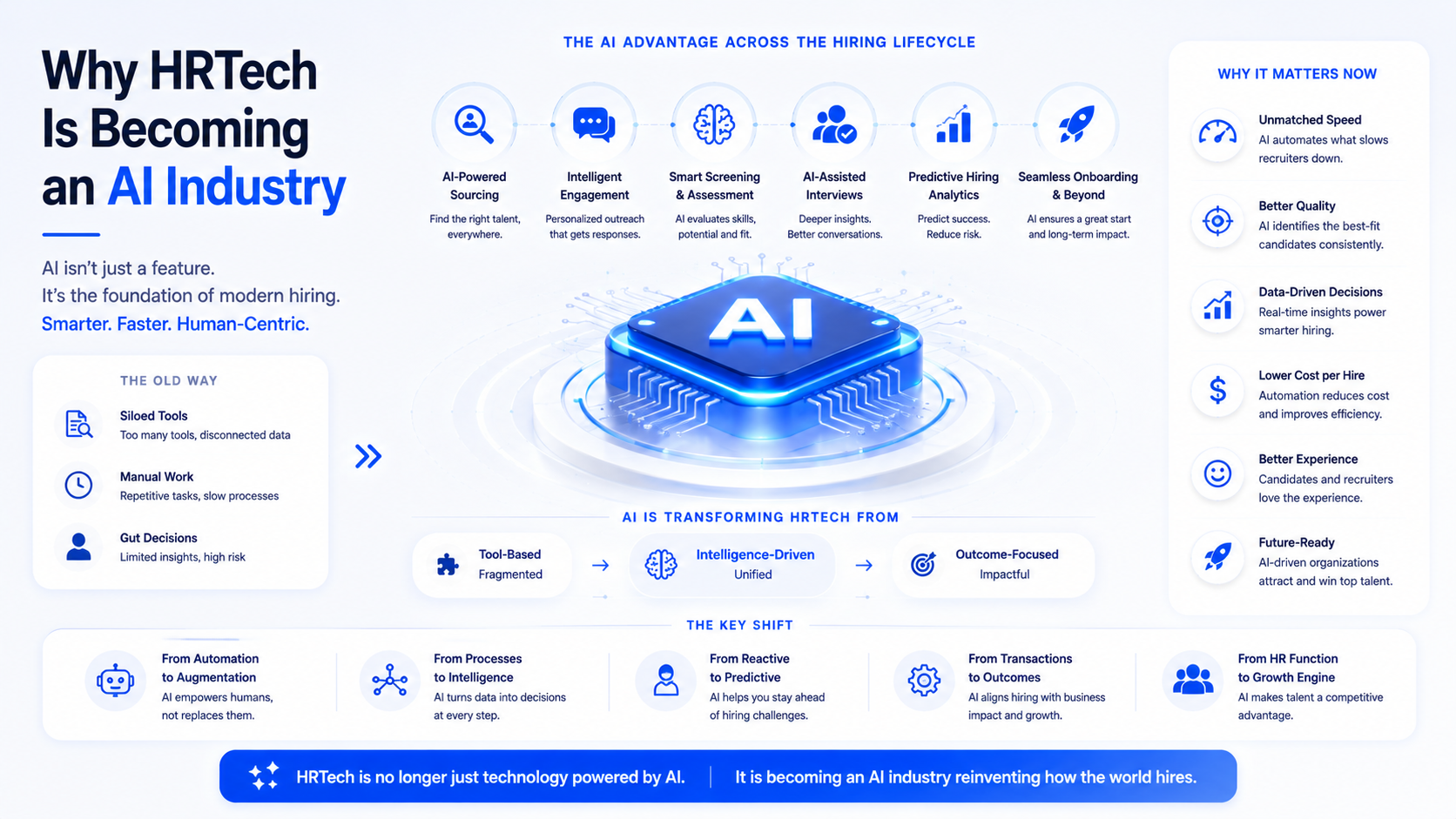
When Priya Mehta closed her firm's largest HRTech fund in late 2024 at four hundred and twenty million dollars, she made a decision that would have been unthinkable five years earlier. She told her investment team that they would no longer evaluate HR technology companies as software businesses. Going forward, every HRTech investment would be assessed as an AI company first and a software company second. Mehta, a partner at a growth-stage venture firm that had backed three HR unicorns over the previous decade, had arrived at this conclusion after watching her portfolio companies split into two distinct performance clusters. The companies that had built AI into their core architecture from day one were growing revenue three to five times faster than those that had retrofitted AI features onto legacy codebases. The market was rewarding AI-native approaches with premium valuations, faster sales cycles, and stronger retention, while legacy vendors were spending increasing amounts of engineering resources just trying to keep up. Mehta's fund thesis was not unique, but it was decisive. Across the venture landscape, the same pattern was playing out: HRTech was being reclassified from a software vertical to an AI vertical, and the companies that understood this shift early were capturing the majority of new investment capital.
The Investment Thesis Has Changed
The venture capital community has fundamentally reclassified how it evaluates HRTech companies, and the implications are reshaping the entire industry. For most of the past two decades, HRTech was categorized alongside other enterprise software verticals like CRM or ERP. Investors evaluated companies on traditional SaaS metrics: annual recurring revenue, net revenue retention, customer acquisition cost, and gross margin. AI capabilities, where they existed at all, were treated as feature differentiators within a software evaluation framework. A recruiting platform with AI-powered matching was still evaluated primarily as a
recruiting platform, not as an AI company. That framework has collapsed. The companies attracting the largest funding rounds and the highest valuations in HRTech today are those that present themselves as AI companies that happen to operate in the HR domain, rather than as HR software companies that happen to use AI.
This reclassification is driven by a straightforward economic logic. McKinsey analysis of enterprise software valuations shows that companies perceived as AI-native command valuation premiums of two to three times compared to legacy software companies in the same category, even when their current revenue is lower. Investors are betting that AI-native architectures will compound their advantages over time through better data network effects, more efficient delivery models, and stronger competitive moats. In HRTech specifically, this dynamic is amplified by the nature of HR data: the more candidate and employee interactions an AI platform processes, the better its models become, which attracts more customers, which generates more data. This flywheel effect is the defining characteristic of AI-native businesses, and it does not exist in legacy HRTech platforms that were architected around database records and workflow rules.
The practical consequence is that HRTech companies seeking growth capital are now essentially forced to demonstrate AI-native credentials. Startups that pitch themselves as software companies with AI features are finding it difficult to raise money at attractive terms, regardless of their revenue growth. The phenomenon of more tools same hiring problems accumulating in enterprise HR departments is directly relevant here: buyers have already discovered that adding more AI features to non-AI platforms does not produce AI-level outcomes, and investors have reached the same conclusion. The market is converging on a clear consensus: in HRTech, AI is not a feature. It is the architecture, and companies that do not meet that threshold will be treated as legacy software regardless of when they were founded.
Why Legacy HRTech Cannot Retrofit AI
The most important structural insight about the HRTech-to-AI transition is that legacy platforms cannot close the gap by adding AI features to existing architectures. This is not a question of engineering effort or investment. It is a fundamental architectural constraint. Legacy HRTech platforms were built on relational database architectures designed for transactional workflows: store a candidate record, move it through a hiring stage, trigger a notification, update a status field. These architectures are excellent at what they were designed to do, but they were not designed to support the continuous, probabilistic, data-intensive operations that AI requires. Training and deploying machine learning models, processing unstructured data at scale, and making real-time predictions based on evolving signals all require infrastructure that looks fundamentally different from a traditional HR database.
Gartner research on AI architecture patterns in enterprise software identifies three levels of AI integration: surface-level AI, where AI features sit on top of a traditional architecture; embedded AI, where AI is woven into specific modules; and AI-native, where the entire platform is architected around AI from the ground up. Most legacy HRTech vendors are at the first level.
Some have reached the second. None have achieved the third without a complete architectural rebuild, because the third level requires a fundamentally different approach to data storage, processing, model management, and product delivery. The cost and risk of rebuilding a production enterprise platform from scratch while maintaining existing customers is enormous, which is why so few legacy vendors have attempted it.
The result is a growing capability gap between AI-native HRTech startups and legacy vendors. Legacy platforms can add chatbots, recommend candidates based on keyword matches, and automate simple workflows, but they cannot deliver the kind of continuous learning, real-time adaptation, and multi-signal analysis that defines state-of-the-art AI. The problem of why AI tools have outdated candidate data data in legacy systems is a symptom of this deeper architectural limitation. Legacy platforms were designed for periodic batch updates, not for the continuous data streams that AI-native platforms consume. As the gap widens, legacy vendors face an increasingly difficult strategic choice: invest in a full architectural rebuild, acquire AI-native companies and attempt to integrate them, or accept a gradual decline in competitive position. Each option carries significant risk, and none guarantees a successful outcome.
The M&A Wave Reshaping the Landscape
The inability of legacy vendors to organically develop AI-native capabilities has triggered a wave of mergers and acquisitions that is rapidly consolidating the HRTech market. Deloitte tracking of HRTech M&A activity shows that the number of acquisitions targeting AI-native HR companies has increased significantly over the past three years, with legacy platforms, private equity firms, and even non-HR technology companies competing for the same targets. The strategic logic is clear: if you cannot build AI-native capabilities fast enough, you buy them. But the M&A approach carries its own complications, because integrating an AI-native architecture into a legacy platform is often more difficult than building it from scratch.
The M&A dynamics are particularly intense in talent acquisition technology, where the value of AI capabilities is most immediately measurable. LinkedIn market analysis shows that AI-native sourcing, screening, and engagement platforms are commanding acquisition premiums that reflect both their current revenue and their strategic importance to acquirers who lack comparable capabilities. The companies being acquired are typically younger, smaller in revenue, and less profitable than the acquiring legacy vendors, but they possess the AI architecture and data assets that the acquirers need to remain competitive. This inversion of traditional M&A dynamics, where smaller, less profitable companies command premium valuations, is a defining feature of the HRTech-to-AI transition.
For buyers of HRTech, the M&A wave introduces significant uncertainty. When a company acquires an AI-native startup, the question of integration becomes critical. Will the AI capabilities be preserved and enhanced, or will they be absorbed into the parent company's legacy architecture and degraded? The experience of how many follow-ups one hire needs after acquisitions illustrates this risk. Platforms that excelled at optimizing follow-up timing and
personalization when independent have sometimes lost that capability after being integrated into acquirers whose architecture could not support the same level of real-time optimization. Buyers evaluating HRTech today need to assess not just a platform's current capabilities but its architectural resilience, because the probability of an acquisition affecting that platform is higher than at any point in the industry's history.
How Market Classifications Are Shifting
The reclassification of HRTech as an AI industry is not just a venture capital phenomenon. It is spreading through every layer of the market ecosystem, from industry analyst firms to stock market indices to buyer evaluation frameworks. EY technology sector analysis notes that the boundary between the HRTech and AI market categories has become increasingly porous, with several major HR technology companies now being covered by AI analysts rather than traditional enterprise software analysts. This shift in analyst coverage matters because it changes the narrative through which the market understands these companies, which in turn influences investment decisions, buyer perceptions, and talent acquisition by the companies themselves.
The classification shift is also visible in how enterprise buyers evaluate HRTech. McKinsey research on technology buying patterns in human resources shows that procurement teams are increasingly applying AI evaluation criteria to HRTech purchases, asking vendors about their model training data, inference latency, bias mitigation processes, and data governance practices. These are questions that would have been irrelevant to an HRTech evaluation five years ago but are now standard. The buyer's frame of reference has shifted from comparing software features to comparing AI capabilities, and vendors that cannot participate in that conversation are at a structural disadvantage in competitive evaluations.
Industry conferences and trade publications have reflected this shift as well. Gartner event programming for major HRTech conferences now dedicates a significant portion of the agenda to AI topics, and the most attended sessions are consistently those that address AI implementation, AI architecture, and AI strategy rather than traditional HR software topics. This is not a marketing trend or a conference organizer's preference. It is a direct reflection of what buyers want to learn about. The language of the HRTech market has shifted from software to intelligence, and every participant in the ecosystem, from the smallest startup to the largest enterprise vendor, is adjusting accordingly.
The Data Problem Beneath the Surface
Beneath the architectural and investment dynamics of the HRTech-to-AI transition lies a deeper structural challenge that will determine which companies succeed and which do not: the quality, breadth, and freshness of the data that AI systems require. The concern about should recruiters worry about AI replacing jobs and whether AI will replace recruiters is a surface-level anxiety that distracts from a more fundamental question. The real issue is not
whether AI will replace human judgment but whether AI systems will have access to the data they need to exercise judgment that is useful. AI is only as powerful as the data it processes, and HR data has historically been fragmented, inconsistent, and difficult to access across the multiple systems that most organizations operate.
The data challenge manifests in several ways. First, HR data is siloed across recruiting, learning, performance, compensation, and workforce planning systems, each with its own data model and format. An AI system that can only access recruiting data but not performance data will make hiring recommendations without understanding what candidate characteristics actually predict success in the organization. Deloitte research on workforce analytics consistently identifies data fragmentation as the primary barrier to AI effectiveness in HR, more significant than algorithm quality, computational resources, or organizational readiness. Second, much of the most valuable HR data is unstructured: interview notes, manager feedback, candidate communications, and performance reviews written in natural language. Extracting signal from this unstructured data requires sophisticated natural language processing capabilities that most legacy systems lack.
Third, the temporal dimension of HR data creates unique challenges. Unlike financial data, which is updated in real time and follows well-established standards, HR data is often stale, incomplete, and inconsistent in its time granularity. A candidate's skills profile might be six months old, a performance review might be conducted annually, and workforce planning data might be updated quarterly. This temporal sparsity makes it difficult for AI systems to build accurate, current models of the workforce. SHRM guidance on HR data governance emphasizes that organizations need to establish data quality standards and refresh requirements before implementing AI, because the AI will amplify whatever data quality problems already exist. The companies that solve this data problem, not just for their own platforms but for their customers, will own the next era of HRTech.
What Talent Leaders Should Do Now
For talent acquisition leaders and CHROs, the transformation of HRTech into an AI industry creates both opportunity and risk. The opportunity lies in the dramatically improved capabilities that AI-native platforms can deliver: faster time-to-hire, better quality of hire, more efficient recruiter workflows, and deeper workforce intelligence. The risk lies in making technology decisions based on outdated evaluation criteria that favor legacy vendors with familiar brand names over AI-native platforms with superior architectures. LinkedIn survey data on talent leader technology preferences shows a persistent gap between the capabilities leaders say they want and the vendors they actually select, suggesting that familiarity and perceived safety continue to influence decisions more than rigorous capability assessment.
The most immediate practical step is to reframe technology evaluation criteria around AI readiness rather than software feature comparison. This means asking vendors specific questions about their data architecture, model training methodology, bias testing processes, and integration capabilities with other AI systems. It means requesting evidence of continuous
learning and improvement, not just static feature lists. And it means testing platforms against real hiring scenarios rather than relying on demo environments where every product looks impressive. Organizations that continue to evaluate HRTech using software-era criteria will find themselves locked into platforms that cannot deliver AI-era outcomes.
The longer-term strategic imperative is to build an internal data and talent foundation that can leverage AI-native HRTech effectively. This means investing in HR data quality and integration, training HR teams to work alongside AI systems, and developing the analytical capabilities needed to interpret AI-generated insights and translate them into organizational action. The transition of HRTech from a software industry to an AI industry is not a speculative future scenario. It is happening now, driven by investment flows, architectural constraints, market reclassification, and the fundamental economics of AI. Talent leaders who recognize this shift and position their organizations accordingly will gain a significant and compounding advantage in the competition for talent. Those who treat it as a marketing narrative will find their technology infrastructure increasingly misaligned with the market's direction.