When Priya Mehta became Chief People Officer at Stratos Logistics in early 2023, one of her first discoveries was that her HR technology environment included twenty-three separate vendor contracts across recruiting, learning, and workforce management. Her talent acquisition team alone used six different tools to move a candidate from initial contact to signed offer, and her HRIS team spent two full weeks each quarter just reconciling data discrepancies between systems. Mehta is not an outlier. She represents a growing class of HR leaders who have realized that the accumulated complexity of their technology ecosystems is no longer an inconvenience but a strategic liability, and that the accelerating consolidation of the HRTech market is not a threat to be managed but an opportunity to be seized.
The Fragmentation Problem Has Reached a Tipping Point
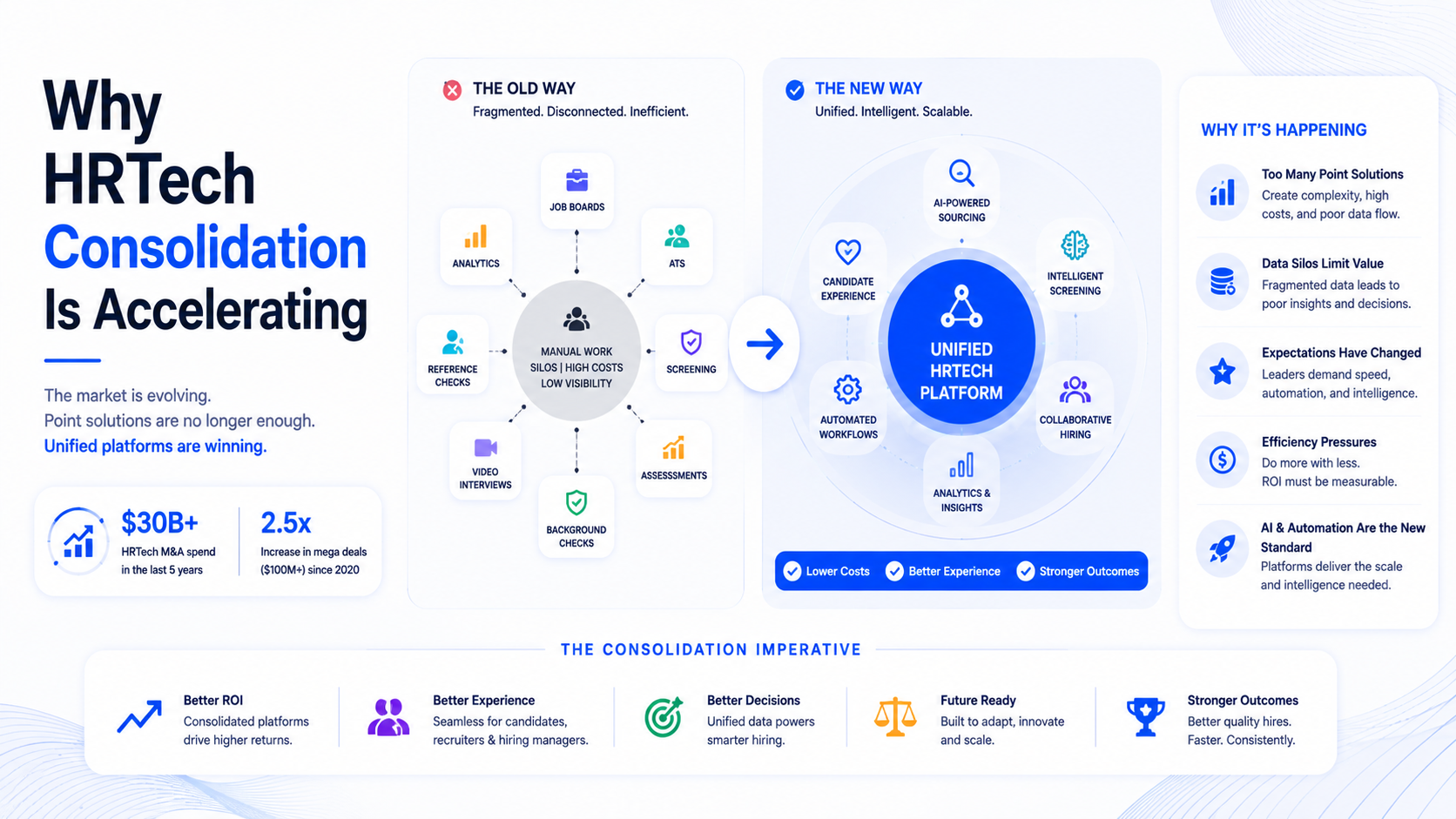
Enterprise HR departments have spent the last fifteen years accumulating technology in a way that would be unthinkable in any other business function. A typical mid-to-large organization now manages between eight and fifteen distinct HR technology tools spanning recruiting, onboarding, performance management, learning, compensation, and workforce planning. Each tool was purchased to solve a specific problem, and each one generates data in its own format, maintains its own user authentication system, and requires its own vendor relationship. According to McKinsey, the average enterprise HR organization spends nearly thirty percent of its technology budget simply maintaining integrations between these disparate systems, a figure that has been climbing steadily as the tool count grows.
The operational cost of this fragmentation extends far beyond integration maintenance. Recruiters working across multiple sourcing tools, an applicant tracking system, and separate assessment platforms lose context every time they switch applications. Hiring managers who receive candidate profiles from one system and interview feedback from another cannot make timely decisions because the information they need is scattered across multiple interfaces. Gartner research indicates that enterprises with highly fragmented HR technology stacks experience thirty to forty percent slower hiring cycles compared to those with more integrated
environments, primarily because of the coordination overhead required to keep multiple systems synchronized throughout the hiring process.
What makes this moment different from previous cycles of consolidation talk is that the pain is no longer confined to IT departments and procurement teams. Business leaders are now directly experiencing the consequences of fragmented technology. CEOs and COOs see slower time-to-fill translating into missed revenue targets. CFOs see rising technology costs with declining returns. And CHROs see their talent acquisition teams spending more time managing tools than engaging with candidates. This convergence of executive frustration with the growing maturity of integrated platform alternatives is creating the conditions for a consolidation wave that will reshape the HRTech landscape over the next three to five years.
Economic Pressures Are Forcing the Hand of Buyers
The macroeconomic environment over the past several years has fundamentally changed how enterprises evaluate technology spending. With hiring volumes fluctuating unpredictably and pressure to reduce operating costs intensifying, HR leaders can no longer justify maintaining expensive collections of point solutions that overlap in functionality. Deloitte analysis of enterprise HR technology spending reveals that companies conducting thorough vendor audits consistently discover twenty to thirty percent redundancy in their HR technology portfolios, meaning they are paying for multiple tools that perform substantially similar functions. In a cost-constrained environment, this redundancy becomes an obvious target for elimination.
Platform economics also favor consolidation in ways that were not true five years ago. The per-seat pricing models of individual point solutions add up quickly at enterprise scale. When a company with ten thousand employees pays separately for a sourcing tool, an ATS, an assessment platform, an interview scheduling system, and an onboarding solution, the cumulative cost often exceeds what a single integrated platform would charge for a comprehensive suite. EY financial analysis of HRTech procurement shows that enterprises switching from best-of-breed collections to unified platforms reduce their per-hire technology costs by an average of eighteen to twenty-five percent, with larger organizations realizing even greater savings due to economies of scale in platform pricing.
The economic argument for consolidation is reinforced by the hidden costs that fragmented stacks impose on organizational productivity. Every additional tool in the recruiting workflow adds training time, increases the cognitive load on recruiters, and creates another potential point of failure in the hiring process. When more tools same hiring problems becomes the operational reality of a talent acquisition team, the predictable result is declining recruiter efficiency despite increasing technology investment. Enterprise leaders are recognizing that the true cost of HRTech fragmentation is not measured in license fees but in the lost productivity, slower decision-making, and degraded candidate experience that inevitably accompany overly complex technology environments.
AI Capability Is Rewriting the Competitive Landscape
Perhaps the most powerful driver of HRTech consolidation is the emergence of artificial intelligence as a fundamental differentiator between vendors. Building genuinely useful AI for recruiting requires three things that fragmented point solutions struggle to deliver: large volumes of high-quality training data, a broad workflow context within which AI can make intelligent decisions, and continuous feedback loops that allow models to improve from real outcomes. Integrated platforms naturally possess all three advantages, giving them a significant edge in AI capability development over single-function tools that see only a narrow slice of the hiring process.
This AI advantage compounds over time. Platforms that process the full candidate journey from initial sourcing contact through onboarding can build more accurate predictive models because they have visibility into the complete cause-and-effect chain of hiring decisions. A platform that sees both how a candidate was sourced and how they performed after being hired can identify which sourcing approaches produce the best long-term outcomes. Point solutions simply cannot make these connections because the data lives in different systems. agentic AI platforms vs automated ones platforms take this further by not just analyzing data but autonomously executing tasks across the hiring workflow, something that is architecturally impossible when each step requires switching to a different application. LinkedIn technology surveys show that enterprises now rank AI capability as the single most important factor in HRTech purchasing decisions, a dramatic shift from just three years ago when integration breadth was the top criterion.
The AI-driven competitive advantage of integrated platforms is also changing the M&A dynamics within the HRTech sector. Larger platform vendors are acquiring point solution companies not to maintain their products but to absorb their technology and user bases into a unified offering. McKinsey analysis of HRTech M&A activity over the past two years shows a marked increase in acquisitions of AI-powered niche recruiting tools by larger platform companies, a pattern that reflects the recognition that AI capabilities are more valuable when embedded in a comprehensive workflow than when isolated in a standalone product. For buyers, this consolidation trend means that the standalone tools they rely on today may be absorbed or discontinued tomorrow, creating additional urgency to move toward platforms that are themselves acquiring capabilities rather than being acquired.
Data Quality Demands Are Accelerating Platform Adoption
The value of any AI system is directly proportional to the quality of its data, and HRTech fragmentation is the enemy of data quality. When candidate information is created, modified, and stored across multiple disconnected systems, the result is a patchwork of incomplete, duplicated, and often contradictory records. A candidate's skill profile in the sourcing tool may
not match what was captured in the ATS. Their interview feedback may be recorded in one system while their offer details live in another. This fragmentation makes it nearly impossible to build the comprehensive, accurate data foundations that effective AI-driven recruiting requires.
The challenge of why AI tools have outdated candidate data is magnified exponentially in fragmented environments because there is no single source of truth to maintain. When a candidate updates their profile on one platform, that change does not propagate to the others. When a hiring manager provides feedback in an interview tool, that insight does not automatically inform future sourcing decisions. Enterprise research on data quality estimates that organizations with fragmented HR technology stacks spend three to five times more on data management activities, including deduplication, reconciliation, and enrichment, than those with unified platforms. This data quality tax is becoming unsustainable as regulatory requirements around candidate data accuracy and privacy continue to tighten globally.
Integrated platforms address the data quality problem at a structural level by maintaining a single, authoritative record for every candidate, job, and hiring outcome. When data lives in one place, it can be enriched, validated, and maintained far more efficiently than when it is scattered across a dozen systems. This architectural advantage translates directly into better AI performance, more reliable analytics, and faster time-to-insight for talent leaders. Deloitte has documented that enterprises adopting unified talent platforms see measurable improvements in data quality within the first quarter, with compounding benefits in subsequent quarters as the platform accumulates a richer, more consistent data history.
The Candidate Experience Imperative Is Reshaping Vendor Selection
In a labor market where top candidates often have multiple competing offers, the quality of the hiring experience has become a decisive competitive factor. Candidates form impressions about an employer based on every interaction they have during the recruiting process, and fragmented technology makes it nearly impossible to deliver a seamless, personalized experience. When a candidate receives an automated email from one system, schedules an interview through another, and receives feedback from a third, the experience feels disjointed and impersonal regardless of how well each individual tool performs. LinkedIn data shows that candidate experience is now the second most cited factor in offer acceptance decisions, trailing only compensation, and its relative importance has increased every year for the past five years.
Unified platforms are inherently better positioned to deliver the coherent, responsive candidate experience that top talent expects. Because every touchpoint is managed within a single system, the platform can personalize communications based on the full history of candidate interactions, maintain consistent messaging across channels, and ensure that feedback and updates are delivered promptly. The evidence that why referrals outperform cold outreach
produce higher-quality hires is well established, and the same principle applies to the broader candidate experience: when the process feels thoughtful and coordinated, candidates engage more deeply and are more likely to accept offers. SHRM workforce research confirms that organizations investing in candidate experience improvements see measurable gains in both offer acceptance rates and employer brand attractiveness.
For enterprise talent leaders, the candidate experience argument for consolidation is increasingly compelling because it connects directly to business outcomes that resonate with the C-suite. A fragmented hiring process that causes candidates to drop out does not just create more work for recruiters. It means the organization is losing the talent it worked hard to attract, often to competitors with more streamlined processes. The cost of a poor candidate experience is not measured in candidate satisfaction scores but in unfilled positions, extended time-to-fill, and the downstream impact on business performance. This framing transforms HRTech consolidation from a technology initiative into a business-critical talent strategy.
What the Next Three Years of Consolidation Will Look Like
The current wave of HRTech consolidation is not a temporary market correction but a structural shift that will reshape the vendor landscape for years to come. Over the next three years, several dynamics will accelerate. First, the largest HRTech platform companies will continue acquiring niche vendors to fill capability gaps and expand their AI feature sets. Gartner forecasts that by 2028, the top five HRTech platform vendors will control approximately sixty percent of the enterprise talent acquisition market, up from roughly forty percent today. Second, mid-market point solution vendors that fail to differentiate through AI will either be acquired or will see their customer bases erode as enterprises standardize on fewer platforms.
For enterprise buyers, this consolidation trajectory creates both opportunity and risk. The opportunity is that integrated platforms are becoming more capable and more cost-effective, making the business case for migration stronger than ever. The risk is that choosing the wrong platform partner could result in being locked into a vendor that fails to keep pace with the market. This is why industry analysts advise enterprises to evaluate platform vendors not just on current capabilities but on their product roadmap velocity, AI investment levels, and track record of successfully integrating acquired technologies. The vendors that will lead the next era of HRTech are those that are building genuine platform intelligence rather than simply assembling a collection of tools under a single brand.The practical implication for talent acquisition leaders is clear: the window for proactively managing this transition is narrowing. Organizations that wait until their existing point solution vendors are acquired or discontinued will face reactive, high-pressure migration projects that are far more disruptive than planned transitions. Industry best practices recommend that enterprises begin auditing their current HRTech portfolios immediately, identifying redundancies and integration pain points, and developing a multi-year roadmap for platform consolidation. The enterprises that navigate this transition most successfully will be those that treat it not as a cost-cutting exercise but as a strategic opportunity to build a technology foundation that makes their talent
acquisition function faster, smarter, and more competitive in an increasingly demanding labor market.