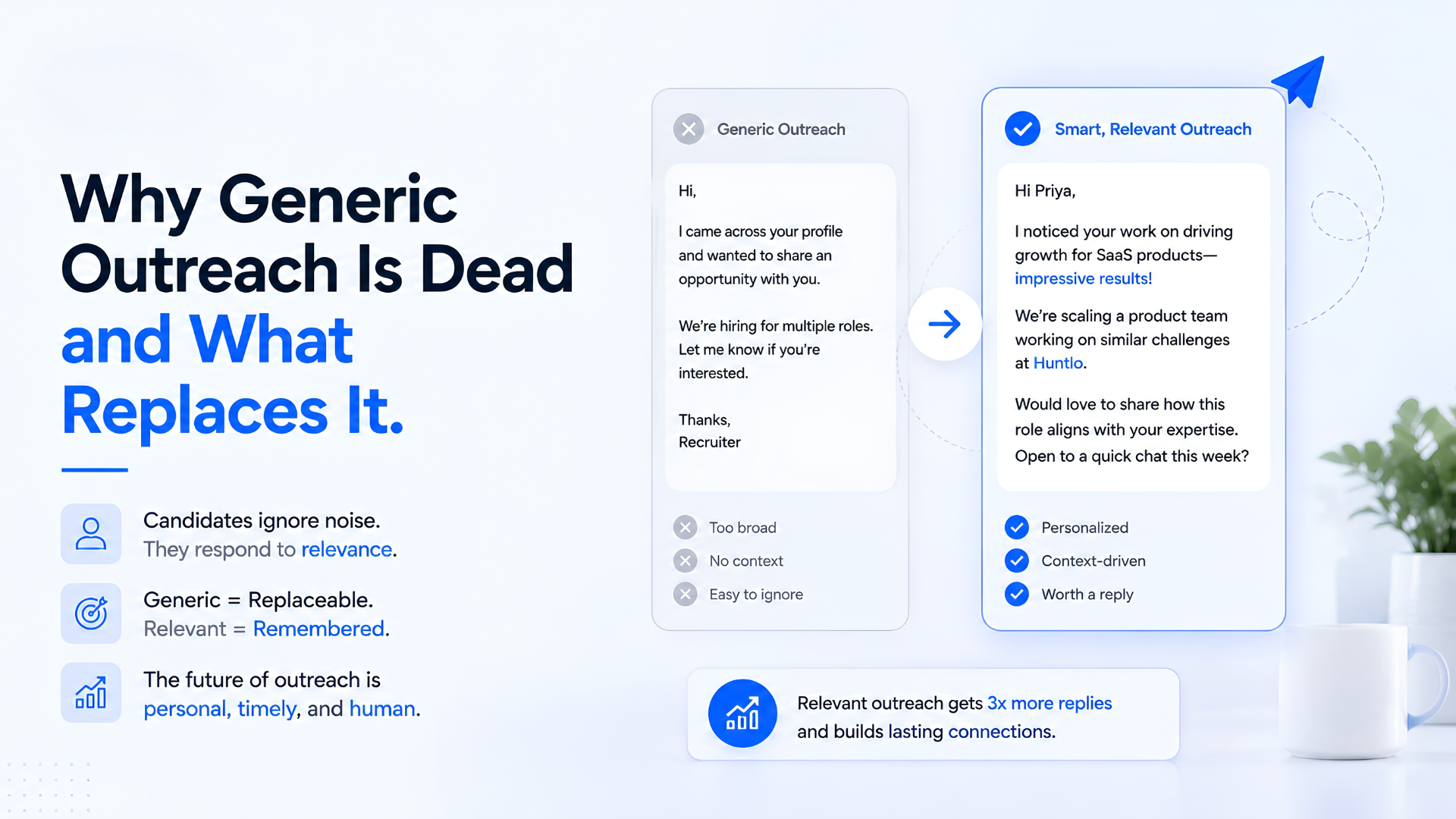
A decade ago, a recruiter could write a single outreach message, load a list of two hundred candidate names into an email tool, hit send, and reasonably expect fifteen to twenty positive responses. The message did not need to be personalized. It did not need to reference the candidate’s specific experience. It did not even need to be particularly well-written. The job market was less competitive, candidates had fewer incoming recruiting messages, and the bar for earning a response was low enough that a competent, professional, clearly-written generic message could clear it. That approach is no longer viable. The response rates that generic outreach produced in 2016 would be considered catastrophic today, and the organizations that are still relying on it are watching their response rates decline quarter after quarter without understanding why. Generic outreach is not declining because candidates have become more hostile to recruiters. It is declining because the fundamental conditions that made it effective have been systematically dismantled by changes in the talent market, changes in candidate behavior, and changes in the technology that competitors are using to reach the same candidates. This article explains what killed generic outreach, why the decline is irreversible, and what the new standard of candidate engagement looks like for organizations that want to compete for top talent.
The word “dead” is used deliberately. Generic outreach is not declining. It is not becoming less effective. It is dead, in the sense that the gap between its performance and the performance of intelligent, personalized outreach has become so large that continuing to use it is not a matter of incremental underperformance. It is a matter of strategic irrelevance. An organization that sends generic outreach messages is operating in a fundamentally different talent market than the one that exists, and the candidates they are trying to reach know it. The candidates who receive generic messages from one organization and personalized, context-aware messages from another do not think “Both of these recruiters
are doing their jobs.” They think “The first company does not value my time, and the second one does.” That perception drives not just the immediate response decision but the long-term employer brand impression, and it compounds over time as candidates share their experiences with peers who are considering similar opportunities.
The Three Structural Forces That Killed Generic Outreach
The death of generic outreach was not caused by a single event or technology. It was caused by three structural forces that emerged independently and converged to make template-based messaging obsolete. The first force is message saturation. The volume of recruiting messages that a typical professional receives has increased dramatically over the past five years, driven by the proliferation of sourcing tools, the expansion of recruiting teams, and the globalization of talent competition. A senior software engineer in Bangalore, a product manager in London, and a data scientist in New York each receive dozens of recruiting messages per month. When candidates received three messages a week, a generic message could stand out by virtue of being clear and professional. When candidates receive fifteen messages a week, clarity and professionalism are table stakes. The differentiator is relevance, and generic messages, by definition, lack relevance. The second force is rising candidate expectations, driven by the broader consumer technology experience. Candidates interact with AI-powered personalization every day: in their social media feeds, their shopping recommendations, their news feeds, and their entertainment platforms. They have been trained by these experiences to expect that any organization reaching out to them will demonstrate some understanding of who they are and what they care about. A recruiting message that could have been sent to anyone with the same job title fails this expectation immediately, and the candidate’s response is not just to ignore the message but to form a negative impression of the organization that sent it.
The third force, and the one that accelerated the decline most dramatically, is the competitive adoption of intelligent outreach. When every recruiter in a market is sending generic messages, the baseline is equal and candidates have no basis for comparison. But as early adopters began using AI-powered personalization, the baseline shifted. Candidates who received a genuinely personalized message from one recruiter and a generic message from another now had a direct comparison, and the comparison was devastating for the generic sender. The personalized message set a new standard that the generic message could not meet, and once that standard was established in the candidate’s mind, it became the permanent filter through which they evaluated all future outreach. This is the dynamic that makes the decline irreversible: the competitors who have already adopted intelligent outreach have permanently raised the candidate’s expectations, and there is no going back. According to Deloitte’s workforce of the future research, the organizations that were earliest to adopt AI-driven candidate engagement are now seeing response rate advantages of three to five times over organizations still using template-based approaches, and the gap is widening because the AI-powered systems improve with every interaction while the template-based systems remain static. The competitive advantage is not just in the response rate. It is in the quality of the candidates who respond, because the personalized approach
attracts candidates who would never have engaged with generic outreach at all.
What Generic Outreach Actually Costs You (Beyond Response Rates)
The most visible cost of generic outreach is the low response rate. But response rate is the tip of the iceberg. The costs that matter more are the ones that are harder to measure: the employer brand erosion, the senior candidate alienation, and the opportunity cost of wasting recruiter capacity on an approach that produces diminishing returns. On employer brand, every generic message that a candidate receives and ignores is a negative brand touchpoint. The candidate does not register it as a positive or neutral interaction. They register it as evidence that the sending organization does not understand their market, does not value individual candidates, and is operating at a level of sophistication that is below the standard they expect from a potential employer. In competitive talent markets, this perception is toxic, and it spreads. Candidates talk to each other. They share screenshots of particularly bad outreach messages on professional forums and social media. The brand damage from a single viral example of tone-deaf generic outreach can outweigh months of employer brand investment, because the outreach message is perceived as authentic proof of the organization’s culture, while the employer brand content is perceived as marketing.
On senior candidate alienation, the impact of generic outreach is even more severe. Senior professionals, executives, and specialized experts are the candidates who are most valuable and hardest to hire. They are also the candidates who are most sensitive to the quality of the initial outreach, because they receive the most messages, have the most options, and have the least tolerance for having their time wasted. A senior candidate who receives a generic message does not just ignore it. They actively categorize the sending organization as one that does not understand their level, and they mentally add it to the list of companies they would not consider working for. This is not hyperbole. Research on executive candidate behavior consistently shows that a single poorly targeted outreach message can permanently disqualify an organization from a senior candidate’s consideration set, because the candidate infers that if the recruiting function operates at this level, the organization as a whole is unlikely to meet their professional standards. The problem is compounded when generic outreach is operating on outdated candidate data. A message that is both generic and factually wrong — referencing a job title the candidate held three years ago, a company they left, or a skill set they have moved beyond — is not just ineffective. It is actively damaging. The causes and consequences of this data freshness problem are analyzed in Why Do Some AI Recruiting Tools Have Outdated Candidate Data?, and the finding is clear: when generic outreach meets stale data, the result is not zero impact. It is negative impact, both on the individual candidate relationship and on the broader employer brand. The message that was supposed to open a door slams it shut instead.
Contextually Intelligent Outreach: The New Baseline
What replaces generic outreach is not simply “personalization” as the term is commonly understood. The recruiting industry has been talking about personalization for years, and for most of that time, what it has meant is inserting the candidate’s first name into a
template and perhaps referencing their current employer. That level of personalization was an improvement over pure generic messaging, but it is no longer sufficient. The new baseline is what might be called contextually intelligent outreach: messages that demonstrate understanding of the candidate’s professional context at a level that goes well beyond name and employer. Contextually intelligent outreach references the candidate’s specific accomplishments, understands the trajectory of their career, recognizes the technical or domain-specific challenges they have worked on, and connects these elements to a specific aspect of the opportunity. It is the difference between “Hi Sarah, I see you work at Google” and “Sarah, your work on the TensorFlow model compression framework caught my attention — we are tackling a similar efficiency challenge at a much larger scale.” Both messages are technically personalized. Only one is contextually intelligent.
The reason contextually intelligent outreach is the new baseline rather than an aspirational standard is that candidates now receive it regularly from the most sophisticated recruiting organizations, and that exposure has reset their expectations. A candidate who has received two or three genuinely insightful, candidate-specific messages from different recruiters develops an internal standard for what outreach should look like. Messages that fall below that standard are filtered out automatically, just as consumers filter out generic marketing emails after years of exposure to personalized advertising. The candidate is not being demanding. They are applying the same filtering heuristic that they apply to every other category of incoming communication. The practical implication is that the minimum viable outreach message in 2026 is one that demonstrates contextual intelligence about the candidate. Anything below that threshold is noise, and candidates have become extremely efficient at filtering noise. According to EY’s workforce research, talent acquisition teams that have made the transition to contextually intelligent outreach report not just higher response rates but fundamentally different candidate conversations. When the first message demonstrates genuine understanding, the candidate’s initial response is more engaged, more substantive, and more likely to progress to a qualified conversation, because the candidate is responding to relevance rather than merely acknowledging receipt. The quality of the first message sets the quality ceiling for the entire candidate interaction, and contextually intelligent outreach raises that ceiling dramatically compared to any form of template-based messaging.
The Production Challenge: Why Most Teams Cannot Manual Their Way to Personalization
The case for contextually intelligent outreach is compelling. The barrier is execution. Crafting a genuinely insightful, candidate-specific message requires the recruiter to research the candidate’s background, identify the most relevant professional signal, formulate a connection to the opportunity, and write a message that integrates these elements naturally. For a single candidate, this takes ten to fifteen minutes for a skilled recruiter. For a recruiter managing a pipeline of two hundred candidates across fifteen open requisitions, this level of investment per candidate is mathematically impossible. At ten minutes per message, reaching two hundred candidates would require thirty-three hours of
message-crafting time per week, which is nearly a full-time job in itself, on top of screening, scheduling, interviewing, hiring manager coordination, and administrative work. The result is that recruiters who try to manually personalize their outreach inevitably ration their effort: they write great messages for the ten candidates they consider highest-priority and default to semi-generic messages for the rest. The candidates who receive the semi-generic messages experience the same low-quality outreach that the organization was trying to escape, and the net improvement across the pipeline is modest.This production challenge is why tool proliferation has failed to solve the problem. Organizations have added sourcing tools, email automation tools, candidate relationship management tools, and AI writing assistants to their tech stacks, but these tools operate in isolation and address different parts of the problem without integrating into a coherent outreach system. The sourcing tool finds candidates. The email tool sends messages. The writing assistant helps with copy. But no single tool is responsible for the end-to-end quality of the candidate’s experience, which means the experience is fragmented and inconsistent. This is the dynamic documented in More Tools, Same Hiring Problems, which argues that the recruiting technology market has been optimized for feature addition rather than outcome delivery, and that organizations with the most tools are not the ones with the best hiring outcomes. The solution is not more tools. It is a system that can produce contextually intelligent outreach at the scale that the pipeline requires, without requiring manual effort from the recruiter for each individual message. That system is AI-powered outreach, but the quality of the AI matters enormously, because not all AI outreach is created equal.
Not All AI Outreach Is Created Equal: How to Tell the Difference
As organizations recognize that generic outreach is dead, many are rushing to adopt AI-powered outreach tools. But the market is full of products that claim to deliver AI personalization while actually delivering template-based automation with minor AI enhancements. Distinguishing between these products is essential, because the gap between genuine contextual intelligence and automated template insertion is the same gap between outreach that works and outreach that does not. The first and most important differentiator is whether the AI generates messages or selects them. A system that generates messages creates original content for each candidate based on their full profile. A system that selects messages chooses from a pre-written library and inserts candidate-specific details. The generated-message approach can produce genuinely different messages for every candidate. The selection approach produces variations on the same themes, which candidates can detect after receiving two or three messages from the same organization. The second differentiator is data depth. A system that generates messages based on the candidate’s full professional profile — career history, publications, projects, skills, and recent activity — will produce more insightful messages than a system that operates on basic contact information and job title.
The third differentiator is adaptability. A genuinely intelligent outreach system does not just send a better first message. It adapts its entire approach based on the candidate’s engagement signals. If the candidate opens the message but does not reply, the follow-up
should be different from what it would be if the candidate did not open it. If the candidate replies with a specific question, the response should address that question in context rather than sending the next message in a pre-set queue. This adaptability is the hallmark of what distinguishes an agentic system from an automated one, a distinction that is critical to understand when evaluating outreach technology. As explored in What Makes an AI Recruiting Platform Agentic vs. Just Automated?, the difference between these two categories is not a matter of degree. It is a difference in kind, and it determines whether the system can produce the kind of dynamic, context-aware engagement that replaces generic outreach or whether it merely produces a slightly more polished version of the same template-based approach. The organizations that are seeing the most dramatic improvements in their outreach performance are the ones that have adopted genuinely agentic AI systems that generate, adapt, and evolve their outreach based on candidate context, not the ones that have layered AI features onto existing automation frameworks.
Huntlo: Where Contextual Intelligence Meets Outreach Scale
The transition from generic outreach to contextually intelligent outreach is not optional for organizations that want to compete for top talent. It is a competitive necessity, and the organizations that make the transition fastest will gain an advantage that compounds over time as their competitor’s generic messages become increasingly invisible to candidates. Huntlo is the platform that makes this transition practical. Its AI engine generates original, candidate-specific outreach messages that are grounded in the candidate’s full professional profile, not selected from template libraries. Each message references specific aspects of the candidate’s career, connects those references to the opportunity, and is crafted to invite a substantive response rather than a binary decision. The system operates across email, LinkedIn, WhatsApp, and SMS, adapting both the content and the channel to the individual candidate’s context. And it maintains this level of contextual intelligence across multi-touch sequences, generating differentiated follow-up content that builds on previous interactions rather than repeating the original pitch. The gap between identifying a great candidate and actually engaging them is the gap that matters most in modern recruiting, and it is a gap that generic outreach cannot bridge. The distinction between sourcing and engagement is the distinction that What’s the Difference Between AI Sourcing and AI Recruiting? explores, and it is a distinction that organizations ignore at their peril. Sourcing without intelligent engagement is an expensive list that produces no conversations. Huntlo closes the gap by making every candidate touchpoint contextually intelligent, from the first message to the final follow-up, so that the candidates you find are the candidates you actually reach, engage, and hire.
The old playbook is finished. Generic templates, spray-and-pray volume, and one-size-fits-all sequences are artifacts of a talent market that no longer exists. The new playbook is about intelligence: understanding each candidate deeply enough to earn their attention, crafting messages that demonstrate that understanding, and building an engagement process that adapts as the candidate’s context evolves. This is not a theoretical ideal. It is an operational capability, and it is the capability that separates the recruiting organizations
that are thriving in 2026 from the ones that are wondering why their response rates keep declining. The candidates have not become harder to reach. They have become harder to reach with generic messages. The organizations that have figured this out are the ones whose recruiters are having more and better conversations, whose hiring managers are seeing stronger candidate pools, and whose employer brands are strengthening with every message sent. Generic outreach is dead. What replaces it is intelligence at scale, and it is available now.
Related Topics:
More Tools, Same Hiring Problems
What’s the Difference Between AI Sourcing and AI Recruiting?
What Makes an AI Recruiting Platform Agentic vs. Just Automated?