Daniel Park, a senior technical recruiter at a large e-commerce company in Seattle, opened his inbox to find a LinkedIn message from a former colleague. The message linked to an article claiming that AI would eliminate ninety percent of recruiting jobs within five years. Daniel had been hearing versions of this prediction since he entered the profession eight years ago, and yet here he was, busier than ever, with fourteen open requisitions and a hiring manager demanding daily updates. He understood why people made these predictions. The AI tools his team had adopted over the past two years could source candidates, screen resumes, schedule interviews, and even draft outreach messages. Tasks that used to fill his entire morning now took less than an hour. But something unexpected had happened as those tasks disappeared: the remaining parts of his job had become more demanding, more complex, and more valuable to his organization. He spent his days navigating sensitive offer negotiations, coaching hiring managers on how to evaluate candidates fairly, managing the expectations of executives who wanted hiring to move faster, and building relationships with passive candidates who would never engage with an automated message. Far from making him obsolete, AI had made the human elements of his role more important than ever. The question was not whether AI would replace recruiters, but whether recruiters would adapt to a reality where the parts of the job that required genuine human capability were also the parts that mattered most.
The Replacement Narrative and Why It Persists
Every few months, a new headline declares that AI is about to make recruiters obsolete. The arguments are predictable: AI can source candidates faster, screen resumes more consistently, schedule interviews without human involvement, and generate outreach messages at scale. If a machine can perform all the tasks that a recruiter does, the logic goes, then the recruiter is no longer needed. This narrative is compelling because it contains a kernel of truth. AI really can do many of the tasks that recruiters have traditionally performed, and it genuinely does them faster and at lower cost. But the narrative collapses when it confuses task replacement
with role replacement, a conflation that misunderstands what recruiters actually contribute to hiring outcomes.
The persistence of the replacement narrative also reflects a narrow view of what recruiting involves. People who predict the end of recruiting tend to define the profession in terms of its most automatable activities: posting jobs, reviewing resumes, sending emails, and coordinating schedules. From this perspective, recruiting looks like a collection of administrative processes that are ripe for automation. But this view ignores the vast portion of a recruiter's work that involves navigating human complexity, making judgment calls under uncertainty, and managing the emotional dynamics of a process that profoundly affects people's lives. McKinsey has repeatedly noted that the most valuable activities in knowledge work are precisely the ones that are hardest to automate, and recruiting is a clear example of this principle.
There is also an economic dimension to why the replacement narrative persists. AI vendors have an incentive to promote dramatic claims about their technology's capabilities because urgency drives purchasing decisions. Media outlets amplify these claims because stories about technology displacing jobs generate clicks and engagement. The result is a feedback loop where exaggerated predictions create anxiety, which generates attention, which incentivizes more exaggerated predictions. The reality of how AI is changing recruiting is far more nuanced and far less dramatic than these headlines suggest, but nuance does not sell subscriptions or generate viral content.
What AI Actually Replaces: Tasks, Not Roles
To understand why AI will not replace recruiters, it is essential to distinguish between tasks and roles. A role is a collection of responsibilities, judgment calls, and interpersonal interactions that together create value for an organization. Tasks are the individual units of work that contribute to fulfilling a role. AI is exceptionally good at replacing tasks: sourcing candidates from databases, parsing resume content into structured data, identifying scheduling conflicts, and generating template-based communications. What AI cannot do is fulfill the role of a recruiter, because a recruiter's role encompasses far more than the sum of these individual tasks.
Consider the difference between scheduling an interview and managing a hiring process. AI can find a time slot that works for all participants, send calendar invitations, and handle rescheduling. But managing a hiring process involves understanding that a hiring manager is about to make a decision based on a single interview because she is under pressure to fill the role before budget reallocation, and intervening to ensure a thorough evaluation. It involves recognizing that a candidate is wavering because they have another offer and proactively connecting them with a future colleague who can address their concerns. It requires reading the political dynamics of an interview panel and ensuring that a strong candidate is not unfairly derailed by a single dissenting opinion. These are role-level responsibilities that require contextual understanding, interpersonal influence, and strategic thinking. agentic AI platforms vs automated ones explains this distinction clearly: agentic AI handles the execution layer while
human recruiters operate at the strategy and relationship layer.
The task-versus-role distinction also explains why productivity gains from AI do not translate linearly into headcount reduction. When AI reduces the time a recruiter spends on sourcing and screening from forty percent of their day to ten percent, that freed-up time does not simply disappear. Recruiters reallocate it to activities that were previously neglected: deeper candidate engagement, more thorough hiring manager consultations, better offer management, and stronger post-hire follow-up. These activities improve hiring quality, which creates its own demand for recruiter capacity because better hiring outcomes lead to more confidence in the recruiting function, which leads to more investment and more open positions. Gartner has observed that organizations implementing AI recruiting tools typically see recruiter headcount remain stable or even increase, because improved team performance generates more hiring demand.
The Relationship Economy of Recruiting
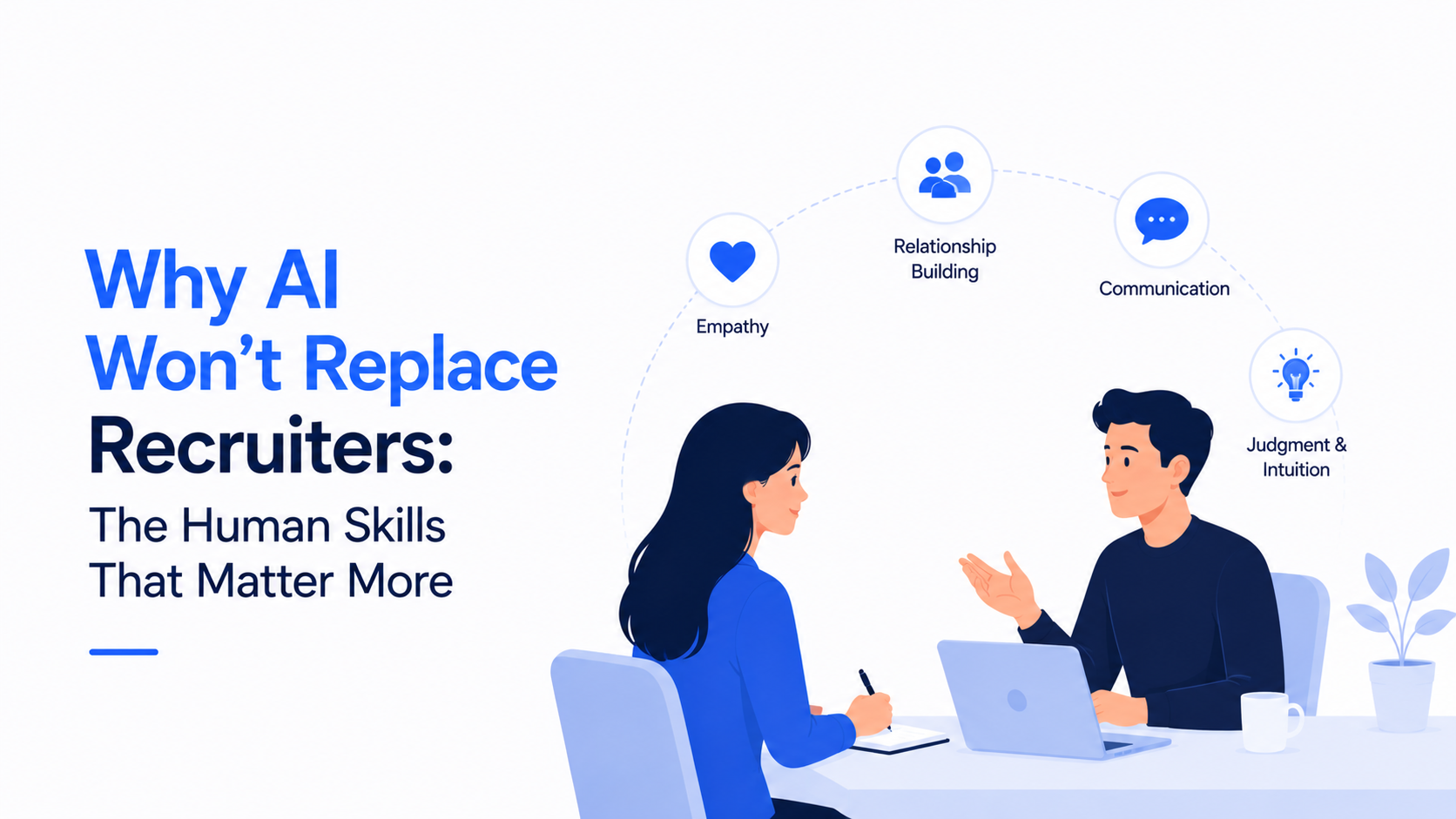
At its core, recruiting is a relationship business. The best hires do not come from optimized job postings or perfectly screened resume pools. They come from relationships: a recruiter who has built trust with a passive candidate over months of conversations, a hiring manager who trusts their recruiter to bring only qualified candidates, a former candidate who refers friends because they had a positive experience even though they did not get the job. These relationships create value that no algorithm can replicate because they are built on shared experiences, mutual respect, and the kind of emotional intelligence that determines whether a human interaction feels genuine or transactional.
The importance of relationships becomes even more pronounced at senior levels and in specialized markets. A vice president of engineering is not going to engage with an automated outreach message, no matter how well-crafted. They will engage with a recruiter who has taken the time to understand their career aspirations, who can speak intelligently about the technical challenges they would face in a new role, and who has a track record of helping similar leaders make successful transitions. These high-stakes recruiting conversations require credibility, and credibility is built through relationships, not through algorithms. why referrals outperform cold outreach demonstrates that relationship-driven hiring consistently outperforms transactional approaches, and this advantage grows larger as the roles become more senior and the talent pool becomes more competitive.
AI can support relationship-based recruiting by providing recruiters with better information about their candidates, surfacing timely reasons to reconnect, and ensuring that no important follow-up falls through the cracks. But the relationship itself resides in the recruiter. Candidates remember the recruiter who called them personally to explain why they were not selected, not the AI that sent the rejection email. Hiring managers remember the recruiter who pushed back diplomatically when they wanted to lower the bar, not the system that flagged the risk. These human interactions are the foundation of recruiting reputation, and reputation is the most valuable asset a recruiter possesses.
Negotiation, Influence, and the Art of Closing
One of the most recruiter-dependent stages of the hiring process is the offer and negotiation phase. This is where the outcome of weeks or months of recruiting effort is determined, and it is also where human capability matters most. Extending a job offer is not a mechanical act of presenting a number and waiting for an acceptance. It is a nuanced negotiation that involves understanding what the candidate values beyond compensation, reading their genuine priorities versus their stated ones, and crafting an offer structure that addresses their concerns without creating internal equity problems. AI can provide market compensation data and suggest offer components, but it cannot conduct the negotiation itself because negotiation requires real-time reading of another person's reactions, adapting strategy mid-conversation, and making judgment calls about when to push and when to concede.
Closing a candidate often involves navigating competing offers, managing timeline pressure from both the candidate and the hiring organization, and addressing concerns that the candidate may not articulate directly. A skilled recruiter can sense when a candidate's hesitation about a role is genuine and when it is a negotiating tactic. They can identify the decision-maker in a candidate's household when family considerations are influencing the decision. They can leverage their relationship with the hiring manager to secure last-minute concessions that make the difference between acceptance and decline. LinkedIn data shows that the closing rate for offers managed by experienced recruiters exceeds the closing rate for offers handled through automated systems by a significant margin, particularly for senior and specialized roles where the stakes are highest.
Influence within the hiring organization is equally important. Recruiters must often persuade hiring managers to adjust unrealistic requirements, convince interview panels to reach consensus on borderline candidates, and advocate for candidates who may not interview perfectly but possess qualities that predict long-term success. This internal influence requires organizational awareness, political skill, and the kind of credibility that comes from a track record of good judgment. These are human capabilities that AI cannot replicate because they depend on understanding the motivations, incentives, and interpersonal dynamics of specific individuals within a specific organizational context.
Empathy and Candidate Experience in a High-Stakes Process
Job changes are among the most stressful life events a person can experience. Candidates are making decisions that affect their financial security, professional trajectory, daily commute, and family life. They are often managing the anxiety of interviewing while still employed, navigating the emotional complexity of potentially leaving colleagues they respect, and weighing uncertain benefits against the comfort of the known. In this high-stakes context, empathy from a recruiter is not a nice-to-have quality but a functional requirement. Candidates need to feel heard, respected, and supported throughout a process that can span
weeks or months, and no AI system can provide the genuine human empathy that communicates those qualities.
Candidate experience has become a strategic priority because talent markets are competitive and candidates share their experiences widely. A single negative interaction with a recruiter can generate a negative Glassdoor review that discourages hundreds of future applicants. Conversely, a positive experience, even for a candidate who does not receive an offer, can generate referrals, social media mentions, and goodwill that benefits the employer brand for years. AI can ensure that candidates receive timely communication and that no one falls through the cracks, but the quality of the human interaction is what candidates remember and share. SHRM has found that candidate experience scores correlate more strongly with recruiter behavior than with any technology-enabled touchpoint.
Empathy also matters during the difficult conversations that are an inevitable part of recruiting. Delivering a rejection to a candidate who invested significant time in the process, managing a candidate's expectations when the hiring timeline extends, or navigating a situation where a hiring manager wants to rescind an offer all require emotional intelligence and tact. These moments define the candidate's experience more powerfully than any number of well-timed automated emails. Recruiters who handle these moments well build lasting positive impressions, and those impressions compound over time into organizational reputation. Deloitte has found that companies investing in recruiter-led candidate experience programs see measurable improvements in offer acceptance rates and employer brand perception.
Strategic Judgment That AI Cannot Provide
Recruiting strategy requires judgment that goes beyond data analysis. Should the organization hire a senior leader first and let them build their team, or hire a full team of mid-level engineers who can start producing immediately? Should a difficult-to-fill role be opened to remote candidates globally or restricted to a specific region where the hiring manager prefers collocation? Should the company make an offer to a candidate who interviewed well but has a pattern of short tenure? These are strategic questions with no obviously correct answer, and resolving them requires understanding the organization's culture, risk tolerance, and business context in ways that data alone cannot provide.
Market intelligence is another area where human recruiters add strategic value. Experienced recruiters develop an intuitive sense for talent market dynamics that complements the quantitative data that AI provides. They know which companies are likely to have layoffs coming based on industry signals, which candidate communities are most active and responsive, and how to position an opportunity against competitors who are recruiting from the same talent pool. This market intuition, built from years of conversations with candidates and hiring managers, provides context that makes AI-generated data more actionable. Deloitte has found that the most effective recruiting organizations combine AI-generated market data with human recruiter insights, and that organizations relying solely on data without human interpretation make poorer strategic decisions.
Workforce planning represents yet another dimension of strategic judgment. As organizations evolve their hiring strategies to respond to market shifts, recruiters who understand the broader business context can provide valuable input about talent availability, hiring feasibility, and competitive positioning. This advisory role elevates recruiting from an operational function to a strategic one, and it depends on the kind of business acumen and organizational awareness that AI cannot develop. AI sourcing vs AI recruiting highlights how the strategic dimension of recruiting is expanding, creating more opportunities for human recruiters to contribute at a level that AI tools cannot reach.
How the Recruiter Role Is Evolving, Not Disappearing
The recruiters who will thrive in the AI era are not those who resist technology or cling to manual processes. They are the ones who embrace AI as a tool that handles the operational burden, allowing them to focus on the human and strategic dimensions of their role that create the most value. This evolution requires new skills: the ability to interpret AI-generated insights, the confidence to override algorithmic recommendations when human judgment suggests a different course, and the communication skills to explain AI-informed decisions to candidates and hiring managers who may be skeptical of automated processes.
The day-to-day reality of an AI-era recruiter looks quite different from the traditional model. Instead of spending the morning sourcing candidates from job boards and the afternoon sending follow-up emails, an AI-era recruiter might spend their morning reviewing AI-generated candidate shortlists and providing contextual input that the algorithm missed, their afternoon coaching a hiring manager on how to conduct a structured interview, and their evening building a relationship with a passive candidate over coffee. The operational tasks have not disappeared, but they have been compressed into a smaller portion of the day, leaving more time for the activities that require genuine human capability. EY projects that by 2028, the average recruiter will spend less than twenty percent of their time on administrative tasks, down from roughly fifty percent today.
New specializations are also emerging within the recruiting function. Talent intelligence analysts who interpret AI-generated market data, candidate experience designers who optimize the human touchpoints of the hiring journey, and recruiting strategists who align hiring plans with business objectives are all roles that did not exist in any formal sense a decade ago. These specializations are direct products of the AI revolution in recruiting, and they all require human judgment, creativity, and interpersonal skills. should recruiters worry about AI replacing jobs explores this phenomenon in detail, showing that AI is creating more specialized and strategically important roles for recruiters even as it automates the generalist tasks that defined the profession's past.
When AI Augmentation Outperforms Full Automation
The most successful applications of AI in recruiting are not fully autonomous systems but
augmented workflows where AI handles data processing and pattern recognition while humans handle judgment and relationship management. This augmentation model consistently outperforms full automation because it leverages the complementary strengths of both humans and machines. AI excels at processing large volumes of data, maintaining consistency, and identifying patterns that humans might miss. Humans excel at understanding context, exercising empathy, making nuanced judgments, and building trust. The best results come from combining these capabilities rather than choosing one over the other.
Consider the candidate screening process. A fully automated screening system might reject a candidate because their resume does not contain the right keywords, even though their experience is highly relevant but described using different terminology. A fully manual screening process is slow, inconsistent, and susceptible to unconscious bias. An augmented approach uses AI to rank candidates by relevance, presents the rankings to a human recruiter along with the reasoning, and allows the recruiter to adjust the results based on contextual understanding that the AI lacks. This approach is faster than manual screening, more accurate than fully automated screening, and more fair than either approach alone. McKinsey has documented numerous cases where augmented recruiting workflows produce measurably better hiring outcomes than either fully manual or fully automated alternatives.
The augmentation principle applies across the entire recruiting lifecycle. AI generates candidate shortlists, recruiters add context and nuance. AI drafts outreach messages, recruiters personalize the final version. AI identifies scheduling conflicts, recruiters handle the sensitive conversations when conflicts cannot be resolved. AI surfaces pipeline risks, recruiters develop and execute mitigation strategies. At every stage, the combination of AI efficiency and human judgment produces better outcomes than either could achieve independently. Organizations that recognize this synergy are investing in training their recruiters to work effectively alongside AI, rather than hoping to replace them.
The Future Recruiter: More Human, Not Less
The defining characteristic of the future recruiter is not technical proficiency with AI tools, though that is important. It is the ability to bring uniquely human capabilities to a hiring process that is increasingly efficient at the operational level. As AI absorbs more of the transactional work, the recruiter's value shifts toward the interpersonal, strategic, and emotional dimensions of hiring. This is not a diminishment of the profession but an elevation. The recruiters who will be most in demand are not those who can process the most candidates per day but those who can build the deepest relationships, exercise the sharpest judgment, and provide the most insightful strategic counsel.
The evidence for this shift is already visible in the market. Compensation for senior recruiters and recruiting leaders has been increasing faster than compensation for junior recruiters who primarily perform operational tasks. Organizations are investing more in recruiter training and development, focusing on skills like influence, negotiation, and strategic thinking rather than sourcing techniques and system proficiency. The recruiters who are most valued by their
organizations are the ones who consistently close difficult hires, build talent communities that yield candidates over multiple years, and serve as trusted advisors to hiring managers and business leaders. Gartner predicts that the recruiting profession will bifurcate into operational roles that are increasingly automated and strategic roles that command premium compensation and organizational influence.
Ultimately, the question of whether AI will replace recruiters answers itself when you look at what recruiting actually requires. The tasks can be automated, but the role cannot. Relationships, judgment, empathy, influence, and strategic thinking are not bugs in the recruiting process that technology will eventually fix. They are the features that make recruiting valuable, and they are becoming more important, not less, as AI handles everything else. The future belongs to recruiters who understand this distinction and lean into the human dimensions of their work, using AI as a tool that amplifies their impact rather than a threat that diminishes their relevance. LinkedIn research confirms that the most in-demand recruiting professionals are those who combine technological fluency with deep human skills, not those who specialize in either domain alone.