Marcus Chen, VP of Talent Acquisition at a Series C healthcare startup in Austin, had spent six months building what his team called the automated hiring engine. Every candidate who applied went through an AI screener that scored resumes, an AI chatbot that conducted initial interviews, and an AI assessment platform that ranked candidates against competency models. The system processed four hundred applications per week and reduced his team's screening time by seventy percent. Then a senior engineer who had been rejected sent a detailed email to the CEO explaining that the AI chatbot had misunderstood her answers to two technical questions, scoring her as unqualified when she had in fact described the exact architecture the team was building. The CEO forwarded the email to Marcus with a single question: who reviewed this decision before she was rejected? The answer was nobody. The AI had made the call, the automated workflow had sent the rejection, and no human had looked at the candidate's profile at any point in the process. Marcus realized that in his pursuit of efficiency he had built a system that could process candidates at scale but could not be trusted to make fair decisions about any single one of them.
The Efficiency Illusion: What AI Gains and What It Risks Losing
AI recruiting tools have transformed talent acquisition by automating tasks that previously consumed enormous amounts of recruiter time. Resume screening that took hours now takes seconds. Candidate outreach that required personalized drafting for every message can now be generated in bulk with reasonable personalization. Interview scheduling, once a multi-day coordination exercise involving back-and-forth emails, can be completed in minutes through automated calendar synchronization. These efficiency gains are real and significant. According to McKinsey, organizations that have deployed AI recruiting tools report thirty to fifty percent reductions in time-to-fill and forty to sixty percent reductions in cost-per-hire for high-volume roles. For talent acquisition leaders facing pressure to do more with less, these
numbers are compelling, and they explain why AI adoption in recruiting has accelerated so rapidly over the past three years.
The problem is that efficiency and quality are not the same thing, and optimizing for one without safeguarding the other produces systems that look productive on dashboards but fail in practice. An AI screening tool might process five hundred resumes in an afternoon and identify fifty candidates who match the job description, but if it systematically rejects candidates with nontraditional career paths, it is not sourcing the best talent. It is sourcing the most conventional talent. An AI chatbot might conduct two hundred initial screening conversations in a week, but if it evaluates candidates based on keyword matching rather than genuine understanding of their responses, it will advance candidates who are good at describing their experience and reject candidates who are good at doing the work. The distinction matters because the entire purpose of recruiting is to identify the best candidates, not to process the most candidates. Gartner has found that organizations using AI screening without human review report twelve to eighteen percent lower quality-of-hire scores compared to organizations that maintain human oversight at the screening stage, because the AI systems optimize for measurable proxies rather than the holistic assessment that experienced recruiters provide.
The efficiency illusion is particularly dangerous because it is self-reinforcing. When an AI tool produces fast results, the organization's confidence in the tool grows, leading to greater automation and less human review. When human review is reduced, the errors and biases that the AI produces become harder to detect, because there is no human in the process to notice them. When errors go undetected, the organization's confidence in the tool grows further, creating a cycle of increasing automation and decreasing quality that can persist for months or years before a significant failure exposes the problem. Breaking this cycle requires a deliberate commitment to human oversight that is built into the process design rather than treated as an optional add-on. Organizations that understand this dynamic treat AI as a tool that augments human judgment rather than one that replaces it, and they design their processes accordingly.
Where AI Recruiting Gets It Wrong: Real Failure Modes
AI recruiting systems fail in predictable ways that human oversight is specifically designed to catch. The first failure mode is proxy discrimination, where the AI uses data points that correlate with protected characteristics to make hiring decisions. An AI system might not explicitly consider a candidate's age, but it might weight the year of a candidate's first professional experience, which is functionally equivalent. It might not consider race, but it might weight the name of the candidate's university, which correlates with racial demographics in many countries. It might not consider gender, but it might penalize resume gaps that disproportionately affect women who have taken parental leave. These proxy patterns are often invisible in aggregate statistics but produce significant disparities for specific candidate groups. SHRM has documented numerous cases where AI hiring tools that passed initial bias audits were later found to discriminate through proxy variables that the auditors had not tested.
The second failure mode is context insensitivity. AI systems evaluate candidates based on the data available to them, which is often incomplete. A candidate who left a prestigious role after eighteen months might appear to be a job hopper to the AI, but a human reviewer who read the candidate's cover letter would learn that the company underwent a merger that eliminated the candidate's position. A candidate who has been unemployed for two years might be automatically deprioritized, but a human reviewer conducting a phone screen would discover that the candidate was caring for a terminally ill family member and has since completed a professional certification. AI systems cannot account for information they do not have, and they cannot exercise the judgment to seek out missing context. This is not a technical limitation that better algorithms will solve. It is a fundamental characteristic of automated decision-making that requires human intervention to address. how to evaluate an AI sourcing tool explains why organizations must assess whether an AI sourcing tool has mechanisms for handling incomplete or ambiguous candidate information, because tools that cannot surface these edge cases will systematically disadvantage candidates whose profiles do not fit neat categories.
The third failure mode is concept drift, where an AI model's performance degrades over time as the hiring environment changes. A model trained on data from a strong employer's market may perform poorly when the market shifts and candidate behavior changes. Job titles that were reliable indicators of seniority two years ago may have been inflated by titleflation trends. Skill requirements that were well-calibrated to the available talent pool may become unrealistic as competition for specific capabilities intensifies. Unlike human recruiters, who naturally adapt their evaluation criteria as market conditions change, AI models continue to apply the same logic until they are explicitly retrained. Organizations that deploy AI without ongoing human monitoring may not detect concept drift until it has produced months of poor hiring decisions. Deloitte research on AI model performance in HR applications found that model accuracy degrades by ten to fifteen percent within six months of deployment in dynamic hiring markets, and that organizations without human monitoring processes take an average of eight months to detect and correct this degradation.
The Legal and Regulatory Case for Human Oversight
The regulatory landscape for AI in hiring has shifted dramatically in favor of human oversight, and organizations that ignore this shift face significant legal and financial risk. The European Union's AI Act, which came into force in stages starting in 2024, classifies AI systems used in employment decisions as high-risk and explicitly requires meaningful human oversight as a condition of lawful deployment. The Act does not define oversight as a human rubber-stamping AI decisions. It requires that humans have the ability to understand the system's outputs, to question them, and to override them when necessary. Organizations that deploy AI hiring tools without these oversight mechanisms face fines of up to seven percent of global annual revenue, a penalty that makes AI governance a board-level concern rather than a technical detail. McKinsey has advised multinational companies to adopt the EU AI Act's oversight requirements as a global standard, because the regulatory direction in the United
States, Canada, and Asia-Pacific jurisdictions is converging toward similar requirements.
In the United States, the regulatory framework is more fragmented but no less consequential. New York City's Local Law 144 requires bias audits for automated employment decision tools, and these audits must evaluate the role of human oversight in the decision-making process. Illinois has proposed legislation that would require employers to provide candidates with the right to a human review of any AI-mediated employment decision. The Equal Employment Opportunity Commission has issued clear guidance that employers bear full legal responsibility for discriminatory hiring outcomes regardless of whether those outcomes result from human judgment or algorithmic processing. This means that an employer cannot defend against a discrimination claim by arguing that the AI tool made the decision. The employer is always the legally responsible party, which makes human oversight not just a regulatory requirement but a practical necessity for legal defense. EY has documented that employment discrimination lawsuits involving AI hiring tools have increased by over two hundred percent since 2023, and that organizations without documented human oversight processes face significantly higher settlement costs.
Beyond legal compliance, human oversight is becoming a market expectation that affects employer brand and competitive positioning. Candidates are increasingly aware that AI is being used to evaluate them, and they increasingly expect that a human will review significant decisions about their candidacy. Survey data from LinkedIn shows that sixty-eight percent of professional candidates believe they should have the right to request human review of an AI-mediated hiring decision, and forty-two percent say they would withdraw from a hiring process if they learned that no human had reviewed their application. For organizations competing for top talent, particularly in tight labor markets, the absence of human oversight is not just a compliance gap but a competitive disadvantage that directly reduces the quality and size of the candidate pool they can attract.
Designing Human Oversight That Actually Works
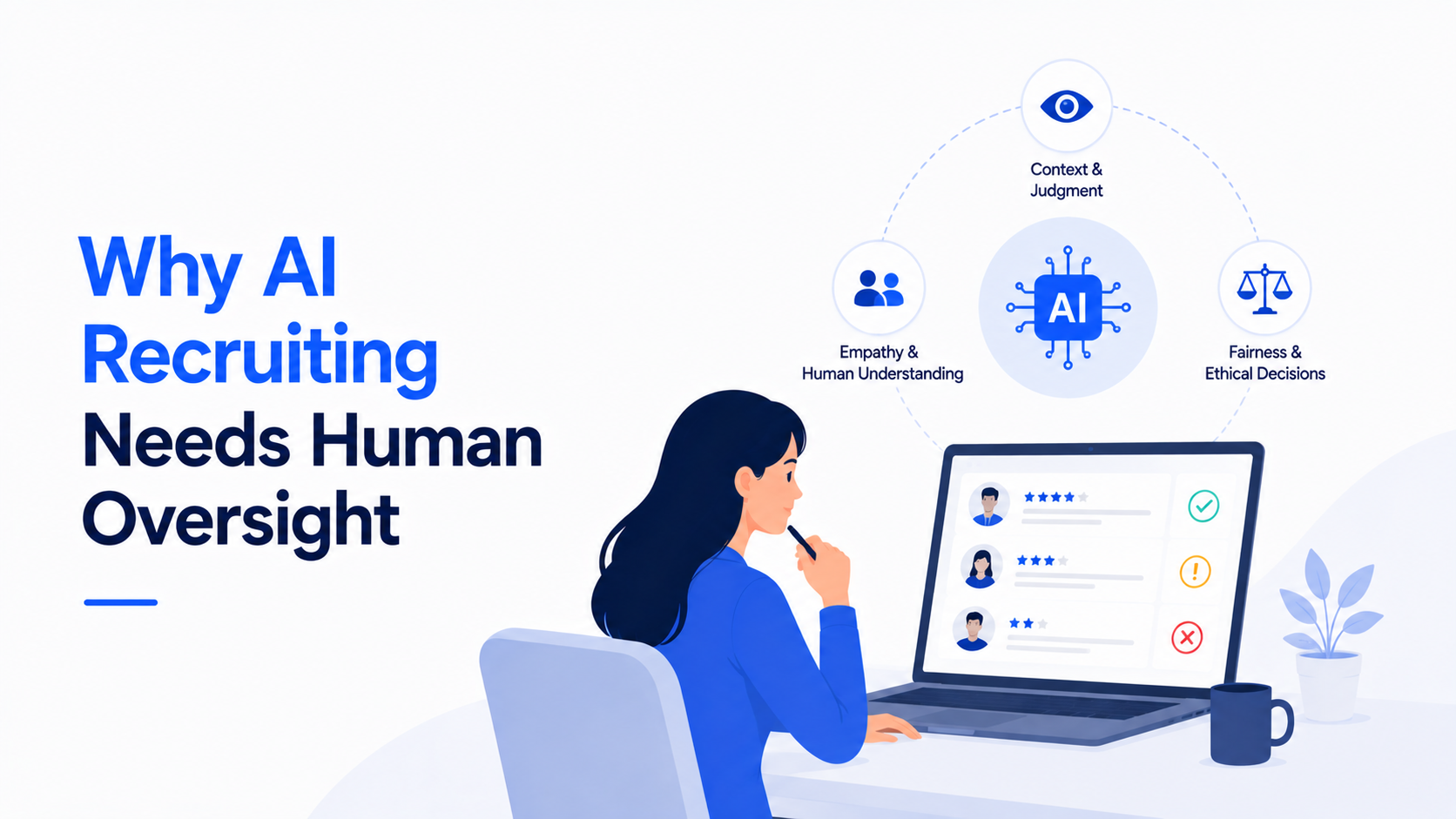
The most common form of human oversight in AI recruiting, a recruiter glancing at an AI-generated ranking and approving the top candidates, is not oversight at all. It is rubber-stamping, and it provides none of the benefits that genuine oversight is supposed to deliver. Meaningful human oversight requires three elements: the reviewer must have the time to actually evaluate the AI's output, not just confirm it; the reviewer must have the information necessary to understand why the AI made its recommendation and what alternatives were available; and the reviewer must have the authority and organizational support to override the AI when their judgment differs. When any of these elements is missing, oversight becomes performative rather than substantive. Gartner has found that in organizations where recruiters are expected to review more than fifty AI-generated candidate profiles per day, the override rate drops below two percent, suggesting that reviewers are approving rather than evaluating. In organizations where review volumes are limited to twenty profiles per day, override rates increase to twelve to fifteen percent, indicating that reviewers are exercising genuine
judgment.
Effective oversight also requires clear criteria for when human review is mandatory versus when AI-only processing is acceptable. Not every hiring decision requires the same level of human scrutiny. A high-volume screening decision for an entry-level customer service role, where the consequence of a false negative is that a qualified candidate receives a rejection email and can reapply, demands less intensive oversight than a final selection decision for a senior leadership role, where the consequence of an error is a bad hire that affects the entire organization. The key principle is proportionality: the level of human oversight should be proportional to the impact of the decision on both the candidate and the organization. Organizations should define oversight tiers that specify which decisions require full human review, which require sampling-based review, and which can be processed by AI alone with periodic human audit. AI sourcing vs AI recruiting illustrates this principle in practice, because the oversight requirements for AI sourcing, where the AI identifies potential candidates, are fundamentally different from the oversight requirements for AI selection, where the AI recommends hiring decisions.
The organizational culture around overrides is as important as the process design. In organizations where overriding the AI is seen as questioning the technology investment, recruiters will hesitate to override even when they have strong reasons to do so. In organizations where overrides are tracked, discussed, and used as feedback to improve the AI's performance, overrides become a source of organizational learning rather than an admission of system failure. The most effective oversight cultures treat the relationship between AI recommendations and human judgment as collaborative rather than hierarchical. The AI surfaces patterns and efficiencies that humans might miss. Humans provide context, judgment, and ethical reasoning that the AI cannot replicate. When this collaboration works well, the combined human-AI system produces better hiring decisions than either could achieve alone. more tools same hiring problems explains why organizations that layer multiple AI tools without designing human oversight into the interaction between them often find that their oversight processes cannot keep pace with the complexity of the combined system, resulting in gaps where no human is reviewing decisions that significantly affect candidates.
The Path Forward: Oversight as Competitive Advantage
Organizations that treat human oversight as a burden, a compliance cost to be minimized, will always implement the minimum viable oversight and will always be vulnerable to the failures that minimum oversight produces. Organizations that treat human oversight as a design principle, a core feature of their hiring system rather than an afterthought, will build processes that are both more effective and more resilient. The difference is not primarily one of cost. Meaningful human oversight does not require doubling the recruiting team or eliminating AI. It requires designing the AI-human workflow so that human attention is directed to the decisions where it adds the most value, providing reviewers with the information and time they need to exercise genuine judgment, and creating an organizational culture that values human
judgment as a complement to AI efficiency rather than a competitor to it. Deloitte has found that organizations with mature AI oversight practices in recruiting report not only fewer fairness incidents but also higher recruiter satisfaction and lower recruiter turnover, because recruiters feel empowered rather than replaced by the technology.
The competitive advantage of effective oversight extends to candidate experience and employer brand. When candidates know that a human will review their application at key decision points, they are more likely to provide complete and honest information, more likely to engage with the process rather than treating it as a black box, and more likely to accept offers when they are extended. In a market where top candidates have multiple options, the candidate experience produced by the hiring process is a meaningful differentiator. Organizations that combine AI efficiency with human warmth and judgment create an experience that neither purely manual nor purely automated processes can match. AI tools for niche technical roles demonstrates why this combination is especially valuable for specialized and technical roles, where the candidate pool is small, candidates have multiple options, and the cost of losing a qualified candidate to a competitor's better process is disproportionately high.
The future of AI in recruiting is not fully autonomous hiring. It is intelligently augmented hiring, where AI handles the volume and complexity that humans cannot manage alone, and humans provide the judgment, empathy, and accountability that AI cannot provide at all. The organizations that will win the talent competition over the next decade are not those that deploy the most AI or the least. They are those that deploy AI with the most thoughtful and effective human oversight, because they will make better hiring decisions, build stronger candidate relationships, face lower legal and reputational risk, and create recruiting operations that are both efficient and trustworthy. The question is not whether to combine AI with human oversight. The question is how to do it well, and the organizations that answer that question first will have a durable advantage that is difficult for competitors to replicate.