Nadia Al-Rashidi, a partner at a leading management consulting firm specializing in HR technology, had spent fifteen years advising enterprise clients on HRTech strategy. In her annual market review presentation to the firm's partners, she opened with a simple observation: every major trend she had identified at the beginning of the year had been accelerated or amplified by AI. Skills intelligence, projected to reach mainstream adoption by 2027, was already being deployed by forty percent of her clients. Platform consolidation, expected to proceed gradually, was accelerating as AI-native vendors acquired or displaced legacy point solutions. Even the criteria her clients used to evaluate HRTech vendors had shifted, with data quality and AI capability now ranking above feature breadth and vendor tenure for the first time. Al-Rashidi told her partners the HRTech industry was experiencing not an incremental evolution but a structural transformation, and that consulting firms, vendors, and buyers all needed to update their frameworks to account for a market fundamentally different from the one that existed eighteen months earlier.
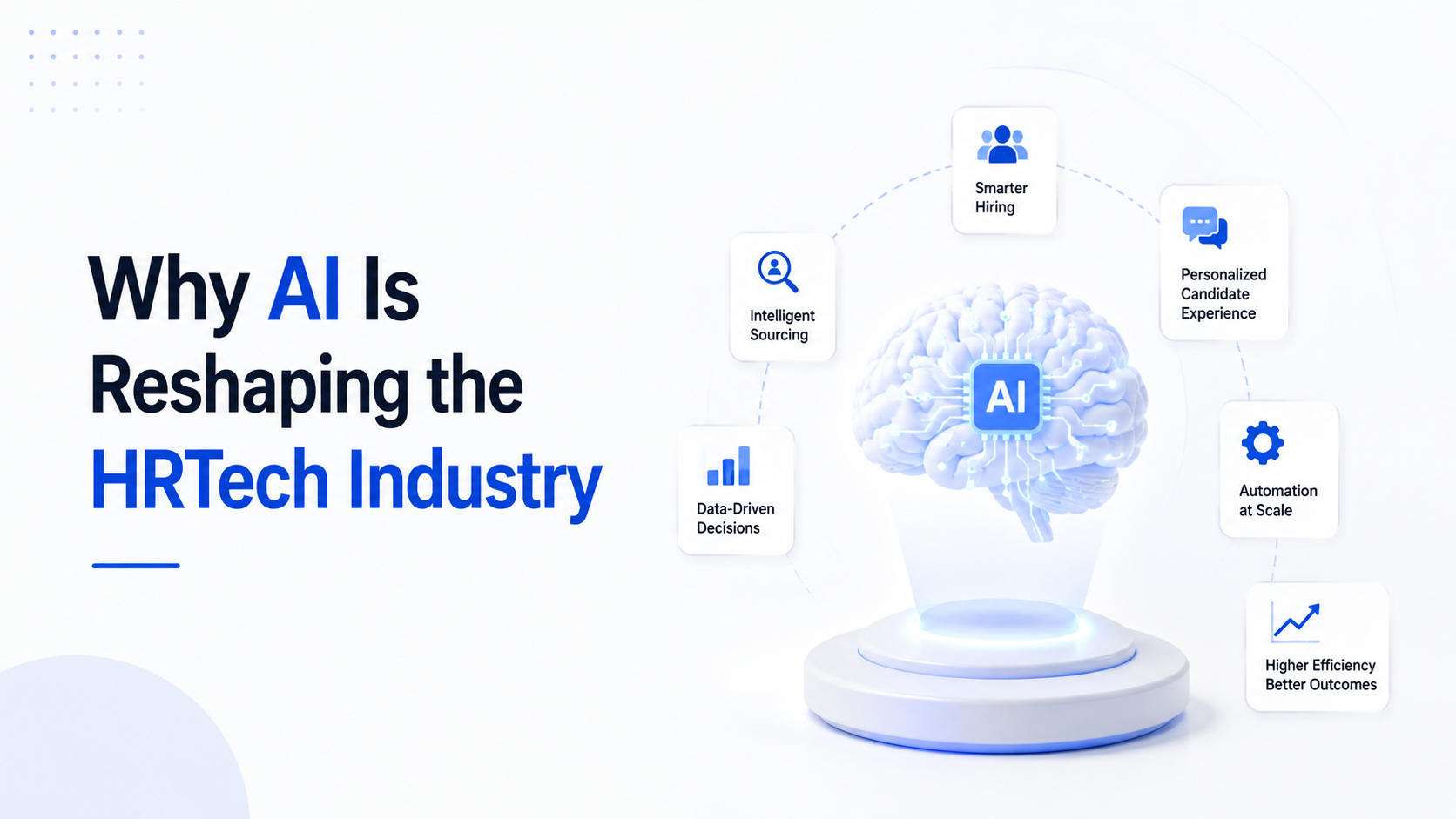
AI Is Changing What HRTech Products Actually Do
The most fundamental way AI is reshaping the HRTech industry is by changing the core value proposition of HR technology products. For most of the industry's history, HRTech products were tools that helped HR professionals execute tasks more efficiently. An ATS managed the hiring workflow. A performance management system tracked reviews. A learning
management system delivered courses. The value was in process automation and data recording. AI is shifting this value proposition from task execution to intelligence generation. Modern HRTech products do not merely record what happened or streamline how it happened. They analyze patterns, predict outcomes, and recommend actions. A recruiting platform does not just track candidates through a pipeline but identifies which candidates are most likely to succeed, predicts offer acceptance probability, and recommends optimal outreach timing. A performance management system does not just record ratings but identifies flight risks, recommends development actions, and predicts future performance trajectories. According to McKinsey, the percentage of HRTech product value that comes from intelligence capabilities rather than process automation has increased from roughly fifteen percent in 2022 to over forty-five percent in 2026, a shift that is fundamentally changing what buyers expect from their HR technology investments and how vendors design, price, and differentiate their products.
This shift in product value has profound implications for how HRTech vendors invest in research and development. In the previous era, R&D investment was directed primarily toward building new features and expanding the breadth of the product's capability set. In the AI era, a significant and growing portion of R&D investment is directed toward improving the quality of the product's intelligence, which means improving data quality, refining machine learning models, and developing new analytical capabilities. This investment shift creates a different competitive dynamic. Feature competition, where vendors raced to add the most capabilities, rewarded large vendors with extensive engineering resources. Intelligence competition, where vendors compete on the quality of their AI outputs, rewards vendors with the best data, the most sophisticated models, and the deepest domain expertise in HR and talent management. According to Gartner HRTech innovation research, the vendors gaining the most market share in the current cycle are those that allocate the highest percentage of R&D spending to AI and data capabilities, regardless of their overall engineering team size, because intelligence quality is now a more important driver of buying decisions than feature breadth.
For buyers, the shift from task execution to intelligence generation changes what they should look for in HRTech products. A product with an extensive feature list but weak AI capabilities will deliver less value than a product with fewer features but stronger intelligence, because the intelligence capabilities produce insights and recommendations that improve hiring, retention, and workforce planning outcomes in ways that feature-rich but intelligence-poor products cannot match. This is a significant change in buyer behavior that is still working its way through the market. Many organizations continue to evaluate HRTech products using feature comparison frameworks that were designed for the previous era, and these organizations consistently select products that underperform relative to their potential because they optimize for the wrong criteria. The organizations that have updated their evaluation frameworks to weight AI capability, data quality, and intelligence output quality alongside traditional feature and usability criteria are making significantly better technology investments and realizing measurably better HR outcomes. The HRTech industry's value proposition is changing, and buyer evaluation frameworks must change with it.
The Architectural Shift From Feature Stacks to Intelligence Layers
Beyond changing what products do, AI is changing how products are built. The dominant architectural pattern in HRTech for the past two decades has been the feature stack, a layered collection of modules where each module adds a specific functional capability on top of a shared database and workflow engine. AI is introducing a new architectural pattern, the intelligence layer, a platform-wide AI capability that sits above the functional modules and provides cross-functional intelligence that no individual module can deliver on its own. The intelligence layer can analyze data from recruiting, performance, learning, and compensation modules simultaneously, producing insights that connect talent acquisition decisions to workforce development outcomes. The question of how to evaluate an AI sourcing tool before buying extends to evaluating entire HRTech architectures, because the intelligence layer's value depends on the quality of data flowing into it from all connected modules. According to Deloitte HRTech architecture research, organizations using platforms with well-implemented intelligence layers report thirty to forty percent better cross-functional workforce insights than those using traditional feature-stack architectures, because the intelligence layer can analyze patterns across functional boundaries that module-specific analytics cannot cross.
The intelligence layer architecture also changes how HRTech products improve over time. In a feature stack architecture, products improve when engineers build new features or enhance existing ones, a process that requires deliberate development effort for each improvement. In an intelligence layer architecture, products improve continuously as the AI models learn from the data flowing through the system. Every hiring decision, every performance review, every promotion, and every departure provides training data that refines the platform's predictive models and improves its recommendations. This creates a compounding improvement dynamic where the platform becomes more valuable with use, a fundamentally different value curve than the feature-stack model where value is determined by the features the vendor has chosen to build. According to EY enterprise technology analysis, organizations using intelligence-layer platforms report that the platform's recommendations improve by ten to fifteen percent in accuracy per year as the models accumulate organizational data, a rate of improvement that feature-stack architectures cannot match because their capabilities are limited to what the vendor's engineering team has explicitly built.
For HRTech vendors, the architectural shift creates both an opportunity and a threat. The opportunity is that intelligence-layer platforms can deliver dramatically more value to customers, creating stronger retention, higher expansion revenue, and more defensible competitive positions. The threat is that building a genuine intelligence layer requires significant investment in data infrastructure, machine learning expertise, and organizational commitment to AI-first design principles, investments that legacy vendors with large installed bases and complex existing architectures may struggle to make. This dynamic is creating a bifurcation in the HRTech market between vendors who have successfully transitioned to intelligence-layer architectures and those who are still operating on feature-stack architectures with AI
features bolted on top. The gap between these two groups is widening as the intelligence-layer vendors compound their advantages through continuous learning, and the feature-stack vendors face increasing difficulty matching the intelligence outputs that buyers now expect. For buyers, the architectural question, whether a vendor has a genuine intelligence layer or a feature stack with AI add-ons, is now one of the most important evaluation criteria because it determines the platform's trajectory, its ability to improve over time, and the ceiling of value it can deliver.
Data Has Become the Primary Currency of HRTech Value
If AI is the engine driving the HRTech transformation, data is the fuel. The quality, freshness, and coverage of the data flowing through an HRTech platform now determines the quality of its intelligence outputs more than any other factor, including the sophistication of its algorithms. This is a structural change in how HRTech value is created and distributed. In the previous era, value was created primarily through software engineering: better workflows, more features, and more intuitive interfaces. In the AI era, value is increasingly created through data operations: acquiring, cleansing, validating, and maintaining the data that powers AI models. The concern about whether some AI recruiting tools rely on outdated candidate data is a specific instance of a general principle that applies across the entire HRTech industry, which is that data quality directly determines AI quality, and AI quality directly determines product value. According to SHRM talent acquisition technology research, data quality has replaced feature functionality as the top-rated evaluation criterion for AI-powered HRTech products, because buyers have learned that impressive AI capabilities produce disappointing results when powered by poor-quality data.
The elevation of data as the primary value currency is changing the competitive dynamics of the HRTech industry in several important ways. First, it creates a data advantage that compounds over time. Platforms with larger, fresher, and more comprehensive datasets produce better AI outputs, which attract more customers, which generates more data, which further improves the AI outputs. This flywheel effect means that early movers in data-driven HRTech can build advantages that are extremely difficult for late entrants to replicate. Second, it changes the basis of vendor competition. Vendors that have invested in proprietary data assets, such as comprehensive talent market databases, skills taxonomies, or compensation benchmarks, have a structural advantage over vendors who rely on publicly available data. Third, it creates new business models. Data enrichment services, where vendors enhance customer data with external intelligence, are becoming a significant revenue stream for HRTech vendors. According to LinkedIn talent solutions research, HRTech vendors with proprietary data assets are growing revenue twenty to thirty percent faster than those relying on commodity data, because data quality has become the primary driver of customer retention and expansion in AI-powered products.
For organizations investing in HRTech, the data-is-currency principle has practical implications for technology strategy. Data governance, the policies and processes that ensure data quality, consistency, and security, must be elevated from an IT concern to a strategic HR
capability. Organizations that deploy AI-powered HRTech platforms without investing in the data governance infrastructure to support them consistently underperform organizations that treat data quality as a co-equal investment alongside software licenses. This means allocating budget for data auditing, establishing data quality standards for HR data, implementing automated validation processes, and building the organizational discipline to maintain data quality over time. The organizations that make these investments alongside their technology deployments will get significantly more value from their HRTech platforms because the AI models will operate on reliable, current data rather than the incomplete and inconsistent data that characterizes many HR systems. Data governance is not the most exciting aspect of HRTech strategy, but in the AI era it is the one that most directly determines whether the technology investment delivers on its promise.
AI Is Redefining Vendor Competition and Business Models
The competitive landscape of the HRTech industry is being restructured by AI in ways that are changing which vendors win, how they sell, and what they charge. In the previous era, HRTech competition was primarily about feature breadth, brand reputation, and sales execution. The vendors with the longest feature lists, the strongest brand recognition, and the largest sales teams dominated enterprise buying decisions. AI is disrupting this competitive order because intelligence quality, which depends on data assets, model sophistication, and domain expertise rather than sales reach, is becoming the primary buying criterion. Smaller, AI-native vendors with superior intelligence capabilities are winning deals against larger incumbents who have more features but weaker AI. This competitive disruption is most visible in talent acquisition, where AI-native platforms have captured significant market share from established ATS vendors, but it is spreading to other HRTech categories as AI capabilities mature. The evidence that referrals outperform cold outreach in hiring effectiveness illustrates a broader competitive principle that applies to HRTech vendors as well: approaches that leverage proprietary data and intelligence consistently outperform those that rely on scale and reach alone. According to McKinsey HRTech competitive analysis, the correlation between vendor AI capability and new deal win rates has increased from roughly thirty percent in 2022 to over seventy percent in 2026, indicating that AI quality has become the dominant factor in competitive outcomes.
AI is also changing HRTech business models. The traditional model of selling perpetual or subscription licenses based on user seats or employee count is being supplemented and in some cases replaced by outcome-based and usage-based pricing models that align vendor revenue with the value the platform delivers. An AI recruiting platform that charges based on successful placements rather than per-user licenses aligns the vendor's incentive with the customer's outcome. An AI analytics platform that charges based on the number of insights generated or actions recommended aligns revenue with intelligence production rather than seat count. These new pricing models are possible because AI platforms can measure their impact more precisely than previous-generation tools, creating the data foundation for outcome-based commercial arrangements. According to Gartner HRTech pricing trend research, the percentage of HRTech vendors offering outcome-based or usage-based pricing options has
doubled since 2023, and early adopters of these models report higher customer satisfaction and lower churn because the pricing structure creates a direct alignment between vendor investment in product quality and customer value realization.
The combination of competitive restructuring and business model innovation is creating a market environment that favors agility and AI expertise over scale and incumbency. Vendors who can rapidly improve their AI capabilities, incorporate new data sources, and adapt their products to evolving customer needs are outperforming vendors who rely on the scale advantages that defined previous competitive eras. For enterprise buyers, this market environment creates both opportunity and risk. The opportunity is access to more capable and more innovative products than ever before, with vendors competing aggressively on AI quality and outcome delivery. The risk is that selecting a vendor who is currently leading in AI capability but lacks the financial resources or organizational agility to maintain that lead can result in a technology investment that underperforms expectations as the market continues to evolve rapidly. The most effective approach to vendor selection in this environment is to evaluate not only current AI capability but also the vendor's data assets, R&D investment trajectory, and organizational capacity for continued innovation, because these factors determine whether a vendor's current AI advantage is sustainable or temporary.
What the AI-Driven HRTech Transformation Means for Buyers
For organizations investing in HR technology, the AI-driven transformation of the HRTech industry requires updated thinking across every dimension of the technology lifecycle, from evaluation and selection to implementation and optimization. The evaluation frameworks that worked for previous-generation HRTech products, which emphasized feature checklists, vendor stability, and integration breadth, must be expanded to include AI capability assessment, data quality evaluation, and architectural analysis. Whether AI recruiting tools are effective for specific hiring segments, particularly specialized or niche and technical roles, depends directly on the quality and specificity of the data and models the platform applies to those segments. A platform that delivers strong results for high-volume professional hiring may underperform for specialized technical roles if it lacks the domain-specific data and modeling required for those talent segments. According to Deloitte HRTech buying research, organizations that have updated their evaluation frameworks to include AI-specific criteria report forty to fifty percent higher satisfaction with their technology selections than those using traditional evaluation approaches, because the updated frameworks identify capability gaps and data quality issues that traditional frameworks miss.
The implementation approach must also evolve. Deploying an AI-powered HRTech platform is fundamentally different from deploying a traditional HR software tool. AI platforms require data preparation, model training, outcome measurement, and continuous optimization in ways that traditional software does not. Organizations that treat AI platform deployment as a standard IT project, following the same project management methodology they would use for any other software implementation, consistently underperform organizations that treat it as a capability-building initiative that requires ongoing investment and attention. The most
successful AI HRTech implementations are those that combine technology deployment with deliberate investment in data governance, recruiter training, process redesign, and outcome measurement, creating an organizational capability that improves continuously rather than degrading over time. According to LinkedIn enterprise talent research, organizations that invest in these complementary capabilities alongside their AI platform deployments report sixty to seventy percent faster time-to-value and significantly higher long-term ROI than those that focus solely on the technology deployment itself, because the complementary investments ensure that the organization can actually leverage the platform's capabilities rather than letting them go underutilized.
Looking ahead, the AI-driven transformation of HRTech will continue to accelerate. The capabilities that are currently considered advanced, such as predictive hiring analytics, automated candidate engagement, and skills-based workforce planning, will become baseline expectations within two to three years. The next wave of AI innovation in HRTech will likely focus on prescriptive intelligence, where platforms do not only predict outcomes but recommend specific actions to optimize those outcomes, and on enterprise-wide talent intelligence, where HRTech platforms connect workforce data to business strategy in ways that elevate HR from a support function to a strategic advisory capability. For HR leaders, the imperative is clear: the AI transformation of HRTech is not a future trend to monitor but a current reality that is reshaping the technology landscape in real time. Organizations that build the data foundations, evaluation capabilities, and organizational readiness to leverage AI-powered HRTech will gain competitive advantages in talent acquisition, workforce management, and strategic planning that compound over time. Those that delay will face not only the cost of less effective technology but the strategic cost of falling behind competitors who are building the intelligence capabilities that will define the next era of HR.