When Martin Vasquez took over as Head of Talent Acquisition at Helios Manufacturing in mid-2024, his first internal presentation included a slide that showed the company's recruiting technology stack: four ATS modules, two standalone sourcing tools, a separate assessment platform, an interview scheduling tool, and a spreadsheet that his team used to track data that none of the other tools could capture. His operations director, Lisa Chen, had counted the manual data entry steps required to move a single candidate through the full hiring process. The number was forty-seven. Forty-seven separate manual actions to move one person from initial contact to offer acceptance, across six different systems, none of which shared data automatically. Vasquez did not present this slide to complain about the tools themselves. Each one had been purchased to solve a real problem. The problem was that solving problems one tool at a time, without an intelligent layer connecting them, had created a system that was more complex than the hiring process it was supposed to support. He told his leadership team that the question was not whether to replace individual tools but whether to adopt a fundamentally different kind of platform: an AI hiring operating system that could orchestrate the entire process intelligently rather than just recording it.
The ATS Was Built for a Different Era
The applicant tracking system was one of the most important enterprise software innovations of the early 2000s. Before ATS platforms became standard, recruiting was managed through spreadsheets, email folders, and physical filing systems. The ATS brought order to this chaos by defining hiring stages, assigning responsibilities, recording decisions, and generating
compliance reports. For organizations managing hundreds or thousands of hires annually, this structuring capability was transformative. The ATS solved a real problem, and it solved it well enough to become the foundational technology for an entire generation of recruiting operations. But the problem it solved was fundamentally about record-keeping and process management, not about intelligence or decision-making.
The architectural foundation of every major ATS reflects this origin. These platforms were designed around a transactional data model: a candidate applies, the record moves through a series of stages, actions are logged, and a hire decision is recorded. Each step in the process is a discrete event that the system captures and displays. This architecture is excellent for answering questions like where is this candidate in the process, how many candidates are at each stage, and what was the time-to-fill for this requisition. These are important operational questions, but they are backward-looking questions. They describe what has happened, not what should happen next. McKinsey research on recruiting technology evolution notes that the ATS architecture has remained essentially unchanged for over fifteen years, even as the complexity and speed of hiring have increased dramatically.
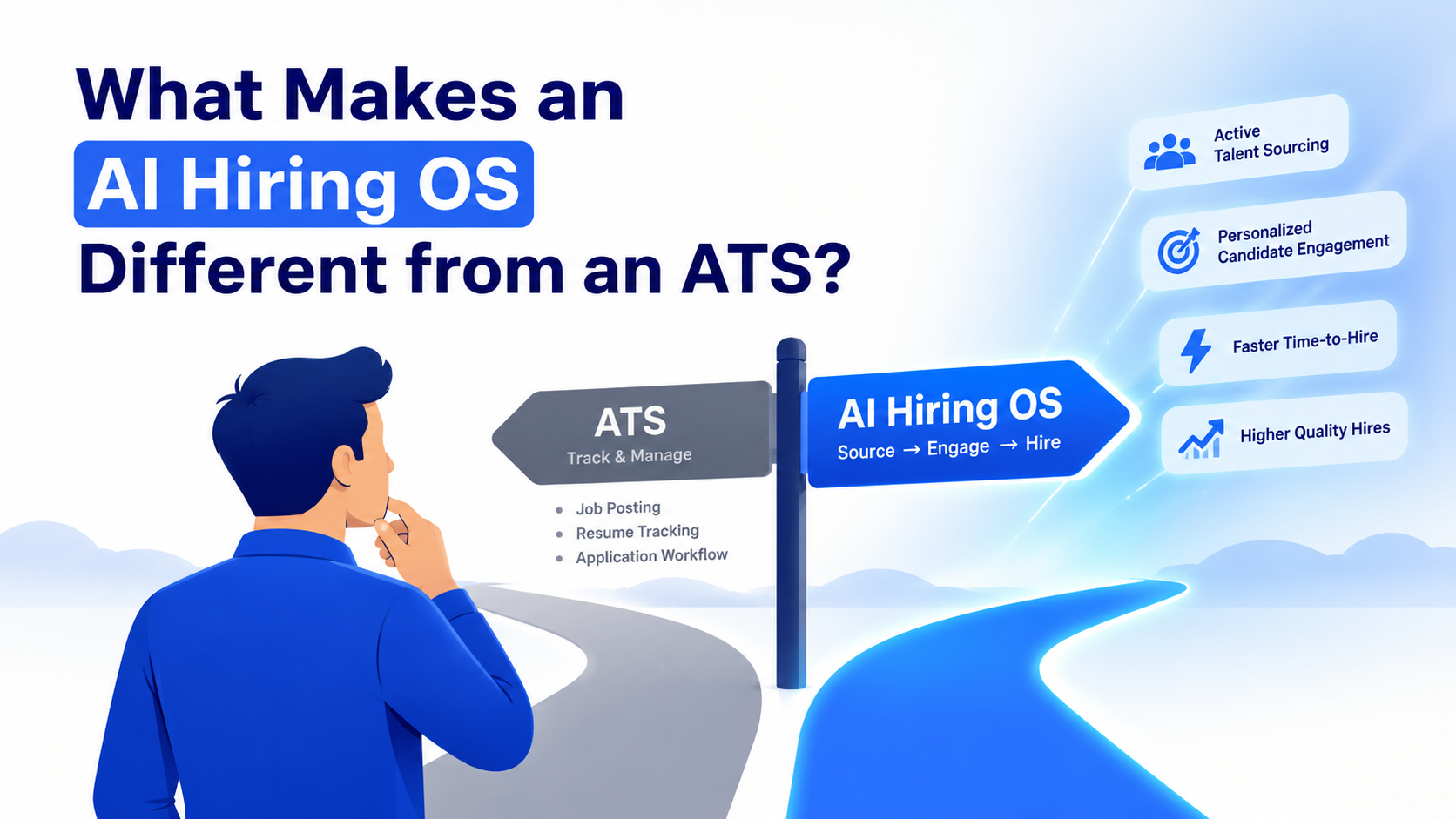
The limitations of this architecture become apparent the moment you ask a forward-looking question. An ATS cannot tell you which candidates in your pipeline are most likely to accept an offer if you extend one. It cannot predict which requisitions will be hardest to fill based on current market conditions. It cannot suggest the optimal sequence of interviewers for a specific candidate based on their background and the hiring team's assessment patterns. These are the questions that recruiting leaders actually need answered, and they require an entirely different kind of system. The distinction between agentic AI platforms vs automated ones AI platforms and traditional ATS tools is fundamentally an architectural distinction. An agentic system generates actions and recommendations, while a traditional system records actions that humans have already taken.
What an AI Hiring OS Actually Does
An AI hiring operating system does not just track the hiring process. It actively manages significant portions of it. Where an ATS records that a candidate was contacted, an AI hiring OS determines the best way to contact them, generates a personalized message, selects the optimal send time, and tracks the response. Where an ATS displays a list of candidates for a recruiter to sort through, an AI hiring OS ranks them by predicted fit, highlights the most promising candidates, and explains the reasoning behind each ranking. Where an ATS requires a hiring manager to manually review interview feedback, an AI hiring OS synthesizes feedback from multiple interviewers, identifies areas of agreement and disagreement, and surfaces the most relevant insights for the hiring decision.
The key difference is that an AI hiring OS operates as a decision-support system rather than a record-keeping system. It continuously analyzes data from across the hiring process and uses that analysis to generate recommendations, automate routine decisions, and flag situations
that require human attention. Gartner technology assessments of AI-native hiring platforms identify this continuous analytical capability as the defining feature that separates them from traditional ATS platforms. An ATS can tell you what happened. An AI hiring OS can tell you what is likely to happen next and what you should do about it. This shift from passive recording to active intelligence is not a feature addition. It is a fundamental change in the relationship between the platform and the recruiting team.
The practical implications of this difference are substantial. Recruiters using a traditional ATS spend a significant portion of their time on data entry, status updates, and coordination tasks that the system could handle but does not. Recruiters using an AI hiring OS spend their time on activities that require human judgment: building relationships with candidates, consulting with hiring managers on role requirements, and making nuanced hiring decisions. The AI tools for niche technical roles challenge of filling highly specialized roles illustrates this dynamic. A traditional ATS can track the candidates sourced for a niche role, but an AI hiring OS can proactively identify candidates with adjacent skills, predict which sourcing channels will be most effective, and recommend engagement strategies tailored to the specific candidate profile. The platform is not just supporting the recruiter. It is extending their capabilities.
Data Architecture: Records vs. Intelligence
The most fundamental difference between an ATS and an AI hiring OS lies in how they handle data. A traditional ATS stores data in structured tables: candidate records, job requisitions, interview scores, and status fields. Each data point exists in isolation, connected to other data points through relational links but not through semantic understanding. The ATS knows that a candidate has a specific skill listed on their resume, but it does not understand what that skill means, how it relates to other skills, or whether it is relevant to a specific open role. The data is stored, not understood. An AI hiring OS, by contrast, builds a semantic layer on top of the data that enables the system to understand relationships, infer capabilities, and make predictions. Deloitte technology architecture analysis describes this as the shift from a database-centric architecture to an intelligence-centric architecture.
This semantic understanding enables capabilities that are impossible in a traditional ATS. Consider the challenge of matching a candidate to a role. In an ATS, matching is typically keyword-based: the system looks for overlap between the words in a job description and the words on a candidate resume. This approach misses candidates who have the right capabilities but use different terminology, and it surfaces candidates who use the right keywords but lack the actual experience. An AI hiring OS uses semantic understanding to match on capabilities rather than keywords, recognizing that a candidate who led a data migration project may be well-suited for a data engineering role even if their title was business analyst. The difference in matching quality is not marginal. It is transformative, particularly for organizations hiring for technical or specialized roles where talent pools are small and keyword matching produces high rates of both false positives and false negatives.
The data architecture difference also affects how the system improves over time. A traditional ATS accumulates data but does not learn from it. The same search returns the same results regardless of how many times it has been run. An AI hiring OS continuously learns from every interaction, every hiring outcome, and every piece of feedback. LinkedIn research on AI platform learning curves shows that these systems become measurably more accurate over time as they accumulate more data about what works and what does not. This learning capability means that the value of an AI hiring OS compounds, while the value of a traditional ATS remains flat. Organizations that invest in an AI hiring OS are not just buying a tool. They are investing in a system that will be more capable a year from now than it is today.
Process Management vs. Process Intelligence
Every ATS defines a hiring process: stages like sourcing, screening, interview, offer, and hire. The system enforces these stages, tracks progress through them, and generates reports on where candidates are. This process management capability was the ATS original value proposition, and it remains useful. But process management and process intelligence are fundamentally different things. Process management ensures that steps are followed. Process intelligence optimizes which steps should be taken, by whom, in what order, and with what inputs. An AI hiring OS provides process intelligence by analyzing the effectiveness of the hiring process in real time and recommending adjustments.
For example, when a hiring process stalls, a traditional ATS can report that the process is stalled. An AI hiring OS can diagnose why it is stalled, predict whether the stall will lead to a candidate dropping out, and recommend a specific intervention to restart momentum. When interview feedback is inconsistent, a traditional ATS can display the conflicting feedback side by side. An AI hiring OS can identify the specific dimensions where interviewers disagree, assess whether the disagreement reflects genuine ambiguity in the candidate qualifications or inconsistency in the interview process, and recommend follow-up questions that would resolve the ambiguity. The research on more tools same hiring problems accumulating in recruiting departments is directly relevant here. Adding more process management tools, more stages, and more checkpoints to a hiring process does not improve outcomes if the underlying process is poorly designed. An AI hiring OS addresses this by continuously optimizing the process itself, not just managing it.
EY analysis of recruiting process effectiveness finds that organizations with intelligent process optimization consistently outperform those with static process management on every key hiring metric. Time-to-hire is shorter because the system identifies and removes bottlenecks in real time. Quality of hire is higher because the system optimizes the evaluation process to focus on the most predictive signals. Candidate experience is better because the system adapts the process to the candidate needs and preferences rather than forcing every candidate through an identical sequence. The shift from process management to process intelligence is analogous to the shift from a map to a GPS navigation system. A map shows you the route. A GPS system shows you the best route based on current conditions and adjusts
when conditions change. That is the difference between an ATS and an AI hiring OS.
The Candidate Experience Divide
The candidate experience produced by a traditional ATS reflects its transactional architecture. LinkedIn survey data on candidate expectations confirms that the technology experience is now a primary factor in how candidates evaluate potential employers, and the gap between candidate expectations and ATS capabilities continues to widen. Candidates fill out lengthy application forms, wait for responses that may or may not come, navigate opaque process stages, and receive generic communications that could have been sent to anyone. The ATS treats every candidate as a record to be processed, not as a person to be engaged. This is not because the organizations using ATS platforms do not care about candidate experience. It is because the platform architecture makes personalized, responsive candidate engagement structurally difficult. Every personalization requires a manual action by a recruiter, and recruiters do not have time to personalize at scale.
An AI hiring OS inverts this dynamic. Because it continuously analyzes candidate data and interaction history, it can personalize every touchpoint without requiring manual recruiter effort. Gartner research on candidate experience and technology finds that AI-powered platforms deliver measurably better candidate experience scores than traditional ATS platforms, primarily because they can maintain context across the entire candidate journey. A candidate who had a phone screen three weeks ago and is now being contacted about a different role does not have to re-explain their background, because the system remembers and uses that context to inform the new interaction. This kind of continuous, contextual engagement is impossible on a traditional ATS because the system treats each interaction as a separate event rather than as part of an ongoing relationship.
The practical impact of this experience divide is measurable in conversion rates and employer brand perception. McKinsey research on talent acquisition competitiveness shows that candidate experience is now one of the top three factors influencing whether high-caliber candidates accept offers, and that the technology platform used to manage the hiring process is a visible and tangible component of that experience. When a candidate interacts with an intelligent, responsive system that understands their background and communicates with relevance, they infer that the organization values talent and invests in its people. When they interact with a rigid, impersonal system that treats them as a data record, they infer the opposite. The technology platform is not invisible to candidates. It is one of their earliest and most direct experiences of the employer brand.
Making the Transition: What Talent Leaders Need to Know
For organizations considering a transition from a traditional ATS to an AI hiring OS, the most important thing to understand is that this is not a like-for-like technology replacement.
Moving from one ATS to another ATS is a migration: you map your existing processes and data from the old system to the new one, and the change is primarily operational. Moving from an ATS to an AI hiring OS is a transformation: you are fundamentally changing how recruiting works, what recruiters do, and how hiring decisions are made. Deloitte research on digital transformation in HR finds that organizations that treat AI hiring platform adoption as a transformation project achieve significantly better outcomes than those that treat it as a technology migration, with the difference in results becoming more pronounced over time. The technology change enables an operational change that requires a mindset change. Organizations that approach it as a simple software migration will be disappointed. Organizations that approach it as an operational transformation will find that the technology is the easiest part.
The transition also requires a different approach to vendor evaluation. The challenge of how many follow-ups one hire needs optimization after switching platforms illustrates a common pitfall. Organizations that evaluate AI hiring platforms using ATS-era criteria, looking at feature checklists and workflow configuration options, will miss the most important differences. The relevant evaluation criteria for an AI hiring OS include data architecture, learning capabilities, prediction accuracy, and the quality of the platform's recommendations in real-world hiring scenarios. SHRM guidance on recruiting technology evaluation recommends that organizations test platforms against their own hiring data, measuring the quality of matches, the accuracy of predictions, and the impact on recruiter productivity, rather than relying on vendor demonstrations that can be staged to highlight features that look impressive but may not deliver value in production.
The organizations that successfully make this transition share a common pattern. They start with a clear understanding of their current hiring outcomes and the specific problems they want to solve. They choose a platform that addresses those problems with AI-native capabilities rather than AI features bolted onto an ATS architecture. They invest in change management to help recruiters shift from executing processes to leveraging intelligence. And they measure success not by whether the new system replicates what the old system did, but by whether it produces measurably better hiring outcomes. The way AI blurs the traditional boundary between sourcing and recruiting is instructive. In an AI hiring OS, the platform manages both sourcing and recruiting as an integrated workflow, eliminating the handoff losses and data gaps that plague organizations using separate tools. The future of recruiting technology is not a better ATS. It is an entirely different kind of system, and the organizations that recognize this distinction earliest will build the most competitive talent acquisition functions.