There is a running joke in the recruiting technology industry that the only thing more complex than AI candidate matching algorithms is the pricing model used to sell them. Enterprise AI recruiting software vendors have mastered the art of presenting an attractive entry price while burying the real costs in footnotes, add-on modules, per-credit overage charges, and mandatory professional services. The result is that organizations routinely underestimate their actual spending on recruiting technology by 40-60%, and finance teams discover the true cost only after the contracts are signed and the invoices start arriving.
This guide exists to change that. If you're evaluating enterprise AI recruiting software — whether for a 500-person TA team at a Fortune 500 company, a 20-person staffing agency, or a 3-person internal HR department — you need to understand every component of the total cost of ownership before you sign anything. We'll break down the pricing models, expose the hidden costs, and show you how to calculate the real number so you can make an informed decision and build a budget that doesn't get blown apart in month three.
The Sticker Price vs. The Real Price: Why They're Never the Same
The first thing to understand about enterprise AI recruiting software pricing is that the number you see on the pricing page — if there even is one — is almost never the number you'll actually pay. The gap between sticker price and real price exists for several structural reasons that are consistent across the industry.
First, enterprise pricing is almost always custom-quoted. Vendors don't publish their enterprise prices because the entire business model is based on charging different organizations different amounts based on perceived willingness to pay, negotiation leverage, and competitive dynamics. Two organizations of similar size can pay dramatically different prices for the same software. A company that publicly announces it's evaluating three vendors will get a different quote than a company that approaches a single vendor with urgency. This opacity is intentional, and it means that benchmarking your price against what others pay is extremely difficult.
Second, the base price covers only a subset of the functionality you'll actually need. The base tier might include sourcing but not outreach automation. It might include email outreach but not LinkedIn messaging. It might include candidate screening but not conversational AI. Each additional capability either requires a higher tier — often with significantly broader functionality than you need, forcing you to pay for features you won't use — or an add-on module with its own pricing. By the time you configure the platform with all the capabilities your team actually needs, the monthly price can be 2-3 times the base quote.
Third, the per-seat pricing model creates a cost structure that scales with your team size rather than your usage. If you have 15 recruiters but only 8 actively use the AI sourcing tool, you still pay for 15 seats if that's what you contracted for. Vendors typically require annual commitments for a minimum number of seats, and reducing seat count mid-contract is either impossible or comes with penalties.
Fourth, and most insidiously, many platforms charge for usage on top of the seat fee. You pay per seat, and then you also pay per candidate contact exported, per email sent, per AI screening session conducted, or per API call made. This hybrid pricing model means that the more successfully your team uses the tool, the more you pay. It's the recruiting software equivalent of a mobile phone plan where using more minutes costs extra — except the "minutes" are the core value you bought the tool to deliver.
Breaking Down Enterprise Pricing Models
Enterprise AI recruiting software vendors use several distinct pricing models, and understanding which model a vendor uses is the first step to understanding your true cost.
Per-Seat Subscription With Usage Overage Charges
This is the most common enterprise pricing model, used by platforms like hireEZ, SeekOut, and Fetcher. You pay a monthly or annual fee per recruiter seat, and then you pay additional charges when your usage exceeds certain thresholds.
For example, hireEZ's enterprise pricing typically starts around $250-$400 per seat per month for a base tier that includes sourcing and basic outreach. However, the number of candidate contacts you can export per month is capped. When you exceed the cap — which active recruiters almost always do — you pay per-contact overage fees. These overage charges can add $100-$300 or more per seat per month to the effective price.
SeekOut uses a similar model. The enterprise tier, which includes technical sourcing, diversity sourcing, and advanced contact finding, is typically quoted in the $300-$500 per seat per month range. Contact finding credits are metered, and additional credits are purchased in bundles. For a team of 10 recruiters actively sourcing, the total cost including overages can easily reach $4,000-$6,000 per month.
Per-Credit or Per-Contact Pricing
Some platforms, particularly those focused on candidate contact discovery, charge primarily based on the number of candidate profiles or contact details you access. This model ties your cost directly to your recruiting activity — the more you source, the more you pay.
The danger of per-credit pricing is its unpredictability. In a month where you have several urgent searches, your costs can spike dramatically. There's no way to budget accurately because your costs depend on factors — search volume, candidate availability, sourcing difficulty — that change month to month. For organizations with predictable hiring volumes, per-credit pricing can be managed, but for most recruiting operations, it creates budgeting chaos.
Tiered Feature Gating
Rather than charging for usage, some vendors gate features behind pricing tiers. The "Professional" tier might include sourcing and email outreach but exclude LinkedIn outreach, WhatsApp messaging, and AI screening. The "Enterprise" tier might include all of those but exclude advanced analytics, custom integrations, or dedicated support. The "Premium" or "Elite" tier includes everything.
This model forces organizations to either overpay for capabilities they don't need or underpay and operate without capabilities they do need. A team that needs AI screening but not advanced analytics might have to purchase the Enterprise tier to get screening, paying for analytics they won't use. This is especially frustrating for mid-size organizations that fall between tiers.
Flat-Rate All-Inclusive Pricing
A small but growing number of vendors use flat-rate pricing where a single monthly fee covers all features, all sources, and all usage. Huntlo is the most prominent example in the AI recruiting space, charging $99 per seat per month with no per-credit charges, no feature gating, and no usage caps. This pricing model provides complete cost predictability — your monthly cost is simply the number of seats multiplied by $99, regardless of how actively your team uses the platform.
Flat-rate pricing is rare in enterprise software because it caps the vendor's revenue per customer. However, it's extremely attractive for buyers because it eliminates the budgeting uncertainty and hidden cost surprises that plague usage-based models. For organizations that value cost predictability — which is most organizations when it comes to software subscriptions — flat-rate pricing represents the lowest-risk purchasing model.
The Hidden Cost Categories That Vendors Don't Highlight
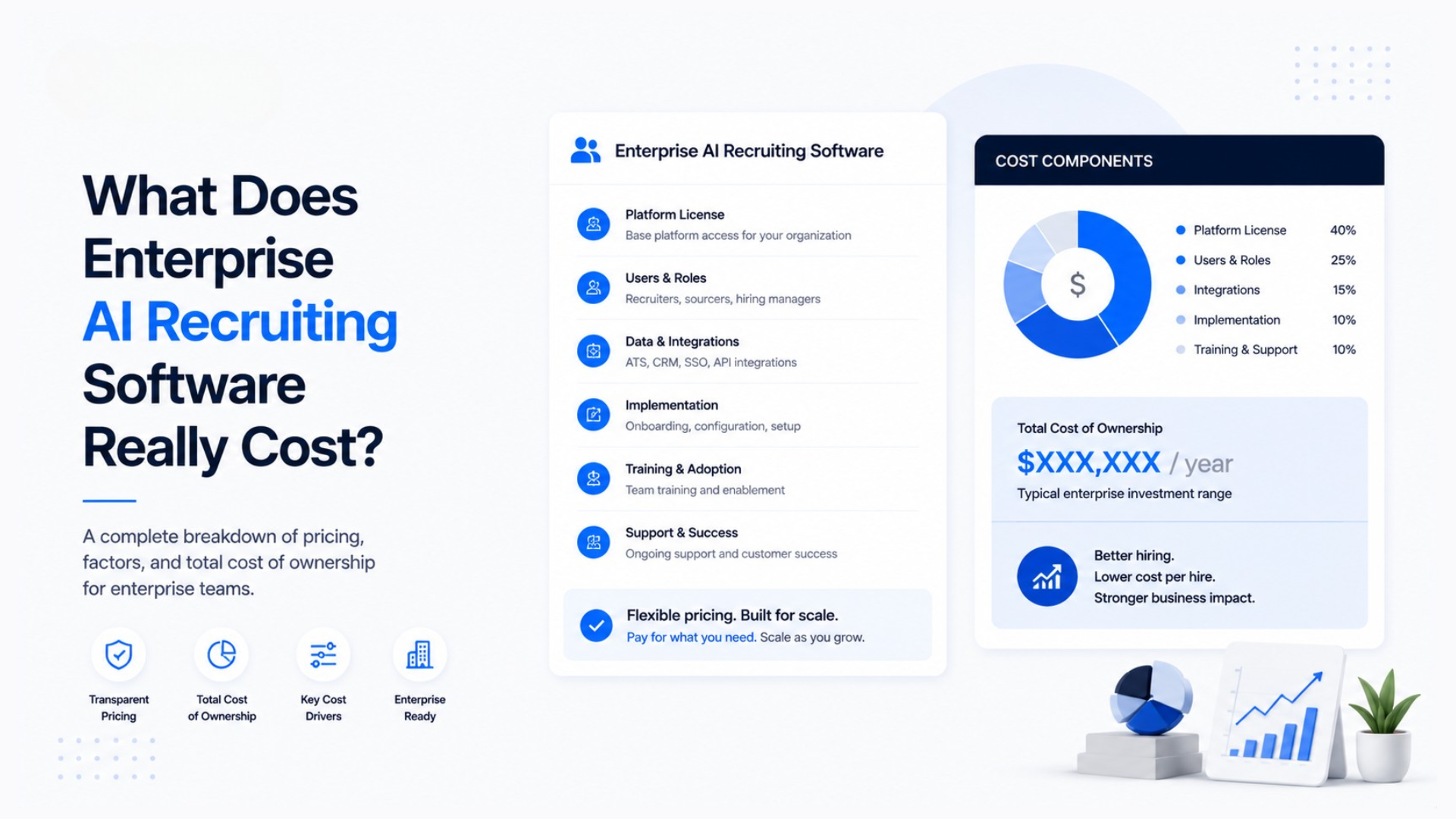
Beyond the base subscription or per-seat pricing, enterprise AI recruiting software carries several categories of hidden costs that collectively can double or triple the sticker price.
Implementation and Onboarding Fees
Most enterprise platforms charge professional services fees for implementation. These fees cover data migration from your existing systems, configuration of custom workflows, integration development with your ATS and other HR technology, and initial training for your team. Implementation fees for enterprise AI recruiting tools typically range from $2,000 to $25,000 depending on the complexity of the deployment and the level of vendor involvement required.
Platforms with webhook-based integration architectures — like Huntlo — tend to have lower implementation costs because the integrations can be configured without custom development. Platforms that require custom API development or middleware for each integration tend to have higher implementation fees because the vendor or a consultant must write and maintain code for each connection.
For a 15-person TA team deploying an enterprise AI sourcing platform, budget $5,000-$15,000 for implementation unless the vendor explicitly includes implementation in the subscription price. Most don't.
Training and Change Management Costs
Enterprise AI tools require training, and training costs money. There's the direct cost of training sessions — vendor-led training typically costs $500-$2,000 per session — and the indirect cost of your team's time during training. For a 15-person team, a two-day training program represents 240 person-hours of productivity loss, which at an average loaded recruiter cost of $50/hour translates to $12,000 in indirect costs.
Beyond initial training, there's ongoing change management. Recruiters who have used manual methods for years need ongoing support, coaching, and reinforcement to adopt AI tools effectively. Industry research suggests that without structured change management, AI tool adoption rates plateau at 30-50% of potential usage, meaning you're paying for capabilities that half your team isn't using. The cost of effective change management — whether internal or through a consultant — typically runs $2,000-$8,000 over the first year.
Integration Development and Maintenance
If the AI sourcing tool doesn't natively integrate with your ATS, HRIS, or other systems, you'll need custom integrations. Integration development costs range from $2,000-$10,000 per integration, depending on complexity. And integrations aren't one-time costs — they require ongoing maintenance as systems update and APIs change. Budget 15-20% of the initial development cost annually for integration maintenance.
This is where the choice of platform architecture matters enormously. Huntlo's webhook-based integration model allows recruiters or technically-savvy ops team members to configure ATS integrations without writing code, dramatically reducing both initial and ongoing integration costs. Platforms that require proprietary connectors or middleware add both cost and dependency on the vendor's integration roadmap.
Annual Price Escalators
Most enterprise contracts include annual price increases of 5-15%. These escalators are often buried in the contract terms and may be expressed as "annual licensing adjustments" or "index-based pricing updates." Over a three-year contract, a 10% annual escalator increases your cost by approximately 33% by year three.
When evaluating a tool, ask specifically about annual escalators and factor them into your three-year total cost of ownership calculation. A platform that looks $50/seat/month cheaper in year one can be more expensive than an alternative by year three if the cheaper option has a 12% annual escalator while the alternative has none.
Data Storage and Export Costs
Some enterprise platforms charge for data storage when you retain candidate profiles and sourcing history beyond a certain period. Others charge for data export — if you decide to leave the platform, exporting your candidate data may incur a fee. These costs are rarely discussed during the sales process but appear in the contract terms.
Before signing any contract, verify that you own your data, that you can export it at any time without additional cost, and that there are no data retention fees. If the vendor won't guarantee these terms in writing, that's a significant red flag.
Underutilization Costs
This is the hidden cost that nobody talks about, and it's often the largest. If your team pays for an enterprise AI sourcing tool but only uses 40% of its capabilities because the tool is too complex, the training was inadequate, or the workflows don't fit your operation, you're effectively paying 250% of what you should be paying for the value you're actually receiving.
According to research from the Technology Services Industry Association, the average enterprise software utilization rate is just 35-45% of purchased capabilities. In recruiting technology, where tools are often purchased based on feature lists rather than workflow fit, utilization rates can be even lower. A platform that costs $400/seat/month but is only 40% utilized has an effective cost of $1,000/seat/month for the features your team actually uses.
Real-World Cost Breakdowns by Platform
Let's apply this framework to specific platforms, estimating the true total cost of ownership for a 10-recruiter deployment over 12 months.
SeekOut Enterprise — Estimated True TCO
Per-seat pricing (Enterprise tier): $350/seat/month × 10 seats = $3,500/month
Contact credit overages (estimated): $800/month
Implementation (professional services): $8,000 one-time
Training: $3,000 one-time
Annual escalator (estimated 8%): applied to months 7-12
Integration with ATS (if custom): $5,000 one-time
Year 1 total cost: approximately $56,000-$65,000
This represents an effective cost of $4,670-$5,420 per seat per month when implementation, training, and overages are included — roughly 3-4 times the base per-seat price.
hireEZ Enterprise — Estimated True TCO
Per-seat pricing: $300/seat/month × 10 seats = $3,000/month
Candidate export overages (estimated): $1,000/month
Implementation: $6,000 one-time
Training: $3,000 one-time
LinkedIn outreach add-on: $150/seat/month × 10 = $1,500/month
Annual escalator (estimated 7%)
Year 1 total cost: approximately $62,000-$72,000
The effective per-seat cost with all components is approximately $5,170-$6,000 per month — again, 2-3 times the base price once you add the LinkedIn add-on, overages, and implementation.
Fetcher Enterprise — Estimated True TCO
Per-seat pricing: $250/seat/month × 10 seats = $2,500/month
Usage-based add-ons for high-volume sourcing: $600/month
Implementation: $5,000 one-time
Training: $2,500 one-time
Custom reporting module: $500/month
Year 1 total cost: approximately $42,000-$48,000
Fetcher's model tends to produce slightly lower total costs because the platform's AI-assistant approach reduces the need for manual sourcing time, which partially offsets the per-seat cost. However, the usage-based add-ons for organizations with high sourcing volumes can still significantly exceed the base price.
LinkedIn Recruiter Corporate — Estimated True TCO
Per-seat pricing: $270/seat/month × 10 seats = $2,700/month (annual billing)
InMail overage packs (common): $300/month
No implementation fee (self-service), but:
Recruiter onboarding time: 20 hours/recruiter × 10 × $50/hour = $10,000
Limited to LinkedIn only — no multi-channel outreach
Requires separate tools for email outreach ($200-400/month) and other channels
Year 1 total cost for LinkedIn + supplemental tools: approximately $42,000-$50,000
The critical cost issue with LinkedIn Recruiter is not the per-seat price but the platform limitation. Because LinkedIn Recruiter only provides sourcing and outreach within the LinkedIn ecosystem, organizations need additional tools for email outreach, WhatsApp communication, AI screening, and other capabilities. The effective cost of a complete recruiting workflow built on LinkedIn Recruiter is significantly higher than the LinkedIn bill alone.
Paradox AI (Olivia) Enterprise — Estimated True TCO
Per-seat or per-conversation pricing: approximately $400/seat/month for enterprise conversational AI
Implementation and knowledge base configuration: $15,000-$25,000 one-time
Ongoing knowledge base maintenance: $1,000/month
Training: $5,000 one-time
Integration development: $8,000-$15,000 one-time
Year 1 total cost: approximately $75,000-$90,000
Paradox AI is one of the more expensive enterprise options, but organizations with very high-volume hiring needs — processing thousands of applications per month — can justify the cost because the conversational AI handles candidate communication at a scale that would require dozens of human recruiters. The high implementation cost reflects the complexity of configuring the AI assistant's knowledge base to accurately answer candidate questions about specific roles, benefits, and company policies.
Huntlo — Estimated True TCO
Per-seat pricing: $99/seat/month × 10 seats = $990/month
Implementation: Minimal — webhook-based integrations are self-service
Training: Self-service resources + vendor support (included)
No per-credit overages, no feature add-ons, no usage caps
No annual escalator (flat-rate pricing)
No separate charges for multi-channel outreach (email, LinkedIn, WhatsApp, AI voice included)
Year 1 total cost: approximately $11,880
The contrast is stark. For a 10-recruiter team, the first-year total cost of ownership for Huntlo is roughly one-fifth to one-sixth the cost of comparable enterprise alternatives. Even if Huntlo's enterprise capabilities are less deep in certain specialized areas — and for most recruiting workflows, they aren't — the cost differential is so large that it would need to be dramatically less capable to not represent a better value.
What Drives Enterprise Prices So High?
Understanding why enterprise AI recruiting software costs as much as it does helps you evaluate whether the premium is justified for your organization.
Vendor Sales and Marketing Costs
Enterprise SaaS companies typically spend 40-60% of their revenue on sales and marketing. This includes large direct sales teams, conference sponsorships, content marketing, and the cost of extended enterprise sales cycles that can take 3-9 months to close. Every dollar spent on sales and marketing is ultimately paid by customers through higher prices.
Companies like SeekOut and hireEZ, which target large enterprise accounts, have significant sales organizations. The cost of a sales team that can engage Fortune 500 procurement processes, conduct multi-stakeholder evaluations, and navigate enterprise security reviews is substantial. These costs are baked into the pricing.
Smaller, more efficient vendors like Huntlo, which uses a product-led growth model where recruiters can try the platform directly, have dramatically lower sales and marketing costs per customer. These savings are passed through to the customer in the form of lower prices. Huntlo's $99/seat/month pricing is sustainable precisely because the company doesn't maintain a large enterprise sales team whose compensation must be recovered through customer pricing.
Enterprise Feature Bloat
Enterprise platforms accumulate features over years of customer requests and competitive pressure. Every new feature adds development cost, testing cost, documentation cost, and support cost. Eventually, the platform becomes a sprawling application where most customers use 20-30% of the available features but pay for all of them.
This feature bloat serves a purpose in enterprise sales — the vendor can claim more capabilities on the feature comparison matrix — but it creates a cost structure that burdens all customers with the expense of maintaining features they don't use. A more focused platform that does fewer things but does them exceptionally well — like Huntlo's focus on multi-channel sourcing, outreach, and screening — can deliver higher value per dollar because development resources aren't diluted across dozens of marginally useful features.
Customer Success and Support Overhead
Enterprise customers demand high-touch support, dedicated customer success managers, quarterly business reviews, and rapid response times for issues. Vendors staff these functions and pass the costs through pricing. If you're paying for a dedicated customer success manager, you're paying their salary regardless of whether you actually need that level of support.
Not every organization needs enterprise-level support. A staffing agency with 5 recruiters who are comfortable with self-service tools and community support forums can get the same value from a platform with lighter support infrastructure at a much lower price.
Data Acquisition Costs
AI sourcing tools that aggregate candidate data from multiple sources pay for access to those sources. LinkedIn data, in particular, is extremely expensive — LinkedIn charges significant fees for API access, and these costs are passed through to the end customer. Platforms that source from a wider variety of free and low-cost sources — job boards, professional networks, open databases — can maintain lower data acquisition costs and pass those savings to customers.
Huntlo's 50+ source integrations include a mix of premium and freely available data sources, and the platform's flat-rate pricing suggests that the company has optimized its data acquisition costs to maintain margin while keeping the per-seat price at $99.
How to Negotiate Better Enterprise Pricing
If you do decide to go with an enterprise platform, there are strategies to get better pricing. First, never accept the first quote. Enterprise pricing has significant margin built in, and the first quote is almost always negotiable. Second, push for a multi-year deal with a price lock. Vendors prefer the revenue certainty of multi-year contracts and will often discount the per-seat price 15-25% in exchange for a 2-3 year commitment. Third, negotiate away or cap the annual escalator. A 3% fixed annual increase is far more manageable than an uncapped escalator.
Fourth, insist on all-inclusive pricing that bundles implementation, training, and a reasonable usage allowance into the per-seat price. This eliminates the surprise overage charges that blow up budgets. Fifth, ask for a right-to-audit clause that allows you to verify you're being charged correctly for usage-based components. Finally, negotiate the exit terms — ensure you can export all your data at no cost and that there are no punitive termination fees.
The Budget-Friendly Alternative: When Flat-Rate Makes More Sense
For the majority of recruiting organizations — staffing agencies with under 50 recruiters, internal TA teams at mid-market companies, and HR departments at organizations with fewer than 5,000 employees — enterprise AI recruiting software is overengineered and overpriced. The specialized features that justify enterprise pricing — advanced workforce planning analytics, multi-entity support for global organizations, granular compliance reporting for regulated industries — are simply not needed by most recruiting operations.
Huntlo at $99/seat/month provides the core capabilities that drive 80-90% of recruiting AI value: multi-source candidate sourcing across 50+ platforms, AI-powered multi-channel outreach, conversational AI screening, talent pool management, and ATS integration through webhooks. For a 10-person team, that's $990 per month — a number that doesn't change, doesn't have overages, and doesn't require a procurement committee to approve.
The simplicity of the pricing model is itself a competitive advantage. When your recruiting costs are predictable, you can budget accurately, plan growth confidently, and make decisions based on recruiting outcomes rather than software cost management. For agencies, this predictability translates directly to more stable profit margins. For HR departments, it means no more embarrassing budget overruns that damage credibility with the CFO.
Building Your Own TCO Calculator
The best way to evaluate any AI recruiting tool is to build a simple total cost of ownership calculator in a spreadsheet. For each platform you're considering, create rows for:
Per-seat monthly cost × number of seats × 12 months
Estimated monthly overage or usage charges × 12 months
One-time implementation fee
One-time training and change management costs
Annual integration maintenance costs
Data storage, export, or retention fees
Annual price escalator impact (calculate months 13-24 and 25-36 separately)
Estimated underutilization cost (if you expect less than 80% feature utilization, apply a multiplier)
Sum these for a 3-year total cost, then divide by 36 months to get your true monthly cost of ownership. Compare this number across platforms, not the sticker price. You'll find that the platform with the lowest sticker price often isn't the lowest total cost once all factors are considered, and that flat-rate options like Huntlo often deliver the most favorable true TCO by a significant margin.
The enterprise AI recruiting software market is filled with excellent products that deliver genuine value. But value is a function of both benefit and cost, and understanding the full cost is essential to making a smart investment. Don't let opaque pricing, hidden fees, and complex contract terms prevent you from making the most cost-effective choice for your recruiting team.
Related Topics
How to Calculate ROI on an AI Sourcing Tool for Your Agency
AI Sourcing Tool Implementation Mistakes That Cost Agencies Time and Money
Is AI Sourcing Worth It for Small Recruitment Teams? (ROI Breakdown)