David Okonkwo, the chief people officer at a logistics company with twelve thousand employees across six countries, had made what he thought was a progressive decision. Rather than buying a specialized AI recruiting tool, he licensed a general-purpose AI platform from one of the largest technology companies in the world. The platform was powerful, well-funded, and backed by some of the best AI researchers on the planet. It could generate text, analyze documents, and answer questions across virtually any domain. David assumed that a platform this capable would handle recruiting effortlessly. Six months later, the results were disappointing. The AI could write generic job descriptions but could not tailor them to the specific candidate segments that performed best in logistics operations. It could summarize candidate resumes but could not evaluate whether a candidate's supply chain experience was relevant to the company's specific warehouse management challenges. It could draft interview questions but could not assess whether a candidate's answers indicated the hands-on problem-solving capability that differentiated high-performing logistics managers from those who looked good on paper but struggled in the role. David replaced the general-purpose platform with a vertical AI recruiting tool built specifically for the logistics and supply chain industry, and within three months, his team's hiring quality metrics improved by measurable margins. The experience taught him a lesson that the HRTech market is beginning to learn at scale: in domains as specialized as hiring, vertical AI beats horizontal AI.
The Horizontal AI Trap in HRTech
The arrival of powerful general-purpose AI platforms has created a wave of optimism in the HRTech market. The reasoning is intuitive: if a single AI system can write code, analyze legal documents, and generate marketing copy, surely it can handle recruiting, which is
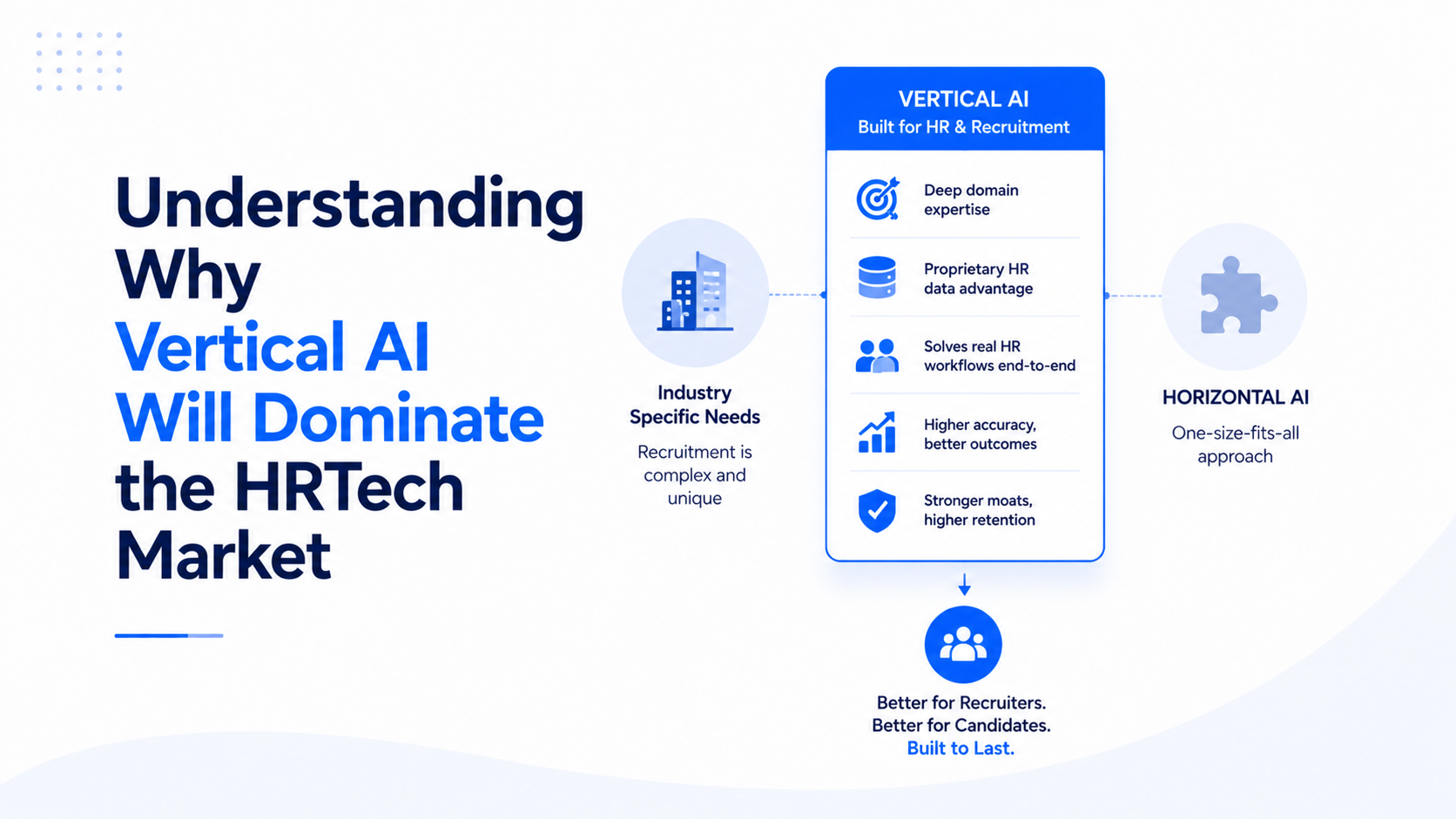
fundamentally a text-processing and decision-support function. This logic has led several major technology platforms to position their general-purpose AI as a solution for HR and recruiting use cases, and it has led some enterprises to attempt using general-purpose AI tools for hiring rather than investing in specialized recruiting technology. The results have been consistently underwhelming. General-purpose AI platforms can perform the surface-level tasks of recruiting, writing job descriptions, summarizing resumes, and drafting candidate communications, but they cannot perform the deep evaluation, contextual judgment, and domain-specific analysis that actually determine hiring quality. The gap between performing the tasks of recruiting and performing the function of recruiting is where horizontal AI fails and vertical AI succeeds.
The horizontal AI trap is particularly dangerous in HRTech because the surface-level tasks that general-purpose AI can perform well enough to create an illusion of competence are the least valuable tasks in the recruiting process. Writing a job description is a commodity task that any competent recruiter or any AI system can perform adequately. Evaluating whether a candidate's specific experience in enterprise software sales translates to success in a startup selling a fundamentally different type of product is a judgment task that requires deep domain understanding. Summarizing a resume is a commodity task. Assessing whether a candidate's communication patterns during a screening conversation indicate the consultative selling style that the role requires is a judgment task. General-purpose AI excels at commodity tasks and struggles with judgment tasks, because judgment requires domain-specific context that general-purpose models were not trained to provide. The result is a system that appears useful during demonstrations but fails to deliver the hiring quality improvements that enterprises actually need.
This dynamic creates a deceptive adoption pattern where enterprises initially adopt general-purpose AI for recruiting because of its breadth and brand recognition, then discover its limitations as they attempt to use it for the high-value judgment tasks that determine hiring outcomes, and eventually migrate to vertical-specific AI tools that can perform both the commodity tasks and the judgment tasks effectively. The migration is costly in terms of time, data, and organizational learning, which means that enterprises that fall into the horizontal AI trap lose months of progress while competitors who chose vertical AI from the beginning are already building data advantages and improving their hiring outcomes. The horizontal AI trap is not a theoretical risk. It is a pattern that is already repeating across the HRTech market as enterprises complete their initial experimentation with general-purpose AI and begin demanding the domain-specific capabilities that only vertical platforms can deliver. According to McKinsey, enterprises that adopted general-purpose AI for recruiting without vertical-specific augmentation report thirty to forty percent lower satisfaction scores and twenty-five to thirty percent smaller improvements in hiring quality compared to enterprises that adopted vertical-specific AI recruiting platforms from the outset, because the general-purpose tools handle the easy parts of recruiting but fail at the parts that actually drive hiring outcomes.
Why Hiring Is Too Specialized for General-Purpose AI
Hiring is one of the most context-dependent business functions, and this context dependency is what makes it resistant to general-purpose AI solutions. Every hiring decision is shaped by factors that are specific to the hiring organization, the role being filled, the team the new hire will join, the industry context in which the organization operates, and the current state of the talent market. A software engineer who would thrive at a mature enterprise with established processes and clear role definitions might struggle at a startup where ambiguity, rapid change, and cross-functional collaboration are the norm. A sales professional who excels in consultative enterprise sales might fail in a high-volume transactional sales environment. These contextual nuances are not edge cases. They are the central challenge of hiring, and they require AI systems that understand not just the content of candidate qualifications but the context in which those qualifications will be applied. General-purpose AI models, trained on broad internet data, have a shallow understanding of every domain and a deep understanding of none. They can recognize that a candidate has JavaScript experience but cannot evaluate whether that experience is relevant to the specific technical challenges the hiring company faces.
The specialization requirements of hiring extend beyond role matching into the entire candidate engagement process. Effective recruiting requires understanding what motivates different candidate segments, how to communicate the specific value proposition of a specific role at a specific company to a specific type of candidate, and how to evaluate candidate responses in the context of the specific competencies the role requires. A vertical AI recruiting platform built for technology hiring understands that software engineers evaluate opportunities based on technical challenge, team caliber, and engineering culture, while sales professionals evaluate opportunities based on compensation structure, territory quality, and sales leadership. A vertical platform built for healthcare hiring understands that clinical professionals prioritize patient outcomes and professional development, while healthcare administrators prioritize operational efficiency and regulatory compliance. These domain-specific communication and evaluation capabilities are not features that can be added to a general-purpose AI through prompting or fine-tuning. They require purpose-built models trained on domain-specific candidate interaction data, hiring outcome data, and industry context that general-purpose models simply do not possess.
The evaluation dimension of hiring is where the gap between general-purpose and vertical AI becomes most consequential. When a vertical AI platform evaluates a candidate for a specific role, it draws on thousands of previous evaluations for similar roles at similar companies, enabling it to identify patterns that predict success with high confidence. It knows, for example, that candidates who demonstrate specific problem-solving approaches during screening conversations tend to perform well in operations roles at logistics companies, or that candidates who ask specific types of questions during interviews tend to be more engaged and more likely to accept offers. These patterns are domain-specific and industry-specific, meaning they cannot be captured by a general-purpose model that lacks exposure to the specific context in
which they were generated. The vertical AI's evaluation advantage grows over time as it processes more interactions and more outcomes within its domain of specialization, creating a data advantage that general-purpose models cannot match because they are not designed to accumulate and leverage domain-specific hiring data. According to Gartner, vertical AI recruiting platforms demonstrate forty to fifty percent higher predictive accuracy for candidate-job fit compared to general-purpose AI platforms when evaluated on hiring outcome data, because the vertical platforms' domain-specific training data and evaluation models capture contextual signals that general-purpose models miss entirely. AI tools for niche technical roles explains how vertical AI recruiting tools outperform general-purpose AI specifically for niche and technical roles, because the specialized evaluation models are trained on candidate interaction data from the specific technical domains where general-purpose models have insufficient training examples to make reliable predictions.
The Data Advantage of Vertical-Specific Training
The most durable competitive advantage of vertical AI in HRTech is the data advantage that comes from domain-specific training. Vertical AI recruiting platforms accumulate training data that is qualitatively different from and more valuable than the data available to general-purpose AI models. This data includes the specific language patterns that indicate candidate quality in particular domains, the interaction behaviors that predict candidate engagement and offer acceptance, the evaluation criteria that correlate with post-hire performance in specific role types, and the workflow patterns that produce the most efficient hiring processes for specific industries. Each of these data types is domain-specific, meaning its predictive value is concentrated in the domain where it was generated. A vertical AI platform trained on technology hiring data cannot directly apply its models to healthcare hiring, because the candidate qualifications, evaluation criteria, communication patterns, and success factors are fundamentally different between the two domains. This domain specificity is not a limitation but an advantage, because it means that the vertical platform develops deep expertise in its domain that no general-purpose model can match.
The data advantage of vertical AI also manifests in the platform's ability to handle the ambiguities and edge cases that are common in hiring but rare in the general internet data on which horizontal AI models are trained. A general-purpose AI model that encounters a candidate with an unusual career trajectory, such as a former military officer transitioning to enterprise sales, will struggle to evaluate that candidate's fit because the model's training data contains relatively few examples of this specific career transition. A vertical AI platform that has processed hundreds of career-transitioning candidates in the sales domain will have developed evaluation models that can assess the transferable skills, learning agility, and adaptation potential that predict success in this specific scenario. The vertical platform's advantage in handling edge cases is not just a matter of having more examples. It is a matter of having the right examples, the domain-specific examples that capture the nuances and patterns that general-purpose models cannot see because they lack exposure to the specific context. This
ability to handle ambiguity and edge cases is particularly valuable in recruiting, because the best hires often come from non-obvious candidate profiles that general-purpose models would reject or deprioritize.
The compounding nature of the vertical data advantage creates a widening gap between vertical and horizontal AI over time. As a vertical platform processes more hiring interactions within its domain, its models become more accurate, its evaluations become more nuanced, and its recommendations become more valuable. This improvement is concentrated within the vertical's domain, meaning that the platform's advantage over general-purpose AI in that domain increases with each month of operation. Meanwhile, the general-purpose AI model, which must serve all domains simultaneously, distributes its learning across a much broader set of use cases, meaning that its improvement in any single domain, including recruiting, is slower and less pronounced. The result is a diverging trajectory where vertical AI recruiting platforms become progressively more accurate and valuable in their domains while general-purpose AI platforms improve more slowly and maintain a broader but shallower capability set. Over a multi-year horizon, this divergence creates an insurmountable advantage for vertical platforms in the domains they serve, because the cumulative data advantage becomes too large for general-purpose models to close through incremental improvements in model architecture or training methodology. why AI tools have outdated candidate data explains why general-purpose AI recruiting tools that rely on broad training data without domain-specific supplementation face structural accuracy limitations that vertical platforms overcome through focused data accumulation, because the domain-specific interaction patterns and outcome correlations that drive accurate hiring predictions are concentrated in specialized datasets that general-purpose models cannot access.
How Vertical AI Creates Superior Buyer Experience
The practical difference between vertical and horizontal AI in HRTech is not limited to model accuracy. It extends to the entire buyer and user experience in ways that significantly influence purchasing decisions and long-term retention. A vertical AI recruiting platform is designed from the ground up for the workflows, terminology, metrics, and decision-making processes that recruiting teams use every day. Its user interface presents information in the format that recruiters expect, using the language and frameworks that are standard in the recruiting profession. Its analytics dashboards display the metrics that recruiting leaders track, such as time to fill, source quality, offer acceptance rate, and quality of hire, in the context that makes those metrics actionable. Its integration capabilities connect to the ATS, HRIS, and communication platforms that recruiting teams already use, with pre-built connectors and data mappings that reflect the standard data structures of the recruiting technology ecosystem. This domain-specific design means that the vertical platform requires less configuration, less training, and less ongoing support than a general-purpose AI tool that must be adapted to recruiting use cases through custom prompting, workflow design, and integration development.
The user experience advantage of vertical AI also manifests in the quality of the platform's
outputs. When a recruiter asks a vertical AI platform to evaluate a candidate, the platform responds with an assessment that is framed in recruiting terminology, references relevant industry context, and provides recommendations that are directly actionable within the recruiting workflow. When a recruiter asks a general-purpose AI the same question, the platform may provide a well-written response that demonstrates general intelligence but lacks the recruiting-specific framing, context, and actionability that the recruiter needs to make a decision. The difference is not in the intelligence of the underlying model but in the domain-specific adaptation that makes the output useful to the specific user. Vertical AI platforms invest this domain-specific adaptation into every aspect of the product, from the training data that shapes the model's understanding to the interface design that shapes the user's interaction. This investment creates a user experience that feels native to recruiting professionals, which drives higher adoption, deeper engagement, and stronger retention compared to the adapted experience that general-purpose AI tools provide. According to LinkedIn, vertical AI recruiting platforms report fifty to sixty percent higher daily active usage rates among recruiting teams compared to general-purpose AI tools configured for recruiting, because the domain-native experience reduces friction, increases confidence in the platform's recommendations, and integrates more seamlessly into the recruiter's existing workflow.
The buyer experience advantage extends to the evaluation and purchasing process as well. When a talent acquisition leader evaluates a vertical AI recruiting platform, the vendor can demonstrate the platform's capabilities using case studies, benchmarks, and outcome data from organizations with similar hiring challenges. The vendor speaks the buyer's language, understands the buyer's pain points, and can articulate the platform's value in terms that the buyer's stakeholders, including hiring managers, HR business partners, and finance leaders, immediately understand. When the same buyer evaluates a general-purpose AI platform for recruiting, the vendor must translate the platform's general capabilities into recruiting-specific value propositions, which requires the buyer to do additional work to imagine how the platform would work in their specific context. This translation burden is subtle but significant, because it increases the cognitive effort required to evaluate the platform, extends the sales cycle, and creates uncertainty about whether the platform will deliver the domain-specific value that the buyer needs. In competitive evaluations, the platform that requires less imagination and less translation from the buyer will win more often, and vertical AI platforms consistently require less of both. how to evaluate an AI sourcing tool provides a framework for comparing vertical and horizontal AI recruiting tools during evaluation, because the assessment methodology accounts for domain-specific accuracy, workflow integration depth, and user experience quality, which are the dimensions where vertical platforms consistently outperform general-purpose alternatives regardless of the underlying model's raw capability.
The Incumbent Disruption Dynamic That Favors Vertical Players
The emergence of vertical AI in HRTech is creating a disruption dynamic that favors new entrants over established incumbents in ways that previous technology transitions in the
category did not. When the cloud transition occurred, incumbent HRTech vendors could adapt by migrating their existing products to cloud infrastructure while leveraging their established client relationships and brand recognition. The AI transition is different because it requires not just infrastructure adaptation but fundamental changes in product architecture, data strategy, and engineering culture. Building an effective vertical AI recruiting platform requires machine learning expertise, domain-specific data acquisition capabilities, and a product design philosophy that treats AI inference as the core product capability rather than an add-on feature. These competencies are rare in traditional HRTech companies, which were built around workflow automation, form-based data entry, and report generation. The cultural and architectural gap between traditional HRTech and vertical AI HRTech is significant, and incumbent vendors that attempt to bridge it by adding AI features to existing products typically produce inferior results compared to vertical-native platforms designed from the ground up for AI-first recruiting.
The disruption dynamic is amplified by the fact that vertical AI creates new competitive dimensions that did not exist in the pre-AI HRTech market. Before AI, HRTech competition was primarily about feature breadth, integration depth, and brand recognition. The vendor with the most features, the most integrations, and the strongest brand typically won enterprise deals. AI introduces a new competitive dimension: prediction accuracy. The vendor whose AI models produce the most accurate candidate evaluations, the most reliable hiring predictions, and the most effective engagement recommendations will deliver better hiring outcomes, which is ultimately what enterprises care about more than features or brand. This new competitive dimension favors vertical-native platforms because prediction accuracy in recruiting depends on domain-specific data and domain-specific model architecture, which vertical platforms have and general-purpose or adapted incumbents do not. As enterprises begin measuring HRTech platforms by hiring outcome improvement rather than by feature checklists, the competitive landscape will shift decisively toward vertical AI platforms that can demonstrate measurable, domain-specific improvements in quality of hire, time to fill, and hiring efficiency. According to Deloitte, sixty-five percent of enterprise talent leaders now rank AI prediction accuracy as a more important evaluation criterion than feature breadth when selecting recruiting technology, a dramatic shift from three years ago when feature breadth was the top criterion, because the practical value of AI in recruiting is measured in hiring outcomes, not in feature counts.
The convergence of these dynamics, the specialization requirements of hiring, the data advantages of vertical-specific training, the superior user and buyer experience of domain-native platforms, and the disruption of traditional competitive dimensions, creates a market environment where vertical AI is not just one of several viable approaches but the approach most likely to produce category-defining companies. The HRTech platforms that will dominate the next decade will not be the horizontal AI platforms attempting to serve every enterprise function from a single model. They will be the vertical AI platforms that have invested deeply in understanding the specific challenges of hiring, accumulated domain-specific data that makes their predictions more accurate, and designed user experiences that feel native to recruiting
professionals. For enterprises evaluating AI recruiting technology, the implication is clear: the platform that knows the most about recruiting will produce the best hiring outcomes, regardless of how capable its underlying AI model is on general benchmarks. For founders building recruiting technology, the implication is equally clear: depth of domain expertise and domain-specific data are more valuable than breadth of general AI capability. According to EY, the HRTech market is projected to produce three to five vertical AI platform companies with market capitalizations exceeding five billion dollars over the next decade, because the combination of domain-specific data advantages, superior user experience, and outcome-driven competition creates the conditions for durable market leadership that horizontal AI platforms cannot replicate. agentic AI platforms vs automated ones demonstrates why the vertical AI approach is particularly powerful in agentic recruiting platforms, because AI agents that operate autonomously in the recruiting domain need domain-specific judgment, domain-specific communication capabilities, and domain-specific evaluation models that only vertical-native platforms can provide.