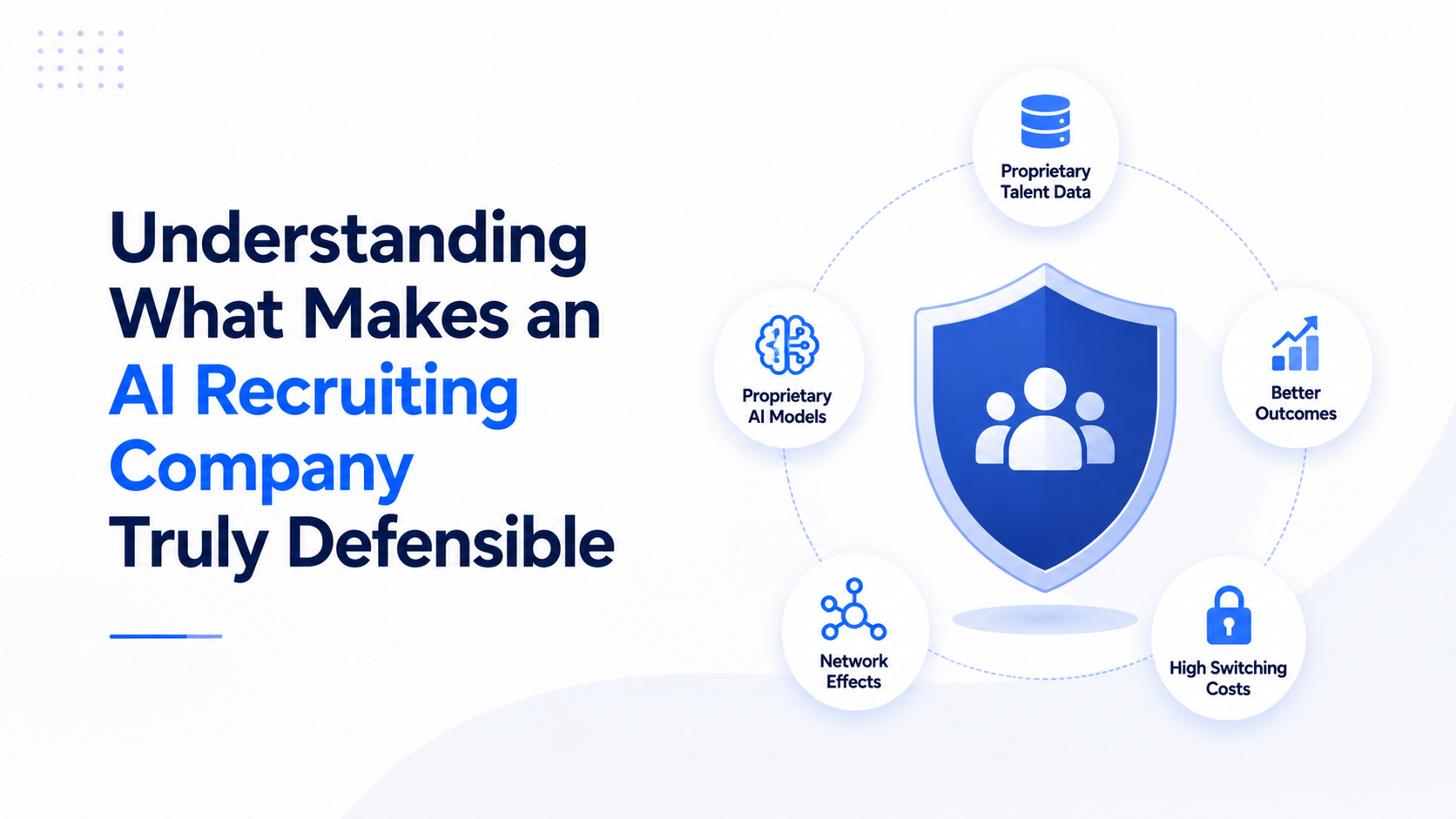
Raj Mehta, the head of corporate development at a global staffing firm with operations in fourteen countries, had been tasked by his CEO with evaluating three AI recruiting companies for potential acquisition. The mandate was specific: identify which of the three had the most durable competitive position, not which had the most impressive demo or the best sales pitch. Raj spent six weeks conducting technical due diligence, interviewing each company's engineering teams, reviewing their model architectures, analyzing their client retention data, and meeting with their largest customers. What he found surprised him. The company with the most polished product and the strongest brand had the weakest competitive position, because its AI capabilities were built on commodity models trained on publicly available data that any well-funded competitor could replicate. The company with the least impressive marketing materials had the strongest competitive position, because it had spent three years building proprietary data pipelines that fed its models with candidate interaction data, hiring outcome data, and workflow engagement data that no competitor could access. Raj's conclusion, which he presented to the board in a thirty-page analysis, was that defensibility in AI recruiting is not about the elegance of the user interface or the sophistication of the marketing. It is about the depth and uniqueness of the data that trains the AI, the degree to which the product is embedded in the customer's operational workflows, and the network effects that make the product more valuable as more people use it.
Why Most AI Recruiting Tools Are Easier to Replace Than You Think
The majority of AI recruiting tools on the market today are built on a foundation that is
fundamentally replicable. They use large language models available through APIs from providers like OpenAI, Google, or Anthropic, they train their models on publicly available recruitment datasets, and they wrap these models in user interfaces that provide resume screening, candidate ranking, or message generation capabilities. The result is a product that appears intelligent and valuable during a sales demonstration but that a well-funded competitor can replicate within six to twelve months by accessing the same foundational models, acquiring similar training data, and building a comparable interface. This replicability is not a theoretical concern. It is a structural reality of the current AI recruiting market, where the barrier to building a basic AI recruiting tool has dropped dramatically because the underlying AI capabilities are available to anyone with engineering talent and API access. Companies that have built their entire value proposition on top of commodity AI capabilities without developing proprietary data assets or deep workflow integration are sitting on businesses that are far more vulnerable than their valuations suggest.
The replicability problem is compounded by the fact that many AI recruiting companies compete on features rather than on structural advantages. A company that promotes its ability to screen resumes faster, generate outreach messages more persuasively, or rank candidates more accurately is making claims that competitors can match by tweaking their own models or adjusting their prompting strategies. Feature-level competition is a race to the bottom because features are inherently copyable. Once one company demonstrates that a particular AI capability attracts buyers, competitors will replicate that capability, and the differentiation erodes. The companies that win feature-level competitions are those with the deepest pockets, not those with the best technology, because they can afford to keep adding features faster than competitors can copy them. This dynamic is particularly dangerous for early-stage companies that have raised significant venture capital based on an initial feature advantage, because the capital creates the expectation of continued differentiation while simultaneously attracting well-funded competitors who can outspend them on feature development.
The distinction between replicable and defensible AI recruiting companies is not about the quality of the AI itself. It is about the structural conditions that surround the AI. A company that has a machine learning model trained on three years of proprietary candidate interaction data from two hundred enterprise clients has a defensible position, even if its model architecture is not fundamentally different from competitors' architectures, because the data that makes the model accurate cannot be acquired by any means other than building an equivalent platform and accumulating equivalent usage. A company that has a similar model trained on publicly available data, no matter how sophisticated its engineering team or how elegant its architecture, has a replicable position, because a competitor can access the same data and build a comparable model. The AI is only as defensible as the data and operational context that surrounds it. According to McKinsey, fewer than fifteen percent of AI recruiting companies currently possess genuine structural defensibility, because the majority have focused on building AI capabilities without simultaneously building the proprietary data assets and workflow integration that would make those capabilities difficult to replicate.
The Data Advantage That Builds Real Defensibility
Proprietary data is the single most important source of defensibility for an AI recruiting company, and not all proprietary data is equally valuable. The data assets that create the strongest competitive moats share three characteristics. First, they are generated through the company's own operations, meaning they are produced as a byproduct of the platform's interaction with candidates, recruiters, and hiring managers. This operational data cannot be purchased, licensed, or scraped from public sources, because it exists only within the platform's own systems. Second, the data is multi-dimensional, capturing not just one aspect of the hiring process but multiple aspects simultaneously. A platform that records candidate responses, recruiter evaluations, interview outcomes, offer decisions, and post-hire performance data creates a dataset that connects cause and effect across the entire hiring funnel, enabling AI models to learn patterns that single-dimension datasets cannot reveal. Third, the data compounds over time, meaning that each day of platform usage adds new data points that improve model accuracy, creating a self-reinforcing cycle where the platform gets better the more it is used.
The compounding nature of proprietary data creates what investors call a data flywheel, and it is the mechanism that turns a good AI recruiting company into a great one. In the early stages, a platform's AI models are only somewhat accurate, because they have been trained on limited data. But as the platform processes more candidate interactions, more hiring decisions, and more outcome data, its models become more accurate, which produces better hiring recommendations, which attracts more clients, which generates more data, which further improves accuracy. This flywheel accelerates over time because the marginal value of each new data point increases as the existing dataset grows. The thousandth candidate interaction adds more predictive value when the model already has knowledge from nine hundred and ninety-nine previous interactions than it would if the model were starting from scratch. This means that early movers in the AI recruiting space who build data flywheels create advantages that late entrants will find increasingly difficult to close, because the late entrant must not only match the incumbent's current model accuracy but also match the rate at which that accuracy is improving, which requires accumulating data at an equivalent or faster rate. According to Gartner, AI recruiting platforms with active data flywheels improve their candidate matching accuracy by eight to twelve percent annually through compounding data advantages alone, while platforms relying on static or commodity datasets show minimal year-over-year improvement because their models have already extracted the available predictive signal from their training data.
The type of data matters as much as the volume. Interaction data, the record of how candidates and recruiters actually behave when using the platform, is more valuable than profile data, the static information contained in resumes and job descriptions. Profile data tells you what a candidate claims about their skills and experience. Interaction data tells you how a candidate communicates under realistic conditions, how quickly they respond to outreach, how they perform in conversational assessments, and whether their actual behavior matches
their stated qualifications. This distinction is critical because profile data is commodity data that every recruiting platform can access, while interaction data is proprietary data that only the platform generating the interactions can possess. An AI recruiting company that has recorded millions of candidate conversations, evaluated thousands of communication patterns, and correlated those patterns with actual hiring outcomes has a data asset that no amount of resume scraping or public dataset acquisition can replicate. why AI tools have outdated candidate data explains why AI recruiting platforms that rely primarily on profile data rather than interaction data face structural disadvantages in model accuracy, because profile data is inherently backward-looking and subject to misrepresentation, while interaction data captures real-time behavioral signals that predict candidate quality and fit with significantly higher reliability.
Why Workflow Embedding Creates Switching Costs
The second structural source of defensibility in AI recruiting is workflow embedding, the degree to which the platform has become integrated into the daily operational processes of the organizations that use it. Workflow embedding is distinct from technical integration, which refers to the API connections between systems. Technical integration is necessary but insufficient for defensibility, because APIs can be reconnected to a competing platform with reasonable effort. Workflow embedding means that the organization has redesigned its hiring processes around the platform's capabilities, that recruiters have been trained to operate within the platform's workflows, that hiring managers rely on the platform's analytics for decision-making, and that the organization's hiring metrics and reporting are built on the platform's data model. When a platform reaches this level of operational embedding, switching to a competitor requires not just a technology migration but an organizational transformation, which is expensive, disruptive, and risky.
The depth of workflow embedding is determined by the breadth of the platform's capabilities and the degree to which those capabilities are used across the organization. A platform that handles only candidate screening has limited workflow embedding, because screening is one step in a multi-step process, and the organization can replace the screening tool without disrupting the rest of the hiring workflow. A platform that handles sourcing, screening, outreach, interview scheduling, evaluation, offer management, and analytics has deep workflow embedding, because it touches every step of the process and every person involved in hiring, from sourcers and recruiters to hiring managers and interviewers. The broader the platform's capability set, the more workflows it touches, the more users depend on it, and the more expensive and disruptive it becomes to replace. This is why investors consistently prefer AI recruiting platforms with broad capability sets over those with narrow, specialized capabilities, even when the specialized capabilities are technically superior. A narrow capability can be replicated and substituted. A broad, embedded workflow cannot. According to LinkedIn, enterprise buyers who adopt AI recruiting platforms with five or more integrated capabilities report seventy to eighty percent higher perceived switching costs compared to buyers of
single-function AI recruiting tools, because the multi-capability platforms become operationally essential in ways that single-function tools do not.
Workflow embedding also creates informational switching costs that are often more powerful than technical switching costs. When an AI recruiting platform has been processing an organization's hiring data for multiple years, it has accumulated institutional knowledge about the organization's hiring patterns, candidate preferences, historical outcomes, and optimal strategies that does not exist anywhere else. This institutional knowledge is embedded in the platform's AI models, its recommendation engines, and its analytics dashboards. If the organization switches to a competing platform, that knowledge is lost, and the new platform must learn the organization's patterns from scratch, which means a period of reduced recommendation accuracy, less useful analytics, and poorer hiring outcomes while the new platform accumulates equivalent data. This learning curve is a powerful deterrent to switching, because it means that the organization will experience a temporary decline in hiring performance during the transition period, and in competitive talent markets, even a temporary decline can have significant business consequences. agentic AI platforms vs automated ones explains how agentic AI recruiting platforms create particularly deep workflow embedding because their autonomous agents manage multi-step processes that span days or weeks, and replacing an agent that has been managing an ongoing process requires restarting the entire process with a new system that lacks the context and history of the original.
The Network Effects That Compound Over Time
The third source of defensibility, and the one that is least understood in the AI recruiting market, is network effects. Network effects occur when a product becomes more valuable to each user as more users adopt it. In consumer technology, network effects are well understood: a social network becomes more valuable as more people join, a marketplace becomes more useful as more buyers and sellers participate, and a communication platform becomes more essential as more contacts use it. In enterprise AI recruiting, network effects operate differently but are equally powerful. An AI recruiting platform that is used by five hundred enterprises generates data from five hundred different hiring processes, five hundred different candidate pools, and five hundred different outcome datasets. This cross-client data, when properly anonymized and aggregated, enables the platform's AI models to identify patterns that no single client's data could reveal. The platform learns, for example, that candidates with certain communication patterns tend to succeed in certain types of roles across multiple industries, or that certain outreach strategies produce higher response rates in certain candidate segments regardless of the specific company sending the outreach.
These cross-client network effects create a quality advantage that scales with the platform's client base. A platform with fifty clients has a limited dataset for identifying cross-client patterns. A platform with five hundred clients has a dataset that is ten times larger, enabling its models to identify patterns with higher statistical confidence and greater predictive accuracy. A platform with five thousand clients has an even larger advantage, because the diversity of
the dataset captures rare but valuable patterns that smaller datasets miss. This scaling dynamic means that the AI recruiting company with the largest client base has not just a revenue advantage but a quality advantage, because its models are trained on more diverse and more comprehensive data than any competitor's models. The quality advantage, in turn, attracts more clients, which expands the dataset further, which increases the quality advantage, creating a self-reinforcing cycle that compounds over time and becomes increasingly difficult for competitors to match. According to Deloitte, AI recruiting platforms with more than one thousand enterprise clients demonstrate fifteen to twenty percent higher candidate match accuracy than platforms with fewer than one hundred clients, because the cross-client data network effects enable the larger platforms to identify predictive patterns that smaller platforms cannot detect.
Network effects in AI recruiting also operate on the candidate side, though this form of network effect is still emerging. As more enterprises use an AI recruiting platform to source and engage candidates, the platform becomes a significant channel through which candidates discover job opportunities. Candidates who have positive experiences being recruited through the platform develop familiarity and trust that makes them more responsive to future outreach through the same platform. This candidate-side network effect means that enterprises using the platform get access to a more engaged and more responsive candidate pool than they would reach through alternative channels, because the platform has already established a positive relationship with those candidates through previous interactions with other enterprises. Over time, this candidate-side network effect could become the most powerful source of defensibility in AI recruiting, because it creates a two-sided market dynamic where enterprises want to use the platform because it has the most engaged candidates, and candidates want to engage with the platform because it connects them with the best opportunities. Two-sided network effects are among the most durable competitive advantages in technology, as demonstrated by companies like LinkedIn, Airbnb, and Uber, and the AI recruiting company that first achieves meaningful two-sided network effects will build a competitive position that is extraordinarily difficult to challenge. more tools same hiring problems explains why AI recruiting platforms that invest in candidate experience and candidate engagement build network effect advantages that pure-play employer-focused tools cannot match, because the candidate-side engagement creates a virtuous cycle where better candidate experience drives higher response rates, which drives better hiring outcomes, which attracts more enterprise clients, which creates more candidate interactions, which further improves the candidate experience.
How to Evaluate Whether an AI Recruiting Company Has a Moat
For talent leaders evaluating AI recruiting vendors, for investors assessing investment opportunities, and for founders building companies in the space, the question of defensibility ultimately comes down to three diagnostic questions. First, does the company have proprietary data that competitors cannot acquire through any means other than building an equivalent
platform? The test is not whether the company has data, because every AI recruiting company has data. The test is whether the data is generated through the company's own operations and whether it captures interaction-level signals that profile data alone cannot provide. A company that can point to millions of proprietary candidate interactions, correlated with hiring outcomes, and used to train models that improve measurably with each month of operation has a genuine data moat. A company that trains its models on public datasets, industry benchmarks, or data purchased from third-party providers does not, regardless of how sophisticated its engineering or how impressive its demo.
The second diagnostic question is whether the company's clients have reorganized their hiring workflows around the platform. The evidence for workflow embedding is not found in integration checklists or API documentation. It is found in the answers to questions like: Do recruiters log into this platform first thing every morning? Do hiring managers rely on the platform's analytics for their weekly talent reviews? Has the organization eliminated manual processes that the platform has automated? Would replacing the platform require retraining dozens or hundreds of users? Companies that can answer yes to these questions have achieved the kind of operational embedding that creates durable switching costs. Companies that cannot, where the platform is one of many tools that recruiters use and where its absence would be inconvenient but not operationally devastating, have not achieved the workflow embedding necessary for long-term defensibility. According to EY, the most reliable indicator of workflow embedding in AI recruiting is whether the client's hiring metrics and reporting infrastructure are built on the platform's data model, because once an organization's performance measurement system depends on a specific platform's data, the switching cost becomes structurally irreversible without accepting a period of significant analytical disruption.
The third diagnostic question is whether the platform's quality improves as it scales. A truly defensible AI recruiting company gets better at hiring with every new client and every new interaction, because the additional data improves model accuracy, the expanded network provides access to more candidates, and the deepened workflow embedding generates more institutional knowledge. The evidence for this scaling quality improvement is found in metrics like client retention rates that increase over time rather than plateau, net revenue retention that exceeds one hundred twenty percent as existing clients expand their usage, and measurable improvements in hiring outcomes for clients who have been on the platform longer. When these three conditions, proprietary data, deep workflow embedding, and scaling quality improvement, are all present, the company has a durable competitive moat that will protect it from competition for years. When one or more of these conditions is absent, the company's competitive position is weaker than it may appear, and its long-term defensibility depends on its ability to develop the missing advantages before well-funded competitors close the window of opportunity. how to evaluate an AI sourcing tool provides a comprehensive framework for evaluating these three defensibility criteria in practice, because the assessment methodology examines data provenance and compounding trajectory, workflow dependency depth across the client organization, and measurable quality improvement correlations with platform scale to determine whether an AI recruiting company has a genuine competitive
moat or merely a temporary first-mover advantage that well-funded competitors can overcome.