Jonathan Park, the CEO of a mid-size staffing firm in Chicago, had watched his margins decline for three consecutive quarters. His firm was placing more candidates than ever, but every placement required five people: a sourcer, a recruiter, a coordinator, an account manager, and a delivery lead. Their salaries and overhead represented eighty-two percent of revenue, leaving a gross margin below eighteen percent, the lowest in the firm's history. Jonathan tried offshoring, workflow automation, and vendor renegotiation, but each saved only a few percentage points. None addressed the fundamental issue that recruiting was a labor-intensive business where cost scaled linearly with volume. Then his operations director presented the results of a three-month pilot with an autonomous recruiting platform. The platform had managed sourcing, screening, and initial engagement for ten roles without a dedicated sourcer or recruiter. It identified candidates, conducted AI-powered screening conversations, and handed pre-qualified profiles to a single account manager. The result was a forty percent reduction in cost per placement and a gross margin jump from eighteen to thirty-four percent on pilot roles. Jonathan realized autonomous recruiting was not a technology upgrade. It was a fundamental restructuring of the economics of his business.
What Makes a Recruiting Platform Truly Autonomous
The term autonomous recruiting is used loosely in the market, with many platforms claiming autonomy when they actually provide assisted automation. The distinction is economically significant, because true autonomy and assisted automation produce fundamentally different cost structures. Assisted automation platforms require human recruiters to initiate, monitor, and intervene in the recruiting process at multiple points. A platform that generates candidate
outreach messages but requires a recruiter to review, approve, and send each message is providing assisted automation. A platform that identifies potential candidates but requires a recruiter to evaluate each profile and decide whether to proceed is providing assisted automation. These platforms reduce the time required for specific tasks but do not reduce the number of people required to manage the process, because the human recruiter remains the decision-maker at every step. The cost savings from assisted automation are real but limited, because the recruiter's time is only partially freed, and the recruiter must still manage the overall process, coordinate between tools, and make the judgments that the platform cannot make.
A truly autonomous recruiting platform operates differently. It manages the end-to-end recruiting workflow, from candidate identification through initial screening and engagement, without requiring human initiation, monitoring, or intervention at each step. The platform receives a job requirement, sources candidates from multiple channels, conducts AI-powered screening conversations to evaluate candidate fit, engages qualified candidates through personalized outreach, schedules interviews, and presents pre-qualified, pre-engaged candidates to a human recruiter or hiring manager for final evaluation. The human's role shifts from managing the process to reviewing the platform's output, which requires dramatically less time per role. This distinction, between a platform that assists a human who manages the process and a platform that manages the process and presents results to a human, is the difference between a tool that saves time and a system that transforms economics. The time savings from true autonomy are not measured in minutes per task. They are measured in the elimination of entire roles from the recruiting process, because the platform performs functions that previously required dedicated human effort.
The operational test of autonomy is simple: can the platform run the recruiting process for a role overnight, processing candidates, conducting screenings, and engaging prospects, without any human involvement, and present qualified candidates to a recruiter the next morning? If the answer is yes, the platform is autonomous. If the answer is no, if a human must be available to initiate steps, review outputs, or intervene when the platform encounters an edge case, the platform is providing assisted automation, regardless of how sophisticated its AI capabilities are. This operational distinction maps directly to an economic distinction. Autonomous platforms reduce the human labor required per role, which reduces the cost per placement. Assisted automation platforms reduce the time per task but do not reduce the headcount per role, which means the cost per placement remains high even as individual tasks become faster. According to McKinsey, truly autonomous recruiting platforms reduce the human labor cost per placement by forty to sixty percent compared to traditional recruiting processes, while assisted automation platforms reduce the same cost by only ten to twenty percent, because autonomy eliminates roles from the process while assistance merely makes existing roles more efficient. agentic AI platforms vs automated ones explains this distinction in detail, because the framework differentiates between agentic platforms that manage recruiting workflows autonomously and automated tools that require human direction, demonstrating that the economic benefits of the two approaches diverge significantly as hiring
volume increases.
The Cost Structure Advantage of Autonomous vs Assisted Platforms
The cost structure of traditional recruiting is dominated by human labor. In a typical staffing firm, compensation and benefits for recruiting staff represent sixty to seventy-five percent of total operating costs. In an enterprise internal recruiting team, the labor cost per hire, including recruiter salaries, hiring manager time, and coordination overhead, typically ranges from eight thousand to fifteen thousand dollars depending on the role's complexity and the market's competitiveness. These labor costs are variable costs that scale linearly with hiring volume. If the organization needs to hire fifty people instead of twenty-five, it needs roughly twice as many recruiting hours, which means either more recruiters, more overtime, or longer time to fill. This linear cost structure is the fundamental economic constraint of traditional recruiting, because it means that growth in hiring volume requires proportionally more investment in recruiting capacity, which limits the organization's ability to scale hiring without proportionally increasing costs.
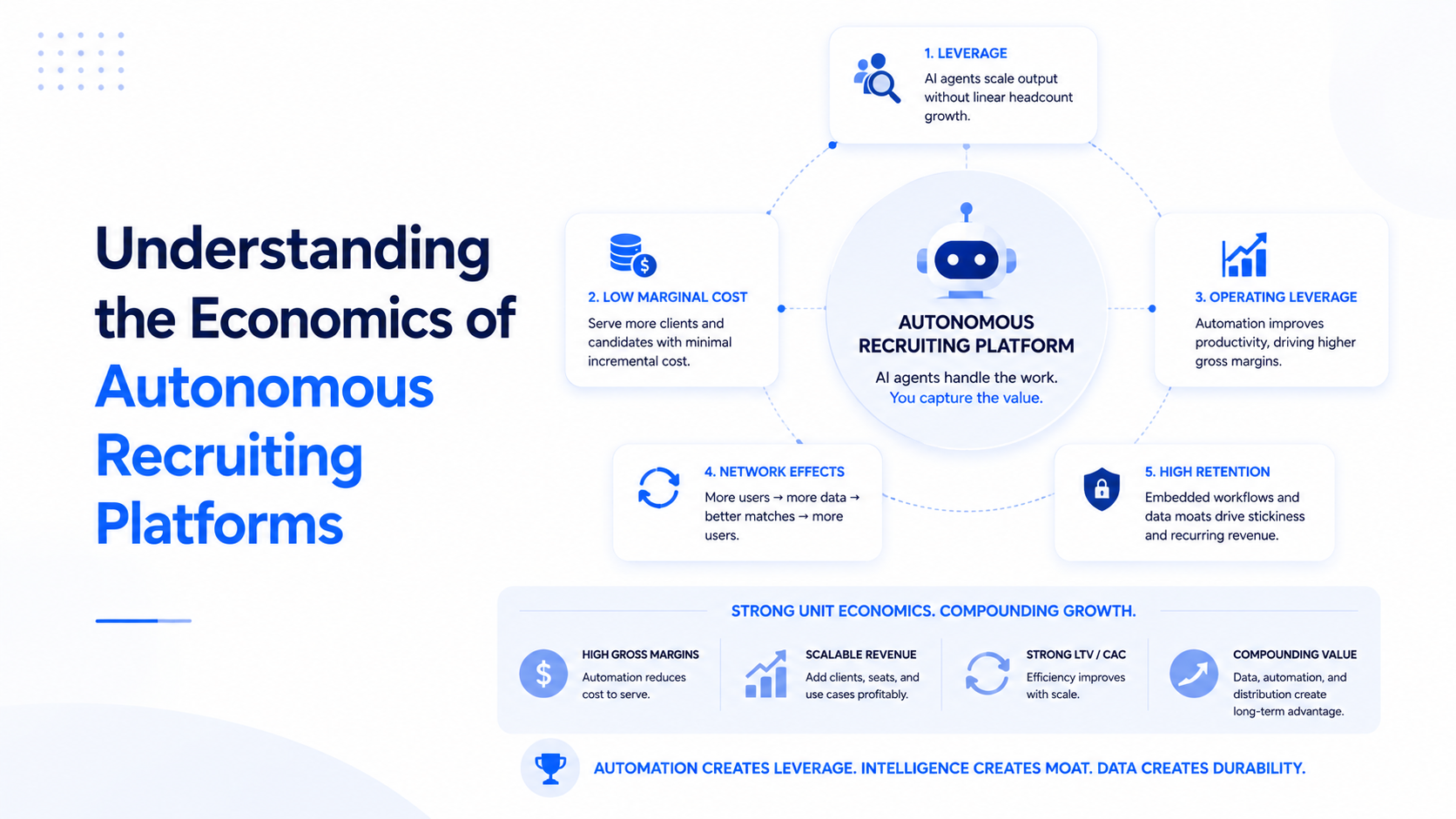
Autonomous recruiting platforms transform this cost structure by converting variable labor costs into fixed technology costs. The platform itself represents a fixed or semi-fixed cost: a subscription fee, a per-seat license, or a per-hire transaction fee that does not increase proportionally with the number of candidates processed or the number of screening conversations conducted. Once the platform is deployed, the marginal cost of processing an additional candidate, conducting an additional screening, or managing an additional role is near zero, because the cost is dominated by computing infrastructure rather than human labor. This cost structure inversion, from variable labor costs to fixed technology costs, creates operating leverage that does not exist in traditional recruiting. The first role managed by the autonomous platform is more expensive per placement than the twentieth or the fiftieth, because the fixed platform cost is spread across more placements as volume increases. This is the economic mechanism through which autonomous platforms reduce cost per placement by thirty to fifty percent at scale: not by making individual tasks cheaper, but by replacing the linear cost structure of human labor with the fixed cost structure of technology.
The cost structure advantage of autonomous platforms becomes more pronounced as hiring volume increases, which is the opposite of the traditional recruiting dynamic where costs increase with volume. In traditional recruiting, an organization that doubles its hiring volume must roughly double its recruiting headcount or accept a proportional increase in time to fill. With an autonomous platform, an organization that doubles its hiring volume spreads the same platform cost across twice as many placements, driving the cost per placement down further. This inverse relationship between volume and unit cost is the hallmark of a technology-driven business model, and it is what enables autonomous recruiting platforms to achieve economics that traditional recruiting businesses cannot match regardless of how efficiently
they manage their human recruiters. The cost structure advantage also creates a competitive moat, because platforms with larger client bases and more processing volume can spread their infrastructure costs across more placements, achieving lower unit costs that smaller competitors cannot match without equivalent scale. According to Gartner, autonomous recruiting platforms that manage more than five hundred roles per month achieve thirty to forty percent lower cost per placement than platforms managing fewer than one hundred roles, because the fixed infrastructure costs are distributed across a larger volume base, creating a scale advantage that further reinforces the economic case for autonomy.
How Autonomous Platforms Change the Economics of Hiring
The economics of hiring extend beyond the direct costs of the recruiting process to include the indirect costs of unfilled positions, poor-quality hires, and slow time to fill. An unfilled position costs the organization in lost productivity, delayed projects, and overworked team members. A poor-quality hire costs the organization in onboarding investment, performance management effort, and eventual replacement costs that typically exceed the original hiring cost by two to three times. A slow time to fill costs the organization in candidate quality, because the best candidates are typically available for the shortest time and are hired by competitors who move faster. Autonomous recruiting platforms improve the economics of hiring across all three of these indirect cost dimensions. By reducing time to fill, they reduce the productivity cost of unfilled positions. By improving screening accuracy through AI-powered evaluation, they reduce the cost of poor-quality hires. By engaging candidates faster and more consistently than human recruiters can, they capture higher-quality candidates who would otherwise be lost to faster competitors.
The quantitative impact of these indirect cost improvements is often larger than the direct cost savings. Consider an engineering role with a fully loaded cost of one hundred fifty thousand dollars per year. An unfilled position costs the organization approximately twelve thousand five hundred dollars per month in lost productivity. If the average time to fill for this role is sixty days, the productivity cost of the unfilled position is approximately twenty-five thousand dollars. If an autonomous recruiting platform reduces time to fill from sixty days to thirty-five days, it saves approximately twelve thousand five hundred dollars in lost productivity per role. If the organization hires fifty engineers per year, the annual productivity savings from faster filling alone exceed six hundred thousand dollars, a figure that dwarfs the direct savings from reducing recruiter headcount. The screening accuracy improvement produces similar or larger savings. If the platform reduces the rate of poor-quality hires from fifteen percent to eight percent, and the cost of a poor-quality hire is one hundred thousand dollars including onboarding, management, and replacement, the annual savings from better screening on fifty hires is three hundred fifty thousand dollars. These indirect cost improvements are the economic argument for autonomous recruiting that resonates most strongly with CFOs and business leaders, because they connect recruiting technology investment directly to business outcome improvement.
The combined effect of direct cost reduction and indirect cost improvement creates a total cost of hiring that is dramatically lower for organizations using autonomous platforms. Direct recruiting cost savings of thirty to fifty percent, combined with indirect cost savings from faster filling and better quality of twenty to forty percent, produce a total hiring cost reduction of forty to sixty percent compared to traditional recruiting processes. This is not a marginal improvement that can be achieved through incremental process optimization. It is a structural transformation in the economics of hiring that changes the fundamental relationship between hiring investment and hiring outcome. Organizations that adopt autonomous recruiting platforms can hire more people, hire better people, and hire faster people for the same total investment, or achieve the same hiring outcomes for significantly less investment. This kind of step-change improvement in the cost-performance ratio of a core business function is rare, and it creates a compelling adoption driver that will accelerate the transition from traditional to autonomous recruiting over the next several years. According to Deloitte, the total cost of hiring, including direct recruiting costs, unfilled position costs, and poor-quality hire costs, is thirty to forty-five percent lower for organizations using autonomous recruiting platforms compared to those using traditional or assisted-automation recruiting processes, because the combination of faster filling, better screening, and lower labor costs addresses all three major cost components simultaneously. why AI tools have outdated candidate data explains why traditional recruiting approaches that rely on manual screening and intermittent outreach cannot achieve these economics, because the labor-intensive nature of traditional recruiting creates a cost floor that no amount of process optimization can break through without fundamentally changing the human-labor-dependent cost structure.
The Revenue Model That Rewards Autonomy
The shift to autonomous recruiting does not just change costs. It creates opportunities for new revenue models that align the platform provider's incentives with the client's outcomes more effectively than traditional pricing structures. Traditional recruiting technology is typically priced per seat, per user, or per job posting, which means the vendor's revenue increases with the number of recruiters using the platform or the number of positions being filled, regardless of whether the platform is actually improving hiring outcomes. This pricing structure incentivizes the vendor to maximize usage rather than outcomes, which can lead to feature bloat, low adoption, and customer dissatisfaction when the platform generates revenue but does not generate value. Autonomous recruiting platforms enable a different pricing model: outcome-based pricing, where the vendor charges per qualified candidate, per successful placement, or per measurable improvement in a hiring metric like time to fill or quality of hire. This model aligns the vendor's revenue directly with the client's success, because the vendor only earns revenue when the platform delivers a tangible hiring outcome.
Outcome-based pricing is only viable when the platform has sufficient autonomy to control the outcome. A platform that assists a human recruiter cannot charge per successful placement, because the human, not the platform, controls the outcome. The platform might
generate better outreach messages or faster screening, but the human decides which candidates to advance, how to manage the client relationship, and whether to submit a candidate. When the human controls the outcome, the platform cannot guarantee or even meaningfully influence the result, which makes outcome-based pricing commercially impractical. An autonomous platform that manages the end-to-end process, from sourcing through screening to pre-qualification, controls enough of the outcome to make outcome-based pricing viable. The platform can commit to delivering a specific number of qualified candidates per role, a specific time to fill, or a specific screening accuracy rate, because it manages the process steps that produce those outcomes. This alignment of control and pricing creates a fundamentally better commercial model where the vendor is incentivized to improve the platform's autonomous capabilities, because better capabilities produce better outcomes, which produce more revenue.
The revenue model advantage of autonomous platforms extends to the client side as well. For staffing firms, autonomous platforms enable a shift from the traditional contingency fee model, where the firm charges twenty to thirty percent of the placed candidate's first-year salary, to a more flexible model that can offer clients lower fees, guaranteed outcomes, or hybrid pricing structures that combine lower base fees with performance bonuses. This flexibility is possible because the autonomous platform dramatically reduces the firm's cost per placement, creating margin room to offer clients more favorable pricing while maintaining or improving the firm's own profitability. For enterprise internal recruiting teams, autonomous platforms enable a shift from a cost-center model, where recruiting is viewed as an overhead expense to be minimized, to a value-center model, where recruiting is viewed as a revenue-enabling function that directly impacts business performance through faster time to productivity and better talent quality. According to LinkedIn, staffing firms that have adopted autonomous recruiting platforms and shifted to outcome-based or hybrid pricing models report fifteen to twenty-five percent higher client retention rates and twenty to thirty percent higher win rates on competitive RFPs, because the pricing flexibility enables them to offer commercial terms that traditional staffing firms, constrained by their high labor costs, cannot match without sacrificing profitability. how many follow-ups one hire needs demonstrates how the revenue model advantage of autonomous platforms manifests in practical recruiting operations, because the autonomous management of candidate follow-up sequences, which traditionally required dedicated recruiter time, eliminates a significant labor cost that staffing firms can convert into pricing flexibility and margin improvement.
Why Autonomous Economics Will Reshape the Recruiting Industry
The economics of autonomous recruiting platforms will reshape the recruiting industry through three interconnected mechanisms. The first mechanism is margin expansion for early adopters. Staffing firms and enterprise recruiting teams that adopt autonomous platforms early will achieve dramatically better margins than their competitors, because they will deliver
equivalent or superior hiring outcomes at thirty to fifty percent lower cost. This margin advantage creates financial resources that early adopters can invest in growth, talent acquisition, and platform capabilities, further widening the competitive gap. The margin expansion also enables early adopters to offer more competitive pricing to clients, which accelerates market share capture. In a competitive market, the firm with the best margins has the most flexibility to invest and the most room to compete on price, which is a self-reinforcing advantage that compounds over time.
The second mechanism is capacity expansion that changes the competitive dynamics of the market. Traditional recruiting firms are capacity-constrained, because hiring more recruiters is expensive, slow, and operationally complex. An autonomous platform can manage ten times or more roles per recruiter than traditional processes, which means that an early-adopter firm can serve significantly more clients and fill significantly more roles without proportionally increasing headcount. This capacity expansion enables early adopters to enter market segments, serve geographies, and pursue client relationships that were previously beyond their reach. A mid-size staffing firm that adopts autonomous recruiting can suddenly compete for enterprise accounts that were previously served only by the largest firms, because the platform provides the capacity to manage high-volume hiring processes without the proportional headcount investment that traditional approaches require. This democratization of capacity levels the competitive playing field in ways that benefit agile, technology-forward firms at the expense of large but slow-moving incumbents.
The third mechanism is the redefinition of the recruiter's role from process manager to strategic advisor. As autonomous platforms handle the operational aspects of recruiting, sourcing, screening, scheduling, and engagement, the humans in the recruiting process are freed to focus on the high-value activities that AI cannot perform: building client relationships, developing talent strategy, managing offer negotiations, and providing the human judgment that final hiring decisions require. This role elevation improves job satisfaction for recruiting professionals, because they spend less time on repetitive tasks and more time on strategic work, and it improves hiring outcomes, because the strategic activities that humans perform have a disproportionate impact on hiring quality and client satisfaction. The recruiting industry of the next decade will not be an industry where AI replaces recruiters. It will be an industry where AI handles the process and recruiters provide the strategy, creating a hybrid model that is more efficient, more profitable, and more valuable to clients than either pure-human or pure-AI approaches. According to EY, the recruiting firms that will generate the highest returns over the next decade are those that adopt autonomous platforms earliest and redeploy their human recruiters into strategic advisory roles, because the combination of autonomous operational efficiency and human strategic judgment creates a service model that delivers superior outcomes at lower cost, which is the formula for sustained competitive advantage in any professional services market. should recruiters worry about AI replacing jobs explains why this human-plus-autonomous-AI model is the end state of recruiting evolution, because the most effective recruiting organizations will be those that leverage AI for operational execution and humans for strategic judgment, rather than relying exclusively on either approach.