Priya Sharma had spent eleven years selling enterprise HRTech for one of the largest vendors in the market. Her business model was straightforward and predictable: sell an annual software license, charge twenty percent for implementation and professional services, and collect maintenance revenue that represented about eighty percent of the initial license value each year. The model worked because HRTech was a software business, and software businesses sold licenses. Two years ago, Priya joined an AI-native recruiting startup, and the business model she encountered was unrecognizable by the standards she had spent her career mastering. The company did not sell licenses. It charged per qualified candidate delivered. It did not sell implementation services, because the platform onboarded clients through an automated configuration process. It did not sell maintenance, because the platform improved itself continuously through data network effects. Instead of a license-and-services model, the company operated an outcome-based model where revenue was tied directly to the hiring results the platform produced. Priya's commission structure was different too. Instead of earning a percentage of the initial license, she earned a percentage of the platform's ongoing outcome fees, which meant her income grew as the platform delivered better results for clients, aligning her incentives with client success rather than with the initial sale. The experience convinced her that AI was not just changing what HRTech products could do. It was fundamentally changing how HRTech companies make money.
The End of the License-and-Services Model in HRTech
For two decades, the dominant business model in enterprise HRTech was the license-and-services model. Vendors sold annual software licenses priced by the number of users or the size
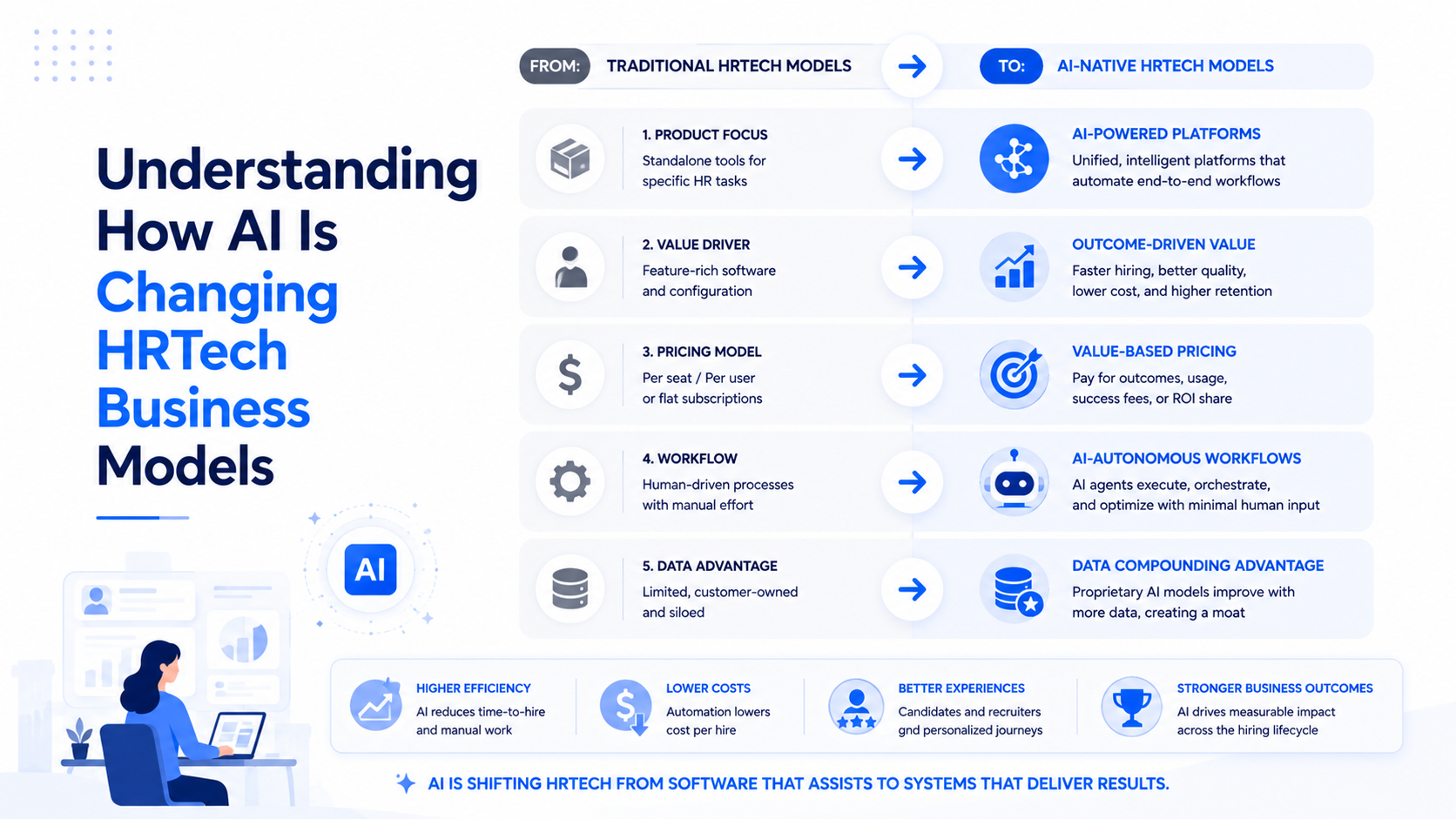
of the employee population, charged separate fees for implementation and customization, and collected ongoing maintenance revenue that funded product updates and support. This model was predictable, scalable, and well-understood by both vendors and buyers. It generated the kind of predictable recurring revenue that investors valued, and it created clear economic incentives for vendors to sell large deployments to large enterprises. The model worked because HRTech was fundamentally a software business, where the product was a tool that enterprises used to manage their HR processes, and the value the product delivered was proportional to the number of users and the breadth of processes it supported. AI is dismantling this model by changing the relationship between the product and the value it delivers. An AI-powered HRTech platform does not deliver value by providing a tool that users operate. It delivers value by producing outcomes, qualified candidates, accurate predictions, and optimized processes, that are not proportional to the number of users but to the quality of the AI and the volume of data it processes. This shift from tool-value to outcome-value makes the per-user license model increasingly misaligned with how AI-native HRTech products actually create value for clients.
The misalignment manifests in several ways that are becoming increasingly problematic for both vendors and buyers. Vendors that price AI-native products using per-user licenses undercapture the value they deliver when the platform produces outcomes that benefit the entire organization, such as better hiring quality or reduced time to fill, rather than just the individual users who log into the platform. A platform that reduces time to fill by thirty percent delivers value to every hiring manager and business unit in the organization, not just to the recruiters who use the platform directly. Pricing by user count captures only a fraction of this value, leaving money on the table for the vendor and creating a pricing ceiling that limits revenue growth. Conversely, per-user pricing overcharges clients when the platform's AI capabilities mean that fewer recruiters are needed to manage the same hiring volume, because the client is paying for fewer seats while the platform is delivering more value. This dual misalignment, undercapturing value when the platform's impact is broad and overcharging when the platform's efficiency reduces headcount, is a structural flaw in the license model that becomes more pronounced as AI capabilities improve.
The license model also creates the wrong incentives for AI-native HRTech vendors. When revenue is tied to user count, the vendor is incentivized to maximize the number of users on the platform, which encourages feature development that drives user engagement rather than outcome improvement. An AI-native vendor should be incentivized to make its platform so effective that clients need fewer recruiters, not more, because the ultimate value proposition of AI in HRTech is doing more with less. The per-user license model creates a perverse incentive where the vendor's financial success depends on the client needing more users, which conflicts with the AI value proposition of reducing the human effort required per hiring outcome. This incentive conflict is the fundamental reason why AI-native HRTech companies are increasingly abandoning the license model in favor of pricing structures that align vendor revenue with the outcomes the platform produces rather than with the number of humans using it. According to McKinsey, AI-native HRTech companies that have adopted
outcome-based or consumption-based pricing models report twenty-five to thirty-five percent higher net revenue retention than those using traditional per-user licensing, because the outcome-based models align pricing with value delivery, which increases client satisfaction and expansion revenue.
From Per-User Pricing to Outcome-Based and Consumption Models
The two pricing models that are replacing per-user licensing in AI-native HRTech are outcome-based pricing and consumption pricing, each suited to different types of AI capabilities and different client relationships. Outcome-based pricing charges the client based on the hiring results the platform produces: a fee per qualified candidate, a fee per successful placement, or a fee tied to a measurable improvement in a hiring metric such as time to fill or quality of hire. This model is most appropriate for platforms that manage end-to-end hiring workflows where the platform controls enough of the process to guarantee or meaningfully influence the outcome. A platform that sources, screens, and pre-qualifies candidates can charge per qualified candidate because it controls the process that produces the qualification. A platform that only provides a screening tool that a human recruiter uses as part of a broader process cannot charge per qualified candidate, because the human controls the outcome, not the platform. Outcome-based pricing aligns the vendor's revenue directly with the client's success, creating a commercial relationship where the vendor profits only when the client achieves the hiring results they need.
Consumption pricing charges the client based on the volume of platform usage: a fee per candidate screened, a fee per AI screening conversation conducted, or a fee per hiring workflow managed. This model is most appropriate for platforms that provide AI capabilities as services rather than as end-to-end solutions. A platform that offers AI-powered candidate screening as a service that integrates with the client's existing ATS can charge per candidate screened, because the value is proportional to the volume of screenings conducted. Consumption pricing provides the scalability advantages of the license model, because revenue grows with usage, while aligning more closely with value delivery than per-user pricing, because the client pays for what the platform actually does rather than for the number of people who have access to it. The key difference between consumption pricing and per-user pricing is that consumption pricing captures the value of AI automation, where the platform processes more candidates per human user, while per-user pricing does not. A platform that enables one recruiter to screen five hundred candidates instead of fifty creates enormous value, but under per-user pricing, the vendor captures none of that value increase because the number of users has not changed. Under consumption pricing, the vendor captures the value increase because the client is paying per screening, and five hundred screenings generate ten times the revenue of fifty.
The shift to outcome-based and consumption pricing is being driven by buyer demand as
much as by vendor strategy. Enterprise procurement teams are increasingly resistant to per-user HRTech licenses because the license model requires them to pay for seats that may not be fully utilized and because the model does not hold the vendor accountable for the hiring outcomes the platform produces. Outcome-based and consumption models address both concerns. The client pays only for the value the platform actually delivers, whether measured in outcomes or in usage volume, which eliminates the risk of paying for unused capacity. And the vendor's revenue is directly tied to the platform's performance, which creates accountability that per-user licensing lacks. This buyer preference is accelerating the pricing model transition, because vendors that offer outcome-based or consumption pricing are winning competitive evaluations against per-user competitors by offering commercial terms that better align with how enterprises want to buy AI-powered HRTech. According to Gartner, fifty-eight percent of enterprise HRTech buyers now prefer outcome-based or consumption-based pricing over per-user licensing for AI-powered recruiting tools, up from twenty-two percent three years ago, because the alignment between cost and value reduces procurement risk and makes the business case for AI adoption easier to justify internally. agentic AI platforms vs automated ones demonstrates how agentic AI recruiting platforms are enabling outcome-based pricing by managing end-to-end hiring workflows autonomously, because the platform's ability to control the process from sourcing through pre-qualification creates the outcome accountability that outcome-based pricing requires.
Why AI Enables Platform Business Models in HRTech
Beyond pricing changes, AI is enabling a more fundamental business model shift in HRTech: the emergence of platform business models where the vendor's value comes not from the software itself but from the ecosystem of data, integrations, and network effects that the software enables. A traditional HRTech product is a standalone tool that enterprises buy and use. A platform is an ecosystem where multiple participants, enterprises, candidates, partners, and developers, interact and create value for each other. The platform business model generates revenue not just from software subscriptions but from ecosystem participation: data services, marketplace transactions, API access, and value-added services that are enabled by the platform's network of participants. This platform model has been transformative in other technology categories, from app stores in mobile to app ecosystems in cloud infrastructure, and AI is making it viable in HRTech for the first time because AI creates the data network effects and participant engagement that platforms require to function.
The platform business model in HRTech operates through multiple revenue streams that did not exist in the traditional software model. The first stream is core platform subscriptions, the foundational software access that enterprises pay for. The second stream is premium AI services, such as advanced predictive analytics, custom model training, or specialized evaluation capabilities that enterprises pay for as add-ons. The third stream is data services, where the platform monetizes the aggregated, anonymized insights from its cross-client data by providing market intelligence, benchmarking, and trend analysis to enterprises, investors, and
industry analysts. The fourth stream is marketplace revenue, where the platform facilitates transactions between participants, such as connecting enterprises with specialized recruiting agencies or connecting candidates with career development resources, and takes a transaction fee. The fifth stream is API and integration revenue, where third-party developers build applications on the platform's infrastructure and pay for API access, developer tools, and platform services. These multiple revenue streams create a more diversified and resilient business model than single-stream software licensing, and they generate higher revenue per client because each client can participate in multiple revenue streams simultaneously.
The platform business model also changes the vendor's relationship with its clients from a transactional vendor-buyer relationship to an ongoing ecosystem partnership. In the traditional model, the vendor sells a product, the client uses it, and the relationship is governed by a contract that defines the scope of the product and the terms of support. In the platform model, the client is a participant in an ecosystem that generates increasing value over time, and the vendor's role is to facilitate, curate, and optimize that ecosystem for all participants. This shift from product vendor to ecosystem facilitator creates deeper client relationships, because the client's investment in the platform, in data, integrations, workflow configurations, and team training, increases over time and creates switching costs that go far beyond the contractual commitment. The platform model also creates natural expansion dynamics, because each new capability, data service, or ecosystem participant adds value for all existing participants, which drives adoption of additional platform services and generates incremental revenue from existing clients without additional sales effort. According to Deloitte, HRTech platforms that operate ecosystem business models with three or more revenue streams achieve forty to fifty percent higher revenue per client and twenty-five to thirty-five percent higher net revenue retention compared to single-stream software vendors, because the ecosystem creates multiple value dimensions that drive deeper client engagement and broader service adoption. more tools same hiring problems illustrates why the ecosystem approach addresses the fragmentation problem that has historically limited HRTech platform value, because the multi-revenue-stream platform model replaces the collection of disconnected point solutions that enterprises have historically assembled with an integrated ecosystem where data, workflows, and participants interact through a single platform.
The Disappearing Services Revenue and What Replaces It
Traditional HRTech vendors derived a significant portion of their revenue from professional services, including implementation, customization, training, and ongoing consulting. For many large HRTech vendors, services revenue represented thirty to forty percent of total revenue, and services margins were often higher than software margins because services were priced as premium offerings. AI is eliminating the need for much of this services revenue by automating the tasks that previously required human professional services. Implementation that previously took months of consultant time can now be completed through automated configuration that maps the client's existing data structures and workflows to the platform's
capabilities. Customization that previously required custom development can now be achieved through AI-driven adaptation where the platform learns the client's specific requirements and adjusts its behavior accordingly. Training that previously required classroom sessions and certification programs can now be delivered through in-product guidance where the platform teaches users how to accomplish their goals through contextual assistance and interactive tutorials.
The elimination of services revenue is both a challenge and an opportunity for HRTech vendors. For vendors whose business models depend on services revenue, the automation of services creates a revenue gap that must be filled through other means. For AI-native vendors that never built services teams, the elimination of services dependency is an advantage, because it reduces the cost structure and increases the scalability of the business. The critical question is what replaces services revenue in the AI-native HRTech business model. The answer is value-based pricing premiums. When an AI-native platform eliminates the need for implementation services by automating configuration, the vendor can capture a portion of the services savings through higher platform pricing, because the client's total cost of ownership, platform plus services, is lower even with a higher platform price. When the platform eliminates the need for customization by adapting automatically, the vendor can capture a portion of the customization savings through premium pricing for advanced AI capabilities. When the platform eliminates the need for training through in-product guidance, the vendor can capture a portion of the training savings through faster time to value, which reduces churn and increases lifetime client value.
The net effect of these shifts is a business model with a higher software-to-services revenue ratio, lower cost of delivery, and faster time to revenue recognition compared to the traditional model. An AI-native HRTech company can onboard a client in days rather than months, generate revenue from the first week rather than after a multi-month implementation, and serve the client with a lean customer success team rather than a large professional services organization. This operational efficiency translates directly into better unit economics: higher gross margins, lower customer acquisition costs, and faster paths to profitability. It also creates a better client experience, because clients get value from the platform faster and with less friction than they would from a traditional HRTech product that requires extensive services engagement. According to LinkedIn, AI-native HRTech companies that automate implementation and onboarding report sixty to seventy percent lower time to first value and forty to fifty percent lower customer acquisition costs compared to traditional HRTech vendors, because the elimination of services dependencies removes the bottleneck that slows both client value realization and vendor scaling. AI tools for niche technical roles shows how AI-native platforms achieve rapid deployment for specialized recruiting use cases without the services overhead that traditional vendors require, because the platform's pre-built domain models and automated configuration adapt to specific recruiting contexts without manual customization or consulting engagement.
What the New HRTech Business Model Means for the Market
The business model transformation driven by AI has implications for every participant in the HRTech market. For vendors, the implication is that competitive advantage will increasingly be determined by business model innovation rather than by product feature competition. The vendors that develop the most effective pricing models, the most scalable delivery mechanisms, and the most diversified revenue streams will outperform those that continue to compete on feature breadth and brand recognition within the traditional license-and-services framework. The business model is the new product, because the way a vendor prices, delivers, and monetizes AI-powered HRTech is becoming as important as the capabilities the product itself provides. Vendors that cling to the license-and-services model will find themselves competing against AI-native vendors with fundamentally better unit economics, which means they will be outspent on product development and outpriced in competitive evaluations.
For enterprise buyers, the business model transformation means more favorable commercial terms, faster time to value, and better alignment between HRTech investment and hiring outcomes. Outcome-based and consumption pricing reduce the risk of HRTech investment by tying cost to value delivery. Automated implementation reduces the time and cost of deployment. And the ecosystem platform model provides access to a broader set of capabilities through a single vendor relationship rather than the fragmented multi-vendor approach that enterprises have historically been forced to adopt. The buyer's role in the market is also changing, from selecting tools to selecting ecosystems. The most sophisticated enterprise buyers are already evaluating HRTech vendors not just on product capabilities but on business model alignment, asking whether the vendor's pricing, delivery, and partnership approach will support their evolving needs as AI becomes more central to their hiring operations.
For investors, the business model transformation creates a new framework for evaluating HRTech companies. The metrics that mattered in the traditional HRTech market, annual recurring revenue, logo count, and net revenue retention, remain important but are insufficient for evaluating AI-native companies with different business models. Investors need to assess pricing model quality, whether the vendor's pricing aligns with the value it delivers and scales with client outcomes. They need to evaluate revenue stream diversification, whether the vendor has multiple revenue streams or depends on a single subscription model. They need to analyze cost structure efficiency, whether the vendor's delivery costs are declining as the platform scales. And they need to evaluate ecosystem dynamics, whether the platform is building the network effects and participant engagement that drive platform economics. These new evaluation criteria will determine which AI-native HRTech companies attract capital and achieve the scale needed to become category leaders. According to EY, HRTech companies with outcome-aligned pricing models, diversified revenue streams, and declining delivery costs are achieving two to three times higher valuations than companies with traditional license-and-services models at equivalent revenue levels, because investors are pricing in the
superior unit economics and scalability that the new business models produce. how to evaluate an AI sourcing tool provides a framework for evaluating AI-native HRTech business models during vendor selection, because the assessment examines pricing alignment, revenue sustainability, and delivery efficiency to determine whether a vendor's business model will support a productive long-term partnership or will create economic friction as the client's AI adoption matures.