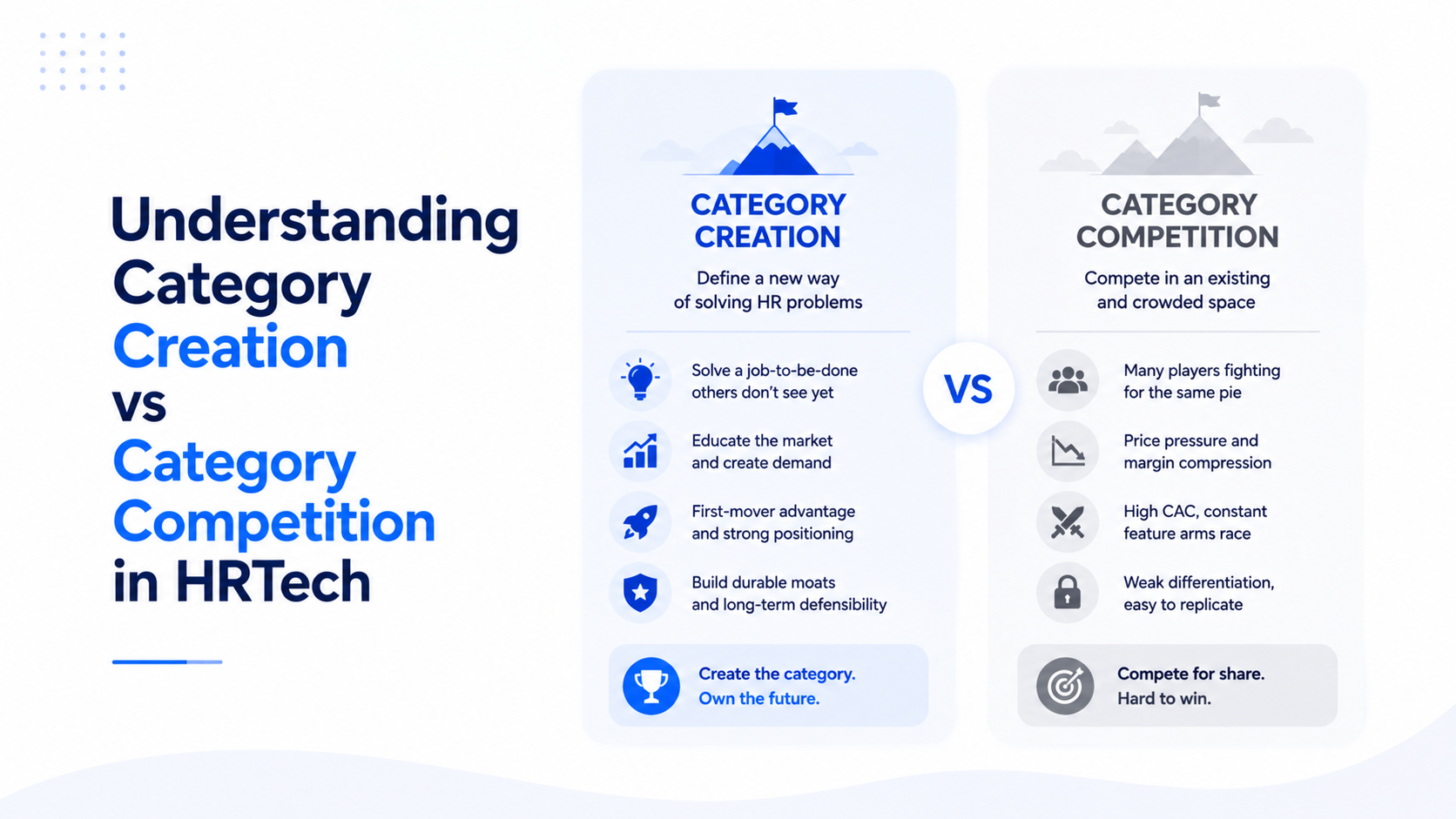
Elena Vasquez had spent three years building an AI candidate screening tool in one of the most crowded segments of the HRTech market. Her product was technically excellent, her clients were satisfied, and her team had built integrations with every major ATS on the market. But despite these strengths, her company was stuck. Every sales conversation began with a comparison to the same three competitors, every procurement process demanded feature-by-feature benchmarking, and every deal came down to price negotiation because buyers saw her product as interchangeable with the alternatives. Elena's frustration peaked when she lost a deal to an inferior competitor that offered a twenty percent discount, because the buyer's evaluation framework treated all candidate screening tools as equivalent. That night, Elena made a decision that would transform her company. She stopped positioning her product as a candidate screening tool and redefined it as a talent intelligence platform that predicted hiring outcomes using behavioral signals that no other platform captured. She was no longer competing in the candidate screening category. She was creating a new category called predictive talent intelligence, and in that category, she was the only participant. Within eighteen months, her sales cycle shortened by forty percent, her average deal size increased by sixty percent, and she stopped losing deals to inferior competitors, because there were no competitors in the category she had created.
Why Most HRTech Companies Compete When They Should
Create
The HRTech market contains hundreds of companies competing in categories that were defined years or decades ago by vendors who no longer lead them. Applicant tracking systems, recruitment marketing platforms, interview scheduling tools, and candidate screening solutions are categories with well-established definitions, well-known incumbents, and well-understood evaluation criteria. When a new company enters one of these categories, it accepts a competitive framework that was designed by and for the incumbents. The evaluation criteria emphasize feature breadth, integration depth, and brand recognition, all dimensions where incumbents have natural advantages. The pricing benchmarks are set by the incumbents' pricing models, which new entrants must match or undercut to win deals. The buyer's perception of value is shaped by the incumbent's marketing, which frames the category in terms that favor established players. By competing in an existing category, the new entrant is playing a game whose rules were written by its competitors, and winning that game requires overcoming structural disadvantages that no amount of product excellence can fully offset.
The pressure to compete rather than create comes from multiple sources. Investors often encourage founders to position their products within existing categories because existing categories are easier to explain to limited partners, easier to benchmark against public market comparables, and easier to evaluate during due diligence. Enterprise buyers prefer existing categories because they provide familiar evaluation frameworks, reducing the cognitive effort required to assess a new vendor. Sales teams prefer existing categories because the category definition does the heavy lifting of market education, allowing them to focus on competitive differentiation rather than category justification. All of these pressures push HRTech companies toward competition and away from creation, even though the economic evidence overwhelmingly favors creation. The companies that have generated the highest returns in enterprise software over the past two decades, Salesforce in CRM, Snowflake in cloud data warehousing, and Datadog in observability, are category creators, not category competitors. They did not win by being better than the incumbents in existing categories. They won by defining new categories where they were the obvious leader.
In HRTech specifically, the case for category creation is even stronger than in other enterprise software categories because the existing category definitions are outdated. The categories that organize the HRTech market, ATS, HRIS, LMS, and their various subcategories, were defined in an era when HR technology was about automating administrative processes. AI has fundamentally changed what HR technology can do, enabling capabilities like predictive talent intelligence, autonomous candidate engagement, and real-time workforce optimization that do not fit into any existing category. Companies that build these AI-native capabilities and position them within existing categories are misclassifying their own innovations, forcing buyers to evaluate fundamentally new capabilities using frameworks designed for fundamentally different products. This misclassification suppresses the perceived value of AI-native HRTech and forces AI-native companies into price-driven competition with legacy vendors whose
products serve fundamentally different purposes. According to McKinsey, HRTech companies that position AI-native products within legacy categories achieve twenty-five to thirty-five percent lower valuations and thirty to forty percent longer sales cycles compared to companies that create new categories for their AI-native capabilities, because legacy category positioning forces buyers to evaluate AI capabilities using criteria designed for process automation rather than for intelligence and prediction.
The Economics of Category Creation in HRTech
The financial advantages of category creation over category competition are dramatic and measurable across every dimension of the business model. The most immediately visible advantage is pricing power. When a company competes in an existing category, buyers can compare its pricing directly to incumbents, which creates downward pressure on prices and compresses margins. When a company creates a new category, there are no direct comparables, which means the buyer cannot benchmark the price against alternatives and must evaluate value on its own merits. Category creators typically price thirty to fifty percent higher than category competitors in adjacent spaces, because the absence of direct competition eliminates the buyer's primary leverage in price negotiations. This pricing advantage flows directly to gross margins, giving category creators the financial resources to invest more heavily in product development, customer success, and brand building than competitors who are engaged in price competition.
The second economic advantage is sales cycle efficiency. When a company competes in an existing category, the sales process is structured as a competitive bake-off where the buyer evaluates multiple vendors against the same criteria. This process is long, expensive, and uncertain, because the buyer must evaluate multiple options, manage multiple vendor relationships, and navigate internal consensus-building with stakeholders who may favor different vendors. When a company creates a new category, the sales process is structured as an educational conversation where the vendor teaches the buyer about a new approach to an old problem. This process is shorter, less expensive, and more certain, because the buyer is not comparing alternatives but evaluating a single vision. The vendor controls the narrative, frames the evaluation criteria, and positions its product as the obvious solution to a problem the buyer already has but has not yet found the right tool to solve. According to Gartner, category-creating HRTech companies report sales cycles that are forty to sixty percent shorter than category-competing companies, because the absence of direct competition eliminates the evaluation complexity and internal debate that lengthen competitive sales processes.
The third economic advantage is brand premium and market leadership. The company that defines a category owns the category's narrative, sets the standards by which the category is evaluated, and becomes the default reference point for anyone discussing the category. This brand premium has compounding effects over time. As the category grows, the category creator's brand grows with it, attracting media coverage, analyst attention, and talent that competitors in the category cannot match. The category creator becomes synonymous with the
category itself, the way Salesforce became synonymous with cloud CRM or Snowflake became synonymous with cloud data warehousing. This brand equity creates a self-reinforcing cycle where market leadership begets more market leadership, because the brand recognition that comes from category creation reduces customer acquisition costs, increases win rates, and attracts the best employees, all of which further strengthen the company's competitive position. agentic AI platforms vs automated ones illustrates how Huntlo's positioning as an agentic AI recruiting platform rather than as another automated recruiting tool reflects the category creation strategy in practice, because the agentic AI framing defines a new category where autonomous AI agents manage hiring workflows, distinguishing the approach from traditional automation tools that require human direction at every step.
How to Identify a Category Creation Opportunity in HR Technology
Category creation opportunities in HRTech share three characteristics that distinguish them from product differentiation opportunities within existing categories. The first characteristic is a problem that is widely experienced but poorly addressed by existing categories. Every enterprise struggles with candidate engagement, but the existing category of recruitment marketing platforms addresses the problem primarily through job advertising and career site optimization, which are necessary but insufficient for the engagement challenge that modern hiring presents. A category creation opportunity exists when there is a gap between the problem as buyers experience it and the solutions that existing categories provide. The gap is usually not a matter of degree, where existing solutions are somewhat inadequate, but a matter of kind, where existing solutions address a fundamentally different aspect of the problem than the one buyers actually care about. Candidate engagement is a category creation opportunity because the problem is not about advertising reach, which existing categories address, but about personalized, ongoing interaction that builds relationship and trust, which no existing category was designed to provide.
The second characteristic of a category creation opportunity is a technology enabler that makes a new approach possible. Category creation is not about marketing spin. It is about building a product that does something genuinely new that existing products cannot do. The technology enabler must be substantial enough to create a meaningful capability gap between the new product and the closest existing alternatives. In the current HRTech market, AI is the primary technology enabler for category creation, because it enables capabilities like predictive hiring analytics, autonomous candidate engagement, real-time talent market intelligence, and behavioral candidate evaluation that were not possible with previous technology. A category creation opportunity exists when a new technology capability can be applied to a widely experienced problem in a way that creates a step-change improvement in outcomes. The step-change is important because incremental improvements can be absorbed into existing categories, while step-change improvements require buyers to rethink their approach, which is the behavioral shift that creates a new category.
The third characteristic is a viable buyer population that is ready to adopt the new approach. Category creation requires market education, which is expensive and time-consuming, and the economics of market education only work if there are enough buyers who are ready to be educated. In HRTech, the readiness signal is usually expressed as frustration with existing solutions combined with awareness that new capabilities are possible. When a critical mass of enterprise talent leaders expresses dissatisfaction with their current tools and curiosity about AI-powered alternatives, the market is ready for a category-creating product that addresses their frustration with a fundamentally new approach. The timing of category creation is critical. Creating a category too early, before buyers are ready, requires enormous investment in market education with delayed returns. Creating a category too late, after competitors have already established positions, means fighting for category ownership against well-funded rivals. According to Deloitte, the optimal window for category creation in HRTech opens when more than forty percent of enterprise talent leaders express dissatisfaction with existing solutions in a specific area, because this threshold indicates sufficient buyer readiness to support the market education investment without requiring the category creator to bear the full cost of demand generation alone. more tools same hiring problems demonstrates how the frustration-driven readiness for category creation manifests in practice, because enterprises that have accumulated multiple recruiting tools without solving their core hiring challenges represent the buyer population most receptive to a category-creating platform that offers a fundamentally different approach.
The Playbook for Creating a New HRTech Category
Creating a new HRTech category requires a deliberate, multi-phase strategy that begins long before the product launches. The first phase is category definition, which involves articulating the new category in a way that is clear, distinct, and compelling to the target buyers. The category definition must name the problem, explain why existing categories fail to address it, describe the new approach, and provide evidence that the new approach delivers superior outcomes. The naming of the category is itself a strategic decision that shapes how the market perceives the opportunity. A name like predictive talent intelligence is more powerful than a name like advanced candidate screening, because it positions the product as providing a fundamentally different capability, intelligence and prediction, rather than an incremental improvement on an existing capability, screening. The category definition becomes the foundation for all subsequent marketing, sales, and product positioning, and it must be developed with the same rigor and precision that goes into product development.
The second phase is market education, which involves creating and distributing content that establishes the category creator as the authoritative voice on the new category. Market education content includes thought leadership articles, research reports, case studies, conference presentations, and analyst briefings that frame the problem, explain the new approach, and provide evidence of its effectiveness. The goal of market education is not to sell the product directly but to change how buyers think about the problem, so that when they begin searching
for solutions, they search using the category creator's framework rather than the incumbent's framework. This is the mechanism through which category creation eliminates direct competition: by changing the buyer's mental model of the problem, the category creator ensures that the buyer evaluates solutions using criteria that favor the category-creating product over the incumbent's offerings. Market education is expensive and requires patience, because the return on investment manifests over quarters and years rather than in immediate pipeline generation. But it is the most important investment a category-creating company can make, because it creates the demand conditions that make the category viable. According to LinkedIn, HRTech companies that invest more than fifteen percent of their revenue in category-defining market education content grow two to three times faster in their second and third years than companies that invest the same percentage in demand-generation marketing, because the category education creates a sustained pull dynamic that compounds over time while demand generation produces short-term pipeline that does not compound.
The third phase is product-market proof, which involves delivering measurable outcome improvements for early clients that validate the category thesis. Category creation without outcome evidence is marketing without substance, and sophisticated enterprise buyers will see through it. The category creator must be able to demonstrate that the new approach produces hiring outcomes, such as quality of hire, time to fill, or candidate engagement rates, that are significantly better than the outcomes produced by solutions from existing categories. These outcome improvements become the evidence that justifies the category definition and convinces subsequent buyers that the new category addresses a real problem in a genuinely new way. The proof phase also generates the case studies, testimonials, and reference clients that fuel the market education engine. Each successful client becomes both a revenue source and a marketing asset, creating a flywheel where product-market proof drives market education, which drives demand, which drives more client acquisition, which generates more proof. how to evaluate an AI sourcing tool explains how buyers should evaluate category-creating HRTech platforms, because the assessment focuses on outcome evidence rather than feature comparison, asking whether the platform can demonstrate measurable improvements in hiring outcomes that existing category solutions cannot achieve rather than whether it has more features or better integrations.
Why Category Creators Capture Disproportionate Value
The long-term value dynamics of category creation versus category competition are not just different in degree. They are different in kind. Category competitors participate in markets where value is distributed among multiple players based on relative feature superiority, pricing, and brand strength. These are competitive markets where no single vendor can sustain a dominant share indefinitely, because the absence of switching costs and the presence of multiple viable alternatives mean that buyers can and do switch vendors when a competitor offers a better deal. Category creators, by contrast, operate in markets where they define the standard of value itself. The company that creates a category establishes the evaluation criteria,
sets the pricing benchmarks, and builds the brand association that makes it the default choice for buyers entering the category. This structural advantage means that category creators capture a disproportionate share of the value their category generates, often maintaining fifty to seventy percent market share even as the category matures and competitors enter.
The disproportionate value capture of category creators is visible in the HRTech companies that have achieved the highest valuations and the most durable market positions. In every case, the highest-valued companies are those that created or redefined their categories rather than those that competed most effectively within existing categories. The reason is that category creation produces three durable advantages that compound over time. First, the brand premium that comes from category ownership reduces customer acquisition costs permanently, because the category creator's name is synonymous with the category itself. Second, the pricing power that comes from category ownership protects margins permanently, because the absence of a direct comparable eliminates the buyer's primary price leverage. Third, the talent advantage that comes from category ownership attracts the best engineers, product managers, and go-to-market leaders, because the most talented people want to work on defining problems rather than on incrementally improving existing solutions. These three advantages create a virtuous cycle where market leadership attracts better talent, which builds better products, which strengthens market leadership, in a self-reinforcing dynamic that becomes more powerful over time.
For HRTech founders, the strategic implication is clear. Before investing years of effort and millions of dollars in building a product, ask whether you are creating a category or competing in one. If the answer is competing, reconsider the approach. The HRTech market is undergoing an AI-driven transformation that is creating dozens of new category opportunities, from predictive talent intelligence to autonomous hiring operations to real-time workforce optimization. Each of these opportunities is available to the founder who defines the category first and builds the product that proves the category thesis. The window for category creation in AI-native HRTech is open now, but it will not remain open indefinitely. As the market matures, categories will be defined, leaders will emerge, and the opportunities for category creation will narrow. The founders who act now to define and prove new categories will build the most valuable companies in the next generation of HRTech. According to EY, category-creating enterprise software companies generate three to five times higher returns for early investors compared to category-competing companies at equivalent stages, because the structural advantages of category ownership, pricing power, brand premium, and talent attraction, create compounding value that competitive positioning cannot replicate. AI tools for niche technical roles shows how category creation works in practice for specialized recruiting technology, because defining a new category for AI-powered niche role recruiting creates a market position where the category creator is the only viable option for buyers with specialized hiring needs, eliminating the competitive benchmarking that drives down prices and compresses margins in established categories.