Marcus Torres had built a candidate screening platform that was growing steadily but not spectacularly. His company had landed forty enterprise clients in its first two years, each paying an annual subscription that generated predictable recurring revenue. The product worked well, clients were satisfied, and retention was strong. But when Marcus benchmarked his growth rate against other enterprise software companies at a similar stage, he realized he was growing at half the rate of the fastest-growing companies in his category. The difference, he discovered after studying the performance of those faster-growing competitors, was not product quality, pricing, or sales efficiency. It was network effects. The companies growing two to three times faster had built platforms where each new client made the platform more valuable for every other client, creating a self-reinforcing dynamic that accelerated growth over time. Marcus's platform, by contrast, was a traditional software product where each new client added revenue but did not make the product better for existing clients. His growth was linear, adding a fixed amount of revenue with each new customer. Their growth was exponential, because each new customer improved the product for everyone, which attracted more customers, which further improved the product. Marcus spent the next quarter redesigning his platform's data architecture to enable cross-client learning, and within six months, he began seeing the early signs of the network effect dynamic that would transform his company's growth trajectory.
Why Network Effects Are Rare in Recruitment Technology
Network effects are among the most powerful growth mechanisms in technology, but they are remarkably rare in recruitment technology. The reason is that most recruitment platforms are designed as single-tenant systems where each client's data, workflows, and candidate interactions are isolated from every other client's. A traditional applicant tracking system used by Company A does not become better because Company B also uses it. The data that Company A generates, its job postings, candidate applications, interview evaluations, and hiring outcomes, is siloed within Company A's instance and provides no value to Company B. This architectural isolation is not an accident. It reflects the historical reality that enterprises are deeply protective of their hiring data, which includes sensitive information about compensation, candidate qualifications, internal hiring criteria, and workforce composition that companies consider confidential. Recruitment technology vendors have historically respected this preference by building isolated systems that prevent any possibility of data sharing between clients.
The result is a market populated by linear-growth businesses that scale through sales and marketing effort rather than through self-reinforcing product dynamics. Each new client requires a dedicated sales effort, a separate implementation, and an independent customer success relationship. The cost of acquiring the fiftieth client is not significantly different from the cost of acquiring the first, because there are no network effects that reduce acquisition costs over time. This linear growth model works, and many successful recruitment technology companies have been built on it, but it produces fundamentally different growth trajectories than network-effect-driven businesses. A linear-growth recruitment platform that adds twenty clients per year will have roughly two hundred clients after ten years. A network-effect-driven recruitment platform that grows at a compounding rate because each new client makes the product more valuable for existing and prospective clients can reach two thousand or more clients in the same period, because the growth rate accelerates rather than remains constant. The difference between linear and compounding growth over a decade is not incremental. It is transformative.
The rarity of network effects in recruitment technology also creates an enormous opportunity for companies that figure out how to build them. In categories where network effects are common, such as social networks, marketplaces, and communication platforms, the market leaders have already established dominant positions that are extremely difficult to challenge. In recruitment technology, no company has yet built a dominant network-effect-driven platform at scale, which means the opportunity to be the first is still available. The company that first builds genuine network effects in recruitment technology at enterprise scale will have a first-mover advantage that compounds over time, because each new client added to the network makes the platform more valuable for the next client, which makes it easier to attract the client after that, in a self-reinforcing cycle that becomes increasingly difficult for late entrants to match. According to McKinsey, recruitment technology is one of the last major enterprise software categories where network-effect-driven platforms have not yet emerged at scale, which means the category is at an inflection point where the companies that build network effects first will capture disproportionate market share and establish durable
competitive positions that late entrants will struggle to overcome.
The Two Sides of a Recruitment Network Effect
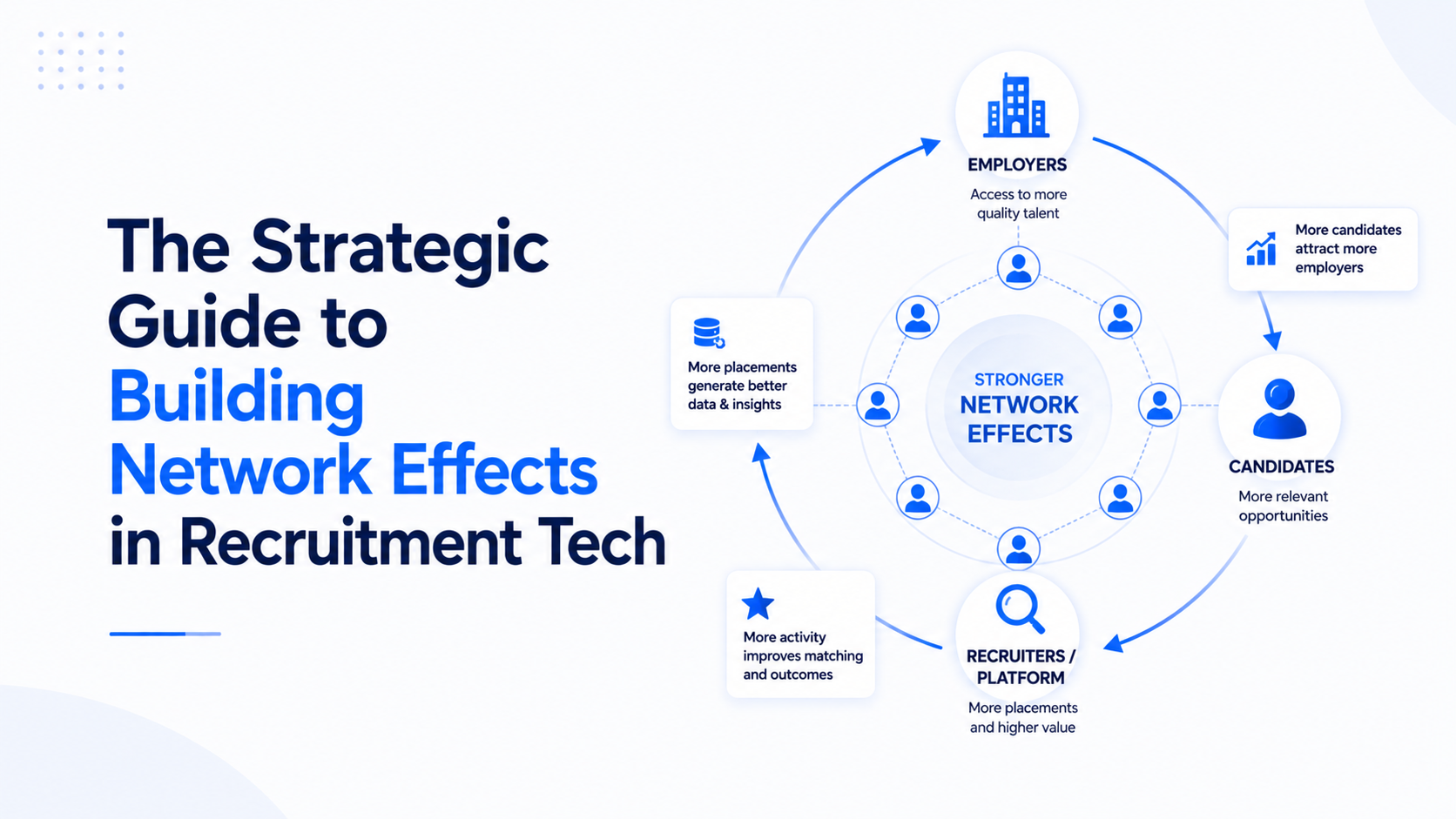
The network effects that matter most in recruitment technology operate on two distinct sides: the employer side and the candidate side. Employer-side network effects occur when the platform becomes more valuable to each employer client as more employers use it, because the aggregated data from multiple employers enables the platform's AI models to identify patterns, predict outcomes, and generate recommendations that no single employer's data could support. An AI model trained on hiring outcomes from five hundred employers across multiple industries can identify candidate characteristics that predict success with far greater accuracy than a model trained on data from a single employer, because the cross-employer dataset provides statistical power and pattern diversity that single-employer data cannot match. This employer-side network effect is a data network effect, meaning it operates through the accumulation and analysis of data rather than through direct interactions between users. It is the form of network effect that is most immediately achievable in enterprise recruitment technology, because it requires only that the platform aggregate anonymized, cross-client data to improve its AI models.
Candidate-side network effects occur when the platform becomes more valuable to candidates as more candidates use it, and more valuable to employers as more candidates are available on the platform. This is the form of network effect that powers consumer platforms like LinkedIn, where the value of the platform to each user increases with the number of other users on the platform. In recruitment technology, candidate-side network effects are rarer and more difficult to build than employer-side data network effects, because they require the platform to have direct relationships with candidates rather than mediating those relationships solely through employer clients. A platform where candidates create profiles, engage in AI-powered screening conversations, and receive job recommendations develops candidate-side network effects because each new candidate adds to the platform's candidate pool, making the platform more attractive to employers, which attracts more employers, which creates more job opportunities for candidates, which attracts more candidates in a classic two-sided market dynamic. The challenge is that building direct candidate relationships requires the platform to provide value to candidates directly, not just to the employers who pay for the platform.
The most powerful recruitment technology platforms will build both sides of the network effect simultaneously, creating a dual-sided flywheel where employer-side data effects and candidate-side marketplace effects reinforce each other. More employers generate more hiring data, which improves AI models, which produces better candidate matches, which attracts more candidates, which makes the platform more valuable to employers, which attracts more employers in a compounding cycle. This dual-sided dynamic is extraordinarily powerful when it achieves escape velocity, but it is also extraordinarily difficult to initiate because it requires the platform to deliver value to two distinct user groups, employers who pay and candidates who typically do not, simultaneously. The platforms that achieve this will not be those
that focus exclusively on one side and hope to add the other later. They will be those that design for both sides from the beginning, building candidate value propositions that are genuinely valuable independent of the employer value proposition, and creating data architectures that enable cross-side learning from day one. According to Gartner, fewer than five percent of recruitment technology platforms have built meaningful network effects on either side, and fewer than one percent have built dual-sided network effects, which means the category is wide open for companies that can solve the design challenge of delivering value to both employers and candidates through the same platform. agentic AI platforms vs automated ones explains how agentic AI recruiting platforms create candidate-side value through conversational AI experiences that provide candidates with immediate, personalized engagement, because the AI agents give candidates a better experience than they receive from most human recruiters, which makes candidates willing to engage with the platform directly and creates the candidate-side network effects that most employer-only platforms cannot achieve.
Data Network Effects: The Foundation That Most Platforms Miss
The most accessible form of network effects in recruitment technology is the data network effect, where the platform's AI models improve as they process more data from more clients. This form of network effect does not require direct user interactions between clients or candidates. It operates entirely within the platform's data infrastructure, where machine learning models are continuously retrained on aggregated, anonymized data from across the client base. The data network effect is accessible because it does not require enterprises to share their data with competitors or even to be aware that their data is contributing to model improvement. The platform can aggregate data at the model level, using each client's interactions to improve the underlying AI models while keeping each client's specific data confidential and isolated. This architectural approach, where data is used to train shared models without exposing individual client data, is well-established in other enterprise AI categories and is the foundation on which most recruitment technology network effects will be built.
The data network effect in recruitment technology manifests in several measurable ways. First, candidate matching accuracy improves as the platform processes more hiring outcomes across more clients, because the AI models learn which candidate characteristics predict success in which types of roles across a broader range of contexts. A platform that has processed ten thousand hiring outcomes across two hundred clients can identify success patterns with far greater confidence than a platform that has processed five hundred outcomes from ten clients. Second, communication optimization improves as the platform records more candidate interactions, because the AI learns which outreach messages, conversation patterns, and engagement strategies produce the highest response rates across different candidate segments. Third, process optimization improves as the platform manages more hiring workflows, because the AI learns which process configurations, interview sequences, and evaluation criteria produce the best hiring outcomes. Each of these improvements is driven by data accumulation, and each improvement makes the platform more valuable to every client, creating the
self-reinforcing dynamic that defines a network effect. According to LinkedIn, recruitment platforms that leverage cross-client data network effects show twenty-five to thirty-five percent faster improvement in candidate match quality over a two-year period compared to platforms that train models on single-client data, because the cross-client dataset provides the statistical diversity and volume needed for continuous model improvement.
Building a data network effect requires a specific technical architecture that many recruitment platforms have not invested in. The architecture must support continuous data ingestion from multiple clients, real-time model retraining on aggregated data, and the ability to deploy improved models to all clients simultaneously without requiring individual client action. This is fundamentally different from the architecture of a traditional recruitment platform, where each client's data is processed independently and model improvements require manual updates to each client's instance. The continuous learning architecture required for data network effects is more complex and more expensive to build, but it creates a compounding advantage that justifies the investment. Once the architecture is in place, the platform improves automatically as it processes more data, and the rate of improvement accelerates as the data volume grows. This is the flywheel that transforms a linear-growth recruitment platform into an exponential-growth one. why AI tools have outdated candidate data explains why recruitment platforms that fail to invest in continuous learning architectures will fall behind those that do, because platforms relying on static models trained on periodic data updates cannot match the prediction accuracy of platforms whose models improve continuously through real-time data network effects, and the accuracy gap widens with each month of operation as the continuous-learning platform accumulates more training data.
From Linear Growth to Exponential: How Network Effects Change the Trajectory
The practical impact of network effects on a recruitment technology company's growth trajectory is profound and measurable. In a linear-growth model, the company must invest proportionally in sales and marketing to maintain its growth rate. If the company wants to add fifty clients next year, it must hire enough salespeople, generate enough leads, and conduct enough demonstrations to close fifty deals. The cost of growth is roughly proportional to the amount of growth, which means that scaling the business requires scaling the cost structure at a similar rate. This dynamic creates a growth ceiling, because the company cannot grow faster than its ability to hire, train, and deploy sales and marketing resources. In a network-effect-driven model, by contrast, the platform itself becomes a growth engine, because each new client makes the product more valuable, which makes it easier to sell to the next client, which reduces the cost of acquiring subsequent clients. Over time, the proportion of new business that comes from inbound channels, peer referrals, and organic advocacy increases, while the proportion that comes from expensive outbound sales decreases. This shift in the mix of acquisition channels fundamentally changes the unit economics of the business.
The shift from outbound-dominated acquisition to inbound-dominated acquisition is the most visible manifestation of network effects in recruitment technology. Companies with strong network effects report that sixty to eighty percent of their new pipeline comes from inbound sources after three to four years of operation, compared to twenty to thirty percent for companies without network effects. This has a direct impact on customer acquisition costs, which decline by forty to sixty percent over the same period for network-effect-driven companies while remaining flat or increasing for linear-growth companies. The declining acquisition cost, combined with the increasing product value that network effects create, produces an expansion in gross margins that accelerates the company's path to profitability. A recruitment platform that reduces its customer acquisition cost by fifty percent while simultaneously increasing its contract values through product improvement driven by network effects achieves the kind of operating leverage that investors value most highly. According to Deloitte, recruitment technology companies with measurable network effects achieve profitability eighteen to twenty-four months earlier than comparable companies without network effects, because the declining acquisition costs and increasing contract values create a faster convergence of revenue growth and cost reduction.
Network effects also change the competitive dynamics of the market in ways that benefit early leaders disproportionately. In a market without network effects, competitors can enter at any time and compete effectively by building a comparable product and investing in sales and marketing. The incumbent's advantage is limited to brand recognition, existing client relationships, and the lead time required for competitors to build comparable products. In a market with network effects, the incumbent's advantage includes all of these factors plus the data advantage that comes from having a larger client base. The incumbent's AI models are more accurate because they have been trained on more data. The incumbent's product is more valuable because it serves more clients who generate more cross-client insights. The incumbent's distribution is stronger because it has more satisfied clients who generate more peer referrals. Each of these advantages compounds over time, making it progressively more expensive and difficult for new entrants to compete. The market tends toward consolidation around the platform with the strongest network effects, because the value gap between the network-effect leader and non-network-effect competitors widens with each client added to the leader's network. more tools same hiring problems explains why this consolidation dynamic favors integrated platforms over point solutions, because platforms with broader capability sets generate more data across more hiring functions, which creates stronger data network effects that narrow-capability point solutions cannot match regardless of how well they perform in their specific function.
The Practical Playbook for Building Network Effects in Recruiting
Building network effects in recruitment technology requires deliberate architectural and strategic decisions that must be made early in the company's development. The first decision
is to build a shared data architecture from the beginning rather than starting with isolated single-tenant systems and attempting to add cross-client data capabilities later. Retrofitting a single-tenant architecture to support cross-client learning is technically complex, expensive, and disruptive to existing clients, because it requires data migration, model retraining, and architecture changes that affect the entire platform. Companies that design for cross-client data from day one avoid this retrofitting cost and begin accumulating the data assets that will drive network effects from their very first client. The shared data architecture does not mean that clients share their data with each other. It means that data is aggregated at the model level, where it improves AI models that serve all clients, while remaining isolated at the application level, where each client sees only their own data. This architectural pattern, sometimes called federated learning or model-level aggregation, is the technical foundation on which recruitment data network effects are built.
The second strategic decision is to design candidate interactions that generate interaction-level data rather than just profile-level data. Profile data, the information candidates provide in resumes and applications, is necessary but insufficient for building powerful data network effects. Interaction data, the record of how candidates actually behave during screening conversations, how quickly they respond, how they communicate, and how they engage with the hiring process, is far more valuable for training AI models because it captures behavioral signals that predict candidate quality and fit. Platforms that design their candidate-facing interactions with data capture in mind, recording not just the content of candidate responses but the patterns, timing, and quality of those responses, generate the rich interaction datasets that power the most effective data network effects. This means designing AI-powered screening and engagement experiences that are simultaneously valuable to the candidate and productive for the platform's data infrastructure, a design challenge that requires close collaboration between product design, data engineering, and AI teams. According to EY, recruitment platforms that prioritize interaction-level data collection show forty to fifty percent higher AI model accuracy improvement rates compared to platforms relying primarily on profile data, because the behavioral signals captured through interactions provide predictive power that static profile data cannot replicate.
The third strategic decision is to measure and optimize for network effect indicators rather than just traditional SaaS metrics. The traditional metrics that recruitment technology companies track, monthly recurring revenue, customer acquisition cost, net revenue retention, and churn rate, are necessary but insufficient for managing a network-effect-driven business. Companies building network effects should also track cross-client model accuracy improvements, the rate at which AI predictions improve as the client base grows, inbound pipeline percentage, the proportion of new business coming from organic and referral channels rather than paid channels, time-to-value for new clients, whether clients with more data history achieve better outcomes than new clients, and advocacy rate, the percentage of clients who actively recommend the platform to peers. These network-effect-specific metrics provide early signals about whether the flywheel is spinning and how quickly it is accelerating. When cross-client model accuracy improves measurably with each quarter of data accumulation,
when inbound pipeline percentage increases steadily as the client base grows, and when the time-to-value for new clients decreases because the platform's AI models are already well-trained from existing client data, the network effect is working. how to evaluate an AI sourcing tool provides a framework for assessing whether a recruitment platform is building genuine network effects or merely accumulating data without generating compounding value, because the evaluation examines whether the platform's product metrics improve systematically as the client base grows, which is the definitive indicator that data is being converted into network-effect-driven product improvement rather than simply being stored without generating incremental value.