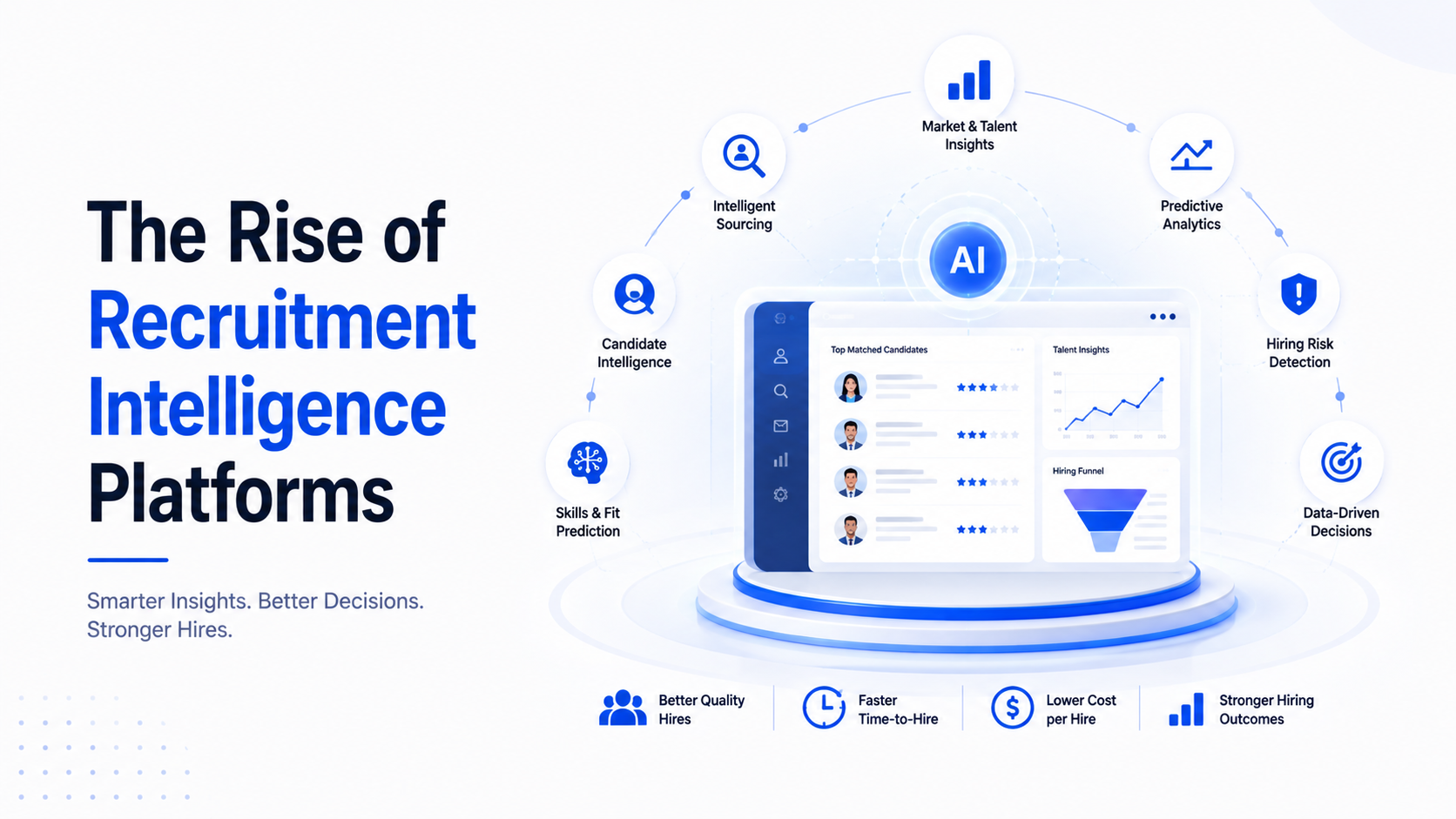
Sarah Mitchell, VP of Talent Strategy at a global logistics company, noticed a pattern in her quarterly hiring reviews that troubled her. Despite investing heavily in recruiting technology over the past five years, her team's key hiring metrics, time-to-fill, quality-of-hire, and cost-per-hire, had barely improved. The team had adopted an AI sourcing tool, an outreach automation platform, and an analytics dashboard, yet the fundamental productivity of the recruiting function remained stubbornly flat. When Mitchell replaced the collection of tools with a single recruitment intelligence platform that unified sourcing, engagement, and decision support within one AI-driven system, the results changed dramatically within ninety days. Time-to-fill for operations managers dropped by thirty-eight percent. Quality-of-hire scores, measured by twelve-month retention, improved by eighteen percent. Most surprisingly, recruiter satisfaction increased sharply because the platform handled the data processing and coordination tasks that had been consuming the majority of their working hours. Mitchell's experience reflects a broader shift that is redefining the recruiting technology market: the rise of intelligence platforms that do not just automate tasks but actively improve hiring decisions.
Why Intelligence Is Replacing Automation in Recruiting
The recruiting technology market is undergoing a fundamental shift from tools that automate tasks to platforms that generate intelligence, and this shift is redefining what organizations can expect from their talent acquisition technology investments. Task automation, the
dominant paradigm for the past decade, focused on making existing recruiting processes faster by reducing manual effort. Resume screening automation reduced the time recruiters spent reviewing applications. Interview scheduling automation eliminated the back-and-forth of coordinating calendars. Outreach automation enabled recruiters to send more candidate communications in less time. These improvements were valuable, but they were limited in scope because they optimized individual tasks without changing the underlying logic of the hiring process. According to McKinsey, the organizations that have moved beyond task automation to intelligence-driven recruiting platforms report twenty-five to forty percent larger improvements in hiring outcomes than those that have only automated individual tasks, because intelligence platforms optimize the entire hiring workflow rather than isolated steps within it.
The distinction between automation and intelligence is not merely semantic. Automated tools execute predefined rules: if a candidate matches these keywords, flag them for review. If an interview slot opens, assign the next candidate in the queue. These rules improve efficiency but they cannot adapt to changing conditions, learn from outcomes, or generate insights that were not explicitly programmed. Intelligence platforms operate differently. They build predictive models from hiring outcome data, identify patterns that human recruiters would not detect, and continuously refine their recommendations based on the results of every hiring decision. When market conditions shift, for example when a new competitor enters a talent market or when candidate preferences change, intelligence platforms adapt their behavior automatically while automated tools continue executing the same rules until a human reprograms them. According to Gartner HR technology adoption research, the percentage of enterprises using intelligence-driven recruiting platforms doubled between 2024 and 2026, while growth in standalone automation tool adoption flattened, indicating that the market has reached an inflection point where intelligence is becoming the baseline expectation rather than a premium feature.
For talent acquisition leaders, the transition from automation to intelligence has practical implications for technology strategy and investment prioritization. Organizations that continue to invest in task-level automation tools are optimizing for a paradigm that is losing relevance, because the incremental gains from automating additional tasks diminish as the easiest automation opportunities are exhausted. Intelligence platforms, by contrast, deliver compounding returns because they improve with every hiring cycle. The data generated by each hire, each candidate interaction, and each market shift feeds into models that make the platform more accurate and more valuable over time. This compounding dynamic means that early adopters of recruitment intelligence build advantages that grow faster than late adopters can replicate, creating a competitive timeline that favors decisive action. The organizations that recognize this dynamic and begin their intelligence platform transition now will be positioned to outperform those that delay, because the gap between intelligence-driven and automation-only recruiting widens with each passing quarter.
The Data Infrastructure Behind Recruitment Intelligence
The performance of any recruitment intelligence platform depends on the quality, freshness, and breadth of the data that powers its AI models. This dependency on data quality has emerged as the single most important factor distinguishing platforms that deliver strong results from those that disappoint, and it has elevated data infrastructure from a technical detail to a primary evaluation criterion. The concern about whether some AI recruiting tools rely on outdated candidate data has become central to the intelligence platform conversation because stale data produces unreliable intelligence regardless of how sophisticated the AI algorithms may be. A platform with advanced machine learning models operating on three-month-old candidate profiles will generate worse recommendations than a simpler model operating on continuously refreshed data, because the fresher data more accurately reflects current candidate availability, skills, and career preferences. According to Deloitte HR technology benchmarking, organizations that evaluate data quality and refresh frequency as their primary vendor selection criterion report twenty to thirty percent higher satisfaction with their intelligence platform investment than those that focus on feature comparison, because data quality predicts actual production performance more reliably than any other evaluation factor.
The data infrastructure requirements for recruitment intelligence extend beyond candidate profiles to encompass market intelligence, organizational hiring data, and outcome feedback loops. Market intelligence data, including compensation trends, talent availability by geography and skill category, and competitive hiring dynamics, enables intelligence platforms to provide sourcing recommendations that reflect current market conditions rather than historical patterns. Organizational hiring data, including historical hiring outcomes, recruiter performance patterns, and hiring manager preferences, enables the platform to calibrate its recommendations to the specific context of each organization rather than applying generic best practices. Outcome feedback loops, where the results of each hiring decision are fed back into the platform's models, enable continuous improvement that makes the intelligence more accurate and more valuable over time. According to EY workforce technology analysis, the platforms that integrate all three data categories, market, organizational, and outcome, into a unified intelligence layer deliver fifty to sixty percent better hiring outcome predictions than platforms that rely on candidate profile data alone, because the multi-source data provides a more complete and more contextual picture of each hiring decision.
The practical implication for organizations evaluating recruitment intelligence platforms is that data due diligence should be as thorough as feature evaluation. Ask vendors to specify their data refresh cycles for each data category, not just an aggregate number. Request evidence of data validation processes and the frequency with which data quality issues are detected and corrected. Test the platform's recommendations against your own knowledge of specific talent markets where you have deep expertise. If the platform's recommendations do not reflect current market realities that you can independently verify, the underlying data may be stale or incomplete regardless of what the vendor's marketing materials claim. The organizations that conduct this level of data due diligence before selecting an intelligence platform consistently achieve better hiring outcomes and higher satisfaction than those who evaluate platforms based primarily on user interface design, feature lists, or vendor brand recognition. Data quality is not the most exciting evaluation criterion, but in 2026 it is the most reliable
predictor of whether a recruitment intelligence platform will deliver on its promises in production.
How Intelligence Platforms Transform Hiring Metrics
The most compelling evidence for the recruitment intelligence shift comes from the hiring metrics of organizations that have made the transition. The impact is not limited to a single metric but extends across the full spectrum of talent acquisition performance indicators. Time-to-fill, the most commonly tracked recruiting metric, improves by twenty-five to forty percent for organizations using intelligence platforms, because the platforms can identify and engage qualified candidates faster than manual or automated processes. Quality-of-hire, measured by performance ratings and retention at the twelve-month mark, improves by fifteen to twenty-five percent, because multi-signal matching produces more accurate candidate-role fit assessments than the keyword-based screening that traditional tools perform. Cost-per-hire decreases by fifteen to twenty percent as the platform's efficiency gains reduce the recruiter time and external spending required per successful hire. The challenge of evaluating an AI sourcing tool before buying is increasingly being answered by this growing body of production metrics, which provides the evidence base that previous generations of recruiting technology lacked. According to LinkedIn talent solutions research, organizations using intelligence platforms report that the availability of comprehensive outcome data from peer organizations has significantly improved their ability to build credible business cases for technology investment and to set realistic expectations for the results they can achieve.
Beyond the standard metrics, intelligence platforms also transform the quality and depth of recruiting analytics available to talent acquisition leaders. Traditional recruiting analytics, typically generated by ATS reporting modules, describe what has already happened: how many candidates were sourced, how many were interviewed, how many received offers, and how many accepted. This retrospective reporting is useful for operational management but limited for strategic decision-making. Intelligence platforms provide predictive analytics that forecast what will happen: which requisitions are at risk of extended time-to-fill, which sourcing channels will produce the best candidates for specific role types, and what compensation ranges will be competitive for candidates with target skill profiles. This shift from descriptive to predictive analytics enables talent acquisition leaders to allocate resources proactively rather than reactively, focusing recruiter effort and budget on the hiring activities that will produce the highest return. According to SHRM talent acquisition analytics research, organizations using intelligence platforms with predictive analytics capabilities make fifteen to twenty percent more efficient use of their recruiting budget than those relying on retrospective ATS reporting, because they can identify and address potential hiring problems before they become costly delays.
The metric transformation also extends to candidate experience, a dimension that has become increasingly important as candidates, particularly those in high-demand fields, have more employment options and higher expectations for how they are treated during the hiring process. Intelligence platforms improve candidate experience through personalized communication
that reflects the candidate's specific background and interests, real-time status updates that eliminate the uncertainty candidates find frustrating, and optimized scheduling that reduces the friction of coordinating interviews across multiple participants and time zones. According to industry benchmarking data, organizations with intelligence-enhanced candidate experience report twelve to eighteen percent higher offer acceptance rates, because candidates who feel respected and informed throughout the hiring process develop a stronger preference for the employer. For talent acquisition leaders, the candidate experience improvement is not merely a feel-good benefit but a measurable driver of hiring outcomes that directly affects the organization's ability to compete for top talent in competitive markets.
The Competitive Advantage Timeline for Early Adopters
One of the most strategically significant aspects of the recruitment intelligence shift is the timeline advantage it creates for early adopters. Unlike traditional recruiting tools, whose value is largely determined by their current feature set, intelligence platforms generate compounding data advantages that grow with every hiring cycle. Each hire produces outcome data that refines the platform's models. Each candidate interaction generates behavioral data that improves engagement optimization. Each market shift, captured in real time by the platform's monitoring capabilities, enhances the accuracy of future recommendations. The organizations that adopted intelligence platforms in 2024 or 2025 now have two to three years of accumulated performance data, giving their platforms a measurable accuracy advantage over platforms deployed more recently. The familiar pattern of adding more tools while experiencing the same hiring problems often results from organizations that delay their intelligence platform adoption and instead continue layering additional automation tools on top of existing systems, a strategy that adds cost and complexity without building the data foundations that drive genuine performance improvement. According to McKinsey talent technology research, the performance gap between early intelligence adopters and organizations still using automation-era tools widens by approximately ten to fifteen percent per year, because the compounding effect of data accumulation and model learning produces accelerating returns that late adopters cannot replicate without equivalent time.
The competitive timeline advantage also manifests in recruiter capability development. Recruiters who have been working with intelligence platforms for two or more years have developed analytical and strategic skills that their counterparts in automation-only environments have not had the opportunity to develop. When an intelligence platform handles data processing, candidate ranking, and routine communication, recruiters can focus on hiring manager advisory, candidate relationship management, and strategic workforce planning. These higher-value activities develop skills that are difficult to acquire in environments where recruiters spend the majority of their time on administrative tasks. The result is a recruiting team that is not only more productive but more strategically capable, able to provide insights and recommendations that influence business decisions beyond the hiring function. According to Gartner HR workforce research, organizations that have been using intelligence platforms for two or more years report that their recruiting teams operate at a measurably higher strategic maturity level than teams in organizations that adopted intelligence technology more recently,
because the combination of tool capability and human skill development produces a recruitment function that is more valuable to the business. This recruiter capability advantage is difficult for competitors to replicate quickly, because it requires both technology investment and time.
For organizations considering when to adopt a recruitment intelligence platform, the timeline analysis suggests that the cost of delay is not linear but accelerating. Each quarter of delay means another quarter of data accumulation that competitors with intelligence platforms are building, another quarter of recruiter skill development that competing teams are advancing, and another quarter of hiring outcome improvements that competing organizations are compounding. The practical recommendation is to begin the transition as soon as the organization can assemble the necessary resources for a well-planned implementation, rather than waiting for a convenient moment that may not arrive. The organizations that have successfully navigated the intelligence platform transition report that the process typically takes six to twelve months from selection to full operational deployment, meaning that an organization beginning the process today will not see full benefits until mid to late 2027. Starting sooner rather than later shortens the gap between the organization and competitors who have already begun building their intelligence capabilities.
What the Recruitment Intelligence Market Looks Like Beyond 2026
Looking beyond the current adoption cycle, the recruitment intelligence market is poised for continued rapid evolution driven by advances in AI capabilities, expanding data ecosystems, and growing buyer sophistication. The most significant near-term development is the integration of agentic AI capabilities into intelligence platforms, enabling the systems to manage entire hiring workflows with minimal human intervention for routine operations. This agentic evolution will extend the value of intelligence platforms from decision support to autonomous execution, handling sourcing, engagement, screening, scheduling, and initial assessment as a coordinated workflow rather than a collection of independent tasks. The question of whether AI recruiting tools work for niche or technical roles will be increasingly answered in the affirmative as intelligence platforms accumulate domain-specific data and refine their models for specialized talent markets. According to Deloitte HR technology forecast research, the recruitment intelligence market is expected to grow at approximately twenty-five to thirty percent annually through 2028, driven by enterprise demand for integrated intelligence capabilities that span the full hiring lifecycle and by the continuous improvement in AI model performance that makes each generation of platforms materially more capable than the last.
The data ecosystem supporting recruitment intelligence will also expand significantly. Today's intelligence platforms primarily leverage professional profile data, job posting data, and organizational hiring records. The next generation will incorporate additional data sources including real-time professional activity signals from collaboration platforms and developer communities, skills assessment data from project portfolios and open-source
contributions, and behavioral indicators from candidate interactions across multiple touchpoints. This expanded data ecosystem will enable intelligence platforms to build richer candidate profiles, make more accurate fit predictions, and provide more nuanced hiring recommendations. The organizations that position themselves to leverage this expanded data ecosystem by selecting platforms with open data architectures and strong integration capabilities will benefit disproportionately from the improvements that additional data sources enable. According to LinkedIn talent solutions market forecast, the platforms that successfully integrate the broadest range of data sources into their intelligence models will deliver fifteen to twenty percent better hiring outcome predictions by 2028 than platforms relying on traditional professional profile data alone, because multi-source data provides a more complete and more dynamic picture of candidate capabilities and availability.
The competitive landscape of the recruitment intelligence market will also continue to evolve. Current market leaders will face increasing competition from AI-native entrants that are building platforms from the ground up around intelligence capabilities rather than adding intelligence features to existing automation architectures. This competitive dynamic will benefit buyers by accelerating innovation, improving pricing, and expanding the range of available options. However, it will also increase the complexity of vendor evaluation, as the gap between marketing claims and production performance may widen as more vendors compete for enterprise buyers with increasingly sophisticated intelligence promises. For organizations navigating this evolving market, the practical recommendation is to maintain a structured evaluation process that prioritizes data quality, production evidence, and outcome guarantees over feature demonstrations and brand reputation. The recruitment intelligence market in 2027 and 2028 will offer more capability and more value than today's market, but realizing that value will require the same disciplined evaluation approach that distinguishes successful technology adopters from those who make expensive mistakes.