When Marcus Rivera took over as VP of Talent Acquisition at Pinnacle Financial Group in mid-2022, his first order of business was auditing the technology his team of thirty-one recruiters used every day. What he found was staggering: seventeen distinct tools across sourcing, screening, interview scheduling, offer management, and onboarding, none of which shared a common data layer. His recruiters spent an estimated forty percent of their week simply moving candidate information between systems, and his talent analytics team required three full days each month just to reconcile data from different sources into a single pipeline report. Rivera's experience is far from unique. Enterprise hiring organizations across industries have spent the last decade accumulating technology without ever designing a coherent architecture, and the result is a fragile, expensive, and increasingly ineffective ecosystem that cannot keep pace with the speed and quality demands of modern talent acquisition.
Why Legacy Hiring Stacks Are Finally Breaking Down
For more than a decade, enterprise hiring technology was built on an assumption that no longer holds: that a collection of best-of-breed point solutions could be stitched together into a coherent recruiting system. Companies accumulated applicant tracking systems, sourcing tools, assessment platforms, interview scheduling software, and onboarding systems, each from a different vendor, each with its own data model and integration requirements. According to McKinsey, the average enterprise recruiting operation now manages seven to twelve separate technology tools, creating a labyrinth of integrations that consume more IT resources than the recruiting tools themselves. The result is a hiring architecture that is structurally fragile, expensive to maintain, and incapable of delivering the real-time insights that modern talent acquisition demands.
The breaking point has arrived because the nature of enterprise hiring has fundamentally changed. Talent scarcity has shifted power from employers to candidates, meaning the speed and quality of the hiring experience now directly determines whether top talent accepts an offer. A Gartner survey found that enterprises with fragmented recruiting stacks take an average
of forty-two days to fill a professional role, compared to twenty-eight days for companies with integrated platforms. The difference is not just speed. It is the quality of candidate engagement throughout the process. When a candidate interacts with five different systems during a single hiring journey, the experience feels disjointed and impersonal. When every touchpoint flows through a unified platform, the experience feels seamless and respectful of the candidate's time.
Enterprise leaders are now recognizing that the cost of maintaining fragmented hiring technology extends far beyond license fees and integration overhead. It shows up in slower time-to-fill, lower offer-acceptance rates, reduced recruiter productivity, and an inability to generate actionable analytics across the full talent funnel. The hidden cost is strategic: when hiring data lives in silos, talent leaders cannot answer basic questions about pipeline health, source effectiveness, or workforce planning needs without manually exporting and reconciling data from multiple systems. This is not an operational inconvenience. It is a structural impediment to treating talent acquisition as a strategic function, and it is the primary reason why enterprises are rethinking their hiring architecture from first principles.
The Shift from Tool Collections to Integrated Hiring Platforms
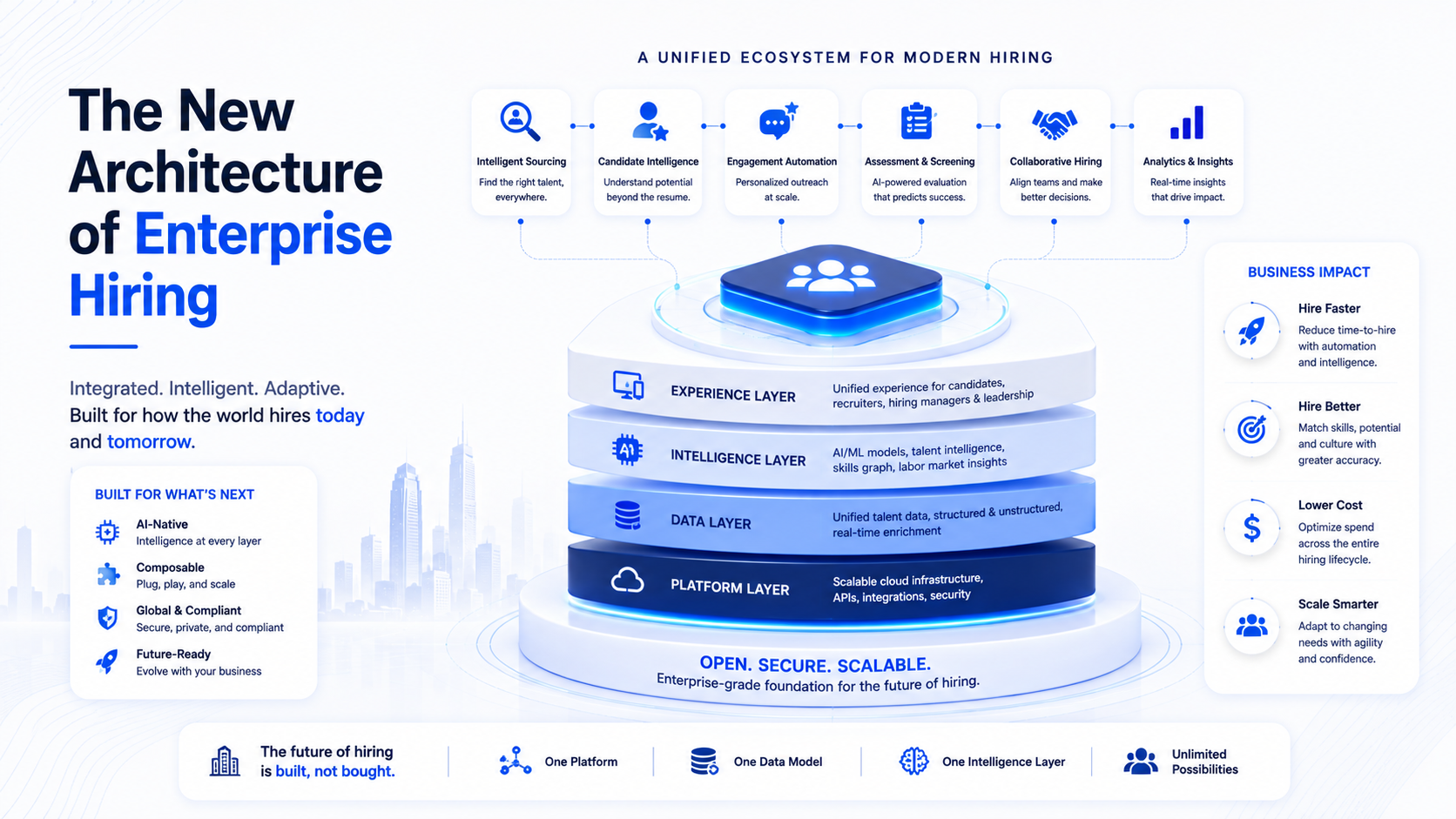
The new architecture of enterprise hiring is not about adding more tools. It is about consolidating the hiring workflow into a unified platform where sourcing, screening, engagement, interviewing, and decision-making happen within a single intelligent environment. Deloitte research on enterprise technology consolidation found that companies using unified talent platforms reduced their recruiting technology costs by an average of twenty-five percent while simultaneously improving key hiring metrics. The efficiency gains come not just from fewer vendor contracts but from the elimination of data handoffs between systems, which are the primary source of delays, errors, and lost context in enterprise hiring.
Integrated platforms also enable a fundamentally different approach to recruiter workflow. Instead of toggling between a sourcing tool, an ATS, an email client, and a calendar application, recruiters work within a single interface that orchestrates the entire hiring process. Tasks that previously required manual coordination across systems, such as moving a candidate from sourcing to screening to interview, now happen as a single automated workflow. This orchestration layer is where the biggest productivity gains emerge. Research on how many follow-ups one hire needs demonstrates that the follow-up cadence between sourcing outreach and interview scheduling is one of the most consequential determinants of hiring success, yet it is precisely the type of cross-system coordination that fragmented tool stacks handle poorly.
The platform approach also changes the economics of hiring technology investment. Instead of evaluating and negotiating contracts with a dozen vendors, enterprise talent leaders can invest in a single strategic platform partnership and redirect the savings toward adoption, training, and continuous improvement. EY analysis of enterprise software spending shows that
companies with consolidated tech stacks allocate thirty to forty percent more of their technology budget to change management and user adoption, which is the actual driver of ROI. The new hiring architecture is not just a technology decision. It is a resource allocation strategy that prioritizes depth of usage over breadth of tools.
AI Orchestration Is the New Integration Layer
In legacy hiring stacks, integration meant building API connections between systems so that data could flow from one tool to another. But this approach has a fundamental limitation: it merely moves data around without adding intelligence. A candidate record might flow from a sourcing tool into an ATS, but the context of how that candidate was sourced, what messages they received, and how they responded is often lost in translation. LinkedIn talent research has shown that this loss of context is a primary reason why candidates drop out of enterprise hiring processes, particularly at the top of the funnel where personalization matters most.
The new architecture replaces traditional integration with AI orchestration. Instead of simply passing data between systems, an orchestration layer understands the hiring workflow as a continuous process and makes intelligent decisions about what actions to take next. It can prioritize which candidates to engage based on likelihood of response, draft personalized messages that reference a candidate's specific experience, and adjust the hiring workflow based on real-time signals such as candidate engagement patterns or changing job requirements. The distinction between AI sourcing vs AI recruiting is particularly relevant here: in the old architecture, sourcing and recruiting were separate functions with separate tools. In the new architecture, AI orchestration blurs these boundaries by enabling a continuous, intelligent workflow from first contact to final offer.
This orchestration capability also transforms the role of data in enterprise hiring. In fragmented systems, analytics is an afterthought, requiring manual extraction and reporting. In an orchestrated platform, analytics is embedded in every action. The system continuously learns from outcomes, refines its matching algorithms, and surfaces insights to recruiters in real time. When a hiring manager rejects a shortlisted candidate, the system understands why and adjusts its scoring model accordingly. When a particular sourcing channel consistently produces high-quality hires, the system automatically allocates more resources to that channel. This closed-loop intelligence is what distinguishes the new hiring architecture from simply bolting AI features onto legacy systems.
Rebuilding the Candidate Experience from the Inside Out
Enterprise hiring has historically been designed around the employer's internal processes rather than the candidate's experience. Job descriptions are written for internal approval committees, application forms are structured for ATS data fields, and interview processes are organized around hiring manager availability. This employer-centric design was acceptable
when talent was abundant, but in a competitive labor market, it is a significant disadvantage. McKinsey research on candidate experience consistently shows that enterprises that redesign their hiring process from the candidate's perspective see measurable improvements in offer-acceptance rates and employer brand perception.
The new hiring architecture inverts this paradigm by building the technology around the candidate journey rather than internal workflows. A candidate entering an enterprise hiring process encounters a single, cohesive experience regardless of how many internal systems are involved behind the scenes. Communication is personalized and timely, interview scheduling respects the candidate's preferences, and feedback is delivered promptly at every stage. This candidate-first design is not just a nicety. For AI tools for niche technical roles where qualified candidates are scarce and highly sought after, the quality of the hiring experience is often the deciding factor in whether a top candidate chooses one employer over another. Candidates remember how they were treated during the hiring process, and they share those experiences with their professional networks.
The technology that enables this experience also benefits recruiters and hiring managers. When the platform handles scheduling, communication, and status updates automatically, recruiters spend less time on administrative coordination and more time on the activities that actually influence hiring outcomes: building relationships with candidates, coaching hiring managers on interview techniques, and making strategic decisions about pipeline composition. Gartner data indicates that recruiters using candidate-centric platforms spend fifty percent more time on direct candidate engagement compared to those using traditional ATS-centric workflows, and their hiring managers report higher satisfaction with the quality of shortlisted candidates.
Data Foundations That Make the Architecture Work
The most sophisticated hiring platform in the world will fail if the data feeding it is unreliable, and enterprise hiring data is among the most challenging to manage at scale. Large organizations typically have multiple ATS instances from mergers and acquisitions, historical candidate records in incompatible formats, and job description libraries that have accumulated inconsistencies over years. Deloitte has documented that data quality issues are the single largest barrier to AI adoption in enterprise talent acquisition, with organizations estimating that thirty to fifty percent of their recruiting data requires cleaning or standardization before it can be used effectively by AI systems.
Building a robust data foundation requires investment in several areas simultaneously. First, enterprises need a unified talent data model that provides a single, consistent view of every candidate, job, and hiring outcome across the organization. Second, they need automated data enrichment processes that keep candidate profiles current by incorporating signals from public sources, professional networks, and internal interactions. Third, they need feedback mechanisms that allow recruiters to flag and correct inaccurate data, creating a virtuous cycle
where the system's accuracy improves over time. When how to evaluate an AI sourcing tool is approached with a clear understanding of the underlying data quality, organizations make better purchasing decisions and set more realistic expectations for platform performance.
The ROI of data foundation work is substantial but often underestimated because it accrues gradually. In the first quarter after implementing a unified data model, enterprises typically see modest improvements in search accuracy and reporting consistency. But by the third and fourth quarters, as the data quality compounds and the AI models have more reliable training data, the improvements accelerate significantly. LinkedIn enterprise research shows that companies with mature talent data foundations fill roles twenty to twenty-five percent faster than those still managing data in silos. The new hiring architecture treats data not as a byproduct of recruiting but as a strategic asset that powers every aspect of the hiring process.
How to Transition Without Disrupting Active Hiring
The biggest concern enterprise talent leaders express about adopting a new hiring architecture is the risk of disrupting active recruiting operations. Large organizations typically have dozens or hundreds of open requisitions at any given time, and the prospect of migrating systems while simultaneously meeting hiring targets is genuinely daunting. The key is to adopt a phased approach that prioritizes continuity while building toward the target architecture. SHRM best practices for HR technology transitions recommend starting with a pilot team, proving the new platform's capabilities on a manageable scope, and then scaling based on documented results rather than optimistic projections.
A practical transition plan typically follows three phases. In the first phase, the new platform is deployed alongside existing tools for a single business unit or hiring team. Recruiters use the new platform for all new requisitions while legacy systems continue to support in-progress hiring. This parallel-run approach eliminates risk because no active hiring process is disrupted. In the second phase, once the pilot team has demonstrated proficiency and the platform has proven reliable, the migration expands to additional business units with dedicated change management support. In the third phase, legacy systems are decommissioned and the new platform becomes the single system of record. Throughout this process, the emphasis is on demonstrating measurable improvements at each stage so that organizational confidence builds naturally.
The transition also requires a deliberate investment in recruiter enablement. Moving from a fragmented tool stack to an integrated platform is not just a technology change. It is a workflow change that requires recruiters to develop new habits and new ways of thinking about their work. Enterprise advisory research consistently finds that the organizations most successful at platform transitions invest heavily in hands-on training, peer mentoring, and iterative feedback loops where recruiters help refine the platform configuration based on real-world usage. The new architecture of enterprise hiring is not simply a better technology stack. It is a fundamentally different approach to organizing the work of talent acquisition, and
realizing its full potential requires both technical migration and cultural adaptation.