Thomas Bauer, Head of HR Technology for a multinational manufacturing company, was tasked by the CHRO with producing a comprehensive map of the company's entire HR technology ecosystem. What he discovered was both illuminating and alarming. The organization was running sixty-three separate HR technology tools across its global operations, spread across twelve distinct categories. Multiple tools overlapped in functionality. Several had been licensed by individual business units without central coordination. Integration between systems was maintained by a team of four full-time engineers who spent most of their time fixing broken data connections rather than building new capabilities. Bauer's audit revealed that the company was spending roughly eighteen million dollars annually on HR technology, yet could not produce a single unified report that connected recruiting data to employee performance to business outcomes. The experience prompted a deep analysis of the HRTech market itself, studying vendor strategies, platform architectures, and the competitive dynamics driving consolidation and innovation. His findings became the foundation for a three-year technology rationalization plan that the executive committee approved unanimously.
The Major Categories of the HRTech Market
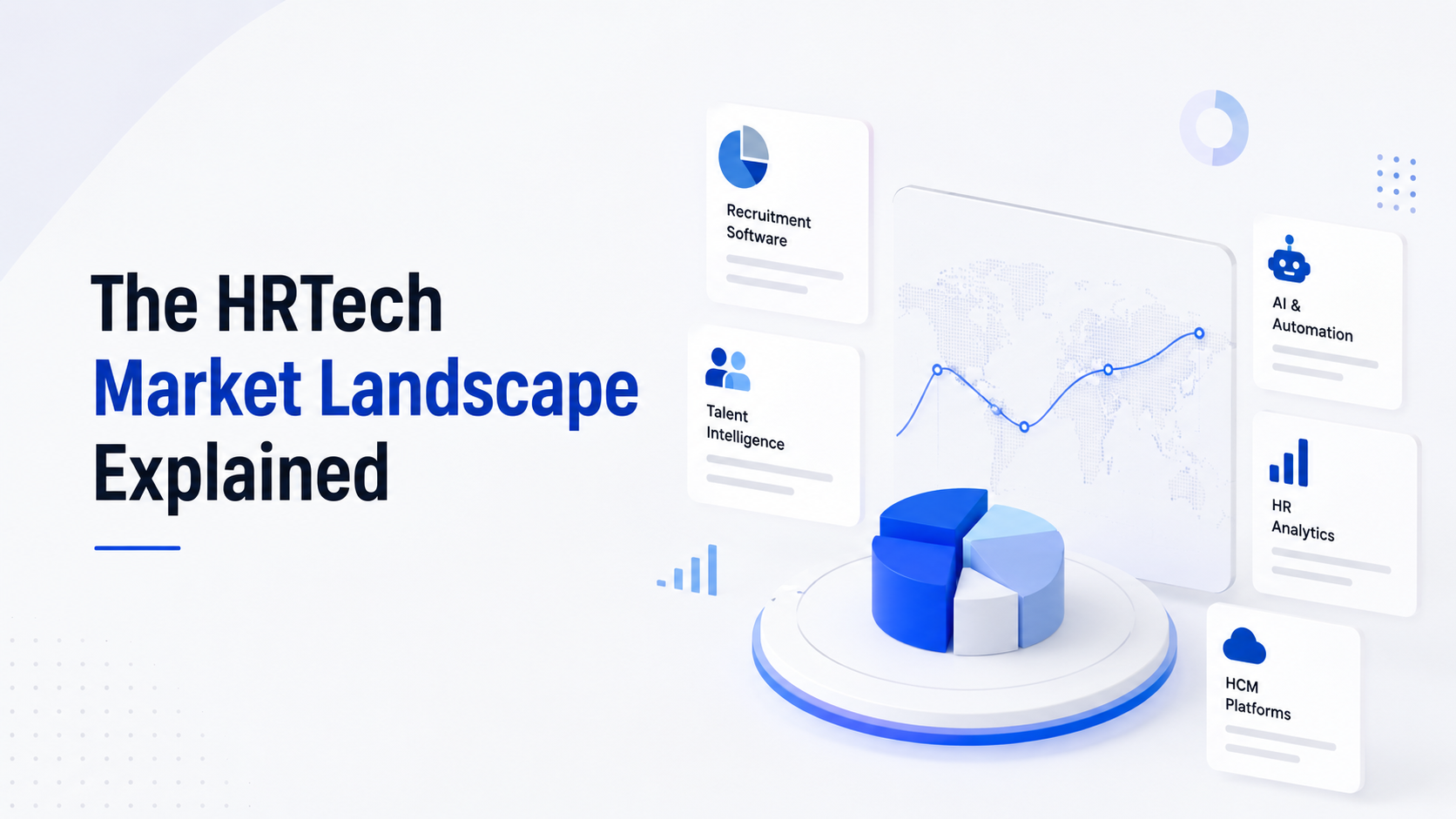
The HRTech market in 2026 can be understood through five major categories that reflect the primary functions HR technology serves within enterprise organizations. The first category is talent acquisition, which includes applicant tracking systems, AI sourcing platforms, candidate relationship management tools, and assessment and interview technology. This is the
fastest-growing category in HRTech, driven by the competitive intensity of talent markets and the rapid maturation of AI capabilities for candidate identification and engagement. The second category is core HR and workforce management, encompassing HRIS platforms, payroll systems, time and attendance tools, and benefits administration. This is the largest category by revenue but the slowest-growing, because core HR platforms are well-established and replacement cycles are long. The third category is talent management, which includes performance management, learning and development, succession planning, and career development tools. According to McKinsey, the talent management category is experiencing a resurgence driven by skills intelligence capabilities that connect development, performance, and internal mobility data in ways that were not possible with previous-generation tools.
The fourth category is workforce analytics and planning, which encompasses people analytics platforms, workforce planning tools, and the emerging category of talent intelligence software. This category is growing rapidly as organizations demand data-driven insights for workforce decisions that were previously made based on intuition and experience. The fifth category is HR service delivery, including employee self-service portals, HR helpdesk and case management, and employee experience platforms. This category has gained strategic importance as organizations recognize that employee experience, the digital equivalent of the candidate experience in recruiting, directly affects retention, engagement, and productivity. According to Gartner HRTech market sizing data, the global HRTech market is now valued at over forty billion dollars annually, with talent acquisition and workforce analytics growing at double-digit rates while core HR and workforce management grow at mid-single-digit rates. The growth differential reflects the broader shift in enterprise HR priorities from administrative efficiency to strategic talent intelligence, with technology investment following the same pattern.
Understanding these categories is essential for buyers because the competitive dynamics, vendor strategies, and evaluation criteria differ significantly across them. In talent acquisition, AI capability and data quality are the primary differentiators, and the market is experiencing rapid innovation and vendor turnover as new entrants challenge established players. In core HR, stability, compliance, and integration breadth are more important than innovation, and the market is dominated by a small number of large platform vendors. In talent management, the key differentiator is the ability to connect data across development, performance, and mobility functions, and the market is being reshaped by skills intelligence capabilities that span traditional category boundaries. In workforce analytics, the differentiator is the quality and actionability of insights, and the market is seeing both consolidation around established analytics platforms and innovation from AI-native startups. For HR leaders mapping their technology strategy, the category-level understanding helps prioritize investments and set realistic expectations for what each technology segment can deliver.
The Platform vs. Point Solution Dynamic
The most consequential structural dynamic in the HRTech market is the tension between integrated platforms and specialized point solutions. This tension exists in every major HRTech
category and shapes the buying decisions of every enterprise HR organization. Platforms offer breadth, integration, and operational simplicity at the cost of potentially weaker capabilities in any single functional area. Point solutions offer depth, specialization, and innovation in a specific domain at the cost of integration complexity and data fragmentation. The historical pattern in HRTech has been one of accumulation, where organizations add best-of-breed point solutions for specific needs and then struggle with the resulting fragmentation. The recurring problem of organizations adding more tools while experiencing the same hiring problems is a direct consequence of this accumulation pattern, because each new tool is evaluated on its individual merits rather than its fit within the broader technology ecosystem. According to Deloitte HRTech market analysis, the average enterprise HR organization now operates between forty and sixty distinct technology tools, and the cost of maintaining integrations between these tools represents the fastest-growing component of HR technology budgets.
The market is currently shifting toward platforms as the total cost of ownership analysis increasingly favors integrated solutions. The cost of maintaining a fragmented technology stack, including integration development, data reconciliation, vendor management overhead, and the productivity cost of system switching, typically exceeds the cost of a unified platform by thirty to fifty percent for large enterprises. This economic advantage is accelerating platform adoption, particularly in talent acquisition and talent management where the integration benefits are most pronounced. However, the platform advantage is not uniform. In categories where specialized capabilities are critical, such as technical skills assessment or compensation benchmarking, dedicated point solutions often outperform platform modules. The most effective technology strategies for 2026 are hybrid approaches that use a core platform for the majority of HR functions while supplementing with specialized point solutions for capabilities where the platform module is not competitive. According to EY enterprise technology research, organizations following this hybrid approach report twenty percent lower total cost of ownership than those using all-point-solution stacks and fifteen percent better functional outcomes than those using all-platform approaches, because the hybrid model optimizes for both integration efficiency and functional depth.
The vendor response to this market dynamic has been varied and instructive. Large platform vendors are expanding their capabilities through both internal development and acquisition, attempting to make their platforms competitive with best-of-breed point solutions in an increasing number of functional areas. Point solution vendors are pursuing integration partnerships and sometimes building their own platform capabilities to reduce the friction of connecting their tools to the broader HR ecosystem. AI-native startups are taking a different approach, building from the ground up with integrated AI capabilities that span multiple HR functions, positioning themselves as next-generation platforms rather than point solutions. For buyers, this vendor diversity creates both opportunity and complexity. The opportunity is a market with more capable options than ever before. The complexity is that the evaluation frameworks that worked for previous-generation HRTech purchases may not adequately distinguish between platforms, point solutions, and AI-native challengers that all claim to deliver integrated capabilities. The organizations that develop updated evaluation frameworks, ones that assess data architecture, AI capability depth, and integration model alongside traditional
criteria like feature breadth and vendor stability, will make better technology choices.
AI-Native Challengers Are Reshaping Every Category
The most disruptive force in the HRTech market is the emergence of AI-native vendors who are challenging established players across every major category. These challengers differ from traditional vendors in a fundamental way: their products were built from the ground up with AI as the core architectural principle rather than an add-on feature. An agentic AI recruiting platform exemplifies this approach in talent acquisition, operating on a model where AI continuously monitors talent markets, updates candidate profiles, and coordinates hiring workflows rather than waiting for human recruiters to initiate each action. The same architectural principle is being applied across other HRTech categories. In learning and development, AI-native platforms use skill gap analysis to recommend personalized learning paths rather than relying on catalog-based course selection. In workforce planning, AI-native tools generate predictive scenarios based on real-time market data rather than relying on static workforce models. The performance advantage of AI-native architectures over legacy systems that have added AI features on top of existing codebases is significant and growing, because AI-native platforms can leverage data and intelligence across the entire system in ways that bolt-on AI cannot replicate. According to SHRM technology trend analysis, AI-native vendors captured roughly twenty-five percent of new HRTech enterprise deals in 2025, up from under ten percent two years earlier, a growth rate that is reshaping the competitive dynamics of every major category.
The impact of AI-native challengers varies by HRTech category based on the maturity of AI capabilities in that domain. In talent acquisition, AI-native platforms have achieved the most significant market penetration because hiring generates rich sequential data that is ideally suited to AI optimization. The sourcing, screening, engagement, and matching tasks that constitute the recruiting workflow can all be enhanced by AI, and the measurable nature of hiring outcomes provides clear evidence of AI impact that accelerates adoption. In talent management, AI-native approaches are gaining traction more slowly because the data is more subjective, performance ratings, development needs, and career aspirations are harder to quantify and model than hiring metrics. In core HR and workforce management, AI-native challengers face the highest barriers because these categories are dominated by large incumbent platforms with deep customer relationships and complex integration dependencies that create high switching costs. According to LinkedIn talent solutions research, the categories where AI-native vendors are gaining the most market share are those where data is abundant, outcomes are measurable, and incumbent platforms have the weakest AI capabilities, a combination that currently favors talent acquisition and workforce analytics over core HR and service delivery.
For established HRTech vendors, the AI-native challenge is forcing significant strategic reorientation. Legacy vendors are investing heavily in AI capabilities, acquiring AI startups, and in some cases rebuilding their platforms on AI-native architectures. The effectiveness of these responses varies. Vendors that have attempted to add AI features to existing codebases have generally produced capabilities that are functionally adequate but architecturally limited,
because the underlying data models and workflow engines were not designed for AI-first operation. Vendors that have committed to architectural transformation, rebuilding their platforms with AI at the core, are producing more competitive offerings but face the challenge of managing the transition without losing existing customers. For buyers, this vendor turbulence creates both risk and opportunity. The risk is that selecting a vendor that is in the middle of an architectural transition may result in a product that is neither the legacy system nor the AI-native platform the vendor is building toward. The opportunity is that vendors competing for market share during this transition are offering favorable pricing, enhanced support, and early-access programs that can provide significant value to early adopters. Understanding where each major vendor sits on the spectrum from legacy to AI-native is now a critical input to HRTech purchasing decisions.
The Consolidation Wave and What It Means for Buyers
The HRTech market is experiencing a significant consolidation wave as large platform vendors acquire smaller companies to fill capability gaps and AI startups with differentiated technology attract acquisition interest. This consolidation is driven by several factors. Enterprise buyers increasingly prefer to reduce the number of vendor relationships they manage, favoring platforms that can serve multiple HR functions over specialized tools that address single needs. The platform economics are compelling for vendors as well, because acquiring a company with an established customer base and proven technology is often faster and less risky than building equivalent capabilities internally. The distinction between AI sourcing and AI recruiting is becoming relevant in the consolidation context because vendors are acquiring both sourcing-focused and full-cycle recruiting platforms, and buyers must assess whether the resulting combined capabilities are truly integrated or merely co-located under the same corporate umbrella. According to McKinsey M&A analysis for the HRTech sector, the number of acquisitions involving AI-capable HRTech companies increased by sixty percent between 2023 and 2025, and the consolidation trend is expected to continue as large platform vendors race to build comprehensive AI-powered HR platforms that can compete across multiple categories.
For buyers, the consolidation wave creates both short-term complexity and long-term opportunity. In the short term, acquisitions create uncertainty about product roadmaps, support quality, and integration priorities. When a platform vendor acquires a point solution, the acquired product may be integrated into the platform, maintained as a standalone product, or in some cases deprecated in favor of the platform’s native capabilities. Buyers using the acquired product must assess the acquiring vendor’s likely strategy and plan accordingly. In the long term, consolidation benefits buyers by reducing the number of vendors to evaluate and manage, improving integration between capabilities that were previously separate products, and creating larger, more financially stable vendors who can invest more heavily in R&D and support. According to Gartner HRTech vendor evaluation research, organizations that proactively monitor the M&A landscape and adjust their technology strategies to account for likely consolidation scenarios make better long-term technology investments than those that evaluate vendors in a static market snapshot, because they account for the probability that their
current or prospective vendors will be involved in acquisitions that affect product direction and support quality.
The practical implication for HRTech buyers is that vendor viability and product roadmap confidence should be weighted more heavily in evaluation decisions than they have been in previous years. The consolidation wave means that some vendors currently in the market will not exist as independent entities within the next two to three years, and the technology, support, and pricing that their customers receive will be determined by the acquiring company rather than the original vendor. Buyers should assess vendor financial stability, customer growth trajectories, and strategic positioning relative to acquisition targets. They should also evaluate the portability of their data and configurations, ensuring that they can migrate to an alternative platform if their vendor is acquired and the acquiring company’s product strategy does not align with the buyer’s needs. The organizations that build vendor diversification and data portability into their HRTech strategies will be better positioned to navigate the consolidation wave than those that are heavily dependent on a single vendor whose future may be determined by an acquisition they cannot control.
How to Navigate the HRTech Market as a Buyer
Navigating the HRTech market in 2026 requires a structured approach that accounts for the market’s complexity, dynamism, and the strategic importance of technology decisions. The first principle is to start with business outcomes rather than technology categories. Instead of beginning the evaluation process by identifying which type of tool to buy, organizations should first define the hiring, retention, and workforce planning outcomes they want to improve and then evaluate which technology capabilities are most likely to drive those improvements. This outcome-first approach prevents the common mistake of buying technology that is impressive in demonstrations but does not address the organization’s most pressing talent challenges. Understanding how many followups one hire actually needs is an example of the kind of outcome-specific question that should drive technology evaluation, because the answer determines what automation and intelligence capabilities the organization actually needs rather than what the vendor wants to sell. According to Deloitte HRTech buying research, organizations that define outcome-based success criteria before beginning vendor evaluation complete their purchasing processes forty to fifty percent faster and report significantly higher satisfaction with their selections than those that start with technology category assessments.
The second principle is to evaluate the technology architecture alongside the features. In the current market, two products with similar feature lists can deliver fundamentally different value depending on their underlying architectures. A platform with a unified data model and AI-native architecture will produce better intelligence, more seamless workflows, and lower integration costs than a product with equivalent features built on a legacy architecture with bolt-on AI. Evaluating architecture requires asking vendors specific questions about their data models, AI model training approaches, integration frameworks, and product development roadmaps. Organizations that invest the time to conduct architectural evaluations make better long-term technology choices because they assess the platform’s potential to deliver
increasing value over time rather than its current capabilities in isolation. According to LinkedIn enterprise talent research, the most effective HRTech buying teams include a technology architect alongside HR and procurement stakeholders in the evaluation process, because the architect can assess technical capabilities that HR and procurement stakeholders may not have the expertise to evaluate independently.
The third principle is to plan for continuous evolution rather than one-time deployment. The HRTech market is evolving too rapidly for any technology decision to be considered permanent. Organizations should build their technology strategies with the expectation that platforms will need to be evaluated, updated, and potentially replaced on a three-to-five-year cycle rather than the seven-to-ten-year cycles that were common in previous generations of HR technology. This planning horizon requires different contract structures, preferring shorter terms with renewal options over long-term commitments, different data strategies, ensuring that organizational data is portable and well-governed independent of any specific platform, and different organizational capabilities, building internal expertise in HRTech evaluation and vendor management rather than relying solely on external consultants. The organizations that adopt this continuous-evolution mindset will be better positioned to take advantage of new capabilities as they emerge, migrate away from vendors whose products fall behind, and maintain a technology environment that consistently supports rather than constrains their talent strategy. For HR leaders navigating the HRTech market, the organizations that treat technology as a continuously evolving strategic capability rather than a periodic purchasing decision will achieve better outcomes and build sustainable competitive advantages in the talent market.