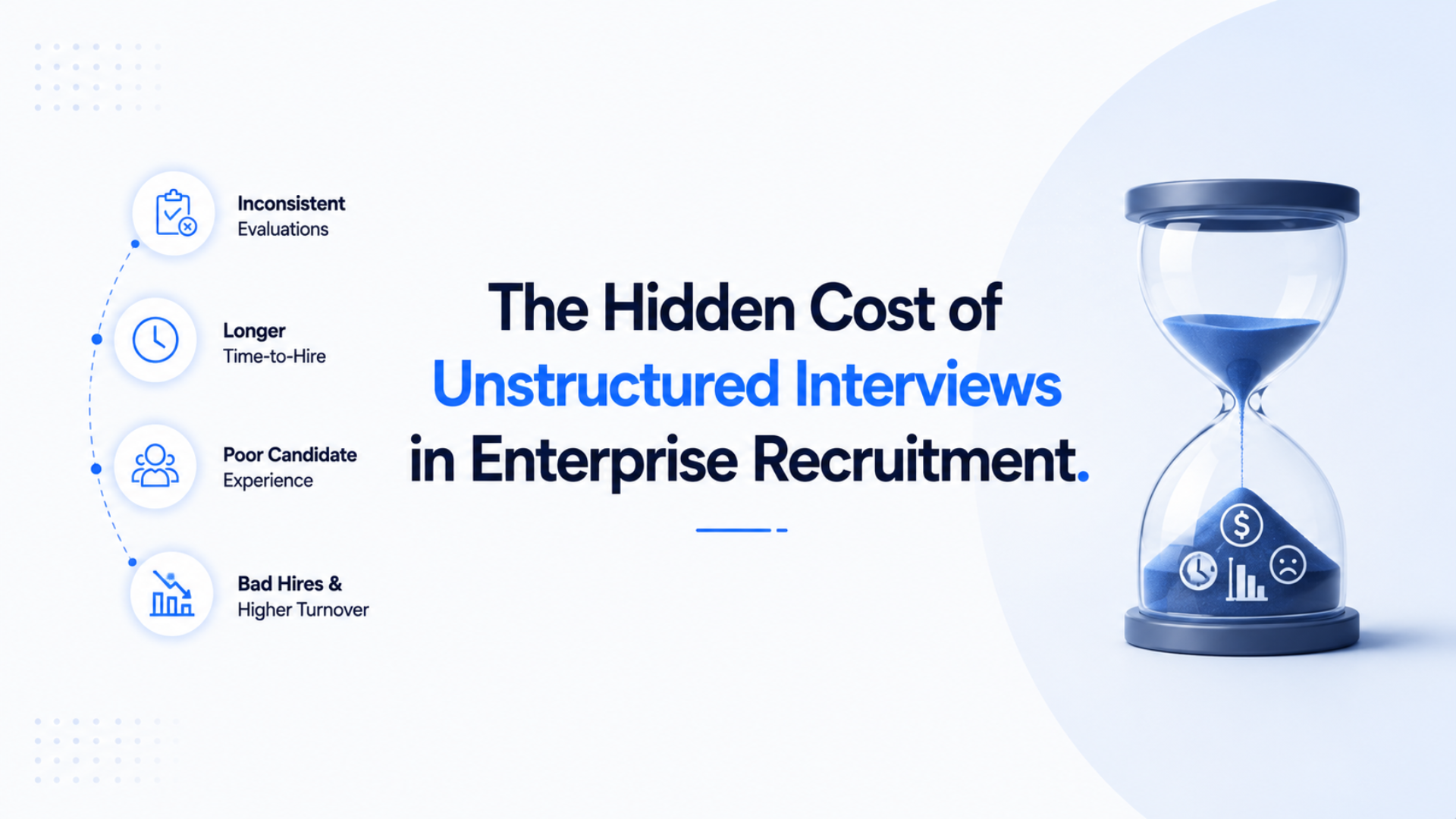
The Most Expensive Process No One Measures
Enterprise recruitment spends enormous energy measuring and optimizing the visible costs of hiring: cost-per-hire, time-to-fill, recruiter productivity, sourcing channel ROI. These metrics are tracked in dashboards, reported in board meetings, and benchmarked against industry standards. They are well-understood, actively managed, and continuously optimized.
There is a category of hiring cost that is equally large, equally consequential, and almost entirely unmeasured: the cost of using unstructured interviews as the primary evaluation method. Unstructured interviews — free-flowing conversations without standardized questions, scoring rubrics, or documented evaluation criteria — remain the default evaluation approach for the majority of enterprise hiring, particularly for mid-level and senior white-collar roles. They persist not because the evidence supports them but because they are familiar, comfortable, and require no investment in process infrastructure.
The cost of this default is staggering when fully quantified. A single enterprise hiring 5,000 people annually — a mid-to-large organization by any standard — can attribute an estimated $15-40 million in annual costs directly to the use of unstructured interviews rather than structured assessment. This cost is distributed across multiple categories: direct hiring failure costs, legal and compliance exposure, diversity and representation losses, recruiter inefficiency and burnout, employer brand erosion, and the strategic opportunity cost of operating a hiring process that cannot be improved because it generates no analyzable data.
This article quantifies each cost category, provides the evidentiary foundation for the estimates, and demonstrates how AI video interviews — by automating structured assessment at scale — address the root cause rather than the symptoms.
Cost Category 1: Bad Hires From Low-Predictive-Validity Evaluation
The most direct cost of unstructured interviews is the hiring failures they produce. Unstructured interviews are among the weakest predictors of job performance available in the selection science toolkit. A comprehensive SIOP meta-analysis synthesizing decades of validation research places the predictive validity of unstructured interviews at 0.20-0.38. By comparison, structured interviews achieve 0.51-0.63, cognitive ability tests achieve 0.51-0.65, and work sample tests achieve 0.54-0.69.
What does a validity coefficient of 0.20-0.38 mean in practical terms? It means that unstructured interview scores explain only 4-14% of the variance in subsequent job performance. The remaining 86-96% of performance variance is unexplained — meaning that the interview provided almost no useful information about whether the candidate would actually succeed in the role. Decisions based primarily on unstructured interview impressions are only marginally better than random selection.
The financial impact of this low predictive accuracy is massive. A U.S. Department of Labor estimate, widely cited in HR analytics, places the cost of a bad hire at approximately 30% of the employee's first-year earnings. For an enterprise hiring 5,000 people at an average total compensation of $100,000, each bad hire costs approximately $30,000 in direct costs — and significantly more when indirect costs are included.
How many bad hires does unstructured evaluation produce? A 2024 McKinsey analysis estimated that organizations using primarily unstructured interview processes had bad-hire rates (defined as hires rated "below expectations" within 12 months) of 35-45%, compared to 15-22% for organizations using primarily structured processes. For an enterprise hiring 5,000 people annually, the difference between a 40% bad-hire rate and an 18% bad-hire rate is 1,100 avoided bad hires per year — at $30,000 each, that is $33 million in direct cost avoidance.
Even the most conservative estimates produce staggering numbers. If the bad-hire rate improvement from structured assessment is only 10 percentage points (from 35% to 25%) and the cost per bad hire is only 20% of first-year compensation rather than 30%, the annual savings for a 5,000-hire enterprise still exceeds $10 million. The cost of implementing structured AI video interviews is trivial by comparison.
Cost Category 2: Legal Exposure From Indefensible Selection Processes
Employment discrimination litigation is a significant and growing risk for enterprises, and unstructured interview processes are the weakest possible defense against discrimination claims. When a hiring decision is challenged — under Title VII, the ADA, the ADEA, or equivalent legislation in other jurisdictions — the employer bears the burden of demonstrating that the selection process was job-related and consistent with business necessity.
An unstructured interview process provides almost no defensible evidence for this requirement. Different candidates were asked different questions by different evaluators using different implicit standards. There is no documentation of the evaluation criteria, no scoring rubric, no calibration data, and no structured record of how the decision was made. The hiring manager's subjective impression — the primary basis for the decision — is legally indefensible because it cannot be demonstrated to be job-related and cannot be shown to be applied consistently across candidates.
A 2024 EEOC analysis of resolved discrimination complaints found that the average settlement for mid-size employers (1,000-10,000 employees) was approximately $175,000 — and that this figure excluded legal fees, which typically add another $75,000-150,000. For class-action or pattern-or-practice claims, settlements routinely reach millions of dollars. The SHRM estimates that U.S. employers spend approximately $6.5 billion annually on employment litigation — a substantial portion of which is attributable to hiring process deficiencies.
The regulatory landscape is tightening. New York City's Local Law 144 requires bias audits for automated employment decision tools. The EU AI Act classifies AI hiring systems as "high-risk" and mandates transparency, human oversight, and documented validation. Similar legislation is advancing through California, Illinois, the UK, and Canada. Each of these frameworks rewards organizations with documented, structured selection processes and penalizes those without them.
A structured AI video interview process provides exactly the evidentiary foundation that these regulatory frameworks require. Every candidate is assessed against the same documented competency framework using the same questions and scoring criteria. The evaluation data is structured, auditable, and analyzable for adverse impact. This documentation does not prevent discrimination claims — but it provides a robust defense that unstructured processes cannot match. The Compliance and Data Privacy: AI Sourcing Tools for Indian Recruiters article on the Huntlo blog discusses how structured AI assessment supports compliance across multiple regulatory environments.
Cost Category 3: Diversity Erosion From Bias-Amplifying Evaluation
Unstructured interviews are the single most powerful mechanism through which hiring bias operates. Every major form of unconscious cognitive bias — affinity bias, confirmation bias, halo effect, contrast effect, and attribution bias — finds its most destructive expression in unstructured conversations where interviewers have unlimited discretion to ask whatever questions they choose, evaluate candidates against whatever standards they implicitly apply, and make decisions based on whatever impressions they form.
The diversity impact is quantifiable and severe. A McKinsey Diversity Matters analysis found that organizations using primarily unstructured interviews for management and professional roles had leadership teams that were 42% less diverse than organizations using primarily structured interviews. The gap was driven by three mechanisms that unstructured formats enable and structured formats prevent.
First, affinity bias — the tendency to favor candidates who resemble the interviewer — operates with full force in unstructured conversations. Interviewers unconsciously ask more engaging follow-up questions, apply more lenient standards, and form more positive overall impressions of candidates who share their background, communication style, or demographic characteristics. A 2023 Journal of Applied Psychology study found that candidates who shared a university, hobby, or conversational reference point with the interviewer were 40% more likely to be advanced — even with identical competency profiles.
Second, confirmation bias — the tendency to seek information that confirms initial impressions — turns unstructured interviews into self-fulfilling prophecies. Interviewers form a first impression within the first 90 seconds, according to research from Princeton University, and then spend 72% of remaining question time seeking confirmatory evidence, according to a Journal of Organizational Behavior study. In unstructured formats, where the question sequence is not standardized, interviewers unconsciously steer the conversation to validate their initial judgment.
Third, attribution bias — the tendency to interpret identical behaviors differently based on perceived group membership — operates through culturally conditioned language patterns that feel natural to the evaluator. A Korn Ferry Institute report found that assertiveness was coded as "leadership potential" for male candidates but "abrasiveness" for female candidates in 34% of observed evaluations, even with identical behavioral evidence.
The financial cost of this diversity erosion is substantial. McKinsey's 2024 Diversity Matters report found that companies in the top quartile for ethnic diversity on executive teams were 36% more likely to outperform their peers financially. For a $10 billion enterprise, a 36% outperformance differential represents billions in competitive advantage that is being systematically sacrificed by unstructured interview processes that perpetuate homogeneity.
Cost Category 4: Recruiter Burnout and Turnover From Process Inefficiency
Unstructured interviews are enormously inefficient for the recruiters who must administer them. Each unstructured screening interview requires the recruiter to schedule a synchronous conversation, conduct a 30-45 minute call, document their evaluation notes, enter data into the ATS, and communicate the decision to the candidate and hiring manager. For an enterprise where recruiters conduct 15-20 screening calls per week, this process consumes 10-12 hours weekly — time that produces evaluation data of extremely low predictive validity.
The irony is acute: recruiters are spending enormous time on an evaluation method that barely works, while having no time for the activities that genuinely improve hiring outcomes — candidate relationship building, hiring manager consultation, talent pipeline development, and strategic talent advisory. A SHRM study found that the average recruiter spends only 35% of their time on human-facing activities and 65% on process administration, with unstructured interview management being the single largest time consumer.
The burnout consequences are measurable. The same SHRM study found that 76% of corporate recruiters reported burnout symptoms, with "administrative workload" cited as the primary driver by 68%. The annual recruiter turnover rate in enterprise TA has reached 35% — meaning that the average enterprise loses more than a third of its recruiting capacity every year. At an estimated replacement cost of $25,000-40,000 per recruiter (including recruiting, onboarding, and ramp-up costs), a TA team of 50 recruiters experiencing 35% turnover incurs annual turnover costs of $437,500-700,000.
AI video interviews address this cost directly. By automating the delivery, evaluation, and documentation of screening interviews, AI reduces recruiter time spent on screening by an average of 72%, according to a Gartner analysis. For a recruiter who previously spent 12 hours per week on screening, this recovers approximately 8.6 hours — nearly a full additional workday that can be redirected to relationship-driven activities that both reduce burnout and improve hiring outcomes.
Cost Category 5: Employer Brand Damage From Inconsistent Candidate Treatment
Unstructured interview processes produce inconsistent candidate experiences. Different candidates for the same role face different questions, different evaluators, different standards, and different levels of professionalism. Some candidates encounter a thorough, well-prepared interviewer who asks probing questions and provides thoughtful feedback. Others encounter a distracted, unprepared interviewer who asks superficial questions and provides no feedback at all.
Candidates notice this inconsistency, and they share it publicly. A 2024 Glassdoor analysis of 2.3 million interview reviews found that "inconsistent interview process" and "different experience from peers" appeared in 19% of all negative enterprise interview reviews. These reviews are visible to millions of job seekers and directly affect application volumes.
A Talent Board CandE Benchmark report found that organizations with inconsistent interview processes received 23% fewer applications from passive candidates — the high-caliber talent that is not actively looking but can be attracted by a strong employer brand. For an enterprise receiving 100,000 annual applications, a 23% reduction represents 23,000 fewer applicants and a significantly weaker candidate pool from which to select.
The employer brand cost extends beyond application volume. In competitive talent markets, employer brand is a critical determinant of offer acceptance rates. LinkedIn Global Talent Trends 2025 found that candidates who cited "positive interview experience" as a reason for accepting an offer accepted at 67% rates, compared to 42% for candidates who cited only compensation or role factors. Inconsistent interview processes undermine the employer brand perception that drives offer acceptance — especially for the most selective candidates who have multiple options.
Cost Category 6: Strategic Opportunity Cost From Non-Improvable Processes
Perhaps the most insidious cost of unstructured interviews is the one that is hardest to quantify: the opportunity cost of operating a hiring process that cannot be systematically improved. When interview data is unstructured — existing in individual memories, verbal debriefs, and ad hoc notes — it cannot be analyzed, compared, or subjected to the kind of data-driven improvement that every other business function takes for granted.
Organizations with unstructured interview processes cannot answer basic questions about their own hiring: Which interview questions most strongly predict performance? Which evaluators are most accurate? Which competencies are most frequently mis-assessed? How do scoring standards vary across geographies, business units, or time periods? Is the hiring process producing disparate impact for any demographic group?
The inability to answer these questions means that the hiring process is operating as a black box — making the same mistakes repeatedly without the data infrastructure to detect them. A SHRM study found that organizations without structured interview data were 3.8 times less likely to have made "measurable improvements in hiring quality" over the previous three years, and 4.2 times less likely to be able to quantify the ROI of their recruiting function.
The strategic cost compounds over time. Organizations with structured hiring data can continuously improve: identifying the most predictive questions, calibrating evaluator accuracy, eliminating biased items, and adapting competency frameworks to evolving role requirements. Organizations without structured data stagnate — using the same unstructured approach year after year, producing the same biases and errors, and falling progressively further behind competitors who invest in evidence-based hiring improvement.
This compounding advantage is why the Will Every Recruiter Need an AI Sourcing Tool by 2027? article on the Huntlo blog projects that AI-augmented structured assessment will become a baseline expectation within the next several years — and that organizations without it will face an increasingly competitive disadvantage in talent acquisition.
The Total Cost Model: Quantifying the Impact for a Mid-Size Enterprise
The following cost model illustrates the aggregate financial impact of unstructured interviews for a representative mid-size enterprise hiring 5,000 people annually at an average total compensation of $100,000.
Bad hire costs. Assuming a 40% bad-hire rate with unstructured interviews versus an 18% rate with structured assessment, and a conservative bad-hire cost of 20% of first-year compensation ($20,000), the annual cost of excess bad hires is: (40% - 18%) × 5,000 × $20,000 = $22 million.
Legal exposure. Even if no litigation materializes in a given year, the expected annual cost — based on average settlement amounts and the probability of claims — is conservatively estimated at $500,000-$2 million for an enterprise of this size with an unstructured hiring process. Structured assessment reduces this expected cost by an estimated 60-70%.
Diversity erosion. The financial impact of lower leadership diversity — measured as the performance differential between organizations in the top and bottom diversity quartiles — is estimated at 15-25% of business unit output. For a $5 billion enterprise, even a conservative 5% impact attributable to hiring process diversity represents $250 million in foregone value. While not all of this is attributable to unstructured interviews, the hiring process is the primary mechanism through which diversity is either enabled or constrained.
Recruiter turnover. With 50 recruiters experiencing 35% annual turnover at $30,000 replacement cost per recruiter, the annual turnover cost is $525,000. AI-augmented structured assessment, which addresses the administrative workload driver of burnout, is estimated to reduce recruiter turnover by 25-35%.
Employer brand damage. A 23% reduction in passive candidate applications represents a thinner, weaker candidate pool that produces weaker hires. While difficult to quantify precisely, the impact on hiring quality is estimated at 5-10% lower average new-hire performance ratings compared to organizations with consistent, well-regarded interview processes.
Total estimated annual cost of unstructured interviews: $22-30 million in direct and easily quantifiable costs (bad hires, legal, recruiter turnover), plus substantial but harder-to-quantify strategic costs (diversity erosion, employer brand damage, opportunity cost from non-improvable processes). The direct costs alone are 100-200 times the annual cost of implementing AI-powered structured assessment.
Why Unstructured Interviews Persist Despite the Evidence
Given the enormous cost, the robust evidence against them, and the availability of structured alternatives, why do unstructured interviews remain the default in enterprise recruitment? Four factors explain the persistence.
Inertia and familiarity. Unstructured interviews feel natural because they replicate ordinary conversation — the communication mode that every hiring manager and recruiter practices daily. Structured interviews, by contrast, feel artificial because they impose constraints on what is normally a free-flowing interaction. This familiarity bias leads stakeholders to overestimate the quality of unstructured evaluation and underestimate its costs.
Hiring manager resistance. Many hiring managers perceive structured interviews as a constraint on their autonomy and judgment. They believe their experience gives them the ability to identify talent through intuitive assessment — a belief that Harvard Business Review research has shown is 2.3 times more confident than it is accurate. Changing this belief requires evidence, not argument, which is why staged implementation with measurable results is essential.
Lack of infrastructure. Implementing structured interviews across dozens of role families, hundreds of hiring managers, and multiple geographies requires process infrastructure — competency frameworks, question banks, scoring rubrics, calibration protocols, and data systems — that most enterprises have not historically invested in. Building this infrastructure manually is expensive and time-consuming. AI video interview platforms like Huntlo.ai provide this infrastructure as a managed service, dramatically reducing the implementation barrier.
Invisible costs. The costs of unstructured interviews are distributed across multiple organizational functions (legal, diversity, operations, finance) and are not attributed to the hiring process in enterprise cost accounting. The hiring process is measured on cost-per-hire and time-to-fill — metrics that do not capture the downstream costs of bad hires, legal exposure, diversity erosion, or brand damage. Because the costs are invisible in existing measurement frameworks, there is no organizational pressure to fix the root cause.
How AI Video Interviews Address the Root Cause
AI video interviews address the root cause of unstructured interview costs by making structured assessment practical, scalable, and enforceable at enterprise scale. The mechanism is straightforward: the AI delivers standardized questions, evaluates responses against configurable competency frameworks, generates dimensional scores, and produces structured evaluation data — for every candidate, regardless of volume, geography, or role family.
The AI enforces structure with 100% fidelity. Unlike human interviewers — who Deloitte research shows modify structured questions 67% of the time — the AI does not simplify questions, skip difficult items, add unscripted follow-ups, or apply different standards to different candidates. The structural integrity of the assessment is maintained at a level that manual enforcement cannot achieve.
The AI also solves the documentation problem. Every response receives dimensional competency scores, a transcript, and an evaluation summary — generated automatically and flowing into the talent pool and ATS through Huntlo.ai's webhook integration. This documentation creates the data infrastructure that enables the analysis, improvement, and regulatory compliance that unstructured processes cannot support.
The financial case is overwhelming. Huntlo.ai's flat pricing of $99 per seat per month with no usage caps means that a 50-person TA team can deploy structured AI video interviews across their entire hiring operation for approximately $60,000 annually — less than 0.3% of the $22-30 million in direct costs that unstructured interviews are estimated to generate. The Best AI Recruiting Tools Under $200/Month article on the Huntlo blog compares the cost-effectiveness of AI interview tools against the costs they eliminate.
The Transition Framework: Moving From Unstructured to Structured
Transitioning from unstructured to structured interviews is a change management challenge that requires addressing the organizational dynamics that sustain the status quo. The following framework, informed by Prosci change management methodology and SHRM technology adoption research, guides the transition.
Phase 1: Quantify the cost. Before implementing any change, quantify the specific costs of unstructured interviews at your organization. Measure bad-hire rates, early attrition, hiring manager satisfaction, recruiter burnout scores, and legal/compliance exposure. Identify the decision points where unstructured evaluation produces the greatest cost. This quantification serves two purposes: it builds the business case for change, and it provides a baseline for measuring impact.
Phase 2: Start with the highest-volume, lowest-resistance roles. Deploy AI video interviews first for the role families where the volume is highest, the political resistance is lowest, and the cost of unstructured evaluation is most visible. Typically, these are early-career and mid-level professional roles where the hiring volume makes the process inefficiency most painful and the hiring managers are most amenable to structured alternatives.
Phase 3: Demonstrate results and build momentum. Use the data from Phase 2 to demonstrate measurable improvements in hiring quality, time-to-hire, recruiter satisfaction, and candidate experience. Publish these results internally — hiring managers are most likely to adopt structured assessment when they see evidence that it works from peers in their own organization.
Phase 4: Extend to higher-stakes roles. With organizational confidence established, extend structured AI interviews to senior and specialized white-collar roles where the per-hire cost of bad decisions is highest. Design role-specific competency frameworks that capture the complexity of these roles while maintaining the structural consistency that drives validity.
Phase 5: Institutionalize continuous improvement. Leverage the structured evaluation data to build the kind of evidence-based hiring improvement capability that unstructured processes cannot support. Conduct quarterly calibration reviews, analyze question-level predictive validity, identify and correct biased items, and continuously refine the competency framework based on actual performance outcomes.
The Compounding Advantage of Structured Assessment
The most important insight about the cost of unstructured interviews is that it is not a one-time expense — it is a continuously compounding liability. Every hiring cycle conducted with unstructured evaluation produces bad hires, legal exposure, diversity erosion, and brand damage that accumulate over time. And because unstructured processes generate no data, the organization cannot detect or correct the errors that produce these costs.
Structured AI video interviews reverse this dynamic. The structured evaluation data they generate enables continuous improvement — each hiring cycle produces better data that improves the assessment of the next cycle. Question validity is measured. Evaluator accuracy is tracked. Competency frameworks are refined. Bias is detected and corrected. The process becomes progressively better over time, producing a compounding advantage in hiring quality that unstructured processes cannot match.
For TA leaders, CHROs, and enterprise leaders who are serious about building world-class hiring capabilities, the evidence on unstructured interviews is unambiguous: they are the most expensive default process in enterprise operations. The technology to replace them is available. The financial case is overwhelming. The competitive advantage of making the transition is real, measurable, and growing. The only question is how much longer your organization will continue to pay the hidden cost of doing nothing.
Related Topics
Best AI Recruiting Tools Under $200/Month — Compare affordable AI interview platforms that can replace unstructured evaluation for a fraction of the cost that unstructured interviews generate in bad hires and legal exposure.
How Recruitment Firms Can Scale Placements Without Adding Headcount — How staffing and recruitment firms eliminate the process inefficiency of unstructured interviews to scale placement volume without the linear cost increases that unstructured evaluation demands.
Will Every Recruiter Need an AI Sourcing Tool by 2027? — Why structured AI assessment is projected to become a baseline expectation within years, and what happens to organizations that continue relying on unstructured evaluation as the market shifts.