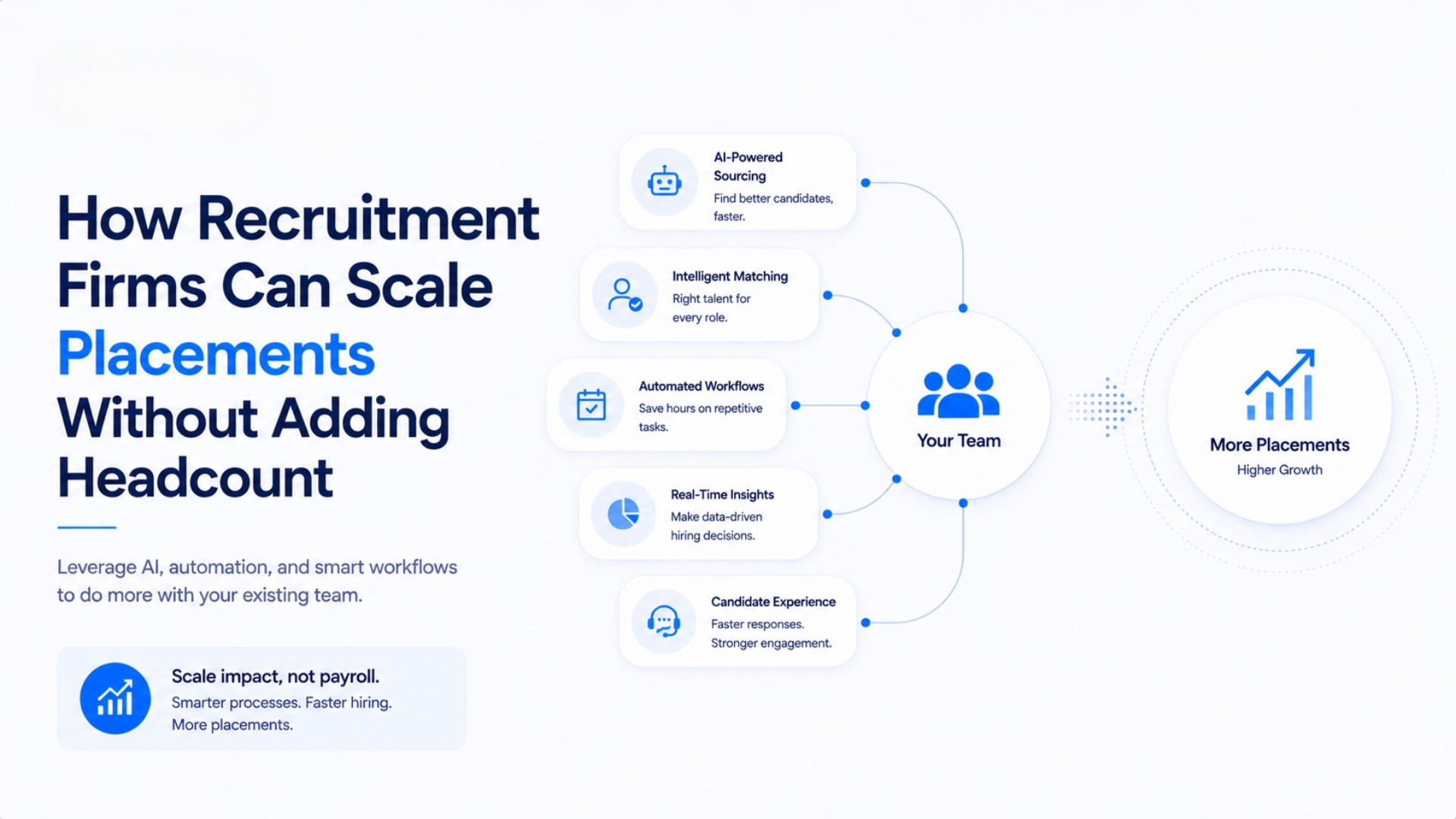
The conventional wisdom in the staffing industry is straightforward: more placements require more recruiters. If your five-recruiter team is making 15 placements per month and you want to reach 25, the math says you need to hire three more recruiters. But the conventional wisdom is wrong — or at least, it's incomplete. The agencies that are growing fastest and most profitably in 2026 aren't scaling by adding headcount. They're scaling by making every existing recruiter dramatically more productive through a combination of AI technology, process redesign, and strategic focus.
According to Bullhorn's Global Recruitment Insights Report, the most profitable staffing agencies generate 40-60% more revenue per recruiter than average agencies. The difference isn't that these agencies have better recruiters — it's that they have better systems. They use technology to automate the low-value, time-consuming activities that consume recruiter capacity, freeing their recruiters to focus on the high-value activities — relationship building, candidate qualification, client advisory, and placement closing — that actually generate revenue.
This guide shows you how to achieve the same result: more placements from the same team, without the cost, complexity, and risk of hiring more people.
The Math of Recruiter Productivity
Before discussing specific strategies, it's essential to understand the math of recruiter productivity and why headcount is such an inefficient lever for scaling.
A typical recruiter's workweek breaks down roughly as follows, according to the Recruitment Process Outsourcing Association (RPOA) and multiple industry time-studies:
Sourcing candidates: 25-35% of time
Outreach and initial engagement: 15-20% of time
Screening and qualification: 15-20% of time
Interview coordination and scheduling: 10-15% of time
Client communication and job order management: 10-15% of time
Administrative tasks, data entry, and reporting: 10-15% of time
Relationship building, negotiation, and closing: 5-10% of time
The critical insight is that the activity that directly generates revenue — relationship building, negotiation, and closing — occupies the smallest portion of the recruiter's week. The majority of time is spent on activities that are necessary but don't directly produce placements. If you can automate or eliminate even a portion of the sourcing, outreach, screening, and administrative activities, you free up hours that the recruiter can redirect toward revenue-generating activities.
Consider the arithmetic. If a recruiter currently spends 8 hours per week on closing activities and makes 2 placements per month, each closing hour produces 0.25 placements. If you free up 10 hours per week through automation and the recruiter redirects all of those hours to closing, they now spend 18 hours per week on closing activities. At the same productivity rate, that's 4.5 placements per month — a 125% increase in placement volume from the same person.
This isn't theoretical. According to LinkedIn's Global Talent Trends 2025 report, recruiters who use AI tools effectively report spending 30-50% less time on administrative and repetitive tasks, with a corresponding increase in time available for candidate and client relationship activities. The agencies that capture this time and redirect it productively are the ones scaling without hiring.
Strategy 1: Multiply Sourcing Reach Without Multiplying Sourcing Time
The single largest time sink in a recruiter's week is sourcing — searching platforms, reviewing profiles, and building candidate shortlists. A skilled recruiter manually searching LinkedIn, job boards, and professional networks might identify 20-50 relevant candidates per day for a standard role. For specialized or difficult-to-fill roles, that number might drop to 5-15.
AI sourcing tools compress days of manual searching into minutes. Huntlo's AI engine searches 50+ platforms simultaneously — including LinkedIn, Indeed, Glassdoor, GitHub, Stack Overflow, AngelList, and dozens of specialized job boards and professional networks — and returns ranked, qualified candidate shortlists based on natural language search queries. What takes a recruiter 4-6 hours to accomplish manually, the AI completes in under 10 minutes.
The productivity multiplier is significant. If a recruiter currently spends 15 hours per week sourcing across 5 active job orders, AI sourcing can reduce that to 2-3 hours per week. The 12-13 hours recovered can be redirected to higher-value activities. For a team of 5 recruiters, that's 60-65 hours per week of additional capacity — equivalent to approximately 1.5 additional full-time recruiters — created not by hiring but by automating the lowest-value use of existing recruiter time.
According to the Recruitment Empowerment Institute's research on AI sourcing ROI, agencies that implement AI sourcing tools see an average 35% reduction in time-to-shortlist, meaning candidates are presented to clients faster, which directly increases placement probability. In competitive markets where multiple agencies compete for the same candidate, speed of presentation is often the deciding factor in which agency makes the placement.
Strategy 2: Automate Multi-Channel Outreach to Increase Candidate Engagement
Finding candidates is only half the battle. Engaging them — getting them to respond, getting them interested, and moving them into the screening process — is where many agencies lose candidates. Industry data from SmashFly's recruitment marketing benchmark report shows that the average response rate to recruiter outreach is 15-25% for email and 25-35% for LinkedIn messages. This means 65-85% of candidates never respond to the first outreach attempt.
The traditional response to low response rates is to send more messages — but human recruiters can only craft and send so many personalized messages per day before quality degrades. A recruiter sending 30-40 personalized messages per day across email and LinkedIn is working at capacity. If the response rate is 25%, they're engaging 8-10 candidates per day from their outreach.
AI-powered outreach automation changes this equation fundamentally. Huntlo's multi-channel outreach sends personalized messages across email, LinkedIn, WhatsApp, and AI voice simultaneously, with AI-generated personalization that adapts to each candidate's profile. The platform can send hundreds of personalized messages per day across all channels, with automated follow-up sequences that re-engage non-responders through different channels and with different messaging angles.
The impact on engagement volume is dramatic. Where a human recruiter engages 8-10 candidates per day through manual outreach, AI-augmented outreach can engage 50-100 candidates per day across all channels. More importantly, the multi-channel approach reaches candidates on their preferred communication platform, which Research by the Hiring Success Institute has shown increases overall response rates by 40-60% compared to single-channel outreach.
For a staffing agency making placements that average $12,000 in fees, even a modest improvement in candidate engagement — converting 2-3 additional qualified candidates per recruiter per month — can translate to $24,000-$36,000 in additional monthly revenue per recruiter. At Huntlo's $99/seat/month, the ROI on outreach automation is extraordinary.
Strategy 3: Deploy Conversational AI Screening to Handle Volume
As your outreach generates more candidate engagement, you need more screening capacity to evaluate the increased flow of candidates. Manual screening — phone calls, video interviews, or questionnaire-based assessments — is the bottleneck that prevents many agencies from scaling, because human screening time doesn't scale efficiently.
Conversational AI screening eliminates this bottleneck. Huntlo's AI engages candidates in natural, adaptive dialogue — asking follow-up questions based on each candidate's responses, evaluating both technical qualifications and communication skills, and producing a structured assessment that the human recruiter can review in minutes rather than spending 30-45 minutes per candidate on a phone screen.
The screening capacity increase is substantial. A human recruiter can conduct 8-12 phone screens per day. Huntlo's conversational AI can screen 50-100+ candidates per day simultaneously, operating 24/7 without fatigue, scheduling conflicts, or quality degradation. The human recruiter reviews the AI's structured assessment and spends their phone screen time only on candidates who have passed the AI screen — meaning every minute of human screening time is invested in qualified candidates.
This approach is particularly valuable for high-volume roles where large candidate pools need initial qualification. For agencies filling roles like data entry jobs, customer service positions, or freshers jobs — where application volumes can be in the hundreds for a single position — AI screening is the difference between being able to serve the client and having to decline the business because you can't screen candidates fast enough.
According to Harvard Business Review's research on AI in hiring processes, organizations using AI screening report a 50-70% reduction in time-to-shortlist and a 20-30% improvement in screening consistency compared to unaided human screening. Consistency matters because inconsistent screening — where different recruiters apply different standards to different candidates — is a leading cause of bad hires.
Strategy 4: Build Compounding Talent Pools
Every candidate you source, engage, and screen represents an investment of time and resources. In traditional recruiting models, that investment is largely lost if the candidate isn't placed in the current role. The candidate's profile might sit in a spreadsheet or ATS, but without active management, it becomes dormant data rather than a reusable asset.
Talent pool management transforms every sourcing activity into a compounding investment. Huntlo automatically captures, tags, and organizes every candidate who enters your pipeline — whether sourced, applied, referred, or screened — into searchable talent pools organized by skill set, experience level, industry, location, and other relevant criteria. When a new job order arrives that's similar to a previous search, the AI can search your existing talent pools first, potentially filling the role from candidates you've already identified and partially qualified.
The compounding effect is powerful. According to Recruitment marketing research from Rally Inside, agencies with mature talent pool programs report that 20-35% of placements come from candidates in their existing database rather than fresh sourcing. This means that over time, a smaller and smaller percentage of your team's time needs to be spent on net-new sourcing, freeing more capacity for relationship management and closing.
For agencies with recurring client relationships — where the same clients return with similar roles quarter after quarter — talent pool compounding is even more impactful. The first time you fill a software developer role for a client, you build a talent pool of developers who weren't quite right for that specific role but might be perfect for the next one. The second time, your AI searches the pool first and may present qualified candidates in minutes rather than days.
Strategy 5: Redesign Processes to Eliminate Non-Revenue Activities
Technology alone won't maximize recruiter productivity if your processes still include time-wasting activities that no amount of automation can fix. Process redesign — systematically identifying and eliminating or streamlining activities that don't contribute to placements — is the organizational complement to technology investment.
The most common non-revenue activities that agencies should target include excessive internal meetings that could be handled through asynchronous updates, manual data entry and CRM updates that could be automated through integrations, redundant screening steps where the same information is collected multiple times from the same candidate, client communication delays caused by internal approval processes, and reporting and administrative tasks that could be automated through dashboard and alert systems.
Huntlo's webhook-based ATS integration directly addresses the data entry problem. When candidate data flows automatically from Huntlo into your ATS through webhook connections, your recruiters never need to manually copy candidate information between systems. For a recruiter who spends 2-3 hours per week on data entry across sourcing, screening, and placement activities, this automation recovers 100-150 hours per year per recruiter — time that can be redirected to revenue-generating activities.
According to the American Staffing Association's operational benchmarks, the average staffing agency recruiter spends approximately 5-7 hours per week on activities that could be fully or partially automated. For a 5-recruiter agency, that's 25-35 hours per week of recoverable capacity — equivalent to nearly a full-time additional recruiter — hidden in inefficient processes.
Strategy 6: Specialize to Increase Placement Rate Per Outreach
One of the most counterintuitive insights about scaling without headcount is that focusing on fewer things — rather than trying to serve every client and every role — actually increases total placements. When recruiters specialize in specific industries, roles, or candidate profiles, they develop deeper expertise, stronger networks, and faster qualification instincts that increase their placement rate per candidate engaged.
According to Magnet.me's research on recruiter specialization, specialized recruiters have a 2-3x higher placement rate per candidate than generalist recruiters. A generalist engaging 50 candidates per week might place 1-2. A specialist in the same role category, engaging the same 50 candidates with deeper market knowledge and more credible outreach, might place 3-5.
Specialization also improves AI tool effectiveness. When a recruiter consistently sources for the same types of roles, the AI tool's talent pools become richer and more targeted, the outreach templates become more refined, and the screening criteria become more precisely calibrated. This specialization dividend compounds over time, making every subsequent search faster and more productive than the last.
For agencies looking to scale, the recommendation is to identify 1-2 industry verticals or role categories where you have the strongest client relationships and the deepest candidate networks, and concentrate your AI tool investment on maximizing productivity in those verticals. The increased placement rate per outreach more than compensates for the reduced breadth of coverage.
Strategy 7: Implement Structured Workflows That Reduce Decision Fatigue
Recruiter decision fatigue is a real and measurable productivity killer. According to research published in the Journal of Applied Psychology on decision fatigue in hiring, the quality of hiring decisions degrades significantly as the number of decisions increases throughout the day. A recruiter who evaluates 30 candidates in the morning may make better decisions than the same recruiter evaluating 30 candidates in the afternoon after a full day of decisions.
Structured workflows reduce decision fatigue by standardizing routine decisions and reserving human judgment for the decisions that genuinely require it. AI screening handles the initial qualification decision — is this candidate worth a human conversation? Standardized evaluation scorecards handle the assessment decision — how does this candidate compare to the job requirements? The human recruiter's judgment is reserved for the relationship and closing decisions where human insight is irreplaceable.
This structured approach doesn't just reduce decision fatigue — it also improves consistency. When every candidate is evaluated against the same criteria through the same AI screening process, the quality and fairness of your screening is more consistent than when different recruiters apply different subjective standards. Better screening consistency leads to better placement quality, which leads to happier clients and more repeat business — all without adding headcount.
Strategy 8: Use Data to Optimize Recruiter Time Allocation
Most agencies don't have clear visibility into how their recruiters spend their time, which means they can't optimize it. Without data, you're relying on assumptions about where recruiter hours go and what activities drive placements.
Implementing basic time tracking and activity analytics — which Huntlo's reporting dashboard supports through outreach metrics, screening volume, and pipeline stage data — provides the visibility needed to make informed optimization decisions. You might discover that your most productive recruiter spends 40% of their time on sourcing when the AI could handle 80% of that work. Or that a recruiter who makes fewer placements per month actually spends more time on high-value activities, suggesting they'd be more productive with better sourcing support.
According to recruiting analytics research from Lever, agencies that implement structured activity tracking and optimize recruiter time allocation based on data see a 15-25% improvement in placements per recruiter within 6 months. The improvement comes not from working harder but from working smarter — redirecting time from low-impact to high-impact activities.
Modeling the Impact: What Scaling Without Headcount Actually Looks Like
To make this concrete, let's model the impact for a typical mid-size staffing agency.
Current state: 5 recruiters, each making 2.5 placements per month at an average fee of $12,000. Total monthly placements: 12.5. Total monthly revenue: $150,000. Total monthly cost (recruiter compensation, tools, overhead): approximately $65,000. Monthly profit: $85,000.
After implementing AI-powered scaling (conservative estimates):
AI sourcing reduces per-recruiter sourcing time by 50%, freeing 6-7 hours per week per recruiter.
Multi-channel AI outreach increases candidate engagement by 40%, generating more qualified conversations per recruiter.
Conversational AI screening handles initial qualification, reducing per-candidate screening time by 60%.
Talent pool management fills 25% of roles from existing pools, reducing net-new sourcing by a quarter.
Process redesign eliminates 4 hours per week per recruiter of non-revenue activities.
Combined, these improvements allow each recruiter to handle 3.5-4 job orders simultaneously instead of 2-2.5, and to fill them faster due to better candidate engagement and screening. Conservative estimate: each recruiter increases from 2.5 to 3.5 placements per month, a 40% increase.
Projected state: 5 recruiters, each making 3.5 placements per month. Total monthly placements: 17.5. Total monthly revenue: $210,000. Total monthly cost: $66,000 (original $65,000 + $990 for Huntlo). Monthly profit: $144,000.
Monthly profit increase: $59,000 (a 69% increase). Annual profit increase: $708,000.
Cost of achieving this increase: $990/month ($11,880/year) for 5 seats of Huntlo. The ROI is approximately 60:1.
To achieve the same placement increase through headcount, you'd need to hire approximately 2 additional recruiters at a total monthly cost of $15,000-$20,000 (including compensation, benefits, tools, and overhead). Those 2 additional recruiters would take 3-6 months to reach full productivity, carry turnover risk, and increase management complexity. The AI-powered approach delivers more profit, faster, with lower risk and lower cost.
The Leadership Challenge: Managing a More Productive Team
Scaling without headcount creates a different management challenge. When your recruiters are more productive, they're also more valuable, and retaining them becomes more important. According to Indeed's 2025 recruiter retention study, the top reason recruiters leave agencies is frustration with inefficient tools and processes — the exact problems that AI implementation solves. By giving your recruiters better tools, you simultaneously increase their productivity and their job satisfaction, addressing both sides of the retention equation.
However, AI implementation also requires change management. Recruiters who have built their careers on manual sourcing expertise may feel threatened by AI tools that automate activities they've prided themselves on. The most successful agencies frame AI as an amplifier of recruiter expertise rather than a replacement — the AI handles the repetitive work so the recruiter can invest more time in the relationship and judgment activities that define great recruiting. This framing, combined with proper training and a clear demonstration that the AI makes the recruiter's job easier rather than redundant, is essential for successful adoption.
The agencies that scale most successfully without headcount are those where leadership actively champions the AI transformation, measures and celebrates productivity improvements, and ensures that the additional capacity created by AI is redirected toward growth activities rather than simply reducing recruiter workload without capturing the productivity dividend.
The Bottom Line
Scaling placements without adding headcount is not a fantasy — it's the operational model that the most profitable staffing agencies in 2026 are already implementing. The combination of AI-powered sourcing, multi-channel outreach automation, conversational AI screening, talent pool management, and process optimization can increase recruiter productivity by 30-60% at a cost of approximately $99 per recruiter per month. The math is unambiguous: for the cost of a few cups of coffee per day per recruiter, you can create the capacity equivalent of 1-2 additional recruiters from your existing team.
The question isn't whether your agency can afford to invest in AI-powered scaling. It's whether you can afford not to. Your competitors are making these investments, and the agencies that scale fastest will capture the clients, candidates, and market share that slower-moving competitors leave on the table.
Related Topics
How Frontline Hiring Teams Can Reduce Hiring Delays with AI (2026)
New Year, New Tools: Refreshing Your Sourcing Stack for 2027
How AI Sourcing Tools Fit into the Future of Talent Acquisition