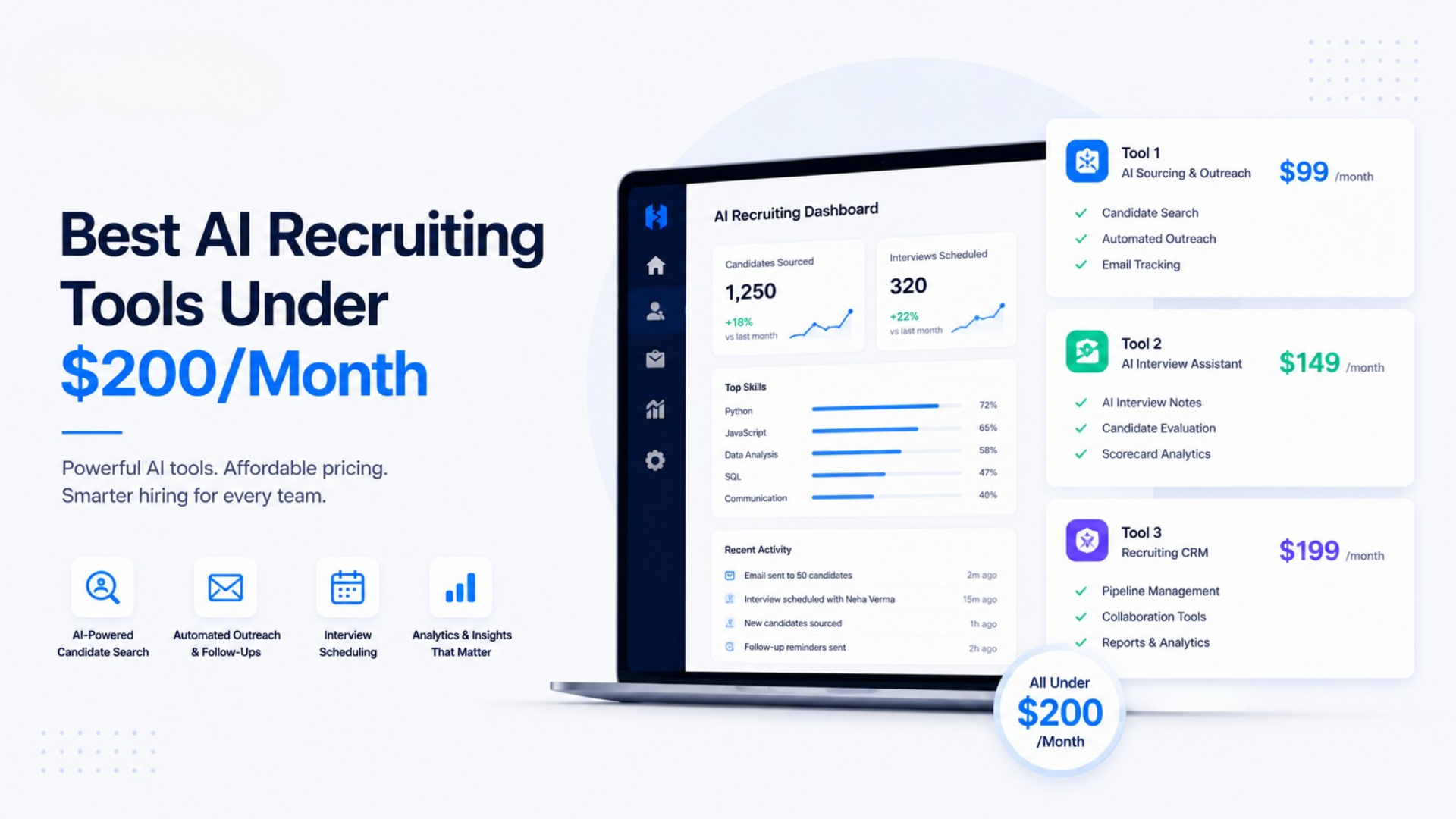
AI has fundamentally changed how recruiters find, engage, and hire candidates. But here's the reality that most software review sites won't tell you: the majority of recruiting teams operate on tight budgets, and enterprise-tier pricing that runs into thousands of dollars per month simply isn't on the table. The good news? The AI recruiting tools market has matured dramatically, and there are now genuinely powerful platforms available for under $200 per month that can compete with tools costing five or ten times as much.
This guide is built for recruiters who need real AI capabilities — not dumbed-down "starter plans" with token automation features. Every tool listed here delivers meaningful artificial intelligence functionality within a sub-$200 budget. We've evaluated each platform on sourcing reach, AI screening quality, outreach automation depth, integration capabilities, and overall value for money. Whether you're posting jobs and searching for candidates nearby or building global talent pipelines for remote positions, there's a tool on this list that fits your workflow and your wallet.
Why Budget-Conscious AI Recruiting Tools Matter Now More Than Ever
The recruiting landscape in 2025 is defined by a paradox: hiring demand remains strong across technology, healthcare, logistics, and financial services, yet recruiting budgets have been slashed at many organizations following the post-pandemic correction. According to data from the Society for Human Resource Management, nearly 60% of talent acquisition teams reported budget reductions in 2024, yet the same percentage were expected to maintain or increase their hiring volume. This squeeze has created enormous demand for affordable AI recruiting solutions that can help smaller teams do more with less.
The rise of remote work has further accelerated this trend. When companies recruit nationally or globally for work from home jobs, the volume of applications and the geographic scatter of candidates make manual sourcing and screening practically impossible. AI tools that can automatically source, score, and engage candidates across multiple channels have shifted from "nice to have" to operational necessities. The question is no longer whether to adopt AI recruiting technology, but how to do it affordably.
For independent recruiters, boutique staffing agencies, and mid-market HR teams, the sub-$200 price bracket has become the sweet spot. It's low enough to be accessible without board-level approval, yet high enough to fund serious AI capabilities. This guide focuses exclusively on tools that deliver genuine value in this range — no free trials masquerading as paid plans, no feature-crippled tiers, and no platforms that require expensive add-ons to become functional.
How We Evaluated These Tools
Every platform in this comparison was assessed against five core criteria that matter most to budget-conscious recruiting teams. First, we looked at AI functionality depth — does the tool actually use machine learning and natural language processing, or is it just keyword matching dressed up as AI? Second, we evaluated sourcing breadth — how many platforms, databases, and channels does the tool access to find candidates? Third, we considered outreach automation — can the tool reach candidates across email, LinkedIn, WhatsApp, and other channels with personalized, AI-generated messages? Fourth, we examined screening intelligence — how well does the platform evaluate candidate fit beyond resume keyword matching? Fifth, we assessed total cost of ownership — are there hidden costs for add-ons, seat limits, or API access that push the real price above $200?
Tools that scored well across all five dimensions made this list. Tools that excelled in one or two areas but had significant gaps were noted but ranked lower. And tools that advertised AI capabilities but delivered only basic automation were excluded entirely.
1. Huntlo — Best Overall Value at $99/Seat/Month
Price: $99 per seat per month
Huntlo has rapidly established itself as the most cost-effective AI recruiting platform on the market, and it achieves this not by cutting corners but by rethinking how recruiting software should be priced. While most competitors charge based on the number of candidate profiles viewed, messages sent, or job postings created — metrics that penalize high-activity recruiters — Huntlo charges a simple flat rate of $99 per seat per month with no usage caps. This pricing model alone makes it the most predictable and scalable option for growing teams.
But pricing is just the entry point. What makes Huntlo genuinely competitive with tools costing significantly more is the breadth of its AI-powered sourcing engine. The platform aggregates candidate data from over 50 sources, including LinkedIn, Indeed, Glassdoor, GitHub, Stack Overflow, AngelList, and dozens of specialized job boards and professional networks. This means when you're searching for candidates — whether you're filling local positions for jobs near me searches or sourcing globally for remote roles — Huntlo casts a wider net than any other tool in this price range.
The multi-channel outreach capability is where Huntlo really separates itself from the pack. While most affordable tools offer email automation and maybe basic LinkedIn messaging, Huntlo provides AI-driven outreach across four major channels simultaneously: email, LinkedIn, WhatsApp, and AI voice calls. The AI voice feature is particularly noteworthy — it uses natural language generation to create personalized phone scripts and can integrate with voice dialing systems to automate initial phone screenings. This is a capability typically found only in enterprise platforms priced well above $200 per month.
Huntlo's conversational AI screening is another standout feature. Rather than relying on static questionnaire-based assessments, Huntlo uses a chatbot-style interface that engages candidates in natural conversation, asking follow-up questions based on their responses to evaluate both technical qualifications and cultural fit. This approach produces significantly richer candidate data than traditional screening tools and reduces the time recruiters spend on initial phone screens by an estimated 40-60%.
The talent pool management system allows recruiters to build and nurture long-term candidate relationships. Every candidate who enters the system — whether through sourcing, application, or referral — is automatically tagged, scored, and added to relevant talent pools. Recruiters can set up automated drip campaigns to keep passive candidates warm, which is especially valuable for roles like part time jobs or specialized positions where the right candidate may not be actively looking today but could be available in three months.
Integration with existing ATS platforms is handled through Webhook connections, making it straightforward to push candidate data from Huntlo into systems like Greenhouse, Lever, Jobvite, or Workday. The webhook architecture also allows custom integrations for teams with proprietary systems. For staffing agencies filling high-volume roles like data entry jobs or customer service positions, this integration capability means Huntlo can slot into existing workflows without requiring a complete technology overhaul.
Best for: Solo recruiters, boutique staffing agencies, growing TA teams, and any organization that needs maximum AI recruiting capability for minimum spend. Particularly strong for teams recruiting across multiple channels simultaneously.
Key limitation: As a newer platform, Huntlo's reporting and analytics dashboard, while functional, is not yet as deep as more established competitors. Teams that require advanced workforce planning analytics may need to supplement with additional tools.
2. hireEZ (Formerly Hiretual) — Best for Deep Sourcing Intelligence
Price: Starter plan at approximately $149/month (pricing varies by team size and feature selection)
hireEZ has been a consistent favorite among recruiting professionals who prioritize sourcing depth, and its AI-powered candidate discovery engine remains one of the most sophisticated in the industry. The platform uses natural language processing to understand the intent behind search queries rather than just matching keywords, which means it can find candidates who have relevant experience but use different terminology on their profiles than what the recruiter searched for.
The AI sourcing algorithm pulls from over 45 public web sources, professional networks, and proprietary databases. What distinguishes hireEZ from simpler sourcing tools is its ability to build "talent maps" — visual representations of the talent landscape for a given role, including competitor companies, skill distributions, and geographic concentrations. For recruiters working on specialized roles where the candidate pool is small and scattered, these talent maps provide strategic intelligence that goes far beyond basic candidate lists.
hireEZ's email outreach automation is robust, with AI-generated personalized messaging that adapts based on the candidate's profile, industry, and seniority level. The platform also offers sequence automation with conditional branching — if a candidate doesn't respond to the first email, the system can automatically try a different channel, subject line, or messaging angle. However, unlike Huntlo, hireEZ's multi-channel capabilities are limited primarily to email, with LinkedIn integration available but not as deeply integrated into the automation workflows.
The candidate scoring system uses machine learning to rank candidates based on likelihood of response and fit for the role, considering factors like recent job changes, profile completeness, and engagement signals. This scoring helps recruiters prioritize their outreach efforts, focusing on candidates who are most likely to convert rather than casting a wide net and hoping for the best.
Best for: Recruiters who need deep sourcing intelligence and are willing to trade some multi-channel outreach flexibility for superior candidate discovery.
Key limitation: The starter plan has restrictions on the number of candidate contacts that can be exported per month, which can be frustrating for high-volume recruiting. Additionally, LinkedIn outreach automation is not included in the base price and requires a higher-tier plan.
3. SeekOut — Best for Technical and Diversity Sourcing
Price: Pro plan starting at approximately $169/month
SeekOut carved its reputation in the recruiting technology space by solving one of the hardest sourcing challenges: finding technical talent. While generalist sourcing tools can find software engineers, SeekOut's AI engine was specifically trained on technical profiles and understands the nuances of programming languages, frameworks, and technology stacks. It can distinguish between a front-end developer who uses React and one who uses Angular, or a data scientist who works with PyTorch versus TensorFlow, and find candidates with precisely the right technical profile.
Beyond technical sourcing, SeekOut has invested heavily in diversity sourcing capabilities. The platform's AI can identify candidates from underrepresented backgrounds without relying on self-reported demographic data, using signals from professional affiliations, educational background, community involvement, and other indicators. For organizations with diversity hiring goals — whether for HR jobs, leadership positions, or entry-level freshers jobs — this capability provides a significant advantage over tools that require manual diversity filtering.
The contact finding engine is one of SeekOut's strongest features. Even when a candidate's profile doesn't include direct contact information, SeekOut's AI can infer and verify email addresses and phone numbers with a reported accuracy rate above 85%. This is particularly valuable when sourcing passive candidates who may have minimal public profile information but are ideal fits for niche roles.
SeekOut also offers a Chrome extension that brings its AI capabilities directly into the recruiter's browser, allowing on-the-fly candidate analysis while browsing LinkedIn, GitHub, or other professional sites. The extension provides instant candidate summaries, skill assessments, and contact information without requiring the recruiter to switch between platforms.
Best for: Technical recruiters, diversity-focused hiring teams, and organizations sourcing for specialized roles where candidate scarcity makes precision more important than volume.
Key limitation: SeekOut's outreach automation is less sophisticated than both Huntlo and hireEZ. The platform excels at finding the right candidates but relies more heavily on the recruiter to craft compelling outreach and manage follow-up sequences manually.
4. Fetcher — Best for AI-Driven Candidate Matching
Price: Starting at approximately $149/month
Fetcher takes a different approach to AI recruiting than most competitors. Rather than giving recruiters a search interface and letting them find candidates manually, Fetcher operates as an AI recruiting assistant. You describe the role you're trying to fill — including required skills, experience level, preferred background, and cultural fit criteria — and Fetcher's AI engine goes out and finds candidates, screens them, and delivers a curated shortlist directly to your inbox.
This "concierge" approach to recruiting AI is particularly appealing for hiring managers and internal recruiters who don't have dedicated sourcing expertise. The AI matching algorithm considers over 50 data points per candidate, including skills overlap, career trajectory patterns, company stage alignment, and geographic preferences. For roles like online jobs or work from home positions where geographic flexibility is a key factor, Fetcher's algorithm can weight location preferences and remote work experience heavily in its matching.
The platform's diversity filtering is integrated directly into the sourcing request, allowing recruiters to specify diversity goals as part of the role description rather than applying filters after the fact. This approach tends to produce more naturally diverse candidate pools because the AI considers diversity signals during the initial sourcing phase rather than as a post-hoc filter.
Fetcher's engagement tracking provides real-time analytics on how candidates interact with outreach messages, including email opens, link clicks, and response rates. This data feeds back into the AI system, continuously improving the relevance and effectiveness of future outreach. For internship jobs or entry-level positions where response rates are typically lower, this feedback loop helps optimize messaging over time.
Best for: Internal recruiting teams, hiring managers, and organizations that prefer an AI-assisted approach where the platform does the heavy lifting of sourcing and initial screening.
Key limitation: Fetcher provides less control over the sourcing process compared to tools like Huntlo or hireEZ. Recruiters who want to manually refine searches, apply custom filters, or directly browse candidate databases may find the hands-off approach limiting.
5. AmazingHiring — Best for IT and Engineering Recruitment
Price: Starting at approximately $159/month
AmazingHiring is a specialized AI sourcing platform built exclusively for technical recruitment. Like SeekOut, it excels at finding software engineers, data scientists, DevOps professionals, and other technology talent, but it takes a broader approach by indexing not just traditional professional networks but also technical communities, open-source repositories, coding challenge platforms, and tech conference attendee lists.
The platform's AI engine builds comprehensive candidate profiles by aggregating data from GitHub repositories, Stack Overflow activity, coding competition results (like Codeforces and LeetCode rankings), technical blog posts, and conference presentations. This means the AI can evaluate candidates not just on what they claim to know but on verifiable evidence of their technical skills. For organizations hiring for senior technical roles where resume claims need to be validated, this evidence-based approach provides significantly more confidence than traditional resume screening.
AmazingHiring's search interface supports natural language queries alongside Boolean search, making it accessible to recruiters who aren't Boolean experts while still providing the precision that experienced sourcers demand. The AI interprets natural language queries and automatically translates them into optimized search strategies across all indexed sources.
The platform also includes a referral matching feature that cross-references a company's existing employees' networks with open position requirements, identifying potential referral candidates that employees may not have thought to recommend. This feature is particularly valuable for passive candidate sourcing, as referred candidates typically have higher conversion rates and longer tenure.
Best for: IT staffing agencies, technical recruitment teams, and organizations with significant engineering hiring needs who want evidence-based candidate evaluation.
Key limitation: The platform's specialization in technical recruitment means it's not well-suited for non-technical hiring. Recruiters who need to fill both technical and non-technical roles — such as HR jobs alongside engineering positions — will need a separate tool for non-technical sourcing.
6. Manatal — Best for Collaborative Recruiting Teams
Price: Professional plan at approximately $119/month
Manatal is an AI-enhanced ATS and sourcing platform that differentiates itself through its collaboration features and clean, intuitive interface. While it may not have the deepest AI sourcing engine on this list, it offers a well-rounded package that combines candidate sourcing, pipeline management, team collaboration, and client management in a single platform.
The AI candidate recommendation engine suggests potential matches from both external sources and the platform's internal candidate database, learning from the recruiter's hiring patterns to improve suggestions over time. For staffing agencies that fill recurring roles — such as part time jobs for women in specific industries or seasonal positions — this learning capability means the platform gets better at finding the right candidates the more you use it.
Manetal's branded career page builder allows agencies and employers to create customizable job listing pages that match their brand identity, which is important for candidate experience and employer branding. The pages are SEO-optimized, helping job postings rank well in search engines when candidates search for terms like jobs for women or work from home jobs for women.
The platform's team collaboration features include shared candidate notes, interview scheduling with calendar sync, evaluation scorecards, and a Kanban-style pipeline view that makes it easy to see where every candidate stands in the hiring process. For teams of 3-10 recruiters working together on high-volume roles like job vacancy placements, these collaboration features can significantly reduce coordination overhead.
Best for: Small to mid-size recruiting teams that need an all-in-one platform combining sourcing, ATS functionality, and team collaboration without paying for enterprise features they won't use.
Key limitation: The AI sourcing capabilities, while functional, are not as deep or as broad as dedicated sourcing platforms like Huntlo or hireEZ. Teams that need extensive multi-channel sourcing may find Manatal's sourcing engine limiting for complex requirements.
7. Talentify — Best for Programmatic Job Advertising
Price: Starting at approximately $99/month (varies by posting volume)
Talentify takes a different approach to AI recruiting by focusing on programmatic job advertising rather than direct candidate sourcing. The platform uses AI algorithms to automatically distribute job postings across hundreds of job boards, social media platforms, and aggregator sites, optimizing the distribution strategy based on the role type, target candidate profile, and budget allocation.
The AI bidding engine manages your job advertising budget in real-time, shifting spend between channels and platforms based on which are delivering the best candidate quality and response rates. For organizations posting high volumes of roles — such as freshers jobs, data entry jobs, or customer service positions — this automated budget optimization can significantly reduce cost-per-applicant while maintaining application quality.
Talentify's AI also optimizes job posting content, analyzing which job titles, descriptions, and keyword combinations generate the highest response rates for different role types. The platform can automatically A/B test different versions of job postings and deploy the highest-performing variants, a capability that would require significant manual effort without AI assistance.
The candidate screening module uses natural language processing to evaluate incoming applications, ranking them based on qualifications, experience relevance, and response quality. While not as sophisticated as conversational AI screening tools like Huntlo's, it provides a solid first-pass filter that reduces the manual screening burden for high-volume roles.
Best for: Organizations with significant job posting volumes that want to maximize their advertising ROI through AI-optimized distribution rather than manual candidate sourcing.
Key limitation: Talentify is fundamentally an inbound recruiting tool — it optimizes how candidates find your jobs, not how you find candidates. Organizations that rely heavily on proactive outbound sourcing for passive candidates will need to pair Talentify with a dedicated sourcing tool.
8. Paradox AI (Olivia) — Best for Conversational AI Candidate Engagement
Price: Starting at approximately $175/month for basic conversational AI features
Paradox AI's flagship product, Olivia, is arguably the most sophisticated conversational AI assistant in the recruiting industry. Olivia engages with candidates through natural, human-like conversations across web chat, SMS, email, and social media messaging platforms. The AI handles everything from initial job inquiries and application assistance to interview scheduling and onboarding logistics.
What makes Olivia different from basic chatbots is the depth of its natural language understanding. It can handle complex candidate questions about benefits, compensation ranges, team structure, and company culture, pulling answers from a knowledge base that the recruiter configures. For roles with high application volumes — such as retail positions, hospitality jobs, or work from home jobs for women — Olivia can handle 80-90% of initial candidate inquiries without human intervention, freeing recruiters to focus on high-value activities.
The interview scheduling automation is particularly robust. Olivia coordinates between candidate availability and interviewer calendars, handles rescheduling requests, sends reminders, and can even conduct preliminary screening through conversational questioning. For organizations conducting high volumes of first-round interviews, this automation alone can save dozens of hours per week.
However, Paradox AI's sourcing capabilities are limited compared to dedicated sourcing platforms. Olivia excels at engaging candidates who have already found your job posting or come to your career site, but it doesn't proactively source candidates from external platforms. It's best understood as an AI-powered candidate engagement layer rather than a full-spectrum recruiting tool.
Best for: High-volume hiring organizations that need to automate candidate communication and screening at scale, particularly in retail, healthcare, hospitality, and logistics.
Key limitation: Limited outbound sourcing capabilities mean Paradox AI works best as a complement to a dedicated sourcing tool rather than a standalone recruiting solution.
9. LinkedIn Recruiter Lite — Best for LinkedIn-First Sourcing Strategies
Price: Approximately $169.99/month (annual billing) or $199.99/month (monthly billing)
LinkedIn Recruiter Lite occupies a unique position in this comparison because it's not an AI-native platform in the same way as Huntlo or hireEZ, but its access to LinkedIn's 900+ million member database makes it an essential tool for many recruiters. The "Lite" version provides access to LinkedIn's search filters, InMail messaging, and candidate saving features, along with some AI-powered recommendations.
The AI-powered candidate recommendations suggest potential matches based on your search history, saved candidates, and hiring patterns. While not as sophisticated as dedicated AI sourcing engines, these recommendations leverage LinkedIn's unparalleled dataset of professional profiles, work histories, and connection networks. For many recruiting scenarios — particularly for professional roles at mid-to-senior levels — LinkedIn remains the single richest source of candidate data.
The platform's strength lies in the depth and freshness of its data. LinkedIn profiles are generally more current and more detailed than profiles on other professional networks, and the platform's algorithm surfaces active candidates and those open to new opportunities. For recruiter jobs, HR positions, and other professional services roles, LinkedIn Recruiter Lite provides access to a candidate pool that's difficult to replicate with any other single tool.
However, the limitations are significant. LinkedIn Recruiter Lite allows only 30 InMail messages per month on the standard plan, and the search filters are less granular than the full LinkedIn Recruiter product. Multi-channel outreach is limited to LinkedIn messaging — there's no email, WhatsApp, or voice integration. And the per-seat pricing adds up quickly for teams.
Best for: Recruiters whose sourcing strategy is primarily LinkedIn-based and who need reliable access to the world's largest professional network.
Key limitation: The 30 InMail per month limit, lack of multi-channel outreach, and dependency on a single platform make this a narrow tool compared to multi-channel alternatives like Huntlo.
10. Zoho Recruit — Best for Budget-Conscious Teams Needing Full ATS + Sourcing
Price: Standard plan at approximately $75/month per recruiter (billed annually)
Zoho Recruit rounds out this list as the most affordable option that still delivers meaningful AI functionality. As part of the broader Zoho ecosystem, it integrates seamlessly with Zoho CRM, Zoho People, and other Zoho business tools, making it an attractive option for organizations already using Zoho products.
The AI features in Zoho Recruit include candidate resume parsing with skill extraction, automated candidate matching based on job requirements, and AI-powered insights that highlight the most promising candidates in your pipeline. The platform also offers basic workflow automation for routine tasks like status updates, notification triggers, and interview scheduling.
Zoho Recruit's job posting distribution reaches multiple job boards simultaneously, and the platform includes a customizable career site builder. For organizations posting roles like internship jobs, part time jobs, or entry-level positions, the combination of wide job board distribution and a branded career site provides a solid foundation for inbound recruiting.
The candidate sourcing capabilities include a built-in candidate database search and the ability to source from LinkedIn (with appropriate permissions) and other platforms. While the sourcing AI is not as sophisticated as dedicated platforms, the integration with Zoho CRM means recruiters can leverage customer and contact data for referral-based sourcing strategies.
Best for: Budget-conscious teams, Zoho ecosystem users, and organizations that need a functional ATS with basic AI features at the lowest possible price point.
Key limitation: The AI capabilities are basic compared to other tools on this list. Teams needing advanced AI sourcing, multi-channel outreach, or conversational screening will find Zoho Recruit's AI features insufficient for complex recruiting workflows.
Comparison: How These Tools Stack Up on Key Dimensions
When choosing between these tools, it helps to think about your specific recruiting workflow rather than looking for a single "best" platform. If your primary challenge is finding candidates — especially passive candidates who aren't actively applying — then sourcing breadth matters most, and Huntlo and hireEZ lead the field with their 50+ and 45+ source integrations respectively. If your challenge is engaging and screening the candidates you already attract, then Paradox AI's conversational engine or Huntlo's multi-channel outreach will deliver more value.
For technical recruiting specifically, the choice narrows to SeekOut and AmazingHiring, both of which offer deep technical profile analysis but differ in their approach. SeekOut is better for diversity sourcing and has a more user-friendly interface, while AmazingHiring provides deeper evidence-based technical assessment through coding platform integrations.
Budget considerations go beyond the monthly per-seat price. Ask about costs for additional candidate credits, premium source add-ons, API access, and onboarding fees. Several platforms on this list have optional add-ons that can push the effective price above $200, so always confirm the total cost for your specific use case before committing.
The Hidden Costs to Watch For
Many recruiting tools advertise an attractive base price but add costs that aren't immediately apparent. Candidate credit charges are the most common — some platforms limit the number of candidate profiles you can view or contact per month and charge per-credit overages. Others restrict access to premium data sources (like verified email addresses or phone numbers) to higher-tier plans. Still others charge extra for ATS integrations, API access, or advanced reporting features.
Huntlo's flat-rate pricing model is designed to eliminate these hidden costs. At $99/seat/month, you get full access to all sourcing sources, all outreach channels, and all AI features without per-credit charges or feature gating. For budget-conscious teams, this predictability is genuinely valuable — you know exactly what you'll pay each month regardless of how actively you use the platform.
When evaluating any of these tools, ask for a complete pricing breakdown including all potential add-ons, overage charges, and implementation fees. The sticker price is rarely the full story.
Getting Started: Recommendations by Team Size and Use Case
For solo recruiters and independent consultants, Huntlo offers the best combination of AI power and affordability. The flat $99/seat pricing, multi-channel outreach, and 50+ source integrations provide capabilities that would typically require 2-3 separate tools. Solo operators who focus exclusively on technical recruiting might also consider SeekOut for its specialized technical sourcing.
For small recruiting teams of 2-5 people, Manatal and hireEZ are strong alternatives. Manatal excels at team collaboration and pipeline management, while hireEZ offers deeper sourcing intelligence. Both can complement Huntlo if you need additional capabilities in specific areas.
For HR departments within larger organizations, Paradox AI's conversational engagement capabilities pair well with a dedicated sourcing tool. Use Huntlo or hireEZ for outbound sourcing and Paradox's Olivia for inbound candidate engagement and screening.
For staffing agencies filling high volumes of roles across multiple industries — from data entry jobs and part time jobs for women to specialized professional positions — Huntlo's combination of breadth (50+ sources), depth (AI screening), and multi-channel outreach (email, LinkedIn, WhatsApp, AI voice) makes it the most versatile single-platform solution.
The AI recruiting tools market under $200/month has never been more competitive, and that's excellent news for recruiting teams with limited budgets. The tools on this list deliver capabilities that were available only to enterprise organizations just two or three years ago. By choosing the right platform for your specific workflow and budget, you can access AI-powered sourcing, screening, and engagement that will transform your recruiting effectiveness without requiring enterprise-level spending.