Elena Vasquez, Chief Talent Officer at a global consulting firm, made a decision in early 2025 that her competitors are now scrambling to replicate. She invested in a talent intelligence platform not as a recruiting tool but as a competitive intelligence system, using it to map the talent landscape across her firm's primary markets, identify emerging skill clusters before competitors recognized them, and build proactive talent pipelines for capabilities that her clients would need twelve to eighteen months in the future. By the time competing firms realized that data engineering and AI governance expertise had become critical consulting service offerings, Vasquez's firm already had established relationships with the top professionals in these fields and had hired twenty percent of the available expert talent. Her competitors spent months trying to catch up, paying premium compensation and still losing candidates to firms that had moved first. Vasquez's approach illustrates the strategic potential that talent intelligence software offers when it is deployed not merely as a hiring efficiency tool but as a competitive intelligence capability that informs business strategy.
Talent Intelligence as a Competitive Moat in Hiring
The most strategically significant use of talent intelligence software is not operational efficiency but competitive differentiation. Organizations that deploy intelligence platforms primarily to reduce recruiter workload or speed up administrative tasks capture only a fraction of the value these systems can deliver. The organizations that achieve the greatest impact use talent intelligence as a competitive intelligence system that provides visibility into talent
market dynamics, identifies emerging skill trends before competitors recognize them, and enables proactive talent positioning that creates hiring advantages competitors cannot easily replicate. This strategic use of talent intelligence transforms the talent acquisition function from a cost center that fills open positions into a strategic capability that informs business strategy and market positioning. According to McKinsey, organizations that use talent intelligence for strategic competitive purposes report twenty to thirty percent higher executive satisfaction with their talent acquisition function and fifteen to twenty percent stronger business alignment scores than those that use intelligence platforms primarily for operational efficiency, because strategic intelligence connects recruiting outcomes directly to business priorities in ways that operational metrics cannot.
The competitive moat created by talent intelligence operates through several reinforcing mechanisms. First, intelligence platforms provide earlier visibility into talent market shifts, enabling organizations to begin sourcing for emerging skill requirements before demand drives up competition and compensation costs. Second, the data accumulated through intelligence operations creates a proprietary knowledge base about specific talent markets that competitors who start later cannot quickly replicate. Third, the relationships built with candidates through intelligence-driven engagement create a network effect where each successful hire strengthens the organization's reputation and referral pipeline in target talent segments. These mechanisms compound over time, making the competitive advantage of early intelligence adopters increasingly difficult for competitors to match. According to Gartner competitive intelligence research, the organizations that have been using talent intelligence strategically for two or more years report that their talent acquisition performance advantage over non-adopting competitors has widened by approximately ten to fifteen percent per year, because the compounding effects of data accumulation, market knowledge, and relationship building produce accelerating returns that late adopters cannot replicate quickly.
For talent acquisition leaders, the strategic framing of talent intelligence has important implications for how they position and fund their technology investments. When intelligence is presented as an operational efficiency tool, it competes for budget against other cost-reduction initiatives and is evaluated on short-term ROI metrics that may not capture its full strategic value. When intelligence is presented as a competitive capability that informs business strategy, it is evaluated alongside other strategic investments and receives the multi-year funding commitment and executive sponsorship needed to achieve its full potential. The organizations that have successfully made this strategic framing shift report that it fundamentally changed the quality of internal conversations about talent technology, elevating discussions from feature comparison and cost analysis to questions about how talent intelligence can strengthen the organization's competitive position in its most critical talent markets. This strategic repositioning of the talent intelligence investment is itself a competitive advantage, because it attracts higher-caliber executive attention and more sustainable funding than the operational efficiency framing that most organizations default to.
How Intelligence Platforms Create Unfair Sourcing Advantages
The sourcing advantage created by talent intelligence platforms is qualitatively different from the incremental improvements that traditional recruiting tools provide. Understanding the difference between AI sourcing and AI recruiting is important for appreciating why intelligence platforms create advantages that are difficult for competitors to match. Traditional AI sourcing tools help recruiters find candidates faster by searching larger databases and applying smarter matching algorithms. Talent intelligence platforms extend this capability by incorporating real-time market data, predictive availability modeling, and competitive hiring intelligence that enables organizations to identify and engage candidates before competitors even know those candidates exist. The intelligence platform monitors talent market activity continuously, identifies professionals whose career trajectories suggest openness to new opportunities, and triggers proactive engagement at the optimal moment in the candidate's decision cycle. According to Deloitte talent acquisition research, organizations using intelligence-driven proactive sourcing report thirty to forty percent higher engagement rates with passive candidates than those using reactive sourcing methods, because the intelligence platform identifies the right moment and the right message for each individual candidate rather than sending generic outreach to large candidate lists.
The unfairness of this sourcing advantage comes from the data feedback loop that intelligence platforms create. Each candidate interaction, whether it results in a hire or not, generates data that improves the platform's understanding of talent market dynamics. The platform learns which outreach approaches generate responses from specific candidate profiles, which compensation ranges are competitive for particular skill combinations, and which talent signals are most predictive of candidate quality and fit. This learning is proprietary to the organization using the platform. Competitors using the same vendor's software will have different models trained on their own data, producing different recommendations optimized for their own hiring patterns and talent markets. The result is that two organizations using the same talent intelligence platform can achieve significantly different sourcing outcomes based on the quality and quantity of data they have fed into the system. According to EY technology competitive analysis, the performance variance between organizations using the same intelligence platform can exceed thirty percent after two years of deployment, because data quality, usage depth, and process integration create divergent learning trajectories that make direct feature comparison between vendors increasingly less relevant to actual outcomes.
The practical implication for talent acquisition leaders is that the value of a talent intelligence platform is determined not only by the vendor's technology but by the organization's ability to generate high-quality data that trains the platform's models effectively. This means that organizations with more structured hiring processes, better data governance, and deeper recruiter engagement with the platform will achieve significantly better sourcing outcomes than organizations with equivalent technology but weaker operational foundations. The sourcing advantage, in other words, is not something the platform provides on its own but something the organization builds in partnership with the platform over time. This insight should influence both vendor selection and internal investment decisions, because selecting a platform with strong learning capabilities and investing in the organizational practices that generate
high-quality training data are equally important for achieving the sourcing advantages that justify the intelligence investment.
The Data Quality Foundation That Determines Intelligence Quality
The quality of intelligence that any talent platform produces is directly proportional to the quality of the data flowing through it, a principle that has become increasingly central as AI models have grown more sophisticated while the data feeding them has become more critical. The concern about whether some AI recruiting tools rely on outdated candidate data has evolved from a niche technical concern into a primary evaluation criterion because organizations have learned through experience that data staleness is the most common cause of intelligence platform underperformance. An intelligence platform with advanced AI algorithms operating on data that is thirty days old will consistently produce worse recommendations than a simpler model operating on data refreshed in real time, because talent market conditions change rapidly enough that even a thirty-day lag significantly degrades the accuracy of availability assessments, compensation recommendations, and candidate matching. According to LinkedIn talent solutions data research, the half-life of candidate profile accuracy has decreased from approximately six months in 2023 to roughly three months in 2026, meaning that data degrades twice as fast as it did three years ago and that platforms without aggressive data refresh strategies are operating on increasingly unreliable information.
Data quality in talent intelligence has multiple dimensions that organizations must evaluate and maintain. Freshness, the frequency with which candidate profiles, market data, and organizational records are updated, is the most time-sensitive dimension. Coverage, the breadth of the talent market the platform can access and analyze, determines whether the intelligence is relevant for all of the organization's hiring needs or only for a subset. Accuracy, the degree to which the data reflects reality rather than outdated or incorrect information, determines the reliability of the platform's recommendations. Completeness, the depth of information available for each candidate and market segment, determines how nuanced and personalized the intelligence can be. Each of these dimensions affects the quality of intelligence output, and a weakness in any single dimension can degrade overall platform performance even if the other dimensions are strong. According to SHRM talent acquisition technology research, organizations that implement structured data quality monitoring across all four dimensions report twenty-five to thirty-five percent better intelligence platform performance than those that focus only on data freshness, because comprehensive quality management catches issues that single-dimension monitoring misses.
The organizations that achieve the best results from their talent intelligence investments treat data quality as an ongoing operational discipline rather than a one-time implementation task. They establish data governance frameworks that define quality standards, assign ownership for data quality in each talent market segment, implement automated monitoring that flags quality degradation when it occurs, and conduct regular audits that assess whether the
platform's data meets the standards required for reliable intelligence output. This operational discipline around data quality is not glamorous, but it is the foundation on which all other intelligence capabilities depend. Organizations that skip or underinvest in data quality governance consistently report lower satisfaction with their intelligence platforms and weaker hiring outcomes, regardless of how sophisticated the platform's AI algorithms may be. For talent acquisition leaders, the lesson is clear: invest in data quality with the same rigor and resources that you invest in technology selection, because the best intelligence platform in the world cannot produce reliable insights from unreliable data.
Niche Talent Markets and Specialized Intelligence Requirements
Talent intelligence platforms deliver the most dramatic advantages in niche and specialized talent markets where the candidate pool is small, the skills are rare, and competition for qualified professionals is intense. In mainstream talent markets with large candidate pools, the advantage of intelligence over traditional methods is meaningful but incremental, because there are enough candidates that even suboptimal sourcing approaches eventually find qualified people. In niche markets, however, the difference between finding the right candidate quickly and failing to find them at all can determine whether a critical business initiative succeeds or fails. The question of whether AI recruiting tools work for niche or technical roles is being answered affirmatively by the organizations that have invested in intelligence platforms with deep specialization capabilities, because these platforms can search broader and more diverse talent pools, apply more sophisticated matching to rare skill combinations, and maintain awareness of professionals who would be invisible to traditional sourcing methods. According to McKinsey talent market research, organizations using intelligence platforms for niche hiring report forty to sixty percent faster time-to-fill and twenty to thirty percent higher quality-of-hire scores compared to traditional methods, advantages that are substantially larger than the improvements seen in mainstream hiring categories where the intelligence advantage is more modest.
The specialized intelligence requirements for niche talent markets go beyond broader search capabilities. Niche markets often have distinct professional ecosystems with their own publications, conferences, online communities, and credentialing bodies that are not well represented in mainstream professional databases. Intelligence platforms that serve niche markets effectively must incorporate data from these specialized sources and understand the domain-specific signals that indicate candidate quality and availability. A cybersecurity talent intelligence platform, for example, needs to understand the significance of specific certifications, open-source contributions, bug bounty participation, and conference presentations in ways that a general-purpose recruiting tool cannot. This domain specialization requires both data investment and model training that is specific to each niche, which is why the most effective niche intelligence capabilities are typically found in platforms that have focused on specific talent verticals rather than in general-purpose tools that attempt to serve all markets with a single model. According to Gartner HR technology specialist research, organizations hiring for specialized roles achieve thirty to forty percent better outcomes when they use platforms
with domain-specific intelligence capabilities rather than general-purpose tools, because the domain specialization produces more accurate matching and more relevant candidate recommendations.
For organizations with significant niche hiring needs, the practical recommendation is to evaluate intelligence platforms specifically against the talent segments that matter most to your organization rather than relying on general-purpose vendor demonstrations that may showcase mainstream hiring capabilities while glossing over niche performance limitations. Request evidence of the platform's data coverage and model performance in your specific talent markets. Test the platform's recommendations against candidates you know independently. Ask about the specialized data sources the platform incorporates for your target talent segments. The organizations that conduct this level of domain-specific evaluation consistently select platforms that perform better in production for their most critical hiring needs, while those that rely on general evaluations often discover that their intelligence platform underperforms precisely in the niche talent markets where hiring success matters most. In competitive talent environments, the quality of intelligence in your most challenging hiring segments is the factor that most directly determines whether your organization wins or loses the competition for specialized talent.
The Next Frontier: Predictive Workforce Planning
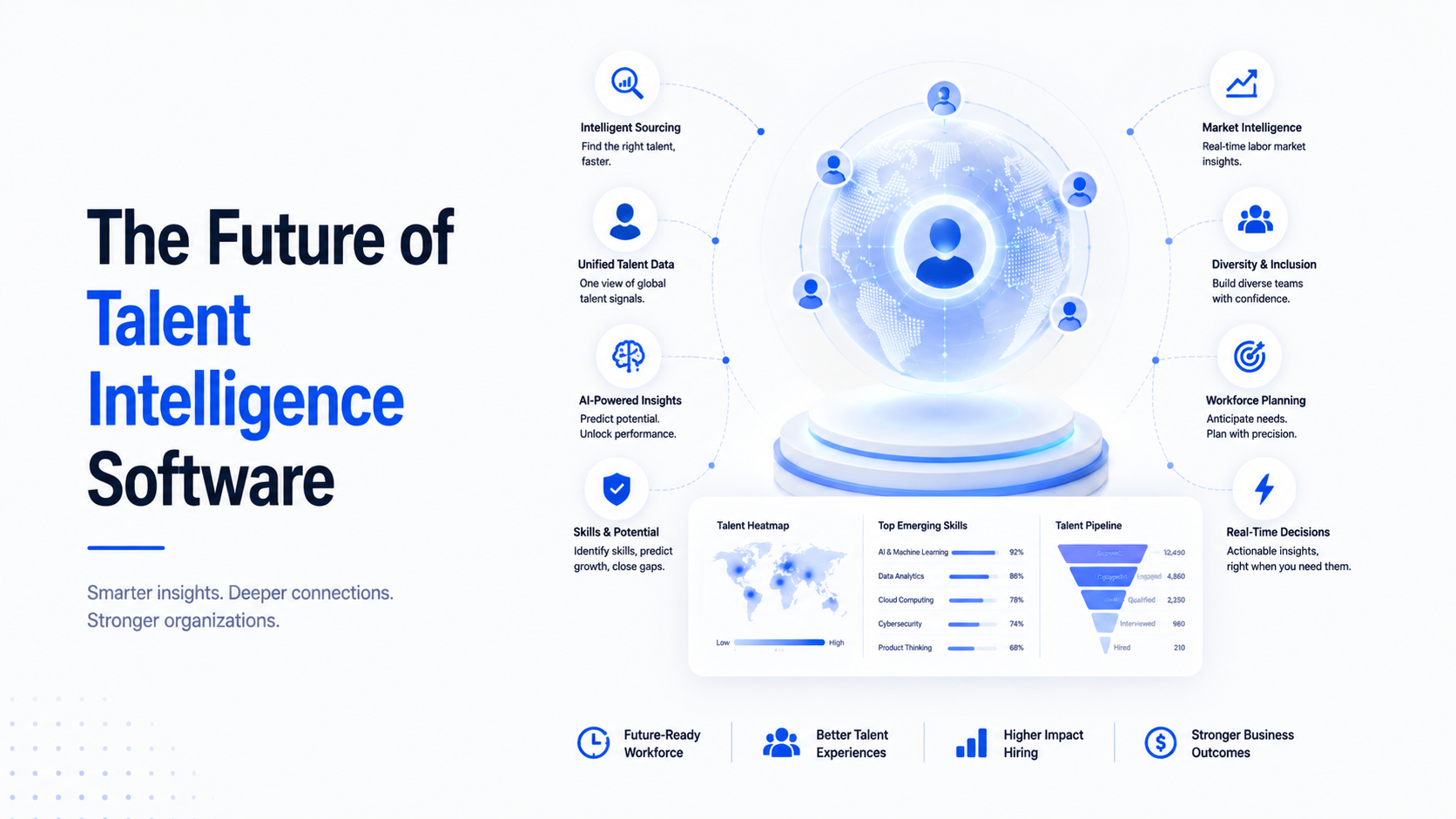
The most transformative application of talent intelligence software is emerging in the area of predictive workforce planning, where intelligence platforms are moving beyond optimizing current hiring to forecasting future talent needs and enabling proactive capability building. This evolution represents a fundamental expansion of what talent intelligence means: from a tool that helps organizations hire better today to a system that helps them build the workforce they will need tomorrow. The question of whether recruiters should worry about AI replacing their jobs is increasingly being answered by the market itself, as talent intelligence platforms create new roles and new strategic capabilities that expand rather than contract the talent acquisition function. Predictive workforce planning combines internal workforce data, including skills inventories, retirement projections, and business growth plans, with external talent market intelligence to forecast where talent gaps will emerge, what skills will be in highest demand, and what compensation levels will be required to attract the necessary capabilities. According to Deloitte human capital trends research, the percentage of large enterprises using talent intelligence for workforce planning has increased from approximately ten percent in 2024 to over thirty-five percent at the start of 2026, making it the fastest-growing application of talent intelligence technology.
The predictive workforce planning capability creates a strategic feedback loop that connects business strategy to talent strategy to recruiting execution. Business strategy defines what capabilities the organization will need. Talent intelligence identifies where those capabilities exist in the external talent market and what it will cost to acquire them. Recruiting execution, informed by this intelligence, builds the workforce that implements the business strategy. The
results of business execution then feed back into the intelligence platform, improving its predictions for the next planning cycle. This closed-loop system transforms talent acquisition from a reactive function that responds to requisitions into a proactive capability that anticipates and prepares for organizational talent needs. The organizations that are building this closed-loop capability are achieving a level of strategic talent alignment that was not possible with previous generations of HR technology. According to LinkedIn talent solutions workforce planning research, organizations using intelligence-driven workforce planning report twenty-five to thirty-five percent better alignment between their workforce capabilities and their business strategy priorities than those using traditional planning methods, because the intelligence platform provides evidence-based forecasts that connect talent decisions to business outcomes in ways that intuition-based planning cannot.
For talent acquisition leaders, the predictive workforce planning frontier represents both an opportunity and an imperative. The opportunity is to elevate the talent acquisition function from an operational service to a strategic advisory capability that influences business decisions. The imperative is that competitors who build this capability first will accumulate advantages in talent market knowledge, proactive pipeline development, and workforce-business alignment that late adopters will find increasingly difficult to overcome. The practical path to building predictive workforce planning capability starts with extending the talent intelligence platform's reach beyond the recruiting function to incorporate data from workforce planning, learning and development, and business strategy functions. This cross-functional data integration enables the platform to generate forecasts that connect talent market dynamics to organizational strategy, producing the kind of strategic intelligence that executive leadership teams increasingly expect from their talent acquisition functions. The organizations that begin building this cross-functional intelligence capability now will be positioned to lead their markets in talent strategy, while those that continue to treat talent intelligence as a recruiting-only tool will find their strategic relevance diminishing as the technology's potential expands beyond the traditional boundaries of the talent acquisition function.