When Sarah Chen joined Vertex Partners as their head of talent acquisition in early 2023, she inherited a staffing operation built on assumptions from 2005. Her team of fourteen recruiters worked across three separate applicant tracking systems, none of which talked to each other. Sourcing was done primarily through Boolean searches on job boards, screening consisted of manual resume review, and the referral program was a Google Sheet that nobody had updated in eight months. Her hiring managers complained about time-to-fill, her recruiters burned out from administrative overload, and her CFO questioned why the staffing budget had grown by forty percent over five years while quality-of-hire metrics remained flat. Chen is not a fictional composite. She represents a growing class of talent leaders who have arrived at a moment of reckoning: the staffing technology that powered the last two decades of recruitment is reaching the end of its useful life, and the next generation of tools demands not just an upgrade in software but a fundamental rethinking of how talent acquisition operates.
From Reactive Filling to Predictive Workforce Shaping
For decades, staffing technology operated on a simple paradigm: a requisition arrives, the system broadcasts it, and candidates apply or are sourced. The entire value chain was built around filling open seats as quickly as possible, with little regard for workforce composition over time. According to research from McKinsey, organizations that treat talent acquisition as a reactive function consistently underperform on quality-of-hire metrics compared to those that adopt forward-looking workforce strategies. The shift from filling seats to shaping workforce capability represents the most fundamental change in staffing technology since the applicant tracking system first appeared.
Modern staffing platforms now incorporate predictive models that analyze historical hiring patterns, turnover curves, and skill evolution trajectories to recommend hiring actions months before a need becomes urgent. Instead of waiting for a manager to submit a requisition, these systems flag emerging skill gaps based on project pipelines, market demand signals, and employee flight-risk indicators. This proactive posture transforms staffing teams from
order-takers into strategic advisors. A recent Gartner analysis found that companies deploying predictive workforce tools reduced their average time-to-fill by nearly a third while improving first-year retention rates, because the candidates sourced were matched not just to a job description but to a long-term competency trajectory.
The implications extend well beyond internal HR departments. Staffing agencies that embed predictive capabilities into their client delivery model can position themselves as true workforce partners rather than transactional suppliers. When an agency can tell a client that three of their critical engineering roles will face retention risk within six months and proactively build a talent pipeline, the conversation shifts from cost-per-hire negotiations to strategic workforce planning. This is the future that next-generation staffing technology enables, and it is already being adopted by the most forward-thinking firms in the industry.
Agentic Platforms Are Replacing Point Solutions
The staffing technology landscape has long been fragmented: one tool for sourcing, another for screening, a third for interview scheduling, and yet another for offer management. Each tool generates data in its own format, creating silos that prevent recruiters from seeing the full candidate journey. Integrating these point solutions has historically required expensive middleware and custom API work that few mid-market firms can afford. The result is a patchwork ecosystem where critical context is lost every time a candidate moves from one stage to the next, and recruiters spend more time toggling between tools than actually engaging with talent.
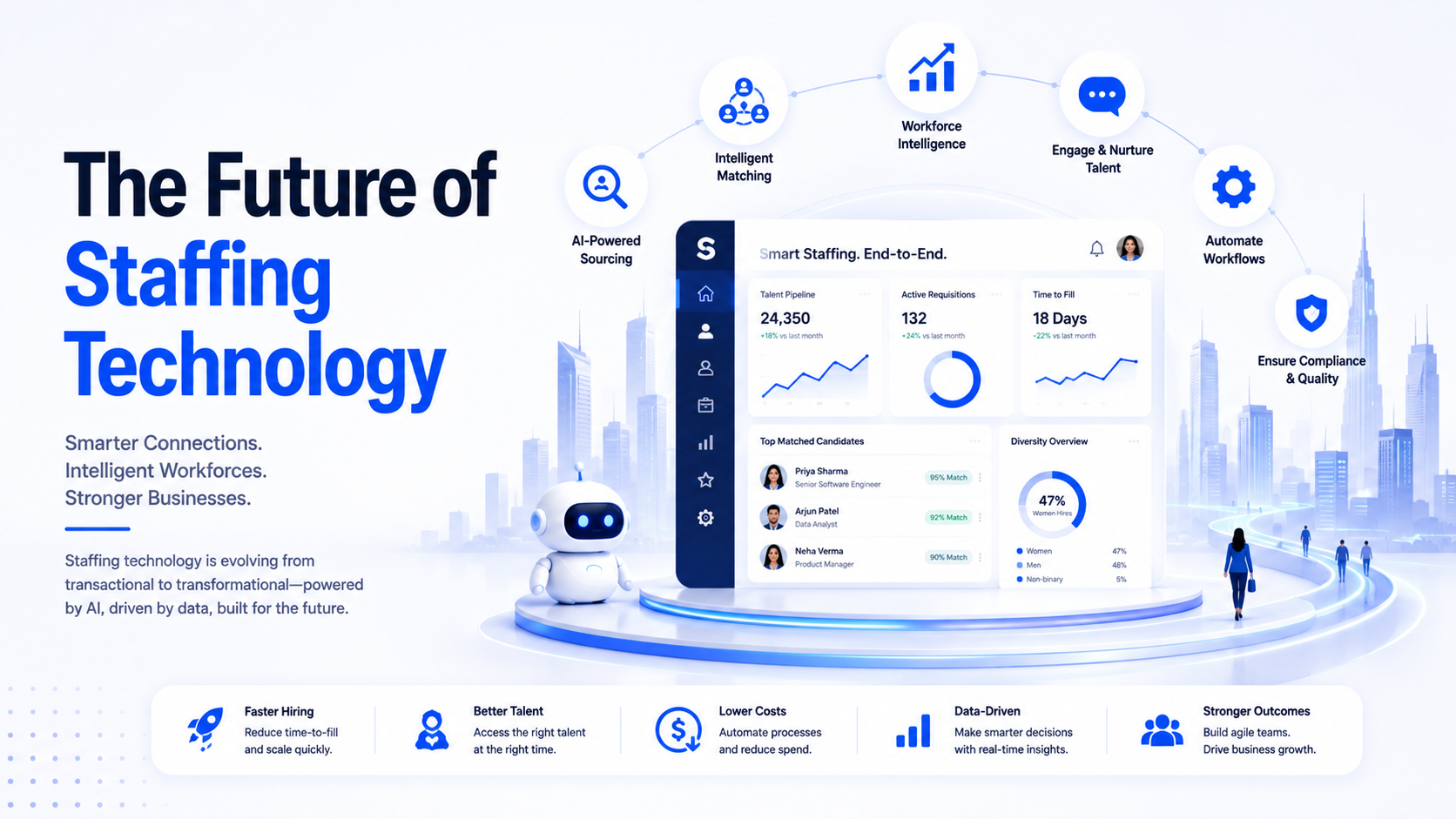
Agentic AI platforms are dismantling this fragmentation by unifying the entire hiring workflow within a single intelligent system. Unlike traditional applicant tracking systems that simply record what recruiters do, agentic platforms actively execute tasks: they autonomously source candidates, draft personalized outreach, score resumes against job-specific criteria, and even recommend interview questions based on a candidate profile. The distinction between agentic AI platforms vs automated ones platforms and merely automated tools is critical here. Automated tools follow rigid rules set by humans, while agentic platforms reason about context, adapt their behavior based on outcomes, and improve their decision-making over time without manual intervention.
For staffing firms evaluating whether to consolidate their tech stack, the ROI case is becoming difficult to ignore. Deloitte research on technology consolidation in talent acquisition shows that organizations using unified platforms reduce their recruiting technology spend by an average of twenty to thirty percent while simultaneously improving recruiter productivity. The elimination of data silos alone produces measurable gains: when sourcing data, screening scores, and engagement history live in one place, recruiters make better decisions faster. This is not a theoretical benefit. It is a documented outcome that early adopters are already realizing, and it explains why the market is shifting so decisively away from best-of-breed point solutions toward integrated agentic platforms.
Intelligent Talent Matching Is Outperforming Keyword Search
Keyword-based candidate search has been the backbone of staffing technology since the earliest resume databases appeared in the late 1990s. The logic was straightforward: if a resume contains the right keywords, it is relevant. But this approach has always suffered from two fundamental flaws. First, it misses qualified candidates who describe their experience using different terminology. A machine learning engineer who specializes in computer vision may never use the phrase image recognition on their resume, yet they possess exactly the skill a hiring team needs. Second, it surfaces candidates who stuff keywords without possessing genuine expertise, a problem that has worsened as AI-generated resumes become more common.
Intelligent talent matching addresses both problems by moving beyond surface-level text analysis. Modern matching engines build semantic representations of both candidate profiles and job requirements, understanding that software development and programming are related concepts while distinguishing between a junior developer and a senior architect. These systems analyze career progression patterns, project complexity indicators, and skill co-occurrence signals to assess a candidate's true capability, not just their stated keywords. The difference is substantial. EY has documented cases where semantic matching engines identified qualified candidates that keyword searches missed entirely, particularly for niche technical roles where terminology varies widely across industries.
The impact on staffing firm performance is particularly significant because it directly affects the metric that matters most to clients: quality of hire. When a staffing firm can consistently present candidates who are not merely keyword-eligible but genuinely aligned with the role's complexity and growth trajectory, client trust deepens and repeat business grows. more tools same hiring problems is a phenomenon many staffing teams know well: adding more sourcing channels or search tools without fundamentally improving the matching methodology does not produce better hires. The breakthrough comes from upgrading the intelligence layer itself, which is exactly what next-generation matching engines deliver. When the underlying technology already produces higher-quality candidate recommendations, every subsequent step in the hiring process benefits from that stronger starting point.
Referral Networks and Relationship Intelligence Are Going Digital
Employee referrals have long been recognized as the highest-quality source of hire, yet most organizations still manage referral programs through spreadsheets, email reminders, and manual tracking. The technology supporting referrals has lagged far behind the technology supporting other aspects of recruiting, creating a paradox where the best source of talent receives the least sophisticated tooling. LinkedIn data consistently shows that referred candidates
advance through hiring stages faster and stay longer, but the majority of referral programs fail to reach their potential because the administrative burden on employees is too high and the feedback loop is too slow.
New staffing platforms are embedding referral intelligence directly into the recruiting workflow. Instead of asking employees to manually submit names, these systems analyze communication patterns, collaboration histories, and professional network graphs to identify potential referral connections automatically. When a new role opens, the platform can surface a ranked list of employees who are most likely to know qualified candidates based on their professional networks and past referral behavior. This approach transforms referrals from a passive, sporadic activity into a systematic, data-driven sourcing channel. The evidence that why referrals outperform cold outreach outperform other sourcing channels is overwhelming, but only now is the technology catching up to make referral programs scalable and measurable.
Relationship intelligence extends beyond internal referrals to encompass the entire talent ecosystem. Staffing firms that maintain relationships with thousands of passive candidates need systems that track interaction history, engagement signals, and career progression over years, not just days. Modern CRM capabilities embedded within staffing platforms can alert recruiters when a previously engaged candidate's status changes, such as a new job title or a LinkedIn activity signal suggesting openness to new opportunities. This continuous awareness transforms the staffing firm's talent pool from a static database into a living, responsive network. Combined with SHRM best practices for talent relationship management, these digital referral and relationship tools are enabling a level of personalized, scalable engagement that was previously impossible.
The Data Quality Problem Is the Biggest Hidden Risk
Every staffing technology vendor promises better AI, smarter matching, and more predictive analytics. But the performance of any AI system is bounded by the quality of its training data, and staffing data is notoriously messy. Candidate records are duplicated across platforms, skill taxonomies are inconsistent, job descriptions use vague or outdated terminology, and contact information decays rapidly. When organizations layer sophisticated AI models on top of this unreliable data, the results can be misleading rather than illuminating. Recruiters may see high match scores for candidates who are not actually qualified, or predictive models may generate forecasts based on patterns that no longer reflect current market realities.
The problem of stale or inaccurate candidate data is especially acute in staffing, where the half-life of a candidate's availability can be measured in days. A developer who was open to new opportunities last month may have accepted a new role, and a candidate's skill profile may have evolved significantly since their resume was last updated. This challenge of outdated candidate data affects virtually every AI recruiting tool on the market, but some platforms invest far more heavily in continuous data refresh mechanisms than others. The difference between a platform that updates candidate records weekly versus one that refreshes them in near
real-time can be the difference between a recruiter reaching an engaged, available candidate and one who has already moved on.
Addressing data quality is not a one-time cleanup project. It requires ongoing investment in deduplication algorithms, standardized skill taxonomies, automated enrichment from public data sources, and feedback loops that allow recruiters to flag and correct inaccurate information. Organizations that treat data quality as a foundational priority rather than an afterthought will extract significantly more value from their staffing technology investments. McKinsey has repeatedly emphasized that data quality is the single most important determinant of AI success in talent acquisition, yet it remains one of the most underinvested areas. As staffing technology continues to evolve, the platforms that win will not necessarily be those with the most impressive algorithms, but those with the cleanest, freshest, and most comprehensive data foundations.
What This Means for Talent Teams in the Next Three Years
The convergence of predictive analytics, agentic platforms, intelligent matching, and relationship intelligence is creating a staffing technology landscape that will look fundamentally different within three years. Teams that continue to rely on legacy applicant tracking systems and manual processes will find themselves at an increasing disadvantage, not because their recruiters are less skilled, but because their tools do not amplify those skills effectively. The question is no longer whether to adopt next-generation staffing technology, but how quickly and strategically to do so. Gartner projects that by 2028, the majority of mid-to-large staffing firms will have replaced at least half of their legacy point solutions with integrated AI platforms.
For talent acquisition leaders, the practical implication is clear: technology evaluation must shift from feature checklists to outcome-based assessments. A platform's value should be measured not by the length of its feature list but by its ability to improve quality-of-hire, reduce time-to-fill, increase recruiter productivity, and enhance the candidate experience. These are the metrics that translate into business impact, and they depend on the integration and intelligence of the entire system, not on any single capability. Deloitte advises talent leaders to pilot integrated platforms with a small team first, measure the concrete productivity and quality improvements, and then scale based on evidence rather than vendor promises.
Recruiters themselves need not fear this evolution. While should recruiters worry about AI replacing jobs is a topic that generates significant anxiety, the reality is that AI-powered staffing tools are eliminating repetitive administrative tasks, not the strategic judgment that experienced recruiters bring to the table. Sourcing, screening, scheduling, and follow-up coordination are being automated, freeing recruiters to focus on candidate relationship building, hiring manager advisory, and workforce strategy. The recruiters who thrive in this new environment will be those who embrace technology as an amplifier of their expertise rather than a threat to their role. LinkedIn data shows that recruiters who adopt AI tools early in their workflow
report higher job satisfaction and better hiring outcomes, suggesting that the technology is enhancing the profession rather than diminishing it.