Jonathan Krause, head of talent acquisition at a European logistics company operating across fourteen countries, had just completed his annual planning cycle and was reviewing the hiring forecasts his team had prepared. The forecasts were based on the same methodology his team had used for years: historical hiring volumes adjusted for known business changes such as new office openings, planned expansions, and projected attrition rates. The problem was that these forecasts had been wrong by an average of thirty-five percent over each of the past three years. Some roles took twice as long to fill as predicted. Others were filled in half the expected time. Unexpected resignations created urgent hiring needs that the forecast had not anticipated. And several planned hires were cancelled when business conditions shifted faster than the planning cycle could accommodate. Jonathan knew that the reactive model of recruiting, where the firm identifies a need, opens a requisition, and then starts looking for candidates, was becoming a competitive liability. His competitors were making offers to top talent before positions were even formally approved because they had predicted the hiring need based on business signals. He needed a predictive approach that could anticipate hiring needs, forecast candidate availability, and pre-position talent pipelines before the requisition arrived.
Why Reactive Recruiting Is Running Out of Road
The traditional recruiting model is fundamentally reactive. A hiring need arises, a requisition is created, a search is initiated, candidates are sourced and screened, interviews are conducted, an offer is extended, and a hire is made. This model has worked for decades because the pace of business change was slow enough that organizations could afford the time lag between identifying a need and filling it. In most industries, that time lag has been shrinking for years while the cost of unfilled positions has been rising. A vacant senior engineering role at a technology company can cost hundreds of thousands of dollars in delayed product launches. An unfilled sales position at a high-growth startup directly reduces revenue. An empty nursing position at a hospital compromises patient care and increases the workload on remaining
staff. The reactive model assumes that the organization can absorb these costs while the recruiting process runs its course. In talent markets characterized by skill scarcity, high candidate expectations, and aggressive competitor hiring, that assumption is increasingly false.
The reactive model also creates chronic inefficiency because it treats every hiring need as a discrete event rather than as a pattern that can be anticipated. Organizations that hire the same types of roles repeatedly, software engineers, financial analysts, project managers, warehouse operatives, and registered nurses, generate enormous amounts of historical data about when these roles are needed, how long they take to fill, what candidates cost, and which factors predict successful placement. Yet most organizations analyze this data only in retrospect, producing reports on what happened last quarter or last year, rather than using it prospectively to predict what will happen next quarter and next year. The data to support predictive recruiting already exists in most organizations. What is missing is the analytical infrastructure and the organizational discipline to use it predictively rather than retrospectively. According to McKinsey, organizations that shift even a portion of their recruiting from reactive to predictive reduce their average time-to-fill by twenty-five to thirty-five percent and their cost-per-hire by fifteen to twenty percent, because prediction enables pre-positioning of candidate pipelines and earlier engagement with potential hires.
The competitive dimension of predictive recruiting is equally significant. When an organization can predict its hiring needs and begin building candidate relationships before a requisition is formally created, it gains a time advantage over competitors who are still waiting for the requisition to be approved. In many talent markets, the first organization to engage a high-quality candidate has a significant probability of making the hire, because candidates often accept the first credible opportunity they receive rather than waiting to explore all options. Predictive recruiting exploits this dynamic by ensuring that the organization is already in conversation with qualified candidates when the hiring need becomes urgent, rather than starting the conversation from zero. This time advantage is difficult for competitors to overcome because it is built on data and analytical capabilities that take time to develop. agentic AI platforms vs automated ones explains how agentic AI platforms enable predictive recruiting by analyzing historical hiring patterns, market signals, and candidate engagement data to forecast hiring needs and pre-build talent pipelines, because the platform continuously processes the data signals that indicate future hiring demand and initiates candidate engagement before the formal recruiting process begins.
The Three Pillars of Predictive Recruitment
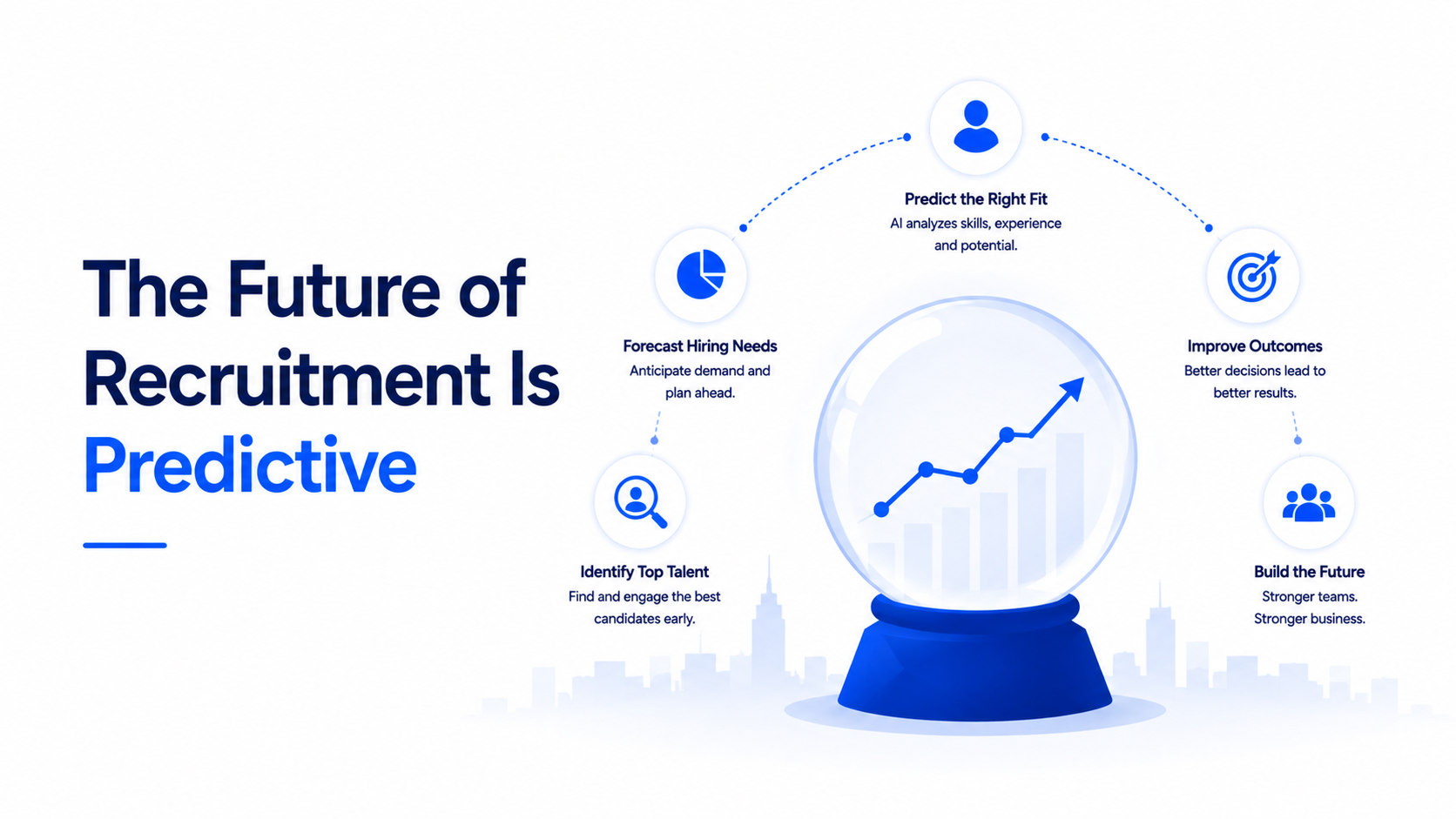
Predictive recruitment rests on three analytical pillars, each of which addresses a different dimension of the hiring forecast. The first pillar is demand prediction, which answers the question of when and what roles the organization will need to fill. Demand prediction models analyze historical hiring patterns, business growth trajectories, workforce attrition data, market expansion plans, and external labor market signals to forecast hiring needs by role type, geography, and time period. A well-built demand prediction model can tell a talent acquisition
leader that the engineering organization will likely need twelve additional backend developers in Q2, that three of these will be driven by projected attrition based on tenure and compensation data, that five will be driven by a new product initiative that is already reflected in approved budget allocations, and that four will be driven by market expansion into a region where the company has recently won several contracts. This level of specificity enables the talent acquisition team to begin sourcing activities months before the formal requisition process begins.
The second pillar is supply prediction, which answers the question of how difficult it will be to find qualified candidates for the predicted needs. Supply prediction models analyze candidate availability in the market, competitor hiring activity, skill concentration by geography, compensation trends, candidate responsiveness patterns, and the firm's own historical success rates for similar roles. When demand and supply predictions are combined, the talent acquisition team can see not just what they will need to hire but how challenging each hire will be, which roles require early pipeline building and which can be filled through standard processes, and where compensation adjustments may be necessary to attract candidates in competitive markets. A demand prediction that shows a need for twelve backend developers is useful. A combined demand and supply prediction that shows that only eight qualified candidates are actively looking in the relevant market, that three competitors are hiring for the same role type, and that the average time-to-fill for this role has increased from thirty to forty-five days over the past two quarters, is strategically transformative because it tells the organization not just what it needs but how hard it will be to get it and what actions will improve the probability of success.
The third pillar is outcome prediction, which answers the question of which candidates are most likely to succeed if hired. Outcome prediction models analyze the characteristics of successful and unsuccessful past hires, including background factors, assessment scores, interview performance, compensation expectations, and engagement patterns, to predict which current candidates will perform well, stay with the organization, and integrate successfully into the team. This pillar is the most analytically sophisticated because it requires tracking post-hire outcomes over meaningful time horizons and building models that distinguish correlation from causation. But it is also the most directly valuable, because it converts the recruiting function from a candidate delivery service into a quality-of-hire optimization engine. According to Gartner, organizations that deploy outcome prediction models alongside demand and supply prediction report twenty to thirty percent improvements in new hire retention at twelve months and fifteen to twenty percent improvements in manager satisfaction with new hire quality, because the models identify candidate characteristics that predict success in the specific organizational context rather than relying on generic hiring criteria.
From Historical Reporting to Forward-Looking Intelligence
The transition from reactive to predictive recruiting requires a fundamental shift in how talent acquisition teams use data. Most recruiting teams today operate with backward-looking
analytics: dashboards and reports that show what happened last month, last quarter, or last year. These reports are useful for understanding trends and identifying problems, but they do not help the team anticipate what will happen next. A report showing that time-to-fill increased by fifteen percent last quarter tells the team that something changed, but it does not tell them what will happen this quarter or what actions they should take now to improve outcomes. Forward-looking analytics, by contrast, use historical data to build models that project future conditions and recommend specific actions. A predictive dashboard might show that based on current pipeline data and historical conversion rates, the team is likely to miss its Q2 hiring targets by twenty percent unless it increases sourcing activity for three specific role types by the end of this month. This forward-looking view transforms the analytics from a reporting tool into a decision-support system that drives specific, timely actions.
Building forward-looking analytics capability requires three investments. The first is in data quality and completeness, because predictive models are only as accurate as the data they are built on. Incomplete placement records, missing candidate outcome data, and inconsistent process tracking all degrade model accuracy. The second is in analytical tools that can handle the complexity of recruiting data, including time-series analysis for forecasting, classification models for candidate evaluation, and probability models for predicting candidate behavior such as likelihood of accepting an offer or likelihood of remaining in the process. The third and most important investment is in the organizational mindset that values prediction and acts on it. Forward-looking analytics are useless if the team continues to operate reactively, waiting for requisitions before initiating sourcing activity. The team must develop the discipline to act on predictive signals, beginning pipeline development when the model indicates future need rather than when the requisition formally arrives. This cultural shift is often the hardest part of the transition because it requires talent acquisition leaders to allocate resources to hiring needs that have not yet been formally approved, which requires confidence in the predictive models and support from organizational leadership. According to Deloitte, organizations that successfully transition to predictive recruiting report that the cultural shift, getting the team to act on predictions rather than waiting for confirmed requisitions, takes six to twelve months longer than the technology implementation, because changing deeply ingrained operating habits requires sustained leadership attention and visible organizational commitment.
The competitive intelligence dimension of forward-looking analytics is particularly powerful. Predictive models can analyze not just the organization's own hiring data but also external signals about competitor hiring activity, industry talent flows, and market-wide candidate availability trends. When a talent acquisition team can tell their business leaders that three of their top competitors have increased hiring for data scientists by forty percent over the past quarter, that the average offer accepted in this market has increased by twelve percent, and that the pool of available data scientists in their primary geographic market has contracted by fifteen percent, they provide strategic intelligence that influences business decisions beyond talent acquisition. The business might accelerate a product roadmap to secure talent before competitors drain the available pool, adjust compensation budgets preemptively, or revise location strategy to access talent markets where supply is more favorable. This strategic advisory capability elevates the talent acquisition function from an operational service to a strategic
business partner, which is the organizational position that predictive analytics makes possible. AI sourcing vs AI recruiting explains why predictive capabilities are most powerful when they span the full recruiting lifecycle from sourcing through post-hire analytics, because the data from each phase improves the accuracy of predictions in every other phase, creating a self-reinforcing intelligence system that gets smarter with every hiring cycle.
How AI Enables True Predictive Recruiting
Artificial intelligence is the technology that makes predictive recruiting practical at scale. The analytical models that underpin demand, supply, and outcome prediction require processing large volumes of structured and unstructured data, identifying complex patterns across multiple variables, and continuously updating predictions as new data arrives. These capabilities exceed what manual analysis or traditional business intelligence tools can deliver. AI models can analyze millions of data points from candidate databases, placement records, market signals, and business indicators simultaneously, identifying patterns that would be invisible to human analysts working with spreadsheets and standard reporting tools. More importantly, AI models can learn continuously, improving their prediction accuracy as they process more data and receive feedback on the accuracy of their previous predictions. A demand prediction model that missed a hiring surge last quarter because it did not account for a specific market signal can be updated to incorporate that signal into future predictions, making the model more accurate over time without manual recalibration.
Natural language processing extends predictive capabilities into the unstructured data that represents a large portion of recruiting intelligence. Candidate communications, hiring manager feedback, interview notes, and market commentary all contain predictive signals that are lost when this data remains in text form. AI can analyze the sentiment in candidate communications to predict the likelihood of offer acceptance. It can identify patterns in hiring manager interview feedback that predict which candidates will perform well. It can process market news, earnings reports, and industry publications to identify signals that predict changes in talent demand or supply. This ability to extract predictive insights from unstructured data dramatically expands the scope and accuracy of predictive models, because much of the most valuable recruiting intelligence exists in the qualitative, text-based interactions that traditional analytics systems cannot process. According to LinkedIn, organizations that deploy AI for unstructured data analysis in recruiting report twenty-five to thirty-five percent improvements in prediction accuracy for candidate behavior outcomes such as offer acceptance, counteroffer susceptibility, and early attrition risk, because the unstructured data contains behavioral signals that structured data alone cannot capture.
The most transformative AI capability for predictive recruiting is the ability to build anticipatory candidate pipelines. An AI system that predicts a hiring need three months before the requisition is formally created can simultaneously begin identifying and engaging potential candidates for that anticipated need. The system can identify candidates whose profiles match the predicted requirements, assess their likelihood of being open to a move based on career
trajectory signals, initiate low-intensity engagement that builds awareness and interest without creating the pressure of an active search, and score and rank candidates based on predicted fit and availability. By the time the requisition arrives, the talent acquisition team has a pre-qualified, pre-engaged candidate pipeline ready for immediate action, compressing time-to-fill from weeks to days. This anticipatory capability represents a fundamental shift in the recruiting paradigm, from responding to needs that already exist to preparing for needs that the data predicts will exist. The organizations that master this capability will hire faster, hire better, and hire more consistently than competitors who remain in the reactive mode. more tools same hiring problems explains why organizations that deploy AI for anticipatory pipeline building must integrate it with their core recruiting platform rather than deploying it as a standalone tool, because the predictive pipeline is most effective when it draws on the full breadth of the organization's talent data and coordinates seamlessly with the human recruiters who will manage the candidate relationships.
Building Predictive Capability: A Practical Roadmap
Building predictive recruiting capability should follow a deliberate sequence that builds analytical sophistication incrementally while delivering value at each stage. The first stage is foundational data preparation, which means ensuring that the organization's core recruiting data, requisition history, candidate records, placement outcomes, time-to-fill metrics, and source effectiveness data, is complete, consistent, and accessible for analysis. Most organizations discover during this stage that their data has significant gaps, particularly in post-hire outcome tracking and candidate disposition tracking, where the reasons candidates decline offers or withdraw from processes are often not systematically recorded. Closing these data gaps is the highest-priority action because predictive models cannot function without comprehensive input data. This stage typically takes three to six months and delivers immediate value even before any predictive modeling begins, because the process of cleaning and consolidating the data often reveals process inefficiencies and improvement opportunities that were previously invisible.
The second stage is descriptive and diagnostic analytics, building the reporting infrastructure that shows what has happened and why. This includes fill-rate dashboards by role type and geography, time-to-fill trend analysis, source effectiveness reporting, candidate pipeline conversion metrics, and cost-per-hire breakdowns. These reports provide the historical baseline that predictive models will build upon, and they often deliver immediate operational value by identifying the recruiting processes and role types that most need improvement. The third stage is predictive modeling, building the statistical or machine-learning models that forecast future hiring needs, candidate availability, and hiring outcomes. The first predictive models should focus on the highest-impact use cases, typically demand forecasting for the organization's most critical and difficult-to-fill roles, and should be built using the historical data assembled in the first two stages. According to EY, organizations that follow this staged approach, data preparation, descriptive analytics, then predictive modeling, report forty to fifty percent higher confidence in their predictive outputs and are twice as likely to sustain their
predictive capabilities over multiple years, because the staged approach ensures that each layer of analytical capability is built on a solid foundation and that the team develops the skills and organizational habits needed to use prediction effectively.
The fourth stage is operational integration, embedding predictive insights into the recruiting team's daily workflows and decision-making processes. Predictive models that produce forecasts but do not influence behavior create no value. The integration stage means that demand predictions inform sourcing priorities, supply predictions inform expectation-setting with hiring managers, outcome predictions inform candidate shortlisting, and all of these insights are presented to recruiters and hiring managers through the tools they already use rather than through separate analytics dashboards that nobody consults. The most effective integration is often subtle: a recruiter sees a priority flag on a candidate profile indicating high predicted fit, a hiring manager receives an automated alert that the market for their open role has tightened and compensation expectations may need adjustment, and a talent acquisition leader sees a forecast showing that three upcoming retirements will create critical skill gaps that require pipeline development starting immediately. These embedded, contextualized predictions drive action without requiring users to seek out analytical insights. how to evaluate an AI sourcing tool provides a framework for assessing an organization's readiness to build predictive recruiting capability, because the assessment identifies the data, technology, process, and skill gaps that must be addressed before predictive models can be deployed effectively and trusted by the recruiting team.