Marcus Chen had spent twenty-two years building his staffing agency in Chicago into a reliable mid-market player. His firm placed roughly four hundred professionals a year across accounting, logistics, and mid-level technology roles. Revenue had been stable at around twelve million dollars annually for three consecutive years. But in the last eighteen months, Marcus had watched three of his largest clients reduce their contingent workforce budgets by thirty to forty percent, each one citing the same reason: they had implemented AI-driven internal talent platforms that automated much of the sourcing and initial screening his agency had traditionally performed. At the same time, two of his best recruiters had left to join internal talent acquisition teams at companies that were building their own AI-powered hiring capabilities. Marcus was not facing a sudden collapse. His agency was still profitable. But the trend lines were unmistakable, and he knew that the business model that had sustained his firm for two decades was being systematically dismantled by technology. He needed to understand not just what was happening but what his agency could become in a world where AI could source, screen, and engage candidates faster and cheaper than his team ever could.
The Disruption Already Underway
The recruitment agency industry is not facing a future disruption. It is experiencing a current one, and the evidence is visible in the financial reports, client conversations, and market positioning of agencies across every segment. Large enterprise clients, the clients that generate the highest fees and the most predictable revenue for agencies, are investing aggressively in internal AI-powered talent acquisition capabilities. According to McKinsey, nearly sixty percent of large enterprises have either deployed or are actively piloting AI sourcing and screening tools, and the primary motivation cited by talent leaders is reducing dependence on external agencies for roles that can be filled through automated processes. This is not a
hypothetical future trend. It is a documented, measurable shift that is already reshaping agency revenue streams. The roles most affected are high-volume, mid-level positions where the hiring criteria are well-defined and the candidate pool is large enough for AI tools to identify qualified candidates reliably. These are precisely the roles that have historically formed the backbone of agency revenue.
The disruption extends beyond client-side AI adoption. The candidate market itself has been transformed by AI-powered job search tools, professional networking platforms with intelligent matching algorithms, and career platforms that connect candidates directly with hiring companies. Candidates who previously relied on agencies to connect them with opportunities now have access to tools that surface relevant openings, optimize their applications, and even negotiate compensation. This candidate-side empowerment reduces the leverage that agencies traditionally held as information intermediaries. When a candidate can find the same opportunities through an AI-powered job platform that an agency would present, the agency's value as a matchmaker diminishes. The result is a compression of the agency's position from both sides of the market simultaneously. Clients need agencies less for standard roles because their internal AI tools handle sourcing and screening. Candidates need agencies less because AI-powered platforms connect them directly with employers. The traditional agency model, which derived its value from information asymmetry between employers and candidates, is being undermined by technologies that eliminate that asymmetry.
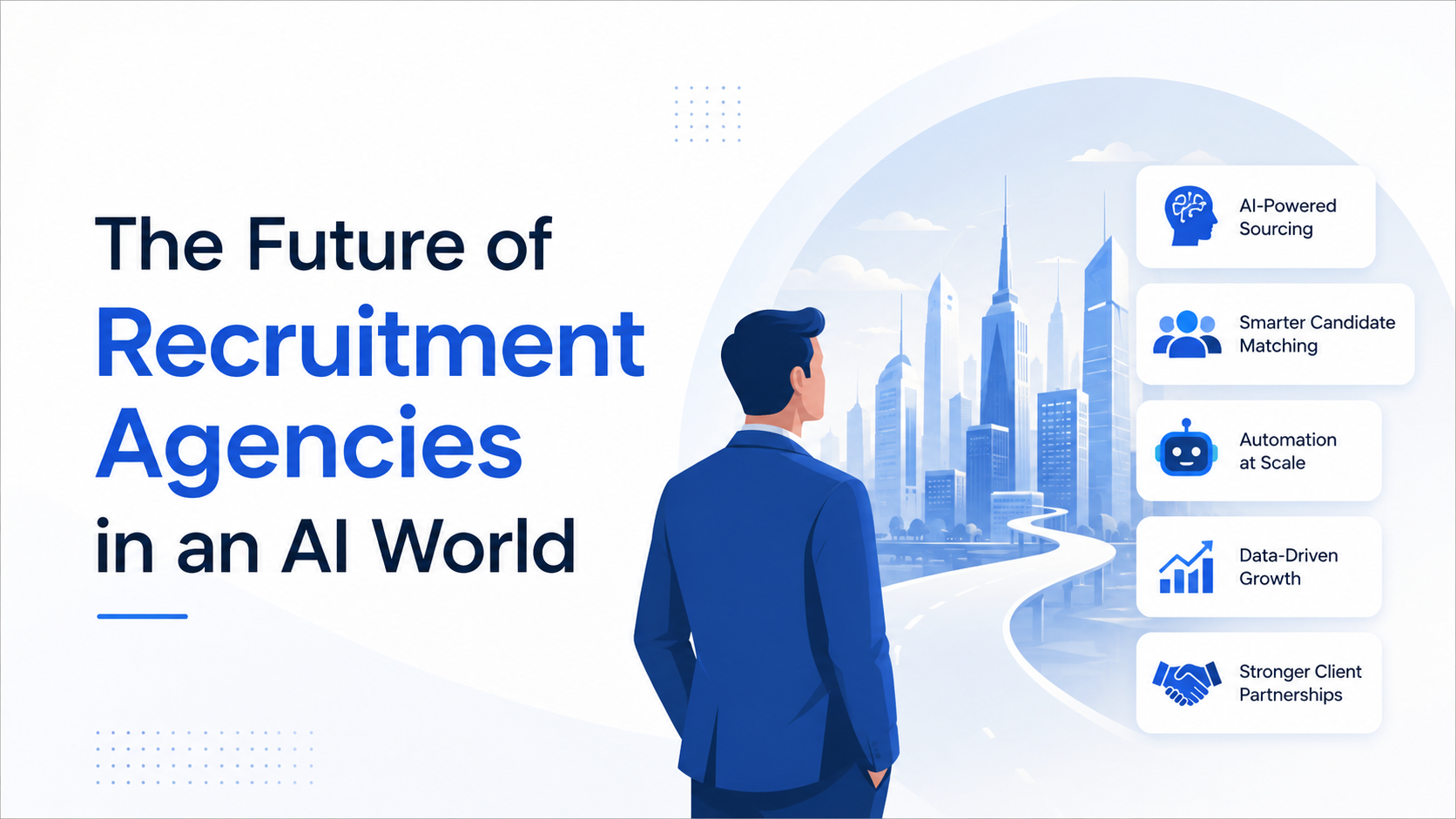
Despite these pressures, the agency industry is not heading toward extinction. The demand for specialized talent acquisition expertise continues to grow, particularly in areas where AI tools alone are insufficient. Executive search, highly specialized technical recruiting, and talent acquisition for emerging skill categories remain areas where human expertise, industry relationships, and nuanced understanding of organizational fit create value that AI cannot yet replicate. The question is not whether agencies will survive but which agencies will survive and in what form. Agencies that attempt to compete with AI on speed and cost for standard placements will lose. Agencies that redefine their value proposition around capabilities that complement and extend what AI can do will find new growth opportunities. According to Gartner, the staffing agencies that will thrive in the next five years are those investing in AI capabilities themselves rather than treating AI as a threat to resist, because these agencies are positioning themselves as technology-enabled talent partners rather than manual service providers competing against automation.
From Transactional Placements to Strategic Talent Partnerships
The most significant strategic shift for recruitment agencies is the transition from transactional placement models to strategic talent partnership models. The transactional model is straightforward: a client has an open role, the agency sources candidates, presents a shortlist, and earns a fee when a candidate is placed. This model treats the agency as a vendor performing a discrete service. The strategic partnership model treats the agency as an extension of the client's talent acquisition function, providing ongoing advisory services, market intelligence,
talent pipeline development, and workforce planning support that go well beyond filling individual roles. In the partnership model, the agency is compensated not just for placements but for the strategic value it delivers across the talent lifecycle. This shift requires agencies to develop capabilities that most do not currently possess: deep industry expertise, data analytics capabilities, consulting skills, and the ability to engage with senior business leaders rather than just HR departments.
The partnership model also changes the agency's relationship with AI. In the transactional model, AI is a threat because it automates the specific service, sourcing and screening, that the agency sells. In the partnership model, AI is an enabler because it allows the agency to deliver more comprehensive and insightful talent services. An agency that uses AI to analyze talent market trends, predict skill shortages, model workforce scenarios, and identify emerging talent pools can provide strategic advice that no manual process could support. The agency becomes not a competitor to the client's internal AI tools but a complement to them, providing the human judgment, industry context, and strategic framing that internal tools cannot deliver on their own. This complementary positioning is essential. agentic AI platforms vs automated ones explores how agencies that adopt agentic AI platforms can deliver continuous talent market intelligence to their clients alongside their traditional placement services, because the AI handles the data processing and pattern recognition while the agency's consultants provide the strategic interpretation and client-specific recommendations that turn raw intelligence into actionable hiring strategy.
Moving from transactions to partnerships also requires a fundamental change in how agencies measure and communicate their value. In the transactional model, success is measured by placements, fill rates, and time-to-fill. These metrics are easily quantified but they capture only a fraction of the value a strategic talent partner can deliver. Partnership metrics include quality of hire over time, retention rates, workforce diversity improvements, talent pipeline health, and the strategic alignment of hiring plans with business objectives. These metrics are harder to measure and require longer time horizons to evaluate, but they reflect the true strategic value that agencies can provide. Agencies that can demonstrate impact on these higher-order metrics will command higher fees, deeper client relationships, and more resilient revenue streams. According to LinkedIn, agencies that have successfully transitioned to partnership models report average contract values that are three to four times higher than their transactional engagements, with significantly higher client retention rates, because the strategic value they deliver creates switching costs that placement-only relationships cannot match.
AI Tools That Empower Rather Than Replace Agencies
The narrative that AI will replace recruitment agencies is incomplete. A more accurate framing is that AI will replace specific tasks that agencies perform while creating opportunities for agencies to deliver new types of value. The agencies that understand this distinction are already using AI tools to enhance their capabilities rather than viewing AI purely as a competitive threat. AI-powered sourcing tools allow agency recruiters to identify candidates faster
and from a wider pool than manual methods enable. AI screening tools can process large volumes of applications and identify the most promising candidates based on criteria that go beyond keyword matching. AI engagement tools can maintain candidate relationships at scale through personalized, timely communication that no human recruiter could sustain for hundreds of candidates simultaneously. These capabilities do not replace the agency. They amplify it, allowing each recruiter to manage larger candidate pools, engage more clients, and deliver faster results.
The key insight for agencies is that AI tools are most powerful when they are combined with human expertise rather than deployed as replacements for it. An AI tool can identify a list of technically qualified candidates, but a human recruiter with deep industry knowledge can assess which of those candidates will thrive in a specific organizational culture. An AI tool can draft an outreach message, but a human recruiter who has built a relationship with a candidate over multiple placements can craft an approach that resonates with that candidate's specific career aspirations and motivations. An AI tool can analyze compensation data, but a human recruiter who understands a client's budget constraints, internal politics, and hiring urgency can negotiate an offer that closes the deal. The combination of AI efficiency and human judgment creates a service that is superior to either alone. why referrals outperform cold outreach demonstrates how agencies that layer AI tools on top of relationship-based recruiting models achieve higher placement rates than agencies using either approach in isolation, because the AI identifies opportunities and the human relationships close them.
For agency leaders, the practical question is not whether to adopt AI tools but which tools to adopt and how to integrate them into existing workflows. The most effective approach is to identify the highest-volume, most time-consuming tasks in the agency's workflow and deploy AI tools to handle those tasks while freeing recruiters to focus on relationship management, client advisory, and strategic activities. This requires investment not just in technology but in training, change management, and process redesign. Agencies that simply plug AI tools into existing workflows without rethinking how work is distributed between humans and technology will see modest efficiency gains but will not achieve the transformative impact that full integration enables. According to Deloitte, staffing agencies that invest in comprehensive AI adoption, including technology, training, and process redesign, report twenty-five to thirty-five percent improvements in recruiter productivity and fifteen to twenty percent increases in placement quality, while agencies that adopt AI tools without corresponding process changes see productivity gains of less than ten percent, because the tools are constrained by workflows that were not designed to leverage their full capabilities.
The New Revenue Models for AI-Equipped Agencies
As AI changes what agencies can deliver, it also creates opportunities for new revenue models that go beyond the traditional placement fee. The most promising new model is the talent intelligence subscription, where clients pay a recurring fee for ongoing access to the agency's AI-powered market insights, talent pipeline data, and competitive intelligence. In this model,
the agency functions as a talent market intelligence provider, delivering regular reports on skill availability, compensation trends, competitor hiring activity, and emerging talent pools that are relevant to the client's industry and growth plans. The subscription model provides the agency with predictable recurring revenue, reduces dependence on individual placements for income, and deepens the client relationship by making the agency an ongoing strategic resource rather than a transactional vendor engaged only when a specific role needs filling. This model works particularly well for agencies that have developed deep expertise in specific industries or talent categories, because their specialized knowledge creates intelligence that is uniquely valuable to clients in those segments.
A second emerging revenue model is the talent community management model, where the agency builds and maintains curated talent communities around specific skill sets or industries and charges clients for access to these pre-engaged candidate pools. Unlike traditional talent databases, which are passive repositories of resumes, talent communities are actively managed groups of professionals who have opted into ongoing relationships with the agency. AI tools make community management scalable by automating engagement, tracking member career progression, and identifying when community members' profiles match client needs. The value proposition for clients is speed and quality: instead of waiting for the agency to source candidates for each new role, clients can tap into a pre-built, pre-engaged talent pool. For the agency, the community model creates a defensible asset that grows in value over time as more members join and more engagement data accumulates. should recruiters worry about AI replacing jobs explains why agencies that build talent communities are positioning themselves for sustainable growth even as AI automates traditional sourcing, because the community itself becomes a proprietary asset that competitors cannot replicate regardless of the AI tools they deploy.
A third model is the embedded talent team model, where the agency provides dedicated recruiters who work as an extension of the client's internal talent acquisition team, with the agency's AI platform providing the technology infrastructure that powers the embedded team's activities. This model combines the strategic proximity of an internal team with the scalability and technology investment of an external agency. Clients benefit from dedicated recruiting capacity without the overhead of hiring, training, and managing additional internal recruiters. Agencies benefit from longer-term contracts, deeper client integration, and the ability to leverage their AI platform across multiple embedded team engagements. According to EY, the embedded talent team model is the fastest-growing segment of the staffing industry, with demand increasing by forty to fifty percent year over year, because it addresses the core challenge that drives companies to build internal capabilities, the desire for dedicated, integrated talent acquisition capacity, while preserving the flexibility and technology advantages that agencies provide.
What Agency Leaders Must Do in the Next 18 Months
The strategic window for agency transformation is open now, but it will not remain open
indefinitely. As more agencies adopt AI capabilities and transition to strategic partnership models, the competitive advantage of early movers will compound, making it increasingly difficult for laggards to catch up. Agency leaders should begin with an honest assessment of their current positioning. Which revenue streams are most vulnerable to AI-driven disruption from clients or competitors? Which capabilities represent the agency's strongest differentiation? What investments in technology, talent, and process redesign are required to transition from the current model to a more resilient one? This assessment should be specific and quantitative, identifying the roles, clients, and service lines where disruption risk is highest and where opportunity for strategic repositioning is greatest. The agencies that move quickly and decisively will capture market share from those that wait for the disruption to become unavoidable before acting.
The second priority is technology investment. Agencies should evaluate and deploy AI tools across three categories: sourcing and candidate identification, engagement and relationship management, and analytics and market intelligence. The sourcing tools should extend the agency's reach beyond traditional job boards and databases, incorporating public professional signals, community platforms, and passive candidate identification. The engagement tools should enable personalized, scalable communication that maintains candidate relationships between placements. The analytics tools should provide the agency with talent market intelligence that forms the foundation of its strategic advisory services. These three categories of AI capability, working together, create a technology platform that supports both the agency's operational efficiency and its strategic evolution. more tools same hiring problems illustrates why agencies that accumulate AI tools without a coherent platform strategy often find their technology stack creates more complexity than value, because disconnected tools require separate management and do not share data, whereas an integrated platform amplifies the impact of each individual tool.
The third priority is talent development. Agencies need recruiters who can operate effectively alongside AI tools, consultants who can deliver strategic talent advisory services, and leaders who can manage the transition from a transactional to a partnership-oriented business model. This requires investment in training programs that build AI literacy, consulting skills, and strategic thinking capabilities across the organization. It also requires changes in hiring, bringing in professionals with data analytics backgrounds, industry consulting experience, and technology expertise that complement the agency's existing recruiting strengths. The agencies that will lead the industry in five years are those that start building these capabilities today, not those that wait until their traditional business has declined to the point where investment in new capabilities becomes financially difficult. According to SHRM, the staffing agencies most likely to thrive in the AI era are those that invest simultaneously in technology and human capital, because the combination of advanced AI tools and strategically skilled professionals creates a service capability that neither technology nor talent alone can deliver. The future of recruitment agencies belongs to those who build it now.