David Park, VP of Talent Acquisition at a global technology company, spent eighteen months watching his team struggle with an increasingly fragmented hiring technology stack. His organization had accumulated seven different tools across the hiring lifecycle, each selected independently by different business units over several years. None of them integrated seamlessly. Candidate data lived in silos. Recruiters spent more time toggling between systems than engaging with candidates. When Park finally secured budget to replace the entire stack with a unified enterprise hiring platform, the results were immediate and dramatic: recruiter productivity increased by thirty-five percent in the first quarter, candidate response rates improved by twenty-two percent, and the time spent on administrative data entry dropped by nearly half. Park's experience illustrates a shift that is gaining momentum across enterprise talent acquisition. The future of hiring technology is not more tools but smarter, more integrated platforms that unify the entire hiring process within a single intelligent system.
From Point Solutions to Unified Hiring Ecosystems
The enterprise hiring technology landscape has reached an inflection point. For most of the past decade, organizations built their talent acquisition technology stacks by selecting best-of-breed point solutions for each stage of the hiring process: one tool for sourcing, another for outreach, a third for interview scheduling, and a separate ATS to manage the administrative workflow. This approach made sense when individual tools offered clearly superior
capabilities in their specific domains. However, as hiring has become more competitive and data-driven, the limitations of disconnected tool stacks have become impossible to ignore. Information does not flow seamlessly between systems. Candidate profiles must be manually transferred or clumsily synced across platforms. Recruiter productivity suffers as talent acquisition teams spend significant portions of their working hours managing technology rather than engaging with candidates and hiring managers. According to McKinsey, the average enterprise talent acquisition team uses six to eight distinct tools in their hiring process, and the integration gaps between these tools account for an estimated fifteen to twenty percent of total recruiter time, a productivity tax that organizations can no longer afford in competitive talent markets.
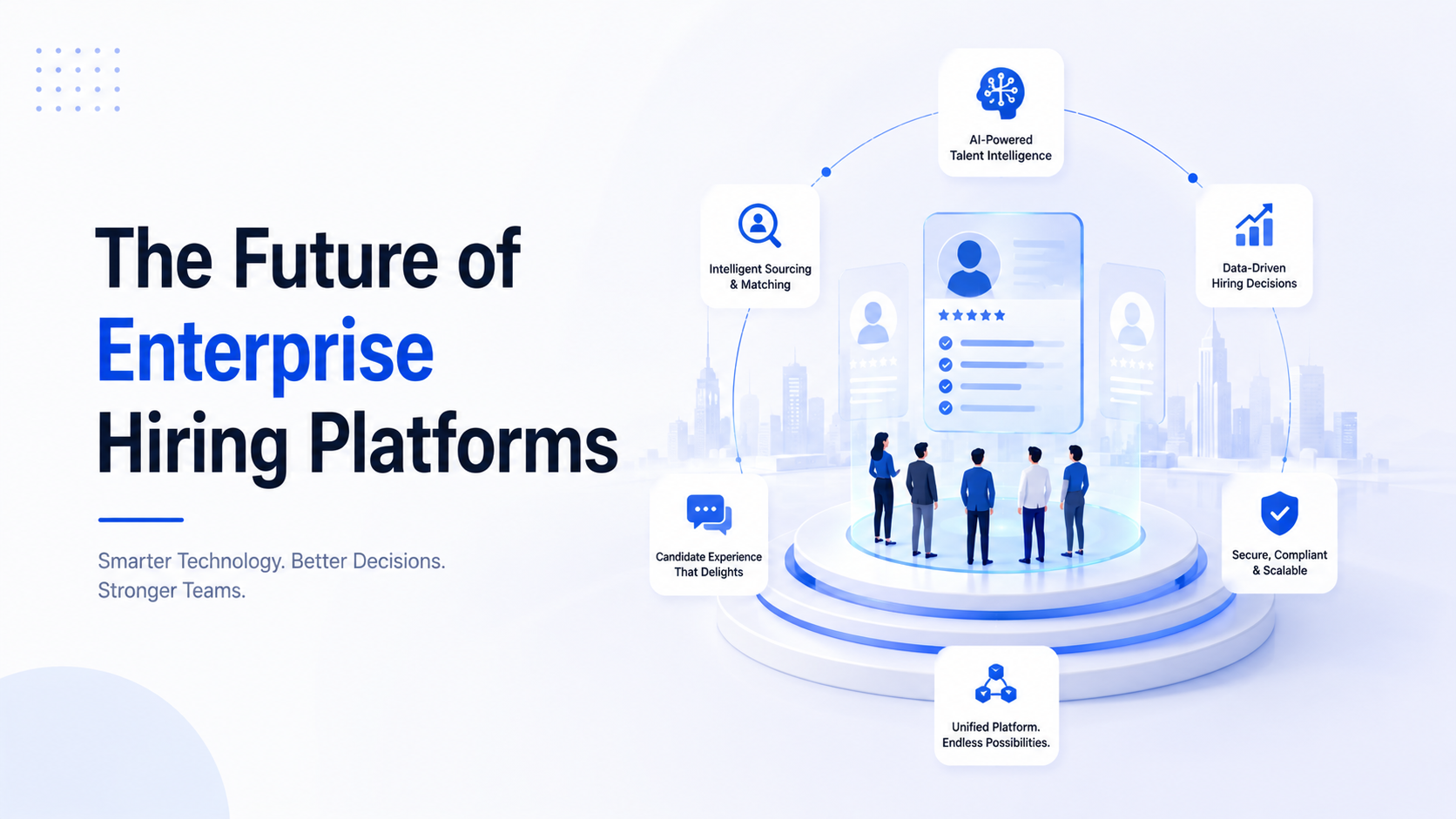
The response to this fragmentation is the emergence of unified enterprise hiring platforms that consolidate multiple hiring workflow stages within a single system. These platforms are not simply bundled point solutions with a shared user interface. They are architecturally integrated systems where data flows continuously across the entire hiring lifecycle, from initial candidate identification through offer acceptance and onboarding. A candidate sourced through the platform's AI engine automatically populates the screening workflow, generates personalized outreach, schedules interviews based on real-time availability data, and feeds interview feedback into assessment scoring without manual data transfer at any stage. According to Gartner HR technology research, organizations using unified enterprise hiring platforms report twenty-five to thirty-five percent higher recruiter productivity and fifteen to twenty percent faster time-to-fill compared to those using disconnected point solutions, because the elimination of integration gaps allows recruiters to spend their time on activities that directly drive hiring outcomes rather than on technology management and data reconciliation.
The transition from point solutions to unified platforms is not without challenges. Organizations with established tool stacks face migration complexity, including the transfer of historical hiring data, the retraining of recruiters on new systems, and the temporary productivity dip that accompanies any major technology change. However, the evidence increasingly favors making this transition sooner rather than later. The data accumulation advantages of unified platforms, where every hiring interaction feeds into AI models that improve future performance, create compounding benefits that grow over time. Organizations that delay the transition continue to operate with fragmented data that cannot support the AI-driven optimization that unified platforms deliver. The practical consideration for enterprise talent acquisition leaders is not whether to move toward platform consolidation but how to sequence and manage the transition to minimize disruption while capturing the productivity and intelligence benefits that unified architectures provide. The organizations that successfully navigate this transition position themselves for sustained competitive advantage in hiring because their platforms improve with every hiring cycle.
Agentic AI Is Redefining What Hiring Platforms Can Do
The most significant capability shift in enterprise hiring platforms is the move from
automated task execution to agentic AI that can coordinate complex, multi-step hiring workflows with meaningful autonomy. The distinction between a platform that is truly agentic versus merely automated is critical for enterprise buyers because it determines the scope of work the platform can handle and the level of recruiter supervision required. Automated tools execute predefined tasks: they send outreach emails on a schedule, screen resumes against keyword criteria, and update candidate status when triggered by specific events. Agentic AI systems operate differently. They can analyze a hiring requisition, identify the optimal sourcing strategy, execute that strategy across multiple channels, adapt their approach based on candidate response patterns, coordinate interview scheduling across multiple participants and time zones, and adjust their behavior based on real-time outcomes data, all within the boundaries defined by the organization's hiring policies and compliance requirements. According to Deloitte human capital technology research, early deployments of agentic AI in enterprise hiring platforms have reduced recruiter time spent on process coordination by thirty to forty-five percent, because the AI handles the operational complexity of managing multiple simultaneous hiring workflows that would otherwise consume the majority of a recruiter's working day.
The enterprise adoption of agentic hiring AI is being driven by a practical calculation: the complexity and volume of modern enterprise hiring has outgrown the capacity of manual coordination, and traditional automation only addresses individual tasks rather than the interconnected workflow as a whole. A large enterprise may have hundreds of open requisitions at any time, each requiring sourcing, screening, outreach, scheduling, assessment, and offer management activities that must be coordinated across multiple stakeholders. Managing this complexity manually or with task-level automation creates bottlenecks, inconsistencies, and delays that directly affect hiring speed and quality. Agentic AI addresses this challenge by managing the entire workflow with an understanding of how each stage connects to and affects the others. According to EY workforce technology analysis, the organizations achieving the best results from agentic AI in hiring are those that define clear decision boundaries for the AI, specifying which decisions it can make autonomously and which require human review, rather than attempting to operate with either full autonomy or no autonomy at all. This structured autonomy approach produces better outcomes because it aligns AI capabilities with organizational risk tolerance and compliance requirements.
For enterprise talent acquisition leaders evaluating next-generation hiring platforms, the agentic capability question should be central to the selection process. Ask vendors to demonstrate not just what their AI can do in isolation but how it coordinates across workflow stages, adapts to changing conditions, and handles the exceptions and edge cases that dominate real-world enterprise hiring. Request evidence from production deployments at organizations of similar size and complexity, because agentic AI capabilities that work well for mid-market companies may not scale to the volume and complexity of enterprise hiring without degradation. The organizations that conduct this level of rigorous evaluation will select platforms that deliver genuine workflow intelligence rather than impressive demonstrations, and they will be positioned to capture the substantial productivity and quality advantages that agentic AI enables as the technology continues to mature through 2026 and beyond.
The Problem of Tool Proliferation in Enterprise Hiring
Despite the clear trend toward platform consolidation, many enterprise organizations continue to accumulate recruiting tools at a pace that outstrips their ability to integrate and optimize them. The pattern of adding more tools while experiencing the same hiring problems has become one of the most widely recognized frustrations in enterprise talent acquisition, and for good reason. Each new tool is typically acquired to solve a specific pain point: a sourcing tool to improve candidate identification, an outreach tool to increase response rates, an analytics tool to provide better visibility into pipeline performance. Individually, each tool may deliver value in its narrow domain. Collectively, the growing collection of disconnected tools creates integration overhead, data inconsistency, recruiter confusion, and an inability to leverage the cross-stage data connections that drive AI optimization. According to LinkedIn talent solutions research, the average enterprise talent acquisition technology stack has grown by approximately forty percent in tool count over the past three years while recruiter satisfaction with their technology tools has declined by roughly fifteen percent over the same period, indicating that more tools are not translating into better outcomes.
The root cause of tool proliferation is typically organizational rather than technical. Different business units, regions, or functional teams make independent technology decisions based on their immediate needs without considering the impact on the overall technology ecosystem. A marketing team adopts one sourcing tool. An engineering team adopts another. The regional office in Europe selects a different ATS than the North American headquarters. Over time, the organization accumulates a patchwork of tools that no single team has the authority or visibility to rationalize. This decentralized approach to technology procurement made sense when tools were simple and self-contained, but it becomes increasingly problematic as tools become more data-intensive and AI-driven, because the value of modern hiring technology depends heavily on data integration across the hiring process. According to SHRM talent acquisition management research, organizations that centralize their hiring technology decisions through a cross-functional governance committee report thirty to forty percent lower total technology costs and significantly higher recruiter satisfaction than those that allow decentralized procurement, because centralized governance ensures tool interoperability, eliminates redundant capabilities, and maintains a coherent technology architecture that supports data-driven optimization.
The practical path out of tool proliferation is a structured technology rationalization process that begins with a comprehensive inventory of all hiring technology currently in use across the organization, evaluates each tool against the organization's current and anticipated needs, and develops a consolidation roadmap that prioritizes the highest-impact transitions first. The organizations that have successfully completed this rationalization report that the process typically identifies three to five tools that can be eliminated entirely, two to three that can be consolidated into a single platform, and one or two specialized capabilities that are genuinely best-of-breed and worth maintaining as standalone solutions integrated through APIs. This rationalized architecture, typically consisting of one primary hiring platform supplemented by one or two specialized tools for niche requirements, delivers better outcomes than the
sprawling tool collections it replaces, while also reducing total technology spend, simplifying vendor management, and creating the data integration foundation that AI-powered optimization requires.
Referral Intelligence and Network-Based Sourcing at Scale
One of the most underutilized capabilities in enterprise hiring platforms is referral intelligence, the systematic use of data and AI to identify, cultivate, and convert employee referrals into high-quality hires at scale. The evidence that referrals outperform cold outreach in every measurable dimension, including response rates, offer acceptance rates, time-to-hire, and long-term retention, has been consistent across industries and role types for years. Yet most enterprise organizations still manage their referral programs through manual processes, basic ATS features, or generic incentive structures that fail to activate the full potential of their employee networks. The gap between the proven value of referrals and the typical organization's investment in referral technology represents one of the largest untapped opportunities in enterprise talent acquisition. According to McKinsey talent acquisition research, organizations that deploy AI-powered referral intelligence platforms generate two to four times more referrals per employee than those relying on manual processes, because AI can systematically identify employees whose networks are most likely to contain qualified candidates for specific open roles and prompt them with personalized referral requests at optimal moments.
The next generation of enterprise hiring platforms is embedding referral intelligence directly into the sourcing workflow, making referrals a first-class sourcing channel alongside traditional outbound and inbound channels rather than an afterthought managed through a separate program. When a requisition is opened, the platform automatically analyzes the role requirements against the organization's employee network data, identifying the employees most likely to know qualified candidates based on their professional backgrounds, previous referral history, and social graph connections. The platform then generates personalized referral requests that include specific role details, explain why the employee's network is a strong match, and make it easy for the employee to submit a referral with minimal effort. This systematic approach transforms referral sourcing from a passive program that depends on employee initiative into an active, data-driven sourcing channel that operates continuously alongside the platform's other sourcing capabilities. According to Gartner HR technology research, organizations using integrated referral intelligence report thirty to forty percent higher referral hire rates and twenty-five percent lower cost-per-hire for referral-sourced candidates compared to those managing referrals through standalone programs or manual processes.
For enterprise organizations with thousands of employees, the scale of the referral opportunity is substantial. An organization with ten thousand employees, each connected to an average of two hundred professional contacts, has access to a network of two million potential candidates through employee connections alone. Most of this network potential goes untapped in organizations that rely on passive referral programs. Enterprise hiring platforms with embedded referral intelligence can activate a meaningful portion of this network, providing access to candidates who are not actively searching for jobs but would be receptive to opportunities
presented through trusted personal connections. The organizations that invest in referral intelligence as a core platform capability will build a sustainable sourcing advantage that is difficult for competitors to replicate, because employee networks are proprietary assets that grow stronger with each successful referral hire and each positive candidate experience that reinforces employees' willingness to make future referrals.
Building a Hiring Platform Strategy for the Next Three Years
The decisions enterprise talent acquisition leaders make about their hiring platform strategy in 2026 will shape their competitive hiring position through at least 2029, because the data accumulation, process optimization, and recruiter development benefits of modern hiring platforms compound over time. The research on how many follow-ups one hire needs illustrates a broader principle that applies to platform strategy as well: the optimal approach depends on data from earlier stages, which means that organizations with unified platforms that capture end-to-end hiring data have a structural advantage in optimizing their processes over time. According to Deloitte HR technology adoption research, the organizations that develop and execute a multi-year hiring platform strategy, rather than making ad hoc technology decisions in response to immediate needs, achieve forty to fifty percent higher returns on their technology investments and report significantly stronger hiring outcomes across all key metrics including time-to-fill, quality-of-hire, and recruiter productivity. The multi-year planning horizon is not a luxury but a necessity, because the switching costs, learning curves, and data accumulation benefits associated with enterprise hiring platforms create significant lock-in effects that make platform changes expensive and disruptive once the platform is deeply embedded in organizational processes.
The practical framework for building a three-year hiring platform strategy has three components. First, define the target architecture: the set of capabilities the organization needs, the integration standards that must be met, and the data governance requirements that will ensure AI optimization is built on reliable foundations. Second, sequence the transition: identify which capabilities to consolidate first based on their impact on hiring outcomes and their readiness for migration, and build a phased roadmap that delivers incremental value at each stage rather than requiring a high-risk big-bang replacement. Third, invest in change management and recruiter development alongside the technology deployment, because the organizations that achieve the best outcomes from new hiring platforms are those that invest equally in technology and in the people who use it. According to LinkedIn talent solutions research, organizations that allocate at least twenty percent of their platform implementation budget to recruiter training, process redesign, and change management achieve full adoption thirty to forty percent faster and report measurably higher satisfaction than those that focus investment primarily on technology deployment and configuration.
The future of enterprise hiring platforms will be defined by the organizations that treat their hiring technology not as a collection of tools but as a strategic capability that requires the same level of planning, investment, and ongoing optimization as other critical enterprise systems. The platforms that will dominate the next decade are those that combine AI-native
architecture, unified data models, agentic workflow intelligence, and embedded referral and network-based sourcing in a single system that improves with every hiring cycle. The enterprises that select and optimize these platforms with strategic discipline will build compounding advantages in hiring speed, candidate quality, and recruiter effectiveness that late adopters will find increasingly difficult to replicate. For enterprise talent acquisition leaders, the message is clear: the platform decisions you make today are not just technology choices but strategic commitments that will determine your organization's competitive position in the talent market for years to come. The organizations that act with urgency and strategic clarity will be the ones that attract and hire the best talent in an increasingly competitive global labor market.