Priya Sharma, CHRO at a Fortune 500 manufacturing company, sat through her third board presentation in two years on talent acquisition challenges. Each time, the numbers told the same story: time-to-fill for engineering roles had increased by twenty percent, offer acceptance rates had declined, and competitor poaching had intensified. What had changed was not the labor market itself but the competitive landscape of hiring technology. Rivals that had invested early in AI-powered talent platforms were hiring faster and more accurately, while her organization was still relying on a patchwork of legacy tools that could not keep pace. Sharma's experience reflects a reality that is prompting C-suite executives across industries to pay closer attention to HRTech market trends. The technology decisions made in talent acquisition today directly affect competitive positioning, workforce costs, and organizational agility. Understanding which trends matter, which are hype, and which require immediate executive attention is no longer optional for leaders who manage knowledge-intensive workforces.
AI-First Talent Acquisition Is Becoming Non-Negotiable
The most consequential trend in the HRTech market for 2026 is the shift from AI-enhanced tools to AI-first platforms. The distinction matters for executives because it affects not just what technology does but how organizations must restructure their talent acquisition operations to capture its full value. AI-enhanced tools add intelligent features to existing workflows, automating specific tasks like resume screening or interview scheduling while leaving
the fundamental process architecture unchanged. AI-first platforms are built from the ground up around AI capabilities, with machine learning models driving the core logic of candidate identification, engagement scoring, and hiring recommendation. According to McKinsey, organizations that deploy AI-first talent platforms report thirty to forty-five percent faster time-to-fill and fifteen to twenty-five percent higher quality-of-hire scores compared to those using AI-enhanced legacy systems, because the AI-first architecture enables end-to-end optimization that bolt-on AI features cannot achieve. For executives evaluating talent technology investments, the question is no longer whether to adopt AI but whether their current technology strategy positions them for AI-first capabilities or locks them into legacy architectures that cannot compete.
The AI-first shift is also changing the competitive dynamics of hiring in ways that have direct bottom-line implications. Organizations with AI-first platforms can identify and engage candidates faster, process larger candidate volumes without proportional headcount increases, and make more accurate hiring decisions based on multi-signal analysis that considers skills, experience trajectory, and predicted cultural fit simultaneously. The cumulative effect of these advantages is significant. According to Gartner HR technology research, organizations using AI-first talent platforms in competitive talent markets report ten to fifteen percent lower total recruiting costs per hire, because faster fills reduce the productivity loss of open positions and more accurate matches reduce the cost of early attrition. For executives managing large workforce budgets, these cost savings are not marginal. A ten percent reduction in recruiting costs for an organization hiring five thousand employees annually can translate to millions of dollars in annual savings, making AI-first talent technology one of the highest-ROI technology investments available to the enterprise.
The executive imperative is clear: the transition from AI-enhanced to AI-first talent acquisition is not a future possibility but a current market reality, and the organizations that delay this transition are accumulating competitive disadvantage with every month of inaction. The practical challenge for executives is not recognizing the trend but managing the transition effectively. Moving to an AI-first platform requires process redesign, data infrastructure investment, recruiter upskilling, and change management that extends well beyond the technology selection itself. The organizations that manage this transition most successfully treat it as a strategic transformation program with executive sponsorship, dedicated resources, and clear success metrics rather than as a technology procurement exercise delegated to the talent acquisition function. The difference between these two approaches determines whether the AI-first investment delivers transformative results or becomes another expensive technology initiative that fails to achieve its full potential.
The Data Quality Crisis in Recruiting Technology
A less visible but equally critical trend is the growing recognition that data quality, not algorithmic sophistication, is the primary determinant of AI recruiting performance. As AI models have converged across vendors, the quality of candidate data feeding those models has become the key differentiator between platforms that deliver strong results and those that
disappoint. The concern about whether some AI recruiting tools rely on outdated candidate data has moved from a niche technical concern to a mainstream executive issue because the financial impact of poor data quality is now well documented. Organizations that deploy AI sourcing tools operating on stale data report twenty to thirty percent lower candidate response rates and fifteen to twenty percent higher time-to-fill compared to those using platforms with continuously refreshed data. According to Deloitte HR technology benchmarking, data quality has surpassed feature breadth as the most reliable predictor of AI recruiting platform satisfaction, a shift that has occurred within the past eighteen months as organizations have accumulated enough production experience to identify what actually drives results versus what looks impressive in vendor demonstrations.
The data quality crisis is worsening for a structural reason: the volume of candidate data is growing exponentially while the mechanisms for validating and refreshing that data are not keeping pace. Professional profiles change constantly as people acquire new skills, change roles, update their career preferences, and adjust their availability. A candidate profile that was accurate three months ago may now be significantly outdated, leading AI models to make recommendations based on information that no longer reflects reality. According to EY technology industry analysis, the half-life of candidate data in recruiting databases has decreased from approximately six months in 2023 to roughly three months in 2026, meaning that data degrades twice as fast as it did three years ago. This accelerating data decay means that the gap between platforms with robust data refresh capabilities and those without is widening, creating a quality divergence that directly affects hiring outcomes for the organizations that depend on these tools.
For executives overseeing talent technology investments, the data quality trend demands a specific response: data freshness and validation must be elevated to first-class evaluation criteria in vendor selection, contractually specified in service level agreements, and continuously monitored in production. The organizations that have implemented these data quality governance practices report significantly better AI recruiting outcomes and fewer unpleasant surprises when platforms underperform expectations. The data quality crisis also has implications for technology architecture decisions. Platforms that can integrate with real-time data sources, including professional networks, public professional activity, and employer systems, have a structural advantage over platforms that rely on periodic bulk data imports. Executives who understand this architectural distinction and prioritize real-time data capabilities in their technology decisions will be better positioned to maintain competitive hiring performance as the data quality challenge intensifies over the coming years.
Vendor Consolidation Is Accelerating Across All HRTech Segments
The third trend that demands executive attention is the accelerating pace of vendor consolidation across the HRTech market. After several years of vendor proliferation, the market is now in a contraction phase as larger platforms acquire specialized capabilities and investors push underperforming vendors toward mergers or wind-downs. According to LinkedIn talent
solutions market analysis, the number of HRTech vendor acquisitions increased by over eighty percent between 2024 and 2025, with the heaviest acquisition activity occurring in the talent acquisition technology segment. This consolidation has direct strategic implications for executive decision-making. When a vendor is acquired, product roadmaps may change, pricing structures may shift, and the quality of customer support may fluctuate as the acquirer integrates the acquired team and technology. Executives who have recently completed major HRTech deployments may find that their carefully selected vendor is now part of a larger portfolio, with different priorities and resource allocation decisions than the standalone company they originally evaluated.
The consolidation trend also affects the dynamics of innovation in the HRTech market. On the positive side, acquisitions can bring specialized capabilities into larger platforms that have the engineering resources and customer base to scale them effectively. A niche AI assessment tool acquired by a major HRTech platform may reach more organizations and receive more development investment than it could as an independent company. On the negative side, consolidation reduces the number of independent innovators competing for enterprise buyers, potentially slowing the pace of innovation in categories where a small number of vendors achieve dominant market share. The evidence that referrals outperform cold outreach has led several consolidating platforms to acquire referral management capabilities, illustrating how acquisition activity is often driven by buyer demand for integrated functionality rather than purely by strategic positioning. According to SHRM talent acquisition technology research, organizations that include vendor financial stability and M&A risk in their technology evaluation criteria report twenty to thirty percent lower rates of disruptive vendor changes, because they select vendors with stronger competitive positions and include contractual protections that mitigate the impact of potential acquisitions.
The executive action item from this trend is straightforward: incorporate market structure awareness into technology strategy. This means tracking M&A activity in relevant technology segments, evaluating the competitive positioning and financial stability of vendors under consideration, and building technology stacks with enough modularity that the replacement of any single component does not require a complete system overhaul. The organizations that treat vendor ecosystem awareness as an ongoing strategic capability rather than a one-time procurement exercise are consistently better positioned to navigate market consolidation without disruption to their talent acquisition operations. The HRTech market will continue to consolidate through 2027 and beyond, making this awareness a durable competitive advantage for executives who invest in it now.
Skills-Based Hiring Technology Is Entering the Mainstream
The fourth trend reshaping the HRTech market is the rapid mainstream adoption of skills-based hiring technology, driven by the convergence of employer demand for more accurate candidate assessment and regulatory pressure to reduce credential-based hiring barriers. Skills intelligence platforms that build detailed capability profiles based on demonstrated competencies rather than job titles or degree credentials are moving from early adoption to
enterprise-scale deployment. According to McKinsey workforce research, the percentage of large enterprises using skills-based hiring tools in at least one talent acquisition workflow increased from approximately fifteen percent in early 2024 to over forty-five percent at the start of 2026, making it one of the fastest adoption curves in recent HRTech history. The appeal for executives is clear: skills-based matching expands the effective talent pool by identifying qualified candidates who might be missed by traditional credential-based screening, reduces bias in the hiring process by focusing on demonstrated capabilities rather than proxy indicators, and produces more accurate hiring decisions because skills are more predictive of on-the-job success than educational credentials or previous job titles.
The operational implications of skills-based hiring technology extend beyond candidate matching into process redesign and recruiter capability development. Recruiters trained to evaluate candidates based on job title alignment and credential verification must develop new competencies in skills assessment, capability mapping, and potential-based evaluation. The research on how many follow-ups one hire needs illustrates a related principle: effective recruiting process design requires understanding how each workflow stage connects to the next, and skills-based hiring changes the logic of these connections fundamentally. When matching is based on skills rather than credentials, the screening criteria change, the interview questions change, and the assessment rubrics change, requiring a coordinated redesign of the entire process rather than the piecemeal addition of a new tool. According to Gartner HR technology adoption research, organizations that pair skills-based technology deployment with coordinated process redesign achieve forty to sixty percent faster adoption and measurably better hiring outcomes than those that deploy the technology without adjusting their hiring processes, because the technology and process changes reinforce each other to produce results that neither could achieve alone.
For executives, the skills-based hiring trend represents both an opportunity and a timeline imperative. Organizations that adopt skills-based hiring technology and process practices early will build proprietary skills taxonomies, accumulated matching data, and recruiter expertise that create compounding advantages over time. The organizations that delay adoption will face not only the immediate cost of less accurate hiring but the longer-term strategic cost of trying to catch up with competitors who have been refining their skills-based capabilities for years. The practical recommendation is to begin with a focused pilot in a talent segment where skills-based hiring has the highest impact, typically specialized or technical roles where credential-based screening produces the most false negatives, and scale from there based on evidence and organizational learning. The transition to skills-based hiring is not a single technology decision but a multi-year strategic capability building effort that benefits from early initiation and structured scaling.
What These Trends Mean for Executive Decision-Making
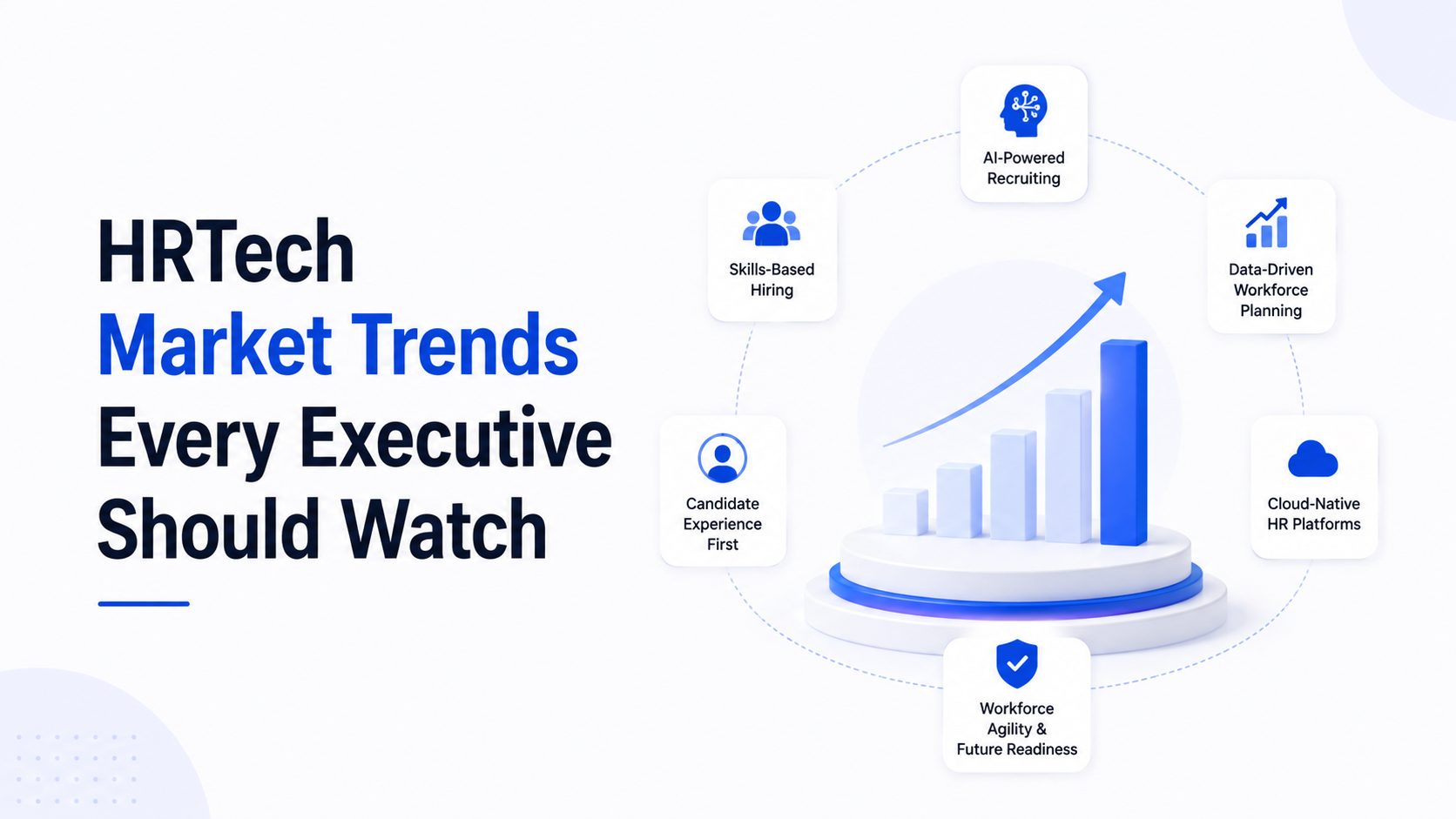
The cumulative effect of these four trends, AI-first platforms, data quality demands, vendor consolidation, and skills-based hiring adoption, is that HRTech decision-making has become significantly more complex and more consequential than it was even two years ago. The
decisions executives make about talent technology in 2026 will affect their organization's competitive hiring position for three to five years, because the switching costs, learning curves, and data accumulation advantages associated with modern HRTech platforms create significant lock-in effects. According to Deloitte human capital trends research, the average enterprise HRTech investment now spans a three to five year commitment period, and the cost of switching platforms prematurely, including data migration, process redesign, recruiter retraining, and productivity loss during transition, can exceed the first-year cost of the original implementation. This extended commitment horizon means that HRTech decisions deserve the same level of executive attention and strategic rigor as other major enterprise technology investments, a standard that many organizations have not yet applied to their talent technology strategy.
The question of whether AI recruiting tools work for niche or technical roles is particularly relevant for executive decision-making because the answer varies significantly by vendor and by the quality of the data and models underlying each platform. Executives cannot assume that a platform that performs well for high-volume professional hiring will deliver equivalent results for specialized technical roles that require deep domain understanding and access to narrow talent pools. The performance variance across vendors in niche hiring scenarios is substantially larger than in mainstream hiring scenarios, making vendor selection for specialized talent acquisition a higher-stakes decision that requires more rigorous evaluation. According to LinkedIn talent solutions research, organizations that conduct structured evaluations specifically targeting their most challenging hiring segments, rather than relying on general-purpose vendor demonstrations, make significantly better technology choices and achieve measurably stronger hiring outcomes for the roles where competitive advantage matters most.
The strategic recommendation for executives is to approach HRTech market trends not as isolated technology developments to react to but as interconnected dynamics that must be managed as a portfolio. The AI-first shift demands data quality investment, which is complicated by vendor consolidation, which creates opportunities for skills-based hiring capabilities through acquisition, which in turn requires process redesign that affects how AI-first platforms are optimized. These trends are not independent; they interact and compound in ways that reward integrated strategic thinking and punish reactive, ad hoc responses. The executives who establish a regular cadence of HRTech market review, maintain relationships with a broad range of vendors and industry analysts, and build internal capabilities for evaluating and integrating new technologies will be best positioned to capture the competitive advantages that these trends offer while managing the risks they create. The HRTech market in 2026 rewards market knowledge and strategic discipline, and the organizations whose executives invest in both will outperform those that treat talent technology as an operational detail delegated to the HR function.