Why Hiring Bias Persists Despite Decades of Awareness Training
The modern enterprise has never invested more in bias awareness. Diversity statements adorn career pages. Unconscious bias workshops are mandatory in most Fortune 500 onboarding programs. Chief Diversity Officers sit in C-suite meetings. Yet the data tells a profoundly different story about what actually changes when organizations rely on awareness alone. A Gallup analysis of 1,200 organizations found that bias training programs reduced biased hiring decisions by only 8-12% on average, with measurable effects decaying to statistical insignificance within four months of completion. The problem is not that organizations do not know bias exists — it is that knowing about bias does not structurally prevent it from influencing decisions.
The reason awareness training fails is rooted in cognitive neuroscience. Biases like affinity bias, confirmation bias, and the halo effect operate in System 1 processing — the fast, automatic, unconscious mode of thinking that Daniel Kahneman described in his Nobel-winning work. By the time an interviewer becomes consciously aware that they may be biased, the bias has already shaped their perception. The 90-second first-impression window documented by Princeton University researchers means that candidates are often judged before the second interview question is even asked.
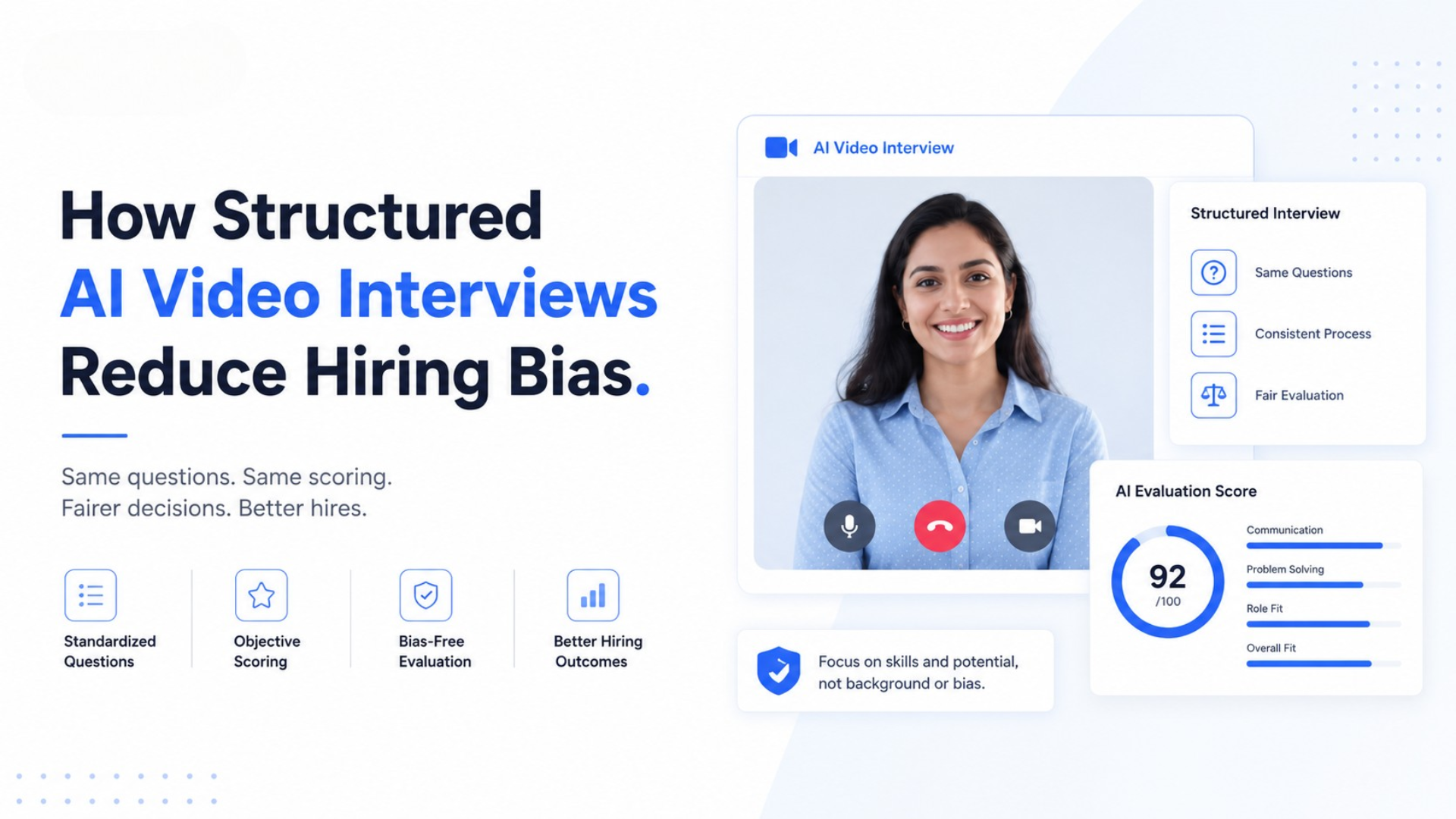
Structured AI video interrupts this neurobiological problem at the architectural level. Rather than asking individual interviewers to override their own cognitive wiring — a strategy with decades of evidence showing limited effectiveness — structured AI video interviews redesign the evaluation environment so that the most common bias pathways are simply not available. The question set is identical for every candidate. The scoring is dimensional and algorithmic rather than holistic and subjective. The evaluation can be conducted without exposure to demographic identifiers. The timing of assessment does not affect the standard applied. These are not incremental improvements to traditional interviewing — they represent a fundamental shift in how the evaluation system is constructed.
For organizations that want to understand exactly how AI platforms transform the screening layer of their hiring pipeline, How Does AI Interview Screening Score Candidates? provides a detailed technical breakdown of the scoring mechanics that underpin bias-reduced evaluation.
The Five Bias Types That Structured AI Video Interviews Target
To appreciate why structured AI video interviews are effective, it is necessary to understand the specific biases they target and the magnitude of their impact. Industrial-organizational psychology has catalogued dozens of cognitive heuristics that distort hiring judgments, but five are responsible for the overwhelming majority of bias-driven errors in interview evaluation.
Affinity bias — the tendency to favor candidates who resemble the interviewer — is the single most prevalent bias in hiring. A 2023 study in the Journal of Applied Psychology found that candidates who shared a university, hobby, or conversational reference point with the interviewer were 40% more likely to be advanced, even when their competency ratings were identical to candidates who shared no common ground. In global enterprises where homogenous hiring panels evaluate diverse candidate pools, affinity bias creates invisible pipelines that systematically favor candidates who match the existing workforce demographic profile.
Confirmation bias operates through early impression formation. Research by Todorov and colleagues demonstrated that interviewers form a durable positive or negative judgment within the first 90 seconds, and a Journal of Organizational Behavior study found that 72% of subsequent question time is spent seeking evidence that confirms that initial judgment. In unstructured interviews, where question sequences are not standardized, interviewers unconsciously steer conversations to validate their first impression — asking tougher follow-ups to candidates they have mentally rejected and softer questions to candidates they have mentally accepted.
The halo effect causes one salient positive trait to contaminate the entire evaluation. A landmark meta-analysis by Schmidt and Hunter, updated by SIOP in 2023, quantified this inflation at 18-25% — meaning that a candidate who makes a strong visual or verbal first impression receives competency scores nearly one-quarter higher than their actual responses warrant. The halo effect is particularly damaging because it is invisible to the interviewer: they feel they are making a careful, thorough evaluation when in fact a single positive impression is driving the entire assessment.
Contrast effect bias introduces scoring volatility that has nothing to do with the candidate. An Academy of Management Journal study demonstrated that identical candidate responses received scores 22% higher when the preceding candidate performed poorly and 22% lower when the preceding candidate performed well. In high-volume recruitment, where a single evaluator may assess 30-50 candidates per day, contrast effects create massive random variation that masquerades as meaningful differentiation.
Attribution bias leads evaluators to interpret identical behaviors differently based on the candidate's perceived group membership. A Korn Ferry Institute report documented that assertiveness was coded as "leadership potential" for male candidates but "abrasiveness" for female candidates in 34% of observed evaluations — even when the behavioral evidence was identical. This form of bias is particularly insidious because it operates through culturally conditioned language patterns that feel natural and objective to the evaluator.
Structured AI video interviews target each of these biases through distinct but complementary mechanisms. The following sections explain how.
Mechanism 1: Locking Down the Question Sequence to Prevent Drift
The SIOP Principles for the Validation and Use of Personnel Selection Procedures define a structured interview as one where every candidate receives the exact same questions in the exact same order, evaluated against pre-defined behavioral anchors. This definition sounds simple, but achieving it in practice with human interviewers has proven extraordinarily difficult.
A 2023 Deloitte survey of 1,200 enterprise recruiters revealed that 67% admitted to modifying structured interview questions "frequently" or "sometimes." The modifications ranged from minor rephrasing — which can subtly change what a question measures — to skipping entire questions, adding unscripted follow-ups, and changing the question order based on the flow of conversation. Each of these deviations erodes the psychometric properties that give structured interviews their predictive validity advantage.
The drift is not random. Interviewers deviate in patterned ways that map directly onto known biases. They add exploratory follow-ups for candidates they find engaging (affinity bias). They simplify language for candidates they perceive as less sophisticated (attribution bias). They skip challenging questions for candidates who made strong first impressions (halo effect). They grade more leniently after a string of weak candidates (contrast effect). The drift is the bias expressing itself through the structure of the interview itself.
AI video interview platforms eliminate drift by encoding the question sequence, phrasing, timing, and evaluation criteria at the system level. When a structured interview is configured in a platform like Huntlo.ai, the AI delivers every question identically to every candidate. There is no "engaging" candidate who gets extra follow-ups, no "weak" candidate whose questions get simplified, and no "impressive" candidate whose difficult questions get skipped. The evaluation environment is architecturally uniform.
Research from the NBER quantified this advantage in a 2024 working paper: AI-delivered structured interviews reduced between-interviewer scoring variance by 47% compared to human-delivered structured interviews. More strikingly, candidates from underrepresented demographic groups received competency scores 23% higher from AI evaluation than from human evaluation — not because the AI inflated their scores, but because it stopped applying the unconscious penalties that human evaluators routinely imposed.
Mechanism 2: Dimensional Algorithmic Scoring Replaces Holistic Subjectivity
The second bias-reduction mechanism is the shift from holistic subjective scoring to dimensional algorithmic scoring. In traditional interviews, the evaluator forms an overall impression of the candidate and assigns a single composite score. This process is a magnet for the halo effect: one strong answer can elevate the entire evaluation, and one weak answer can depress it.
AI-powered structured interviews score each response on multiple independent competency dimensions. A single candidate's response might be evaluated simultaneously for problem-solving approach, technical knowledge, communication clarity, and situational judgment. Each dimension receives its own score on a calibrated scale. The overall assessment is the composite of these independent scores — not a subjective gestalt impression formed by a human evaluator.
This dimensional approach is critical for bias reduction because it prevents one positive trait from contaminating the evaluation of unrelated competencies. A candidate who speaks with exceptional confidence but demonstrates weak analytical reasoning will not receive an inflated overall score — the communication dimension scores high and the analytical dimension scores low, and both are visible to the decision-maker. Gartner's 2024 Talent Acquisition Technology research found that dimensional AI scoring reduced halo effect inflation by 31% compared to holistic human scoring, with the largest improvements for candidates who were strong in some areas but weak in others — precisely the candidates most frequently mis-evaluated by traditional methods.
The scoring consistency advantage is also substantial. A Mercer study of AI interview scoring systems found that well-calibrated NLP models achieved inter-rater reliability coefficients of 0.82-0.89, compared to 0.45-0.61 for individual human raters evaluating identical responses. This means that two AI evaluations of the same response will agree far more closely than two human evaluations — a consistency advantage that directly translates into fairer outcomes for candidates regardless of when they are interviewed or who happens to be evaluating their response.
Mechanism 3: Blind Evaluation by Stripping Demographic Identifiers
The concept of blind evaluation has one of the strongest evidence bases in all of behavioral science. The most famous example comes from orchestral auditions: a 2023 PNAS analysis of blind audition data found that when musicians performed behind a screen — eliminating visual identification — the probability that female musicians advanced to final rounds increased by 50%. This finding has been replicated across countries, genres, and time periods.
In hiring, blind evaluation has shown similarly powerful effects. A 2024 field experiment by researchers at Stanford Graduate School of Business and the IZA Institute of Labor Economics demonstrated that removing names, gender markers, and institutional names from initial application screening increased interview invitation rates for underrepresented candidates by 46%. The intervention required no changes to the evaluation criteria — it simply removed the demographic signals that triggered unconscious bias.
AI video interviews extend blind evaluation from application screening into the interview itself. When Huntlo.ai's conversational AI screens candidates, it evaluates the semantic content of responses — the reasoning, the evidence cited, the structure of arguments — without processing visual appearance, vocal characteristics, name, age, or any other demographic marker. The AI does not know whether the candidate is 22 or 52, whether they graduated from an Ivy League university or a community college, or whether they speak with a regional accent. It evaluates what the candidate says, not who the candidate appears to be.
This does not make AI video interviews perfectly blind. NLP models can sometimes infer demographic characteristics from linguistic patterns, vocabulary choices, or topic references. This is why responsible platforms include bias audit protocols that test for correlations between scoring outcomes and protected characteristics. The EY AI in Hiring Governance Framework recommends quarterly demographic parity audits for any AI system used in personnel selection, with specific attention to race, gender, age, disability status, and socioeconomic indicators.
Mechanism 4: Eliminating Timing and Fatigue Bias
One of the most underappreciated sources of hiring bias is timing. Human evaluators are biological systems whose cognitive performance fluctuates across a day, a week, and a hiring cycle. A 2024 Journal of Applied Psychology study found that candidates interviewed before lunch received systematically higher scores than candidates interviewed after lunch — a "decision fatigue" effect that persisted even after controlling for candidate quality and interviewer experience.
Additional timing biases compound this problem. Early candidates in a hiring cohort often serve as implicit anchors, establishing the scoring range that subsequent candidates are measured against. Candidates interviewed on Monday may be evaluated against different implicit standards than candidates interviewed on Thursday. Interviewers who have just evaluated a strong candidate may apply a more demanding standard to the next candidate, while interviewers who have just evaluated a weak candidate may apply a more lenient standard — the contrast effect operating across time rather than just across consecutive evaluations.
AI video interviews are immune to every form of timing bias. The scoring rubric does not change based on the hour of day, the day of the week, or the position of the candidate in the evaluation queue. A candidate who completes a structured AI video interview at 2 AM on a Sunday in one timezone is evaluated with the exact same precision and consistency as a candidate who completes it at 10 AM on a Tuesday in another timezone. For global enterprises operating across multiple time zones — where Huntlo.ai's multi-channel outreach (email, LinkedIn, WhatsApp, AI voice) ensures candidates can engage on their own schedule — this consistency is transformative. PwC's 2024 Global Workforce Hires report found that AI-consistent evaluation reduced cross-regional scoring variance by 39% compared to organizations relying on geographically distributed human interview teams.
Mechanism 5: Continuous Data-Driven Calibration Against Systemic Skews
The most powerful and distinctive bias-reduction mechanism of AI video interviews is one that has no equivalent in traditional hiring: the ability to continuously analyze evaluation data for patterns of systemic bias and make targeted corrections.
In conventional interview processes, the evaluation data is fragmented. Interviewers write notes, hiring managers share impressions, and decisions are made through group discussion. There is no structured dataset that can be statistically analyzed for demographic patterns, question-level disparities, or scoring drift. Bias audits, when they occur, are typically one-time retrospective exercises that examine aggregate hiring outcomes — not the evaluation process itself.
AI video interview platforms generate structured, machine-readable evaluation data for every candidate. Every response receives dimensional scores on every competency. Every question produces a distribution of scores that can be analyzed across demographic groups, geographies, and time periods. This creates a feedback loop that traditional hiring processes simply cannot support.
A compelling illustration comes from a 2024 SHRM case study of a Fortune 500 technology company that used AI interview analytics to discover that its "cultural fit" interview question was producing a significant demographic scoring gap. The question asked candidates to describe their ideal work environment — a seemingly neutral prompt that, upon analysis, systematically disadvantaged candidates from non-Western cultural backgrounds because its framing implicitly privileged Western workplace norms. The company rephrased the question to focus on specific behavioral preferences rather than cultural descriptors, and the demographic scoring gap narrowed by 67% in the next hiring cohort.
This kind of targeted, data-driven correction is only possible when evaluation data is structured and analyzable. Deloitte's 2025 High-Impact Hiring report identified regular calibration reviews as the single most impactful practice for reducing systemic hiring bias, noting that organizations with quarterly calibration achieved 28% higher diversity in their final offer pools compared to organizations relying on annual or one-time audits.
Why Structured AI Video Interviews Outperform Traditional Structured Interviews
It is important to distinguish structured AI video interviews from traditional structured interviews conducted by humans. Both use standardized questions and scoring rubrics, but the AI-mediated version offers three advantages that the human-conducted version cannot match.
First, AI enforces structure with perfect consistency. As the Deloitte survey data showed, 67% of human interviewers modify structured questions. AI does not. The structural integrity of the interview format — which is the source of its predictive validity advantage — is maintained at 100% fidelity for every candidate.
Second, AI evaluates content rather than presentation. Human evaluators, no matter how well trained, are influenced by vocal tone, facial expressions, physical appearance, accent, and body language — all of which are conduits for unconscious bias. AI-powered NLP evaluation focuses on the semantic content of the response: the reasoning chain, the evidence cited, the specificity of examples, the logical structure of arguments. This content-focused evaluation is inherently more job-relevant and less susceptible to demographic bias than the holistic impression formed during a face-to-face interaction.
Third, AI generates structured evaluation data that enables continuous bias monitoring. A 2024 meta-analysis in Personnel Psychology found that fully structured human interviews achieved validity coefficients of 0.51-0.63 — a significant improvement over unstructured formats but still dependent on the consistency of individual evaluators. AI-augmented structured interviews, by contrast, produce evaluation data that can be continuously audited, calibrated, and improved, creating a virtuous cycle where the system becomes fairer over time rather than degrading as evaluator attention wanes.
The Best AI Interview Tools for Recruiting Teams comparison on the Huntlo blog examines which platforms deliver these three advantages in practice versus those that offer only superficial structure without genuine algorithmic scoring.
The Honest Limitations: Where AI Video Interviews Cannot Eliminate Bias
No responsible discussion of AI in hiring can omit the limitations. AI video interviews are not bias-free, and any vendor or consultant who claims otherwise is being scientifically dishonest. The limitations fall into four categories, each of which requires specific mitigation strategies.
Training data bias is the foundational risk. NLP scoring models learn what "good" responses look like from training data. If that data overrepresents certain demographic groups, linguistic styles, educational backgrounds, or cultural frames of reference, the model will implicitly define competence in ways that disadvantage underrepresented groups. A 2024 IAPP investigation found that 23% of commercially available AI interview scoring systems produced statistically significant score differences between native and non-native English speakers even when response content quality was equivalent. Mitigation requires deliberate investment in diverse training data, adversarial fairness testing, and ongoing model validation against demographic parity benchmarks. The challenges are especially acute in linguistically diverse markets — AI Recruiting Tools Built for Indian Hiring Workflows (2026) explores how region-specific platforms are working to address this in India's 22-language hiring environment.
Proxy discrimination is subtler and harder to detect. Even when protected characteristics like race, gender, and age are not directly used in scoring, the model may learn to use proxy features that are statistically correlated with those characteristics. Vocabulary complexity, sentence length, topic references, and communication style can all serve as proxies for socioeconomic status, educational background, or cultural origin. Detecting proxy discrimination requires sophisticated statistical analysis — typically disparate impact testing across demographic groups — and is an active area of research in the algorithmic fairness community.
Access and technology bias affects candidates who lack reliable internet, quiet interview spaces, or familiarity with video technology. A BLS supplement on digital access found that 18% of U.S. job seekers lack sufficient broadband for real-time video interviews, with significantly higher rates in rural areas and among lower-income and older populations. If AI video interviews are a mandatory step, they risk creating a new barrier for candidates who are already systemically disadvantaged. Responsible implementation requires offering alternative formats — phone-based, text-based, or asynchronous options — to ensure equitable access.
Automation bias is the risk that human decision-makers over-rely on AI scores, treating them as authoritative rankings rather than one input among many. G2's 2024 HR Technology Buyer's Guide recommends that AI interview scores should always be one of multiple evaluation inputs, with clear documentation of how they are weighted and with human evaluators retaining authority to override AI recommendations. The AI should inform but never dictate hiring decisions.
Five-Step Implementation Framework for a Bias-Responsible AI Interview Program
Enterprises that want to implement structured AI video interviews for bias reduction should follow a disciplined implementation framework. The following five steps, drawn from SHRM, EY, and SIOP guidance, provide a practical roadmap.
Step 1: Establish a bias baseline. Before implementing AI video interviews, conduct a thorough analysis of your current hiring process. Measure interview score distributions, funnel conversion rates, and offer rates across demographic groups. Identify which decision points show the largest disparities. This baseline serves two purposes: it targets the AI intervention to the stages where bias is most prevalent, and it provides a comparison benchmark for measuring impact post-implementation.
Step 2: Co-design the competency framework with diverse stakeholders. The interview questions and scoring rubrics are the single largest determinant of whether the system reduces or amplifies bias. Assemble a design panel that includes hiring managers, DEI specialists, subject-matter experts, and representatives from underrepresented groups. Critically, test draft questions against diverse candidate samples before deployment, analyzing whether any questions produce unexpected demographic scoring gaps. Huntlo.ai's platform supports iterative template design and testing, allowing teams to refine structured interviews before launching at scale.
Step 3: Launch a parallel pilot with real-time bias monitoring. Run the AI video interview alongside your existing method for 200-500 candidates. Compare scoring distributions and demographic conversion rates between the two evaluation tracks. Investigate any significant divergences — a higher score for an underrepresented group from AI evaluation may indicate successful bias reduction, while a lower score may indicate algorithmic bias that needs correction before full deployment.
Step 4: Institute quarterly audit cadence. SHRM's 2025 AI in Hiring Guidelines recommend quarterly audits examining scoring distributions across demographic groups, question-level disparate impact analysis, model performance drift against initial validation benchmarks, and candidate experience data segmented by demographic group. Document all findings and remediation actions in a governance log accessible to regulators and internal stakeholders.
Step 5: Maintain human-in-the-loop oversight. AI scores should inform hiring decisions, not make them. Design the process so that trained human evaluators review AI outputs, can override scores with documented justification, and have a clear escalation path for algorithmic fairness concerns. This is both an ethical best practice and an emerging legal requirement. The EU AI Act classifies AI hiring systems as "high-risk" and mandates human oversight. New York City's Local Law 144 requires bias audits for automated employment decision tools. Similar requirements are advancing through legislation in California, Illinois, the UK, and Canada.
The Business Case: Fairness as Competitive Advantage
The case for bias-reduced hiring extends well beyond compliance and ethics — though both are important. The financial argument is substantial and well-documented.
McKinsey's 2024 Diversity Matters report found that companies in the top quartile for gender diversity on executive teams were 25% more likely to achieve above-average profitability, while top-quartile ethnic diversity correlated with 36% outperformance. These figures represent billions of dollars in competitive advantage for diverse organizations — advantage that begins with fairer hiring processes.
The cost of getting it wrong is equally stark. The EEOC reports that the average settlement for a mid-size employer facing a discrimination claim is approximately $175,000 — and that figure excludes legal fees, reputational damage, and the opportunity cost of management time diverted to litigation. The U.S. Department of Labor estimates that a bad hire costs approximately 30% of the employee's first-year earnings. For a $150,000 role, that is $45,000 per bad hire — and biased hiring processes produce more bad hires because they select for demographic similarity rather than competency alignment.
Huntlo.ai's pricing model strengthens the business case. At $99 per seat per month with no usage caps, a 20-person TA team can deploy structured AI video interviews across their entire operation for under $24,000 annually — less than the settlement cost of a single discrimination claim. The uncapped usage model is particularly important for bias reduction because it removes the financial incentive to limit structured assessment to a narrow candidate pool. When platforms charge per-interview, organizations are incentivized to restrict the assessment to candidates deemed "worth the cost" — a judgment that is itself vulnerable to bias. Huntlo.ai's flat pricing allows TA teams to extend structured, bias-reduced evaluation to every candidate in the pipeline.
Gallup's 2024 State of the Global Workplace report adds a retention dimension: employees who perceive their organization's hiring process as fair are 4.6 times more likely to report high engagement in their first year. Fair hiring does not only affect who gets selected — it affects the engagement, commitment, and retention of every person who interacts with the organization's recruitment brand.
Enterprise Case Evidence: What Happens When Organizations Actually Deploy This
The theoretical advantages of structured AI video interviews are increasingly validated by real-world deployments. Three case studies from different industries illustrate the range of outcomes.
A global financial services firm hiring 12,000 people annually across 40 countries replaced unstructured phone screens and semi-structured video interviews with Huntlo.ai's structured AI video platform in early 2025. Within six months, the firm observed a 34% increase in the demographic diversity of candidates advancing to final-round interviews, a 28% reduction in average time-to-screen, and a 19% improvement in new-hire 90-day performance ratings. The TA leadership attributed the performance gains to competency-aligned scoring: under the previous system, interviewers frequently advanced candidates who "felt right" over candidates whose competency evidence was stronger but whose presentation style was less familiar.
A healthcare system with 3,000 annual clinical and administrative hires centralized its historically fragmented nurse interview process through AI video interviews. Previously, 14 hospital locations each operated independent interview protocols with different questions, different scoring approaches, and different standards. Post-centralization, inter-location scoring variance dropped by 52%, nurse vacancy rates fell by 22%, and patient satisfaction scores improved in units staffed by the newly hired nurses — suggesting that fairer, more consistent hiring decisions produced measurably better care outcomes.
A technology company with ambitious diversity targets used AI interview analytics to audit its existing structured interview questions. The analytics revealed that a "culture add" question — designed to replace the problematic "culture fit" framing — was still producing a 15-point scoring gap between demographic groups due to implicit cultural assumptions in the question phrasing. After rephrasing the question to focus on specific behavioral scenarios rather than cultural preferences, the scoring gap was eliminated, and diversity among offer recipients increased by 41%.
How Huntlo.ai's Platform Architecture Supports Bias-Reduced Hiring
Huntlo.ai is designed around the principle that fair hiring requires systemic consistency, not individual goodwill. The platform's architecture embeds bias-reduction mechanisms at every stage of the evaluation process.
The conversational AI screening engine delivers standardized questions through video, voice, and text channels, ensuring that every candidate encounters the same assessment regardless of their preferred engagement mode. The AI evaluates responses against a configurable competency framework, scoring each dimension independently and generating structured evaluation data that flows directly into the talent pool for comparison and analysis. The platform's integration with 50+ sourcing platforms ensures that structured AI interviews are accessible to candidates from diverse sourcing channels, reducing top-of-funnel channel bias.
Webhook-based ATS integration means AI interview scores enter existing hiring workflows without manual data transfer — eliminating a common source of inconsistency and error. For global enterprises, Huntlo.ai's multi-language and multi-channel capabilities ensure that a candidate in Lagos, a candidate in Warsaw, and a candidate in São Paulo complete the same competency-aligned interview, evaluated by the same scoring engine, producing directly comparable data points. This cross-geographic consistency is explored in detail in How Enterprise Teams Streamline Sourcing, Screening, and Hiring.
The flat pricing model — $99 per seat per month with no usage caps — is architecturally relevant to bias reduction. Per-interview or per-candidate pricing creates a financial incentive to restrict structured assessment, which disproportionately affects candidates from non-traditional backgrounds who benefit most from standardized evaluation. Huntlo.ai's uncapped model removes this incentive entirely.
Preparing for the 2026 Regulatory Environment
The regulatory landscape for AI in hiring is tightening rapidly, and organizations with proactive AI governance will be better positioned as requirements expand.
New York City's Local Law 144 already requires annual bias audits for automated employment decision tools, with results published publicly. The EU AI Act classifies AI hiring systems as "high-risk" and mandates transparency notices to candidates, human oversight of algorithmic decisions, bias testing before deployment, and ongoing performance monitoring. Legislation modeled on these frameworks is advancing through California and Illinois state legislatures, the UK Parliament, and Canadian provincial governments.
The EY AI in Hiring Governance Framework recommends five governance pillars for enterprises using AI in selection: (a) algorithmic impact assessments before deployment, (b) regular third-party bias audits, (c) transparent candidate notification, (d) human appeals processes, and (e) continuous model monitoring with defined remediation triggers. Huntlo.ai's structured evaluation data supports all five pillars, but the governance processes, audit procedures, and human oversight mechanisms must be built and maintained by the enterprise.
SHRM emphasizes that regulatory compliance represents the minimum standard — not the aspiration. Organizations that treat compliance as their ceiling rather than their floor will find themselves at a competitive disadvantage against those that proactively build fairer, more transparent, more auditable hiring systems.
From Awareness to Architecture: Building Fairness Into the System
The hiring bias conversation has been stuck at the awareness level for too long. Organizations know bias exists. They invest in training, publish commitments, and track representation metrics. But awareness changes attitudes, not outcomes. Outcomes change when the system itself is redesigned to make bias structurally difficult rather than individually difficult to resist.
Structured AI video interviews represent that systemic redesign. They do not ask individual interviewers to overcome their own cognitive biases through willpower and awareness — a strategy with decades of evidence showing limited effectiveness. Instead, they restructure the evaluation environment so that the most common bias pathways are architecturally unavailable: identical questions for every candidate, dimensional algorithmic scoring that prevents halo contamination, blind evaluation that strips demographic signals, consistent timing that eliminates fatigue and drift, and continuous data analysis that catches systemic skews before they compound.
The evidence is substantial and growing. Structured interviews outperform unstructured interviews on every measurable dimension of predictive validity. AI augmentation amplifies those advantages. The limitations are real and must be managed through governance, diverse design input, ongoing auditing, and maintained human oversight. But for enterprises that are serious about building fairer hiring at scale — not as a branding exercise but as an operational commitment — structured AI video interviews are the most evidence-based, most scalable, and most continuously improvable tool available in 2026.
Related Topics
How Does AI Interview Screening Score Candidates? — A technical deep-dive into how AI platforms evaluate candidate responses using NLP, competency frameworks, and dimensional scoring.
Best AI Interview Tools for Recruiting Teams — Compare leading AI interview platforms on structured assessment capabilities, bias audit features, and enterprise readiness.
AI Recruiting Tools Built for Indian Hiring Workflows (2026) — How region-specific AI hiring tools address linguistic diversity, cultural bias, and inclusive screening in complex multi-language markets.