Search "best AI recruiting tools" and most of what comes back is written by US-based reviewers with India treated as a footnote — platforms evaluated on Workday and Greenhouse integrations, Indeed connectivity, and USD pricing that makes little sense once converted for an Indian mid-market budget. TheHireHub's 2026 buyer's guide for the Indian market names this problem directly: the standard evaluation framework under-weights DPDP compliance, ignores Tier-2 deployability, and over-indexes on integrations most Indian mid-market teams simply don't use.
This guide takes the opposite approach — evaluating AI recruiting tools specifically on whether they were built with Indian hiring workflows in mind: Naukri and regional job board integration, Hindi and regional language support, WhatsApp-first outreach, INR pricing, and DPDP compliance handled as a core feature rather than a premium bolt-on.
What "Built for India" Actually Means, Beyond a Marketing Claim
Before ranking specific platforms, it's worth defining the criteria that separate a genuinely India-built tool from a global platform with a localized landing page. Weekday's 2026 evaluation framework weighs six factors specifically calibrated for this market: database size and India coverage depth (since global breadth matters less than depth in the Indian talent pool specifically), outreach automation across email, WhatsApp, and phone (noting that single-channel tools achieve sub-10% response rates while multi-channel approaches cross 50%), AI matching quality beyond keyword filtering, India-specific features like regional language support and INR pricing, integration depth with the Indian recruiting stack, and deployment timeline.
That last criterion deserves more weight than it typically gets. TheHireHub's guide is blunt about it: Indian teams cannot afford a six-month deployment with US-hours support, and platforms shipping in four weeks with India-time success teams out-deploy slower competitors by a wide margin in that firm's own data. A platform that's technically capable but takes half a year to stand up isn't actually usable for a mid-market Indian company that needs to fill roles this quarter, not next year.
Integration depth with the Indian sourcing stack specifically — not just LinkedIn — is another differentiator worth calling out directly. TheHireHub's guide notes that a platform integrating only with LinkedIn and Indeed leaves 40-60% of a typical Indian pipeline unsourced, since Naukri, Apna, Hirect, LinkedIn India specifically, Internshala, and regional college job boards each cover meaningfully different segments of the market.
The Best AI Recruiting Tools for Indian Hiring Workflows in 2026
1. Huntlo — Best for Multi-Channel Outreach and Discovery Beyond a Single Platform
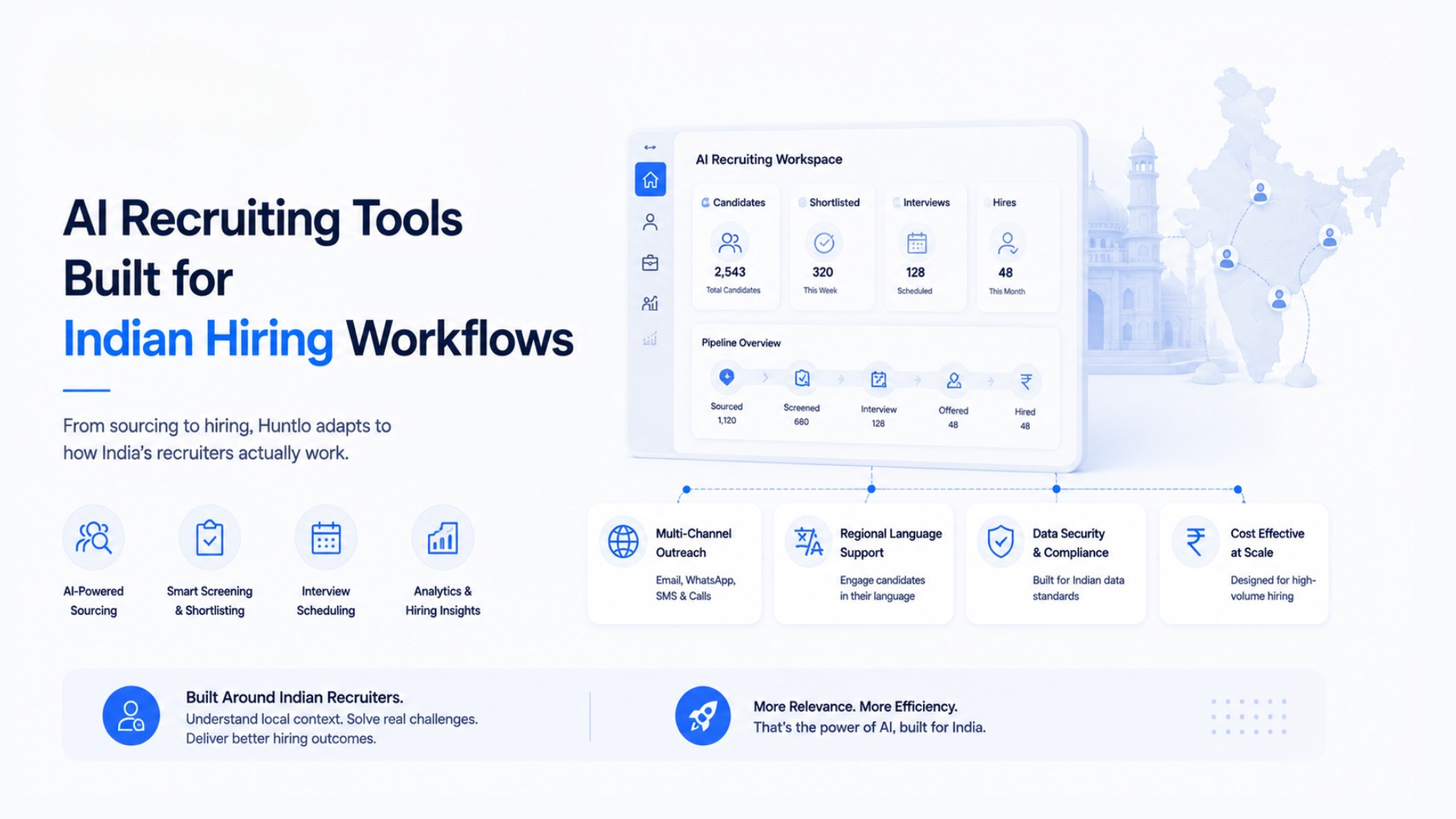
For Indian hiring teams specifically, the gap between sourcing and actually reaching a candidate is often wider than it is in Western markets, given how central WhatsApp is to how Indian professionals communicate versus the email-first norms most global sourcing tools were built around. Huntlo is built around that exact gap — natural-language sourcing across 50+ public platforms, not limited to a single network's index, paired with autonomous outreach across email, WhatsApp, and AI voice from one coordinated workflow.
For an Indian recruiting team, this addresses two of the specific criteria Weekday's evaluation framework treats as most important: multi-channel outreach that goes beyond the sub-10%-response-rate ceiling of email-only sourcing, and discovery breadth that doesn't stop at whichever single platform a recruiter happens to check first. Rather than a recruiter manually working across LinkedIn, forwarding candidates to a separate outreach tool, and then following up individually by hand, Huntlo's agentic AI runs sourcing, scoring, and multi-channel follow-up as a single workflow — with outreach halting automatically the moment a candidate responds.
It's worth being direct about where this fits relative to India-native platforms covered below: Huntlo is not built specifically around Naukri RMS integration or India-specific statutory compliance workflows the way some India-headquartered platforms are, and companies with a heavy dependency on Naukri as a primary sourcing channel should weigh that directly. Where it's a strong fit is as the passive-sourcing and multi-channel outreach layer sitting alongside — not necessarily replacing — an existing India-native ATS or HRMS, particularly for teams that need to reach candidates who aren't actively browsing job boards at all.
Best for: Indian recruiting teams whose core gap is reaching passive candidates across multiple channels — especially WhatsApp — rather than managing high-volume inbound applications from job boards. Standout feature: Natural-language sourcing across 50+ platforms combined with autonomous email, WhatsApp, and AI voice outreach in one workflow. Pricing: 7-day free trial (3 active roles, 30 candidate searches); paid plans start at $99 per seat/month.
2. TheHireHub.AI — Best India-Native, End-to-End Agentic Platform
TheHireHub.AI positions itself as India-native from the ground up rather than a global platform with local features added on. According to its own 2026 buyer's guide, the platform ships with DPDP compliance handled by default rather than as a premium tier, multilingual conversational AI, and custom-trained predictive shortlisting, with a deployment timeline of three to four weeks — notably faster than the six-month timelines common among global enterprise platforms. A separate comparison guide notes flat, transparent pricing around $299 a month rather than complex per-seat licensing, along with native Naukri, WhatsApp, and INR billing support.
Best for: GCCs, mid-market Indian product companies, and captives scaling 50 to 500 hires a year that want an India-native, full-lifecycle agentic platform without enterprise deployment timelines. Trade-off: As a full-lifecycle platform, teams that only need one specific function — pure sourcing, or pure interview intelligence — may find themselves paying for broader functionality than they need.
3. Darwinbox — Best HCM Backbone for Mid-Market to Enterprise Indian Companies
Darwinbox remains the most commonly cited default backbone for large Indian enterprises specifically because it connects recruitment to the same unified data model running payroll, performance, and the full employee lifecycle, rather than treating hiring as a disconnected first step. According to TheHireHub's talent acquisition platforms comparison, Darwinbox's India-specific features include Indian labor law compliance spanning both recruitment and post-hire workflows, native Naukri.com API integration, multi-city and multi-state management, and regional language support, with typical pricing in the ₹15,000 to ₹1,00,000 per month range depending on scale.
Best for: Mid-market to enterprise Indian companies that want recruiting integrated into a single connected HR platform rather than a standalone point solution. Trade-off: Enterprise pricing and an 8-12 week deployment timeline limit accessibility for smaller companies, and the recruitment module's AI features are generally regarded as table stakes rather than best-in-class when purchased standalone rather than as part of the full HCM suite.
4. Keka — Best India-Built HRMS for SMB and Growth-Stage Teams
Keka fills a specific gap between smaller point solutions and Darwinbox's enterprise scale — an India-built HRMS with genuinely capable payroll integration, ESI/PF handling, and a functional ATS module, priced for companies that have outgrown a spreadsheet-based process but aren't yet enterprise-scale. Pricing typically runs ₹199 to ₹599 per employee per month according to TheHireHub's platform comparison, positioning it clearly for the 50-300 employee range.
Best for: SMBs and growth-stage Indian companies that want recruiting bundled with genuinely strong payroll and statutory compliance rather than a standalone AI sourcing tool.
5. Zoho Recruit — Best Affordable, Broadly Capable ATS for Agencies and SMBs
Zoho Recruit combines AI resume parsing, semantic candidate matching, and workflow automation into a platform designed for both in-house teams and staffing agencies, according to Internshala's 2026 AI recruitment platforms guide. Its integration with the broader Zoho application suite and third-party tools, combined with Naukri integration and INR billing, makes it a common default for companies that want reasonably capable AI features without a large dedicated budget — TheHireHub's comparison puts typical pricing around ₹4,000-12,000 per month.
Best for: SMBs and staffing agencies of 50-500 employees that want an affordable, broadly capable ATS rather than a specialized sourcing or interview-intelligence tool.
6. Naukri RMS — Best for Volume Hiring Directly on India's Largest Job Board
Naukri's own recruitment management system remains widely adopted specifically because of its tight integration with Naukri.com's job board and the broader Infoedge product suite, giving direct access to a database of more than 30 million candidates. TheHireHub's IT services software comparison is candid about its positioning: functional but not best-in-class on AI or bench management, which makes it a reasonable default specifically for smaller and mid-sized firms doing most of their sourcing through Naukri already, rather than a differentiated AI-first platform.
Best for: Small to mid-sized Indian firms running high-volume, primarily inbound hiring directly through Naukri as the dominant channel.
7. NeoRecruit — Best for Verified, Auditable Interview-Stage Assessment
NeoRecruit occupies a distinct category from the sourcing and workflow platforms above — it addresses a problem NeoRecruit's own analysis frames sharply: none of the standard sourcing, tracking, or payroll tools answer whether a candidate who performs well in the process is genuinely capable of doing the job, a question that's gotten harder to answer as AI-assisted cheating on technical assessments has reportedly doubled year-over-year, from 16% to 35% according to CodeSignal data cited in that analysis. NeoRecruit's positioning is specifically around verified, adaptive interviews that produce auditable assessments — relevant for GCCs and enterprises whose global headquarters increasingly expect documented rigor behind Indian hiring decisions, not just a documented sourcing process.
Best for: GCCs and enterprises that need auditable, fraud-resistant interview assessment specifically, layered on top of an existing sourcing and workflow stack rather than replacing it.
8. HirePro — Best for Campus Hiring and Mass Candidate Evaluation
HirePro's standout strength is automation built specifically for campus recruitment at scale — mass evaluation and engagement of candidates through digital platforms, combined with fraud detection and plagiarism checks for remote assessments, according to Internshala's 2026 AI tools for recruiters guide. A separate India-specific interview platforms comparison notes native support for Hindi plus several regional languages, direct Naukri and LinkedIn India sync, and pricing structured around volume-based per-candidate assessment (roughly ₹500-2,000 per assessment) rather than flat seat licenses.
Best for: IT companies, staffing agencies, and organizations running large-scale campus recruitment programs that need mass evaluation with fraud detection built in.
9. Skillate — Best for Bias-Reduction and Inclusive Screening at Scale
Skillate differentiates itself around fairness-focused screening — AI job description assistants that help recruiters write more inclusive postings, alongside blind-hiring features that anonymize candidate information during initial screening specifically to reduce bias, according to Internshala's AI tools guide. This positions it well for organizations under growing pressure to demonstrate DEI rigor in hiring, particularly GCCs reporting into global parent companies with formal diversity commitments.
Best for: Organizations prioritizing bias reduction and inclusive candidate evaluation as an explicit part of their India hiring process, not just a compliance afterthought.
Choosing the Right Combination for Your Company's Stage
Rather than picking a single winner, the research across multiple India-focused buyer's guides points toward a layered stack that changes by company size and hiring model:
Early-stage startups and lean teams typically do best with an affordable, broadly capable ATS like Zoho Recruit or Keka, paired with a sourcing and outreach layer like Huntlo for reaching passive candidates who won't be found through Naukri alone.
Mid-market Indian product and services companies hiring 50-500 people a year tend to benefit most from an India-native, full-lifecycle platform like TheHireHub.AI, or a combination of Keka/Darwinbox for HRMS plus Naukri and LinkedIn for sourcing, with NeoRecruit or a comparable tool layered in for interview-stage assessment — a stack TheHireHub's own comparison describes as the practical mid-market default.
GCCs and enterprises generally need Darwinbox or Workday as the HCM backbone, Naukri, LinkedIn, and a specialist sourcing tool for volume and niche technical segments respectively, plus a verified interview-assessment layer given the auditability global headquarters increasingly expect. Where a GCC's global parent mandates a platform like Eightfold or Phenom, TheHireHub's guide recommends layering an India-native tool specifically for the parts the parent platform under-serves — typically regional-language conversational AI and Tier-2 sourcing.
IT services and staffing firms running contract-heavy models have a genuinely different requirement set entirely — bench management, Contract Labour Act compliance, 240-day rule tracking, and client billing integration — that most general ATS platforms don't address, making a platform built specifically for that workflow, rather than a generic product-company ATS, the more defensible choice.
Frequently Asked Questions
Is it worth paying more for an India-native platform over a global one with India features added on? Often yes, particularly for DPDP compliance, deployment speed, and regional language depth — features that India-native platforms tend to build into the core product rather than offer as a premium add-on. Global platforms remain a reasonable choice specifically when a parent company mandates them or when the core AI matching capability is meaningfully stronger, but the India-specific gaps should be evaluated directly rather than assumed to be covered.
Does a company need Naukri integration if it's already using LinkedIn for sourcing? For most Indian hiring volume, yes. Naukri surfaces a different, generally larger pool of active job seekers than LinkedIn, and a platform integrating only with LinkedIn and Indeed can leave a substantial share of the addressable Indian candidate pool unsourced, particularly for volume and mid-level hiring.
How important is regional language support in practice? It varies significantly by role. For customer-facing positions requiring English fluency, it matters less. For backend, engineering, and roles based in Tier 2 and Tier 3 cities specifically, regional language screening has been shown to measurably improve candidate response and completion rates.
Should a GCC use its global parent's mandated platform, or an India-native tool instead? Current guidance from India-focused analysts generally recommends layering rather than replacing — using the parent-mandated platform as required, while adding an India-native tool specifically for the functions it under-serves, most commonly regional-language conversational AI and Tier 2/3 city sourcing depth.
The Bottom Line
The right AI recruiting stack for an Indian hiring team looks different depending on company size, hiring model, and how much of the workforce is on formal payroll versus contract, but the underlying evaluation criteria stay consistent: does the platform reach candidates beyond a single job board or network, does it handle DPDP compliance and regional language as core capabilities rather than afterthoughts, and can it actually deploy fast enough to matter for hiring happening this quarter.
If the specific gap is reaching passive candidates across the channels they actually check — particularly WhatsApp — alongside whatever India-native ATS or HRMS is already handling workflow and compliance, Huntlo's agentic AI sourcing and outreach platform is built specifically for that layer, worth testing directly against your next open role with the free trial.