The Interview Bottleneck That AI Is Finally Solving
Consider the math that every recruiting team lives with. A typical hiring process involves three to five interview rounds. Each round requires coordinating schedules between the candidate and one or more interviewers, each of whom has their own calendar full of meetings, projects, and deadlines. The average interview takes 45 to 60 minutes of interviewer time plus 15 to 20 minutes of preparation and follow-up. For a team hiring 200 people per year, that is 600 to 1,000 interviews — or roughly 800 to 1,300 hours of interviewer time that is pulled away from their actual job.
According to SHRM's 2025 Talent Acquisition Benchmark Report, interviewing is the single largest time investment in the recruiting process, accounting for 40 to 55 percent of total recruiter and hiring manager time. And a surprising amount of that time is spent on activities that do not actually require human judgment: scheduling logistics, asking the same basic screening questions to every candidate, collecting and synthesizing feedback from multiple interviewers, and trying to remember what was discussed in back-to-back interviews.
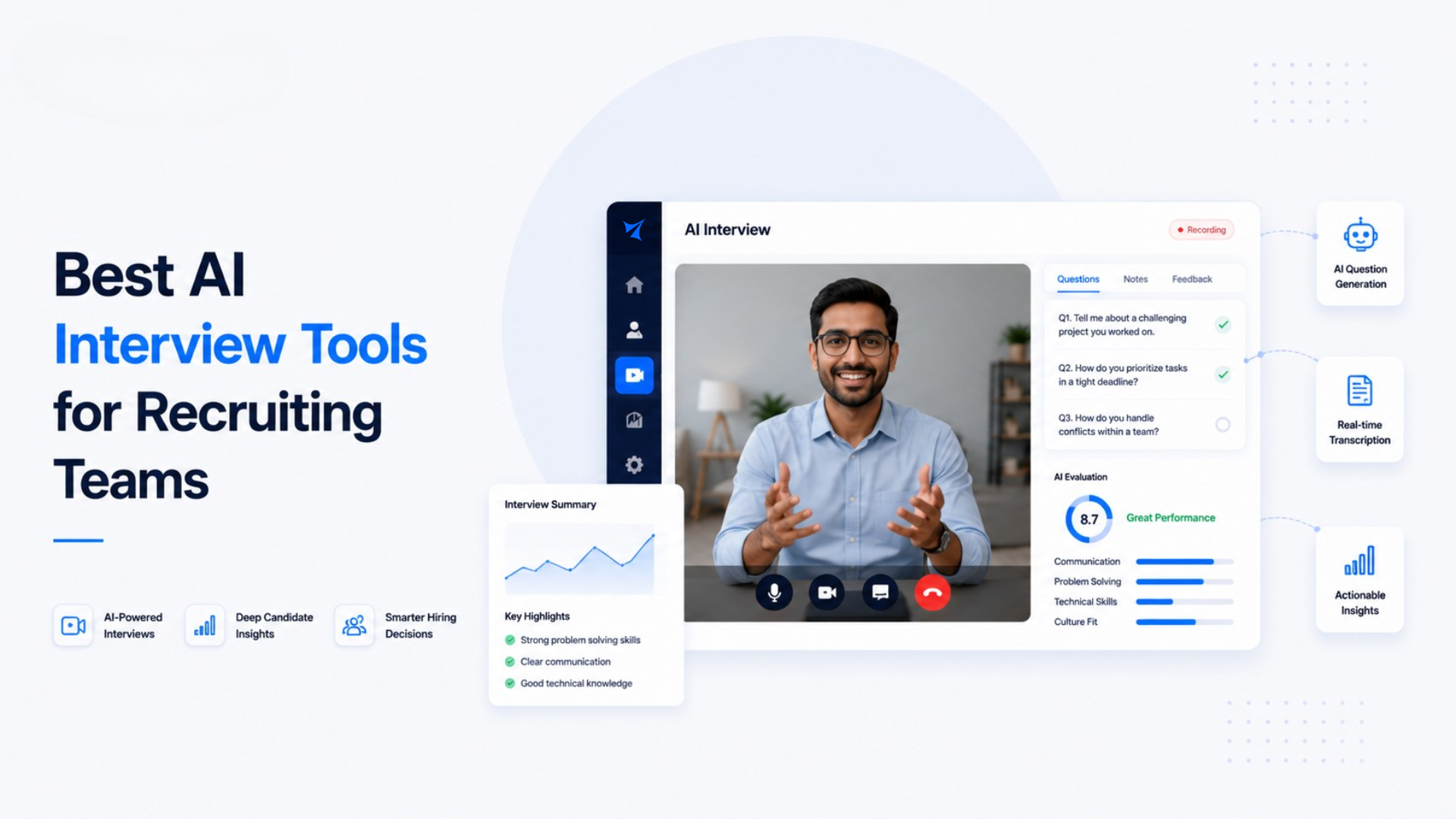
AI interview tools address this bottleneck in two distinct ways. Some tools automate or augment the interview itself — using AI to conduct screening conversations, analyze video interviews, or administer structured assessments. Other tools automate the logistics around interviews — scheduling, follow-up, note-taking, and feedback collection. Both categories are essential for recruiting teams that want to move faster without sacrificing quality, and the best teams in 2026 use a combination of both.
The Four Categories of AI Interview Tools
Before diving into specific platforms, it is important to understand the four distinct categories of AI interview tools, because they solve different problems and are often used together rather than as alternatives to each other.
Conversational AI screeners. These tools use AI chatbots or voice assistants to conduct initial screening conversations with candidates. The AI asks predetermined questions, evaluates the candidate's responses, gauges interest and availability, and passes qualified candidates to the next stage. The key advantage is scale — an AI can conduct hundreds of screening conversations simultaneously, something no human team can match. This category is particularly valuable for high-volume hiring where the initial screening stage creates the biggest bottleneck.
AI video interview and analysis platforms. These tools ask candidates to complete on-demand video interviews — answering predetermined questions on camera — and then use AI to analyze the recordings for competency signals, communication skills, and personality indicators. The AI does not make hiring decisions, but it provides structured evaluations that help human reviewers process large numbers of video interviews more efficiently. This category has been controversial due to concerns about AI bias in facial expression analysis, and the leading platforms have significantly refined their approaches in response.
Interview scheduling and coordination tools. These tools automate the logistics of setting up interviews — finding mutual availability between candidates and interviewers, sending calendar invitations, handling reschedules, and managing the complex scheduling requirements of multi-stage interview processes. They do not conduct interviews, but they save enormous amounts of time by eliminating the back-and-forth emails and calendar juggling that consume recruiter and coordinator hours.
Interview intelligence and analytics platforms. These tools record and analyze live interviews — either video or audio — and use AI to extract key insights, generate summaries, identify follow-up questions, and provide structured data that helps hiring teams make more consistent decisions. They do not replace the interviewer, but they augment the interviewer's capabilities by capturing and organizing information that would otherwise exist only in scattered notes and memories.
Understanding these categories is critical because the best interview tech stack in 2026 typically includes tools from multiple categories, not just one.
Category 1: Conversational AI Screeners
Huntlo.ai — Conversational Screening Built Into the Sourcing Workflow
Huntlo.ai takes a fundamentally different approach to AI screening than any other platform on this list. Instead of asking candidates to complete a separate screening interview, Huntlo's conversational AI screens candidates as part of the natural sourcing and outreach workflow. When a candidate responds to Huntlo's personalized outreach — whether via email, LinkedIn, WhatsApp, or AI voice call — the AI engages them in a natural conversation. It answers their questions about the role, gauges their interest level, asks relevant screening questions about skills, experience, availability, compensation expectations, and work authorization, and evaluates their responses against the role requirements.
This approach has several advantages for recruiting teams. First, candidates do not have to complete a separate assessment or interview — the screening happens organically within a conversation they are already having. According to LinkedIn's 2025 hiring insights, candidates are 3.2 times more likely to complete a screening conversation embedded in an outreach exchange than a standalone assessment. Second, the AI's conversational approach captures richer information than structured questionnaires because it can follow up on interesting responses, probe ambiguous answers, and adapt its questions based on what the candidate says. Third, because Huntlo handles the entire journey — from sourcing through screening to warm handoff to the human team — there is no data loss or context gap between the sourcing and screening stages.
Huntlo's conversational AI is available as part of its core platform at $99 per seat per month, which makes it the most affordable AI screening solution available. For teams that are currently paying for separate screening tools on top of their sourcing tools, consolidating into Huntlo delivers both cost savings and a more seamless candidate experience.
Paradox AI (Olivia)
Paradox AI is the most established conversational AI platform in recruiting. Its AI assistant, Olivia, interacts with candidates via text messaging and web chat to answer questions, collect basic information, and screen for role qualifications. Olivia is widely used by large enterprises for high-volume hiring — retail, hospitality, logistics, and customer service roles where thousands of candidates need to be screened quickly. The platform is effective at what it does, and Olivia's conversational abilities are polished and professional.
However, Paradox AI is purely a screening and communication tool — it does not source candidates or handle outbound outreach. Teams need a separate sourcing platform to feed candidates into Paradox, and the integration between the two tools can be a source of friction. Paradox pricing is enterprise-level, typically ranging from $30,000 to $100,000+ per year depending on volume and configuration. For teams exploring alternatives that combine screening with broader capabilities, our analysis of the best Paradox AI alternatives covers platforms that deliver AI screening alongside sourcing and engagement.
HeyMilo
HeyMilo is an AI interview platform that conducts voice-based screening interviews with candidates. Candidates interact with an AI voice assistant that asks role-specific questions, evaluates responses in real time, and provides structured feedback to recruiters. The voice-based approach is distinctive — most conversational AI screeners use text, but HeyMilo's voice interviews feel more like actual phone screens, which can be valuable for roles where verbal communication skills are important.
HeyMilo handles the screening stage well but, like Paradox, it does not include sourcing or outreach capabilities. It is a screening-specific tool that needs to be part of a broader recruiting tech stack. For teams evaluating their options, our comparison of the best HeyMilo alternatives includes platforms that offer voice-based AI screening alongside sourcing and multi-channel outreach. HeyMilo pricing typically starts around $200 to $400 per month for small teams and scales up for larger volumes.
Ashby AI Screening
Ashby, primarily known as an ATS, has added AI-powered screening capabilities that integrate directly into its hiring workflows. The AI can screen candidates based on application responses, automatically advance qualified candidates, and flag borderline cases for human review. The integration with the ATS is seamless — screening data lives in the same system as the rest of the hiring process. However, Ashby's AI screening is application-based rather than conversational — it evaluates written responses to application questions rather than conducting interactive conversations. This works well for candidates who have already applied but does not help with screening candidates who are being sourced proactively.
Category 2: AI Video Interview and Analysis
HireVue
HireVue is the undisputed market leader in AI-powered video interviewing, with a client base that includes many of the world's largest companies. The platform asks candidates to complete on-demand video interviews — typically answering three to five pre-set questions on camera — and then uses AI to analyze the recordings. HireVue's AI has evolved significantly since its early days. After facing criticism about facial analysis and potential bias, the company shifted its approach to focus primarily on what candidates say — the content of their responses — rather than how they look while saying it. According to HireVue's 2025 algorithmic impact assessment, the current AI model evaluates responses for job-relevant competencies using natural language processing, with structured bias auditing and explainability features.
HireVue is powerful for high-volume screening where you need to evaluate hundreds or thousands of video interviews. The AI provides consistent, structured evaluations that help hiring teams process large volumes efficiently. The platform also offers live interview tools, scheduling features, and integrations with major ATS platforms. The main drawbacks are cost — enterprise pricing typically starts at $30,000 to $50,000 per year — and the fact that some candidates find on-demand video interviews impersonal or intimidating, which can affect their performance and your candidate experience.
VidCruiter
VidCruiter offers AI-powered video interviewing with a focus on structured hiring processes. The platform supports both on-demand and live video interviews, with AI features that help evaluate candidate responses and streamline the review process. VidCruiter's strength is in customization — the platform allows teams to configure highly specific interview structures, scoring rubrics, and evaluation criteria. This makes it popular with organizations that have rigorous, standardized hiring processes, such as government agencies and regulated industries.
VidCruiter's AI capabilities are solid but not as advanced as HireVue's. The platform is more of a video interview platform with AI features than an AI-native tool. Pricing is mid-market, typically ranging from $500 to $2,000 per month depending on volume and features. For teams that want structured video interviews without the enterprise price tag of HireVue, VidCruiter is a reasonable alternative.
Spark Hire
Spark Hire is a straightforward video interviewing platform with basic AI features. It supports one-way video interviews, live interviews, and interview sharing and feedback. The AI capabilities are lighter than HireVue or VidCruiter — primarily automated transcription and basic sentiment analysis rather than deep competency evaluation. Spark Hire's advantage is simplicity and affordability. Pricing starts around $100 to $300 per month, making it accessible to smaller teams that want video interviewing capabilities without enterprise complexity. The trade-off is that the AI analysis is less sophisticated, so human reviewers need to spend more time evaluating each interview.
Category 3: Interview Scheduling and Coordination
GoodTime
GoodTime is the most capable interview scheduling platform available, and it is used by some of the most hiring-intensive companies in technology and professional services. The platform connects to your ATS and your team's calendars, then automates the entire scheduling process. When a candidate advances to the interview stage, GoodTime identifies available time slots across all required interviewers, presents options to the candidate, books the interview, sends calendar invitations, and handles reschedules automatically. For complex multi-stage interview processes involving five or more interviewers across different time zones, GoodTime saves enormous amounts of coordinator time.
GoodTime's AI features include smart scheduling that accounts for interviewer preferences and workload balancing, no-show prediction that flags candidates who may not show up based on engagement signals, and analytics that identify scheduling bottlenecks in your hiring process. The platform integrates with all major ATS platforms and calendar systems. Pricing typically ranges from $500 to $2,000 per month depending on the number of interviews scheduled.
Clockwork
Clockwork is a newer interview scheduling tool that has gained traction for its clean interface and intelligent automation. Like GoodTime, it automates the scheduling logistics of multi-stage interviews. Clockwork's differentiator is its focus on candidate experience — the platform provides a polished, branded scheduling interface that makes a positive impression on candidates. For companies where employer brand matters — which is most companies in competitive talent markets — this attention to candidate experience is valuable. Pricing is competitive with GoodTime, typically in the $300 to $1,500 per month range.
Huntlo.ai — Scheduling as Part of the Full Workflow
Huntlo.ai handles interview scheduling as an integrated part of its end-to-end workflow rather than as a standalone function. When the AI's conversational screening identifies a qualified, interested candidate, it can coordinate scheduling directly with the candidate through the same channel — whether that is email, LinkedIn, WhatsApp, or voice. This integration means the candidate does not have to switch platforms or fill out a scheduling form; the AI handles it within the conversation they are already having. For teams using Huntlo for sourcing and screening, this integrated scheduling eliminates the need for a separate scheduling tool and provides a more seamless candidate experience.
Category 4: Interview Intelligence and Analytics
Glint AI (part of LinkedIn)
Glint AI, integrated with LinkedIn's recruiting ecosystem, provides interview intelligence features that analyze interview conversations and extract structured insights. The platform records and transcribes interviews, identifies key themes and topics discussed, highlights potential concerns or strong signals, and generates summaries that help hiring teams make more consistent decisions. The integration with LinkedIn's broader recruiting data gives Glint AI a rich context layer — the AI can reference a candidate's LinkedIn profile alongside interview content to provide a more complete picture.
Glint AI is available as part of LinkedIn's enterprise recruiting packages, which means it is most accessible to companies already invested in the LinkedIn ecosystem. The standalone value is strong, but the integration with LinkedIn Recruiter and LinkedIn Talent Insights makes it particularly powerful for teams that rely heavily on LinkedIn for their recruiting. Pricing is bundled with LinkedIn's enterprise offerings.
Metaview
Metaview focuses specifically on interview intelligence — recording, transcribing, and analyzing hiring conversations to help teams improve their interviewing and hiring decisions. The platform integrates with video conferencing tools like Zoom, Google Meet, and Microsoft Teams, so it captures interview content automatically without requiring interviewers to take detailed notes. Metaview's AI generates structured summaries, identifies patterns across interviews, and provides coaching insights that help interviewers improve over time.
Metaview is particularly valuable for teams that want to improve interview quality and consistency over time. The analytics show which interview questions are most predictive of successful hires, which interviewers have the highest calibration accuracy, and where bias might be creeping into the process. According to Metaview's 2025 benchmark data, teams using the platform report a 20 percent improvement in interviewer calibration within six months. Pricing typically ranges from $500 to $2,000 per month depending on team size and usage volume.
Pillar
Pillar is an interview intelligence platform that records and analyzes interviews with a focus on reducing bias and improving hiring consistency. The platform provides real-time interview guides, AI-powered note-taking, and post-interview summaries that highlight both strengths and areas of concern. Pillar's differentiator is its emphasis on structured, equitable interviewing — it helps teams ensure that every candidate is asked the same core questions and evaluated against the same criteria, which reduces the inconsistency that plagues unstructured interview processes.
According to research from Industrial and Organizational Psychology published by Cambridge University Press, structured interviews are 2.5 times more predictive of job performance than unstructured interviews. Tools like Pillar that enforce structure without making the interview feel rigid are particularly valuable for teams that want to improve hiring quality. Pillar pricing typically starts around $300 to $1,000 per month.
Huntlo.ai — Built-In Intelligence From Sourcing Through Screening
Huntlo.ai provides interview intelligence not as a separate tool but as an inherent part of its conversational AI workflow. Every interaction the AI has with a candidate — from initial outreach through screening conversation — is captured, summarized, and available to the human recruiter who takes over. This means the recruiter starts the interview process with full context: what the AI discussed with the candidate, what questions were asked, what the candidate's responses were, and what their interest level and qualifications appear to be.
This built-in intelligence is particularly valuable because it covers the entire pre-interview journey, not just the interview itself. Traditional interview intelligence platforms only capture what happens during a formal interview. Huntlo captures everything that happened before — the initial outreach, the candidate's response, the screening conversation, and any preliminary assessments. This comprehensive context gives human interviewers a significant advantage: they can focus their interview time on areas that the AI has identified as needing deeper exploration, rather than re-asking questions the AI has already covered.
Choosing the Right AI Interview Tools for Your Team
The best combination of AI interview tools depends on your team size, hiring volume, and the types of roles you fill.
Small teams (1–5 recruiters, under 100 hires per year). Keep it simple. Use Huntlo.ai for sourcing, conversational screening, and basic interview coordination — all in one platform for $99 per seat per month. Add a free or low-cost scheduling tool if your interview processes are complex enough to warrant it. You probably do not need a dedicated video interview platform or interview intelligence tool at this scale — the AI screening and built-in intelligence in Huntlo provide sufficient pre-interview evaluation, and your human interviewers can manage the interview stage directly.
Mid-size teams (5–20 recruiters, 100–500 hires per year). Huntlo for sourcing, screening, and initial coordination. A dedicated interview scheduling tool like GoodTime or Clockwork for the complex logistics of multi-stage interviews. An interview intelligence tool like Pillar or Metaview if you want to improve interview quality and consistency across a larger team of interviewers. Consider adding Spark Hire for video interviews if you hire for customer-facing roles where communication skills assessment at scale is valuable.
Large teams (20+ recruiters, 500+ hires per year). The full stack. Huntlo for AI-powered sourcing, multi-channel outreach, and conversational screening. HireVue for AI-powered video interviewing at scale. GoodTime for enterprise-grade scheduling. Metaview or Pillar for interview intelligence and analytics. This combination gives you AI capabilities at every stage of the interview process, from initial screening through final evaluation. The total cost of this stack is significantly less than adding more RPO capacity or expanding your internal team to handle the same volume manually.
High-volume teams (hundreds of hires per quarter). Huntlo for sourcing and AI screening at scale — its ability to conduct hundreds of screening conversations simultaneously through multiple channels makes it uniquely suited for high-volume hiring. HireVue for on-demand video assessments. Paradox AI if you need additional conversational screening capacity for candidate populations that are not reached through Huntlo's sourcing channels. GoodTime for scheduling logistics. This combination handles the full volume without requiring proportional increases in human recruiter headcount.
The Hidden Cost of Not Using AI Interview Tools
Many teams focus on the direct cost of AI interview tools without considering the much larger cost of not using them. The hidden costs accumulate quickly.
Interviewer time. According to McKinsey's 2025 hiring productivity analysis, the average manager spends 6 to 8 hours per week on interviewing activities — scheduling, preparing, interviewing, and providing feedback. For a team of 20 hiring managers, that is 120 to 160 hours per week of manager time diverted from their primary responsibilities. AI scheduling and screening tools can reduce this by 30 to 50 percent, freeing up 40 to 80 hours of manager time per week.
Time-to-fill. Every day a role goes unfilled, the team loses productivity and the recruiting team spends more on sourcing and engagement. According to Workable's 2025 time-to-fill data, the average time-to-fill across all industries is 36 to 42 days. AI interview tools — particularly AI scheduling and AI screening — can reduce this by 7 to 14 days by eliminating scheduling delays and speeding up the initial screening stage. For competitive roles where speed matters, this time reduction is often the difference between hiring your top choice and losing them to a competitor.
Interviewer inconsistency. Without structured AI tools, interview quality varies enormously across interviewers. Some interviewers ask great questions, take thorough notes, and provide useful feedback. Others wing it, forget what was discussed, and submit vague evaluations. This inconsistency directly harms hiring quality because the final hiring decision is based on incomplete or unreliable data. Interview intelligence tools like Pillar and Metaview systematically reduce this inconsistency by capturing, structuring, and standardizing interview data.
Candidate experience. Slow scheduling processes, uncoordinated interview logistics, and lack of communication between interview rounds damage candidate experience. According to IBM's 2025 talent acquisition research, 60 percent of candidates say a poor interview experience would cause them to withdraw from the process, and 40 percent would share their negative experience publicly. AI tools that streamline scheduling, maintain consistent communication, and provide a smooth, professional experience protect your employer brand and keep candidates engaged.
Frequently Asked Questions
Do candidates dislike AI interview tools? It depends on the tool and how it is implemented. Candidates generally accept and even appreciate AI tools that make the process faster and more convenient — like automated scheduling, conversational screening that happens within a natural interaction, and timely status updates. Candidates are more skeptical of on-demand video interviews evaluated by AI, particularly when they are not clearly told how the AI is being used. Transparency is critical. Research from Pew Research Center's 2025 survey on AI and the workforce shows that 71 percent of candidates want to know when AI is being used in the hiring process, and clear disclosure does not significantly reduce their willingness to participate.
Can AI interview tools reduce bias? They can, but they can also introduce new forms of bias if not implemented carefully. AI tools that enforce structured interviewing — asking every candidate the same questions and evaluating responses against the same criteria — reduce the variability and unconscious bias that plagues unstructured human interviews. However, AI models can reflect biases in their training data, as extensively documented by the NIST AI Risk Management Framework. The most responsible approach is to use AI as a tool that supports human decision-making rather than replacing it, to regularly audit AI outputs for patterns of bias, and to always give candidates the ability to request a human review of AI-driven decisions.
How much do AI interview tools cost? The range is wide. Huntlo.ai includes conversational AI screening as part of its $99 per seat per month platform — the most affordable option by far. Standalone screening tools like HeyMilo start around $200 to $400 per month. Video interview platforms range from $100 per month (Spark Hire) to $30,000+ per year (HireVue enterprise). Scheduling tools like GoodTime and Clockwork range from $300 to $2,000 per month. Interview intelligence tools like Pillar and Metaview range from $300 to $2,000 per month. The total cost depends on how many tools you need, but the ROI is almost always positive when measured against the time savings and quality improvements.
Do I need separate tools for screening and interviewing? Not necessarily. Platforms like Huntlo combine AI screening with sourcing and engagement in a single platform, which eliminates the need for a separate screening tool. However, for the actual interview stage — the live or video conversations where hiring managers evaluate candidates — you will likely want a scheduling tool and potentially a video interview platform. The key insight is that the screening stage and the interview stage are different activities that may benefit from different tools, but the best modern platforms are reducing the number of separate tools you need.
Which AI interview tool is best for remote hiring? Remote hiring amplifies the value of AI interview tools because the logistics are more complex — coordinating across time zones, managing virtual interviews, and maintaining candidate engagement through a fully digital process are all harder at a distance. Huntlo's multi-channel outreach and conversational screening work equally well for remote and in-office roles. HireVue and Spark Hire are designed for video interviews, which are the default for remote hiring. GoodTime handles cross-time-zone scheduling particularly well. For fully remote hiring processes, a combination of these tools provides the most seamless experience.
The Bottom Line
AI interview tools are no longer experimental. They are standard equipment for recruiting teams that want to hire faster, more consistently, and more efficiently. The technology has matured significantly — AI screening conversations feel natural, video analysis focuses on what candidates say rather than how they look, and interview intelligence tools provide actionable insights without replacing human judgment.
The most impactful investment most teams can make in 2026 is an AI platform that handles the early stages — sourcing, outreach, and conversational screening — so that human interviewers spend their time on the conversations that genuinely require their expertise. Huntlo.ai delivers this at $99 per seat per month, with AI screening built directly into the sourcing workflow rather than requiring a separate tool. For the interview logistics and intelligence stages, targeted tools like GoodTime for scheduling and Pillar or Metaview for interview analysis round out a comprehensive AI interview stack. Together, these tools transform the interview from the biggest bottleneck in your recruiting process into a streamlined, data-driven operation that consistently identifies the best candidates.
Related Topics
Want to see how AI screening compares across platforms that also do sourcing?
Our detailed pricing comparison of Huntlo vs Juicebox vs SeekOut vs hireEZ shows which platforms include AI interview or screening capabilities alongside their sourcing tools — and which ones leave you needing a separate product.
Need AI that handles the full journey from finding candidates to screening them?
Our analysis of the best Findem alternatives for AI-powered sourcing covers platforms that combine candidate discovery with engagement and evaluation — so the screening conversation starts the moment the AI finds the right person.
Trying to decide between a conversational AI screener and a more traditional approach?
Our honest review of Juicebox in 2026 breaks down how its AI-personalized outreach compares to platforms that go further with actual conversational screening — helping you figure out whether you need outreach automation or full AI interview capabilities.