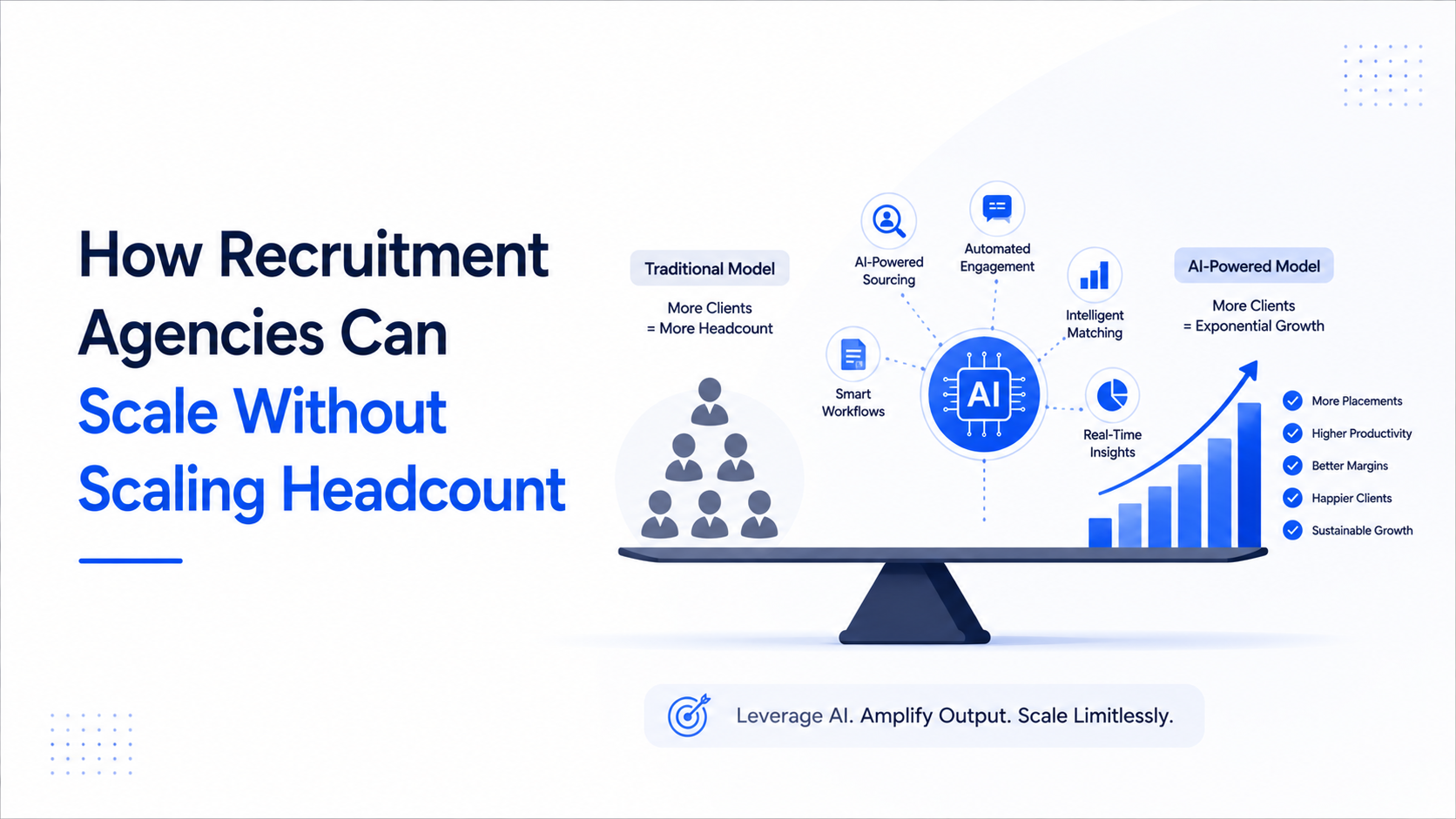
Sofia Martinez had grown her Phoenix-based recruitment agency to twenty-eight consultants and was generating eight point five million dollars in annual revenue. Her growth strategy had been straightforward: win more clients, hire more recruiters, and place more candidates. But over the past year, the math had stopped working. Each new recruiter required three to four months of ramp-up time before becoming productive, consumed management bandwidth during training, and increased the firm's fixed cost base at a rate that outpaced revenue growth. Sofia's profit margin had declined from eighteen percent to eleven percent even as revenue grew, because the cost of adding headcount was rising faster than the revenue each additional headcount produced. Meanwhile, two of her competitors had grown their placement volume by sixty and eighty percent respectively over the same period without adding a single recruiter. Both had invested heavily in AI platforms that automated sourcing, screening, and candidate engagement, enabling their existing teams to handle significantly higher requisition volumes. Sofia realized that the traditional growth model, more revenue requires more recruiters, was no longer the only path or even the best path to scaling her agency. She needed to understand how AI-enabled agencies were breaking the linear relationship between headcount and capacity.
The Linear Growth Trap
The traditional recruitment agency growth model operates on a simple principle: each recruiter can manage a finite number of requisitions, so growing placement volume requires adding recruiters in direct proportion to the volume increase. This model creates a linear relationship between headcount and revenue that limits both profitability and growth speed. If
each recruiter generates two hundred fifty thousand dollars in annual placement revenue and costs one hundred twenty thousand dollars in total compensation, the firm earns one hundred thirty thousand dollars in gross margin per recruiter. To grow revenue by one million dollars, the firm must hire four additional recruiters and incur four hundred eighty thousand dollars in additional compensation cost, plus training, management overhead, and the productivity loss during ramp-up. The net effect is that each increment of growth becomes progressively less profitable because the overhead costs of managing a larger organization grow faster than the revenue per recruiter. This is the linear growth trap, and it explains why many agency owners find that growing their firm feels like running on a treadmill where increased effort produces diminishing returns.
The linear model also creates a ceiling on growth speed that is determined by the firm's ability to recruit, train, and retain recruiters. Hiring qualified recruiters is itself a recruitment challenge, and agencies in competitive markets often struggle to find experienced talent faster than their competitors can. Training new recruiters takes three to six months before they reach full productivity, and during this period the firm is paying compensation without receiving full revenue contribution. Retention compounds the problem, because the recruiting industry experiences annual turnover rates of twenty to thirty percent among consultants, meaning the firm must continuously replace departing recruiters just to maintain its current capacity before it can invest in growth. The combination of hiring difficulty, training latency, and retention pressure means that an agency growing at twenty percent per year through headcount addition is already operating near the maximum growth rate that the traditional model can sustain, and pushing beyond this rate degrades service quality, consultant morale, and client satisfaction.
AI breaks the linear relationship by multiplying the output of each existing recruiter rather than requiring additional recruiters to increase output. When AI handles sourcing, initial screening, interview scheduling, and routine candidate communication, the recruiter's capacity shifts from being constrained by the number of hours available for manual tasks to being constrained by the number of client and candidate relationships they can manage effectively. Since relationship management scales differently than task execution, a recruiter whose administrative burden has been reduced by AI can manage twenty-five to forty percent more requisitions without a proportional increase in workload. For an agency with twenty recruiters, a thirty percent capacity increase is equivalent to adding six full-time recruiters at a fraction of the cost, because the AI platform license that enables this capacity increase costs tens of thousands of dollars annually compared to the seven hundred twenty thousand dollars in compensation that six additional recruiters would require. According to McKinsey, recruitment agencies that implement AI-powered workflow automation report average revenue per consultant increases of thirty to forty-five percent within twelve months of deployment, because the automation frees consultant time for higher-value activities that generate revenue rather than consuming it.
The Four Capacity Multipliers
Scaling without headcount requires understanding and leveraging four specific capacity multipliers that AI enables. The first multiplier is sourcing automation. In a traditional agency, each active requisition requires a recruiter to spend four to eight hours sourcing candidates from job boards, databases, and professional networks. For a recruiter managing fifteen active requisitions, sourcing alone consumes sixty to one hundred twenty hours per month, a significant portion of the available work time. AI sourcing tools can identify and rank candidates for all fifteen requisitions simultaneously in a fraction of the time, reducing the recruiter's sourcing effort by seventy to eighty percent. This multiplier does not eliminate the recruiter's involvement in sourcing, but it changes their role from executing searches to reviewing and refining AI-generated candidate lists, a far less time-intensive activity. The practical impact is that the recruiter can either manage more requisitions with the same time investment or invest the freed time in higher-value activities like client consulting and candidate relationship development.
The second multiplier is screening acceleration. Traditional screening requires a recruiter to review each candidate's resume, assess qualifications against the role requirements, and make a judgment about whether to advance the candidate to the next stage. For a requisition that receives one hundred applications, manual screening might take six to ten hours. AI screening tools can process the same volume in minutes, producing ranked shortlists with explanatory scoring that the recruiter reviews and adjusts rather than creates from scratch. The time savings per requisition are substantial, and when multiplied across all active requisitions, the cumulative effect on recruiter capacity is transformative. The third multiplier is engagement at scale. Maintaining candidate engagement across a large active pipeline requires constant communication, and manual engagement is constrained by the number of messages a recruiter can personally write and send each day. AI engagement tools can maintain personalized, context-aware communication with hundreds of candidates simultaneously, ensuring that no candidate falls through the cracks due to recruiter bandwidth limitations. how many follow-ups one hire needs explains how AI-powered follow-up systems can maintain candidate engagement across the entire pipeline without requiring proportional recruiter time, because the AI handles the timing, personalization, and channel selection for each follow-up while the recruiter focuses on the high-touch conversations that require human judgment and relationship skill.
The fourth multiplier is client self-service enablement. AI-powered client portals give hiring managers direct visibility into pipeline progress, candidate status, and market intelligence without requiring the recruiter to prepare and send manual updates. In traditional agencies, client reporting and communication consume ten to fifteen percent of a recruiter's time, a significant overhead that scales with the number of clients and requisitions. Self-service portals eliminate much of this overhead by providing real-time dashboards that clients can access independently, reducing the recruiter's communication burden while actually improving the client's experience through more timely and transparent information. When combined, these four multipliers can increase effective recruiter capacity by fifty to one hundred percent depending on the role types, the client base, and the sophistication of the AI implementation. According to Gartner, agencies that deploy all four capacity multipliers report average
revenue per consultant increases of fifty to seventy percent compared to pre-AI baselines, because the multipliers compound when implemented together, producing capacity gains that exceed the sum of their individual impacts.
Scaling Client Base Without Adding Account Managers
One of the most significant scaling opportunities AI enables is the ability to grow the client base without proportionally adding account management staff. In traditional agencies, each account manager can effectively manage ten to fifteen client relationships, because each client requires regular communication, status updates, issue resolution, and strategic advisory support. Growing the client base beyond this ratio requires hiring additional account managers, creating the same linear cost structure that constrains recruiter-driven growth. AI enables agencies to serve more clients per account manager by automating the routine aspects of client communication while preserving the high-touch advisory interactions that strengthen client relationships. AI-powered client dashboards provide real-time pipeline visibility, automated weekly reports summarize progress against hiring targets, and AI-generated market intelligence keeps clients informed about talent market trends without requiring manual preparation by the account manager.
The practical impact is that an account manager who previously served twelve clients can serve eighteen to twenty-two clients with the same or higher level of client satisfaction, because the AI handles the informational and administrative aspects of the relationship while the account manager focuses on strategic advisory, problem-solving, and relationship deepening. This capacity increase is particularly valuable for agencies pursuing a land-and-expand strategy, where the goal is to win initial engagements with new clients and then grow the relationship by demonstrating value and earning additional requisitions. The AI platform makes it possible to maintain consistent service quality during the initial engagement phase, when the account manager's attention is distributed across many new clients, and then increase the attention allocated to each client as the relationship deepens and the revenue per client grows. According to Deloitte, agencies using AI-enabled client management tools report thirty to forty percent higher client retention rates and twenty-five percent higher revenue per client compared to agencies using manual client management processes, because the AI ensures consistent communication and service quality regardless of the account manager's workload.
Scaling the client base also requires a systematic approach to client onboarding that does not consume disproportionate account manager time. AI can automate much of the onboarding process, including collecting client hiring requirements, configuring dashboards and reporting preferences, setting up integration with the client's ATS or HRIS systems, and generating initial market intelligence relevant to the client's hiring needs. This automated onboarding reduces the time cost of adding a new client from weeks to days, making it economically feasible to pursue smaller client engagements that would not justify the manual onboarding investment. The ability to serve smaller clients profitably opens a large market segment that traditional agencies, which require substantial client relationships to justify their cost structure,
cannot address. agentic AI platforms vs automated ones describes how agentic AI platforms can autonomously manage routine client interactions while escalating complex situations to human account managers, because this tiered approach to client service enables agencies to serve more clients at varying levels of complexity without requiring proportional increases in account management headcount.
Leveraging Data Assets for Scalable Revenue
The most overlooked scaling opportunity for recruitment agencies is the monetization of data assets that accumulate naturally as the agency operates. Every placement, every candidate interaction, every market engagement generates data that, when aggregated and analyzed, becomes a proprietary intelligence asset. Traditional agencies largely ignore this data after the immediate placement is complete. The candidate who was not selected for one role but who would be perfect for a future role is forgotten in a spreadsheet. The compensation data collected during negotiation is not aggregated into market intelligence. The hiring patterns that reveal which skills are becoming scarce and which are becoming commoditized are not systematically analyzed. AI platforms that capture and structure this data transform it from a byproduct of operations into a strategic asset that generates new revenue streams without requiring additional headcount.
The first data-driven revenue stream is talent market intelligence. Agencies with AI platforms that analyze placement data, candidate flow patterns, and compensation trends across their client base can offer subscription-based market intelligence reports to clients and prospects. These reports provide insights into skill availability, compensation benchmarks, competitor hiring activity, and emerging talent trends that are more relevant and timely than generic market reports because they are based on the agency's own proprietary data from actual hiring transactions. This intelligence service requires no additional consultants to deliver because the AI platform generates the analytics and the existing account managers present the insights during their regular client interactions. The second data-driven revenue stream is talent pool access. Agencies that build and maintain AI-curated talent communities around specific skill sets or industries can charge clients for access to pre-qualified, continuously refreshed candidate pools. The AI handles the community management, candidate profiling, and match scoring, while the agency's consultants focus on the high-touch engagement that converts community members into placements. According to EY, recruitment agencies that have launched data-driven service lines report that these services contribute fifteen to twenty-five percent of total revenue within two years of launch, with profit margins that are ten to fifteen points higher than traditional placement services because the services leverage existing data assets rather than requiring proportional headcount investment.
The third data-driven revenue stream is predictive hiring analytics. As an agency's AI platform accumulates outcome data from hundreds or thousands of placements, the platform develops predictive models that can assess candidate fit, predict retention risk, and estimate time-to-fill with increasing accuracy. These predictive capabilities can be offered to clients as
a premium service, providing data-driven hiring recommendations that go beyond what the client's internal analytics can produce because they are based on the agency's cross-client, cross-industry hiring outcome data. The strategic importance of these data-driven services extends beyond their direct revenue contribution. They change the agency's relationship with clients from transactional vendor to strategic data partner, creating deeper, more resilient relationships that generate higher retention rates and more predictable revenue. more tools same hiring problems explains why agencies that diversify their revenue beyond placement fees into data-driven services build more resilient and valuable businesses, because data-driven revenue streams are less cyclical than placement revenue and create switching costs that protect client relationships from competitive disruption.
The Operational Blueprint for Headcount-Free Scaling
Implementing a headcount-free scaling strategy requires a phased approach that builds AI capabilities incrementally while measuring their impact on recruiter productivity and client service quality. Phase one, covering months one through six, focuses on deploying AI sourcing and screening tools that address the highest-volume, most time-consuming tasks in the agency's workflow. During this phase, the goal is not to reduce headcount but to increase each recruiter's effective capacity by twenty to thirty percent. This capacity increase should be absorbed by taking on additional requisitions from existing clients rather than adding new clients, which allows the team to adapt to AI-enhanced workflows in a controlled environment. Phase two, covering months seven through twelve, extends AI into engagement automation and client self-service, further increasing capacity while improving the consistency and quality of candidate and client communication. By the end of phase two, each recruiter should be managing thirty to forty percent more requisitions than they could handle before AI implementation, and the firm should have measurable data on the impact of AI on placement quality, time-to-fill, and client satisfaction.
Phase three, covering months thirteen through eighteen, focuses on launching data-driven service lines that monetize the intelligence assets the agency has accumulated during the first year of AI-enhanced operation. This phase also involves optimizing the agency's pricing model to reflect the higher value of AI-enhanced services. Agencies that continue pricing their services based on the traditional headcount-dependent cost structure leave money on the table, because AI-enhanced services deliver more value to clients at lower marginal cost, which should translate into higher margins rather than lower prices. The pricing optimization should be data-driven, using the placement quality, time-to-fill, and retention metrics collected during phases one and two to demonstrate the superior outcomes that AI-enhanced services produce. According to LinkedIn, agencies that restructure their pricing to reflect AI-enhanced outcomes report fifteen to twenty percent higher average deal values and ten to fifteen percent higher profit margins, because clients are willing to pay premium rates for demonstrated superior hiring outcomes regardless of the agency's internal cost structure.
The final and most important element of the operational blueprint is a cultural shift from
measuring activity to measuring outcomes. In traditional agencies, performance is measured by activity metrics like calls made, resumes sent, and interviews scheduled. These metrics reinforce the linear growth model by equating more activity with more results. In an AI-enabled agency, the relevant metrics are placement quality, client retention, time-to-fill, and revenue per consultant, because these outcome metrics capture the actual value the agency delivers rather than the volume of tasks its consultants perform. When the agency's performance management system rewards outcomes rather than activity, consultants are incentivized to leverage AI tools to maximize their impact rather than maximizing their task output. This cultural shift is the most difficult part of headcount-free scaling because it requires changing deeply ingrained habits and management practices, but it is also the most impactful, because it aligns every consultant's behavior with the agency's strategic objective of multiplying capacity rather than adding headcount. AI tools for niche technical roles demonstrates how agencies that adopt outcome-based performance management with AI tools achieve higher growth rates with smaller teams, because the combination of AI capability and outcome-focused management creates an environment where each consultant's impact compounds over time rather than being limited by their individual task capacity.