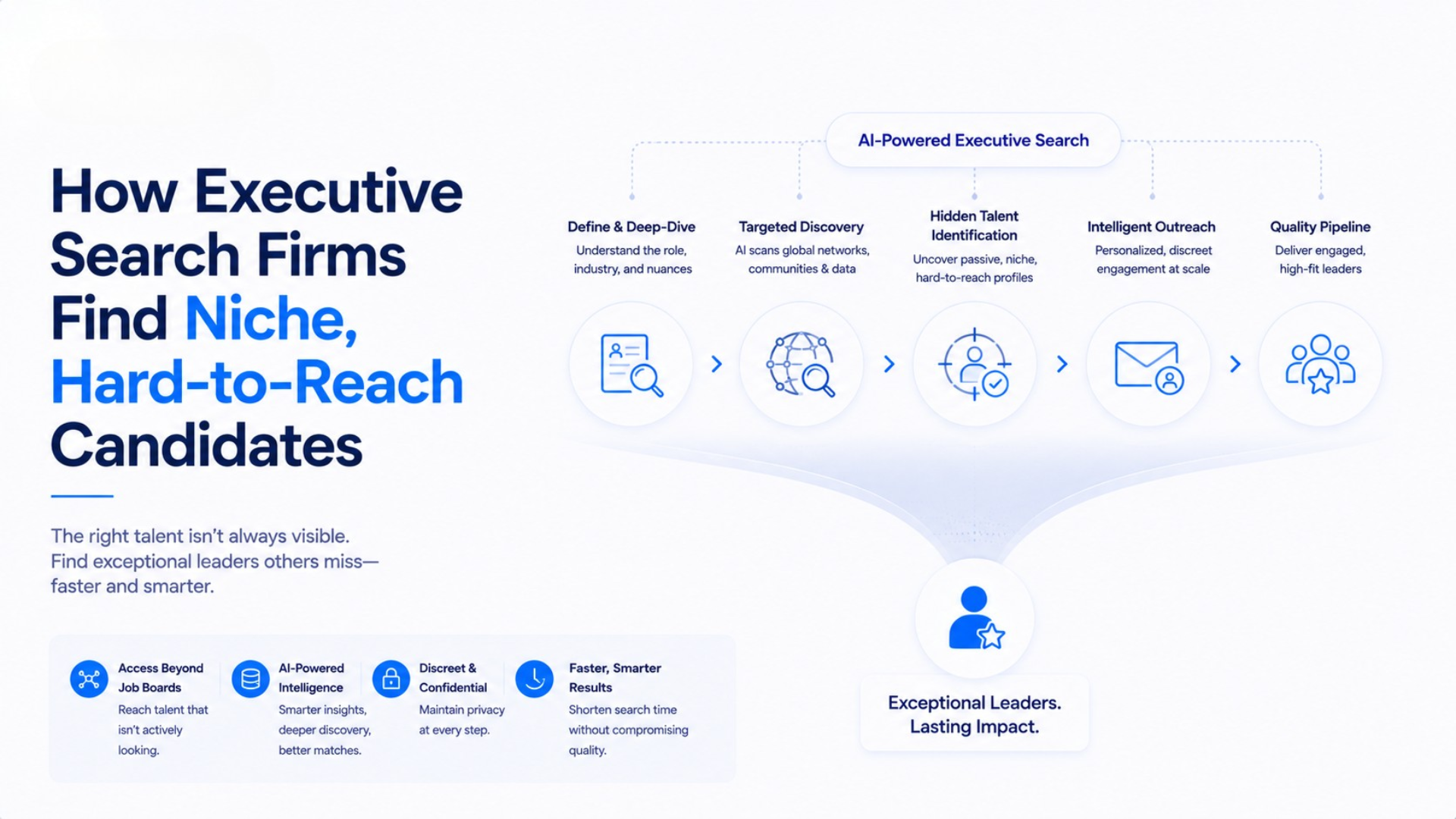
The executive search profession was built on a simple premise: the best candidates are not looking for jobs, and only a skilled search professional with deep relationships and investigative persistence can find them, engage them, and present them to clients. For decades, this premise held true. Retained search firms like Spencer Stuart, Korn Ferry, Heidrick & Struggles, and Egon Zehnder built their reputations on the ability to identify and attract C-suite and senior vice president-level talent that no other firm could reach. Their methods were labor-intensive, relationship-driven, and highly profitable — AESC data shows that the average retained executive search engagement commands fees of $75,000 to $250,000 or more, typically calculated as one-third of the placed executive's first-year compensation.
But the landscape is shifting in ways that challenge even the most established search firms. According to McKinsey's research on the future of work, the demand for specialized executive talent is growing faster than the supply of qualified candidates, particularly in areas like AI leadership, cybersecurity, climate technology, and digital transformation. At the same time, the candidates these firms need to reach are more dispersed, more digitally sophisticated, and more resistant to traditional outreach than ever before. A chief data officer at a Fortune 500 company is unlikely to respond to a cold call from a search consultant she has never met. A vice president of engineering at a high-growth startup may not even have a traditional resume — their professional identity lives on GitHub, personal blogs, conference recordings, and community forums where no conventional search database has visibility.
The implication is clear: the methods that built the executive search industry are no longer sufficient on their own. Search firms that rely solely on personal networks, proprietary databases, and manual outreach will find their candidate pools shrinking and their fill rates declining. The firms that thrive in 2026 and beyond are those that layer AI-powered sourcing intelligence onto their existing relationship expertise, using technology to extend their reach far beyond what any individual consultant could achieve through manual effort alone.
This guide provides a comprehensive framework for doing exactly that — covering the technology, the methodology, the economics, and the practical implementation steps that executive search firms need to adopt in order to consistently find the most niche, hard-to-reach candidates in any market.
Why Traditional Executive Search Methods Are Losing Effectiveness
Understanding why AI-powered approaches are necessary requires an honest assessment of where traditional methods are falling short. The problems are not with the fundamental concept of executive search — the idea that the best talent requires proactive identification and personalized engagement is more true today than ever. The problems are with the execution methods that most firms still rely on.
The database dependency problem. Most search firms maintain proprietary candidate databases that they have built over years or decades. These databases are valuable, but they are inherently backward-looking — they contain people who were identified and catalogued in the past, not people who have recently emerged as leaders in their fields. A database built over ten years may contain excellent candidates for traditional roles like CFO and General Counsel, but it will be thin or nonexistent for newer executive positions like Chief AI Officer, Head of Sustainability, or Vice President of Platform Engineering. According to Korn Ferry's talent landscape research, the average tenure of a C-suite executive has decreased from 8.2 years in 2010 to 5.8 years in 2025, meaning that a database entry from even three years ago may be significantly outdated.
The network limitation problem. Every search consultant has a personal network, and the best consultants have genuinely impressive ones. But personal networks are constrained by geography, industry, and social circles. A consultant who spent 15 years in financial services will have deep relationships in banking and insurance but limited reach into healthcare, climate tech, or government. When a client asks that same consultant to find a Chief Digital Officer for a hospital system — a role that sits at the intersection of healthcare, technology, and digital strategy — the consultant's network may not extend far enough to identify the strongest candidates. Harvard Business Review's analysis of executive search notes that the most common complaint from search clients is that their search firm presented candidates who were "the usual suspects" — people who were well-known in the industry but not necessarily the best fit for the specific challenge at hand.
The outreach scalability problem. Even when a search firm identifies a strong long-list of 40 to 60 candidates for a senior role, the process of engaging each one is painfully manual. A consultant typically reaches out via LinkedIn, email, or phone — one candidate at a time. Each conversation requires scheduling, preparation, and follow-up. At a pace of perhaps 8 to 12 meaningful outreach conversations per week per consultant, working through a 50-candidate long-list takes four to six weeks before the shortlist phase can even begin. In a market where top candidates are receiving multiple approaches simultaneously, being the fourth or fifth firm to reach out dramatically reduces the probability of engagement. LinkedIn's talent acquisition data shows that the first organization to make contact with a passive candidate is 2.5 times more likely to generate a response than the third or fourth.
The visibility gap problem. The most accomplished executives in emerging fields are often the least visible through traditional channels. They may not maintain active LinkedIn profiles. They may not publish on traditional platforms. They may be known primarily within specialized communities, open-source projects, academic collaborations, or industry working groups that exist outside the mainstream professional network ecosystem. A manual search that focuses on LinkedIn profiles, conference speaker lists, and industry association directories will systematically miss these hidden leaders — and in many executive searches, the hidden leader is precisely the candidate the client needs most.
These are not theoretical problems. They are structural limitations that affect every search firm, from the largest global retained firms to boutique practices. The question is not whether traditional methods have value — they absolutely do, particularly in the relationship-building and assessment phases of a search. The question is whether they are sufficient on their own, and the answer is increasingly no.
How AI Sourcing Changes the Game for Executive Search
AI sourcing platforms address the structural limitations of traditional executive search methods by providing capabilities that no human consultant, regardless of experience or network, can replicate at scale.
Deep, multi-source candidate discovery. An AI platform like Huntlo searches across 50 or more talent sources simultaneously — not just LinkedIn and job boards, but developer platforms like GitHub, academic databases, patent repositories, conference proceedings, startup equity databases like PitchBook and Crunchbase, professional association membership directories, industry publication contributor lists, and dozens of other sources that most search firms do not systematically access. The G2 AI recruiting software category now includes platforms that aggregate hundreds of millions of candidate profiles across these diverse sources, providing coverage that no proprietary database or personal network can match.
For executive search specifically, this multi-source approach is transformative because the most distinguished candidates in specialized fields are often visible in unexpected places. A world-class machine learning researcher may have a minimal LinkedIn presence but a prolific GitHub profile and a significant publication record on Google Scholar. A seasoned supply chain executive may not be active on social media but may be listed as a speaker at industry conferences and as an inventor on relevant patents. The AI platform finds these candidates by matching their professional footprint across all available sources, not by waiting for them to appear in a single database.
Semantic understanding of candidate profiles. Traditional database searching relies on keyword matching: you search for "Chief Marketing Officer" and get back profiles that contain that exact phrase. But executive titles are notoriously inconsistent — the same role might be called "CMO," "Head of Marketing," "SVP Marketing," "Marketing Director," or "VP Growth" across different organizations. A keyword search for any one of these titles will systematically miss candidates with the others. AI semantic matching understands that these titles refer to similar roles and will return all of them, along with candidates whose experience demonstrates marketing leadership even if their title does not explicitly say so. Gartner's analysis of AI in talent acquisition estimates that semantic matching improves candidate coverage for senior roles by 40 to 60 percent compared to keyword-based approaches.
Multi-channel outreach at executive-caliber quality. Reaching passive executives requires communication that is thoughtful, personalized, and respectful of their time. Generic outreach is worse than no outreach at all — it signals that the sender does not value the recipient enough to invest in a genuine approach. AI platforms like Huntlo generate personalized outreach for each candidate based on their specific career trajectory, accomplishments, and professional context. A message to a Chief Technology Officer might reference a specific open-source project they contributed to or a technical paper they authored. A message to a Chief Financial Officer might reference a successful M&A transaction they led or a financial transformation initiative they oversaw. This level of personalization, applied across hundreds of candidates simultaneously, is simply not possible through manual effort.
Critically, this outreach is not limited to a single channel. Huntlo supports engagement across email, LinkedIn, WhatsApp, and AI-powered voice calls — ensuring that candidates are reached on their preferred channel rather than the one most convenient for the search firm. For global executive searches, this multi-channel capability is essential. A candidate based in Riyadh may be far more responsive to a WhatsApp message than to a LinkedIn InMail. A candidate in London may prefer email. A candidate in Silicon Valley may respond best to a LinkedIn approach from someone in their extended network. The AI platform adapts the channel strategy to the candidate, not the other way around.
Conversational AI screening for senior candidates. When a candidate expresses interest in learning more about an opportunity, the initial screening conversation is often the most time-intensive part of the search process. For executive-level roles, this conversation needs to cover availability, compensation expectations, geographic preferences, relocation willingness, and career motivations — all while building rapport and representing the client's opportunity compellingly. AI-driven conversational screening can handle the factual components of this conversation — availability, compensation range, location constraints — while capturing the candidate's responses in a structured format that the search consultant can review before investing time in a personal call.
According to SHRM's talent acquisition benchmarks, AI screening reduces the time spent on preliminary candidate qualification by 60 to 70 percent, allowing search consultants to focus their personal interaction time on the relationship-building and assessment activities that genuinely require a human touch. For executive search firms where consultant time is the most expensive and scarce resource, this efficiency gain translates directly into the ability to run more searches simultaneously, take on more clients, and increase revenue per consultant.
Persistent talent pools that appreciate in value. Perhaps the most strategically important capability of AI sourcing for executive search is the talent pool. Every candidate identified, contacted, or engaged — regardless of whether they are a fit for the current search — is captured in a persistent, searchable database that grows with every engagement. Over time, a search firm that consistently uses an AI sourcing platform builds a talent intelligence asset that is deeper, broader, and more current than any proprietary database that was compiled manually. When a new search engagement begins, the AI can search this pool first, often finding pre-qualified candidates who were identified during previous searches and are now available or interested in a new opportunity.
This compounding effect is particularly powerful for firms that specialize in specific industries or functional areas. A boutique search firm focused on healthcare technology will, after a year of systematic AI sourcing, have a talent pool containing thousands of vetted healthcare technology executives — a resource that becomes an increasingly powerful differentiator in client pitches and a significant competitive moat against firms that rely on ad-hoc sourcing for each new engagement. Josh Bersin's research on talent intelligence platforms identifies talent pool depth as the primary indicator of long-term recruiting competitiveness, more important than brand, budget, or headcount.
The Economics: Huntlo vs. Enterprise Executive Search Tools
Cost is a critical consideration for search firms evaluating AI sourcing platforms, particularly boutique and mid-market firms that do not have the budgets of global retained firms.
Huntlo — $99 per seat per month. Flat-rate pricing with no usage caps. For an executive search firm with five consultants, the monthly platform cost is $495 — less than the cost of a single LinkedIn Recruiter Corporate license at $170 to $270 per month. The platform includes multi-source sourcing across 50-plus platforms, multi-channel outreach (email, LinkedIn, WhatsApp, AI voice), conversational AI screening, and talent pool management. For a firm running 20 to 30 active searches per year, the annual platform cost of approximately $5,940 is recovered many times over by the reduction in consultant time spent on sourcing and initial screening.
hireEZ — $149 to $400 per seat per month. Offers strong sourcing capabilities, particularly for technical and senior-level candidates. The higher-tier plans include advanced analytics and team collaboration features that some search firms find valuable. However, the per-seat pricing can become significant for firms with multiple consultants. Five seats at the mid-tier price of $275 per month would cost $1,375 per month or $16,500 per year — nearly three times the cost of Huntlo for comparable core capabilities.
SeekOut — $169 to $500 per seat per month. Excellent for diversity sourcing and deep technical talent discovery. The premium tiers include powerful candidate intelligence features like compensation benchmarking and company health indicators. For executive search firms focused on technology leadership roles, SeekOut offers genuine value. But at $500 per seat per month for the full-featured plan, a five-consultant firm would pay $2,500 per month or $30,000 per year — a significant investment that may be difficult for mid-market firms to justify.
LinkedIn Recruiter — $170 to $270 per seat per month. The incumbent tool for most search firms. LinkedIn's database is enormous and its interface is familiar. However, LinkedIn Recruiter is fundamentally a single-source tool — it only searches LinkedIn. It lacks the multi-source discovery capability that is critical for finding candidates who are not active on LinkedIn, which, as discussed earlier, is often precisely the candidates that executive search clients need most. Additionally, LinkedIn Recruiter's outreach is limited to the LinkedIn platform, missing the WhatsApp, email, and voice channels that can be essential for reaching candidates in certain markets.
Entelo (acquired by HireVue) — Enterprise pricing. Historically popular among search firms for its "passive candidate" identification capabilities. Enterprise pricing typically starts at $500 to $1,000 per seat per month, putting it out of reach for all but the largest firms. Post-acquisition, the product's direction has shifted more toward HireVue's assessment-focused platform, making it less relevant for pure sourcing use cases.
For boutique and mid-market search firms, the economics are unambiguous. Huntlo delivers the most complete sourcing and engagement capability set at the lowest price point. The flat-rate model is particularly important for search firms because search volumes can vary significantly month to month — a firm might source candidates for two searches one month and five the next. With per-candidate or per-requisition pricing, this variability creates budget uncertainty. With Huntlo's flat rate, the cost is always the same regardless of volume, allowing firms to scale their sourcing activity up or down without financial penalty.
A Methodology for Finding Niche, Hard-to-Reach Candidates
Technology without methodology is expensive noise. The most successful executive search firms combine AI sourcing platforms with a disciplined, structured approach to candidate identification. Here is a proven methodology, organized into five stages.
Stage One: Deep Role Analysis Before Sourcing Begins
The single most common mistake in executive search is beginning to source candidates before the role is fully understood. This sounds obvious, but in practice, many search firms receive a brief from a client, extract the basic requirements, and immediately start searching. The result is a candidate list that matches the stated requirements but misses the unstated ones — the cultural dynamics of the leadership team, the political complexities of the organization, the specific technical challenges that the new executive will face, and the client's genuine priorities versus their stated priorities.
Before configuring any AI sourcing platform, invest time in a thorough role analysis. This should include a detailed conversation with the hiring executive (CEO, board member, or CHRO), conversations with two to three stakeholders who will work closely with the new hire, a review of the organization's recent strategic documents (annual reports, investor presentations, strategic plans), and a candid discussion about why the previous person in the role left or why the role is being created now. According to Heidrick & Struggles' leadership consulting research, the quality of the role analysis is the single strongest predictor of search success, more important than the sourcing strategy, the firm's database, or the consultant's individual network.
Translate the role analysis into a detailed candidate specification that includes not just skills and experience but leadership style, cultural fit indicators, risk tolerance, industry domain knowledge, and specific accomplishments that would demonstrate readiness for the role. This specification becomes the foundation for your AI sourcing configuration.
Stage Two: Multi-Layer AI Sourcing
With a detailed candidate specification in hand, configure the AI sourcing platform to search across all available sources simultaneously. But do not rely on a single search configuration. Instead, run multiple parallel searches with different emphasis areas.
The first search should be a broad match against the core requirements — the must-have skills, experience level, and industry background. This search casts the widest net and generates the largest candidate pool.
The second search should focus on specific accomplishments and career trajectories that indicate readiness for the role. If you are searching for a Chief Revenue Officer who has led a scaling from $50 million to $200 million in ARR, configure the search to identify candidates whose career history shows progression through that exact inflection point. If you are searching for a Chief Technology Officer who has led a cloud migration, look for candidates who have held relevant technical leadership roles at companies that publicly completed cloud transformations.
The third search should be a lateral exploration — looking for candidates in adjacent industries, functions, or geographies who might bring a fresh perspective. Some of the most successful executive placements come from candidates who were not obvious fits on paper but brought exactly the right combination of skills and perspective. The AI's semantic matching capability is particularly valuable here, because it can identify candidates whose experience is relevant even when their job titles and industry labels do not match the specification exactly.
Stage Three: Multi-Channel, Personalized Outreach
Once you have built a long-list of candidates, the outreach strategy is critical. For executive-level candidates, the quality of the initial approach determines whether the search succeeds or fails. A poorly crafted message — generic, impersonal, or clearly mass-produced — will not simply be ignored; it will damage the search firm's credibility and make subsequent outreach to that candidate impossible.
Configure the AI platform to send personalized outreach that references the candidate's specific career context. The message should acknowledge their current role and organization, reference a specific accomplishment or project that demonstrates understanding of their background, and provide a compelling but non-specific description of the opportunity that creates intrigue without revealing the client identity. According to the AESC's best practices for candidate engagement, the most effective executive outreach messages are between 75 and 150 words, reference at least one specific detail about the candidate's career, and create enough interest to warrant a conversation without revealing so much that the candidate can disqualify themselves prematurely.
Deploy this outreach across multiple channels simultaneously. Email should typically be the primary channel for US and UK-based executives. WhatsApp is often more effective for executives in India, the Gulf, and Southeast Asia. LinkedIn is a strong secondary channel globally but should not be the only channel, as many senior executives receive dozens of LinkedIn messages per week and have become desensitized to them. AI voice calls can be effective as a follow-up channel for candidates who do not respond to text-based outreach within 72 hours — the phone call signals genuine interest and effort.
Stage Four: AI Screening with Human Judgment
When candidates respond to the initial outreach, the AI platform's conversational screening capabilities become valuable. The AI can handle the preliminary qualification conversation — confirming the candidate's interest level, understanding their availability and timeline, exploring their compensation expectations at a high level, and assessing their geographic flexibility. This screening serves two purposes: it filters out candidates who are not genuinely available or interested, saving consultant time, and it gathers structured data that helps the consultant prepare for a more substantive personal conversation.
However, and this is critical for executive search, the AI screening should not replace the consultant's personal engagement. Executive candidates expect — and deserve — a human conversation with someone who understands the role, the client, and the industry. The AI screening is a triage step, not a replacement for the consultant's expertise. The optimal workflow is: AI conducts initial screening, consultant reviews the screening summary, consultant conducts a personal call with candidates who pass the screening, and the personal call is the foundation for the consultant's assessment and shortlist development.
Stage Five: Talent Pool Capture and Re-engagement
Every candidate who was identified, contacted, or engaged during the search — including those who declined, those who were not a fit, and those who were interested but not selected — should be captured in the talent pool with detailed notes about the interaction. This is where long-term competitive advantage is built.
Over the course of a year, a search firm running 20 to 30 engagements will identify and engage thousands of candidates. Even if only 10 percent of those candidates are not a fit for the current search but could be a fit for a future search, that is 200 to 300 pre-qualified candidates who are already in the system and have already been pre-vetted to some degree. When a new engagement begins, the AI can search this pool first, often finding matches within hours rather than the weeks that traditional sourcing would require.
For search firms that specialize in specific industries or functions, this talent pool becomes a proprietary strategic asset. A firm that has systematically built a pool of healthcare technology executives over 18 months can credibly tell a prospective client: "We already have relationships with over 500 vetted candidates in your specific space." That claim, backed by a real data-driven talent pool, is a powerful differentiator in a competitive pitch.
Industry-Specific Strategies for Hard-to-Reach Candidates
The approach to finding niche candidates varies significantly by industry and functional area. Here are strategies tailored to the most challenging executive search scenarios.
Technology Leadership (CTO, VP Engineering, Chief AI Officer)
Technology leaders are among the most difficult executives to find through traditional methods because their professional identity is often dispersed across multiple platforms. A world-class Chief AI Officer may have a moderate LinkedIn profile, an extensive publication record on arXiv and Google Scholar, a significant GitHub presence, and a history of speaking at academic conferences — but no single source provides a complete picture.
Configure the AI platform to weight developer platforms (GitHub, Stack Overflow), academic databases, and patent repositories alongside traditional professional networks. Search for specific technical accomplishments — open-source projects with significant adoption, papers published at top-tier conferences, patents granted in relevant technology areas — rather than relying solely on job titles and company names. Huntlo's analysis of AI sourcing for SaaS and technology companies emphasizes that the most effective sourcing strategies for technical leadership roles prioritize demonstrated output over credentials or titles.
Outreach to technology leaders should be technically informed. A message that references a specific technical challenge the client is facing and why the candidate's particular expertise is relevant will dramatically outperform a generic "we have an exciting opportunity" message. The AI's ability to reference specific projects, publications, or code contributions makes this kind of technically informed outreach possible at scale.
Healthcare and Life Sciences Leadership
Healthcare executives often have strong industry-specific networks but limited visibility on general professional platforms. They may be active in specialized associations (like AHIP for health insurance executives or HIMSS for health IT leaders), published in industry journals, and known through regulatory or policy involvement rather than through mainstream professional networks.
AI sourcing for healthcare leadership should emphasize industry publication databases, regulatory filing records (where publicly available), conference speaker lists from healthcare-specific events, and board membership records for healthcare organizations. The AI's multi-source capability is particularly valuable here because the relevant data points are scattered across highly specialized, industry-specific sources that no single database aggregates comprehensively.
Financial Services Leadership
Financial services executives present a different challenge: they are often highly visible on LinkedIn and in industry media, but they are also among the most heavily recruited and therefore the most resistant to unsolicited outreach. A managing director at a bulge-bracket bank or a senior partner at a private equity firm may receive 10 to 20 recruiting approaches per month.
For these candidates, the quality of the introduction matters enormously. The AI-generated outreach should demonstrate genuine understanding of the candidate's specific deal experience, investment thesis, or functional expertise. A message to a private equity operating partner that references a specific portfolio company transformation they led will stand out dramatically from the generic messages they receive daily. The multi-channel approach is also critical — a carefully crafted email that arrives at the right time, followed by a LinkedIn connection request that reinforces the message, creates a much stronger impression than any single-channel approach.
Cross-Border and Emerging Market Executive Searches
Executive searches that span multiple geographies face the additional complexity of differing communication preferences, cultural norms, and regulatory environments. A search for a regional CEO for the Middle East, for example, requires sourcing from candidates across multiple Gulf countries with different business cultures, different language preferences, and different expectations about professional communication.
The AI platform's multi-channel capability addresses this directly. In the Gulf region, WhatsApp is the dominant professional communication channel for many executives, and outreach that reaches candidates on WhatsApp will dramatically outperform email or LinkedIn. Huntlo's analysis of GCC hiring automation notes that WhatsApp-based outreach generates response rates 40 to 60 percent higher than email for Gulf-based candidates. For India-based executives, a combination of email and WhatsApp is most effective. For European executives, email and LinkedIn lead. The AI platform adapts the channel strategy automatically based on candidate location and engagement patterns.
Building Long-Term Candidate Relationships at Scale
One of the most valuable but underutilized capabilities of AI sourcing platforms for executive search is systematic candidate relationship management. Traditional executive search is inherently transactional — a firm identifies candidates for a specific search, engages them, and either places them or moves on. There is limited infrastructure for maintaining relationships with candidates who were not a fit for the current search but might be ideal for a future one.
AI platforms change this by providing automated, personalized re-engagement capabilities. After a search engagement concludes, the AI can schedule periodic touchpoints with candidates who expressed interest but were not placed. These touchpoints are not generic newsletters — they are personalized messages that reference the candidate's career context and offer relevant content or opportunities. A candidate who was interested in a Chief Technology Officer role but was not selected might receive, three months later, a message about a relevant industry event or a new search that aligns with their stated career interests.
This systematic relationship nurturing has a compounding effect. Candidates who have been engaged by the search firm multiple times over 12 to 18 months develop a genuine relationship with the firm, even if they have never been placed. When they are finally ready to make a move, the search firm is their first call — not because of a cold outreach message, but because of a relationship that has been built over time through consistent, thoughtful, personalized communication.
According to LinkedIn's relationship economics research, candidates who have been nurtured through multiple touchpoints over time are 3x more likely to engage with a new opportunity and 2.5x more likely to accept an offer compared to cold outreach. For executive search firms, where a single placement can generate $100,000 or more in fees, the ROI on this kind of systematic relationship building is enormous.
The Human Element: What AI Cannot and Should Not Replace
The case for AI-powered sourcing in executive search is strong, but it is important to be clear about where human judgment remains irreplaceable. The most successful search firms use AI to amplify their consultants' capabilities, not to replace their judgment.
AI cannot assess cultural fit. Understanding whether a candidate will thrive in a specific organizational culture — a fast-paced startup environment, a consensus-driven academic institution, a hierarchical corporate bureaucracy, or a politically complex family-owned business — requires human intuition, emotional intelligence, and the ability to read between the lines of what candidates say and how they say it. This assessment is the core value that experienced search consultants provide, and it cannot be automated.
AI cannot navigate complex client dynamics. Executive searches often involve multiple stakeholders with different priorities, different evaluation criteria, and different levels of influence over the hiring decision. Managing these dynamics — understanding who the real decision-maker is, what trade-offs the client is willing to make, and how to position candidates to align with the organization's internal politics — is a fundamentally human skill.
AI cannot sell the opportunity. Convincing a highly successful, currently employed executive to consider a career move requires a compelling narrative about the opportunity, the organization, and the impact they could have. This narrative must be tailored to the individual candidate's motivations, concerns, and aspirations. It requires a deep understanding of both the client's situation and the candidate's perspective, and the ability to find the intersection where both parties' interests align. This is the art of executive search, and it remains firmly in the domain of skilled human consultants.
What AI does is free consultants from the mechanical, time-intensive work of sourcing and initial screening so they can invest more of their time in these high-value, human-intensive activities. A consultant who previously spent 60 percent of their time on sourcing and 40 percent on assessment and relationship management can, with an AI platform, shift to 20 percent sourcing oversight and 80 percent assessment and relationship management. The total number of hours worked may decrease, but the value generated per hour increases dramatically.
Compliance and Ethical Considerations in Executive Search Sourcing
Executive search firms that use AI sourcing platforms operate in an increasingly regulated environment, and compliance should be a foundational consideration, not an afterthought.
In the European Union, the GDPR requires that candidates be informed about how their data is collected and processed, that they can access and request deletion of their data, and that technology vendors processing candidate data on behalf of the search firm have appropriate data processing agreements in place. The GDPR also places restrictions on automated decision-making, which has implications for AI screening tools that generate candidate scores or recommendations.
In India, the Digital Personal Data Protection Act of 2023 imposes similar requirements for consent, purpose limitation, and data deletion. For search firms with global practices, maintaining compliance across multiple jurisdictions simultaneously is a non-trivial operational requirement.
In the United States, the regulatory landscape is more fragmented but no less important. State-level regulations like California's CCPA, Illinois' BIPA, and New York City's Local Law 144 (which specifically addresses automated employment decision tools) each impose specific obligations that search firms must understand and comply with. The Equal Employment Opportunity Commission's guidance on AI in hiring provides federal-level guidance on ensuring that AI tools do not introduce discriminatory bias into the hiring process.
Huntlo and other reputable platforms provide the compliance infrastructure that search firms need — data processing agreements, consent management, data deletion capabilities, and transparency about how AI algorithms make recommendations. When evaluating any platform, compliance capabilities should be verified before adoption, not discovered through an audit after a problem arises.
Implementation Roadmap for Executive Search Firms
For search firms ready to integrate AI sourcing into their practice, here is a practical implementation roadmap.
Month one: Platform selection and pilot. Choose an AI sourcing platform based on your firm's specific needs, search volume, and budget. Huntlo's $99 per seat per month pricing makes it an ideal starting point, with the option to scale as the firm's usage matures. Select two to three consultants to participate in a pilot program. Configure the platform for two active searches — one that is in the early sourcing phase and one that is in the candidate identification phase. Compare the AI-generated candidate lists with the consultants' own sourcing results to assess coverage and quality.
Month two: Workflow integration. Based on the pilot results, develop standardized workflows for how the AI platform integrates into the firm's existing search process. Define when in the search lifecycle the AI is used, how candidates from the AI pipeline are reviewed and prioritized, and how the AI's screening data feeds into the consultant's assessment process. Train all consultants on the new workflows and establish feedback mechanisms for continuous improvement.
Month three: Talent pool construction. Begin systematically adding all candidates from all active searches to the AI platform's talent pool. Segment the pool by industry, function, seniority level, geography, and engagement status. Develop re-engagement sequences for candidates who were interested but not placed in recent searches. This is the month where the long-term strategic value of the platform begins to materialize.
Months four through six: Optimization and scale. Analyze performance data across all searches conducted with the AI platform. Which sourcing configurations generated the highest-quality candidates? Which outreach templates achieved the best response rates? Which screening criteria were most predictive of eventual placement? Use these insights to optimize the platform's configuration and develop firm-wide best practices. Huntlo's guide to measuring results from new AI sourcing tools provides a detailed framework for this optimization process.
Month six and beyond: Strategic differentiation. By this point, the firm's talent pool should be a significant strategic asset. Begin incorporating the talent pool's depth and breadth into client pitches and proposals. Develop industry-specific talent market intelligence reports based on the data the AI platform has accumulated. Position the firm's AI-powered search capability as a genuine differentiator in a market where most competitors are still relying on manual methods.
The Future of Executive Search
The executive search industry is at an inflection point. The firms that will dominate the next decade are those that combine the irreplaceable human elements of executive assessment, relationship building, and client advisory with the scalable, intelligent, multi-source capabilities of AI-powered sourcing technology.
The technology will continue to advance rapidly. Predictive analytics will enable firms to identify candidates who are likely to be open to a move before they actively express interest. AI-generated market intelligence will provide clients with real-time data on talent availability, compensation benchmarks, and competitive hiring dynamics. Natural language processing will enable AI assistants that can draft candidate presentations, prepare interview briefings, and even generate preliminary assessment summaries based on screening data and public information.
But the core value proposition of executive search — the combination of deep client understanding, nuanced candidate assessment, and the ability to make transformative leadership placements — will remain fundamentally human. The technology amplifies this value proposition by extending the firm's reach, improving its efficiency, and deepening its talent intelligence. It does not replace it.
For search firms that embrace this combination, the opportunity is enormous. The global demand for executive talent is growing faster than the supply, and the premium that clients will pay for firms that can consistently identify and attract the best candidates will continue to increase. The firms that invest in AI-powered sourcing today will be the ones who deliver those candidates tomorrow — not because the technology found them, but because it freed the firm's consultants to focus on the human work that actually closes the deal.
Related Topics:
How to Calculate ROI on an AI Sourcing Tool for Your Agency
AI Sourcing Tools Are All the Same — Here's Why That's Wrong
Over-Automating Outreach: When AI Sourcing Hurts Your Brand