When Rachel Thornton became Chief Talent Officer at Meridian Global Solutions in early 2024, she asked her team a simple question: what will our recruiting technology look like in five years? The answers she received were deeply troubling. Her team described a future that looked essentially like the present, only with slightly better AI features layered on top of the same fundamental architecture. Thornton had just spent eighteen months overseeing a digital transformation at her previous company and had seen firsthand how quickly technology paradigms could shift when the right market forces aligned. She recognized that her team was not lacking in capability or ambition. They were constrained by an inability to imagine a fundamentally different architecture for enterprise hiring. She convened a cross-functional working group, brought in external technology analysts, and spent three months developing a comprehensive technology vision for 2030. The exercise changed her entire investment strategy and convinced her that the enterprises that treat the next five years as an incremental upgrade cycle will find themselves dangerously far behind.
The ATS as We Know It Will Disappear
For more than a decade, the applicant tracking system has been the backbone of enterprise recruiting technology. By 2030, the ATS in its current form will be unrecognizable. The ATS was designed for an era when recruiting was primarily an administrative function: receive applications, record their status, and move them through a defined workflow. That paradigm is already crumbling, and the next five years will complete its dissolution. The systems that replace the ATS will not be passive record-keeping tools but active participants in the hiring process. They will autonomously identify hiring needs, source candidates, manage engagement, evaluate fit, and coordinate decision-making, all while maintaining the compliance and audit trail capabilities that made the ATS valuable in the first place. McKinsey projects that by 2030, fewer than twenty percent of enterprises will use a standalone ATS as their primary recruiting system, down from over ninety percent today.
The replacement will not be a single product category but a new class of intelligent talent platforms that combine the compliance infrastructure of the ATS with the analytical power of business intelligence tools and the autonomous capabilities of AI agents. These platforms will maintain candidate records, but those records will be living, continuously updated profiles enriched with real-time data from multiple sources rather than static snapshots submitted through an application form. Gartner forecasts that the standalone ATS market will contract by nearly half by 2029, with the value migrating to integrated talent intelligence platforms that serve recruiting alongside workforce planning, internal mobility, and skills management.
For enterprises still investing heavily in ATS customization and configuration, this trajectory should prompt a fundamental reassessment of technology strategy. The organizations that will be best positioned in 2030 are those that begin transitioning away from ATS-centric architectures now rather than extending the lifespan of systems designed for a bygone era. The transition does not require abandoning existing investments overnight. It requires directing new spending and integration work toward platforms that demonstrate the intelligence and autonomy characteristics that will define the next generation of enterprise hiring technology, rather than deepening commitment to tools whose fundamental architecture will be obsolete within five years.
Autonomous Hiring Agents Will Handle the Full Funnel
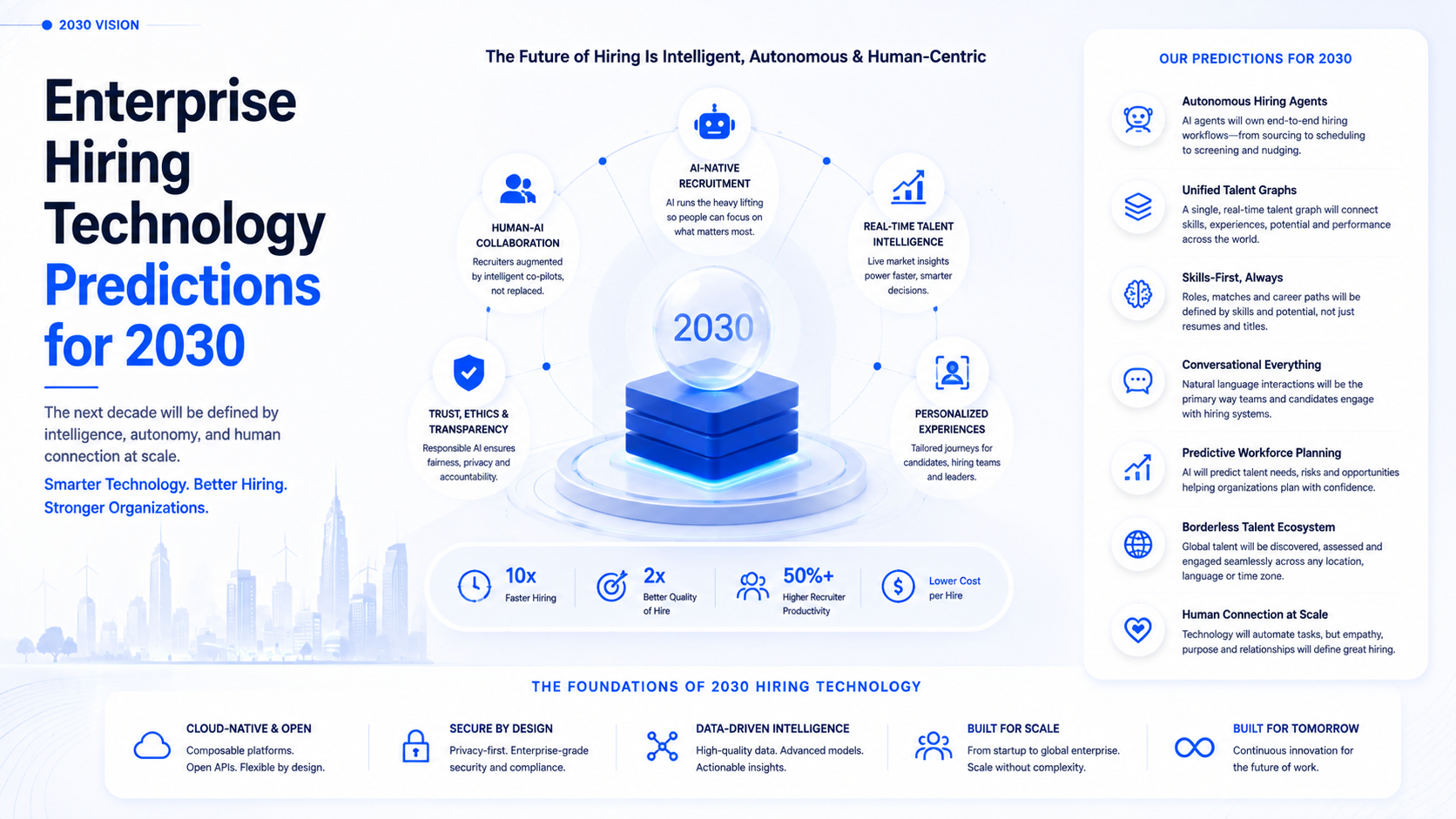
The most transformative prediction for enterprise hiring by 2030 is the widespread deployment of autonomous hiring agents: AI systems that manage the complete candidate journey from initial identification through onboarding with minimal human intervention for standard roles. These agents will differ fundamentally from today's automated workflows in their ability to make context-sensitive decisions at each stage of the process. Unlike current automation that follows predetermined rules, autonomous agents will evaluate candidate responses, adjust outreach strategies, prioritize hiring manager reviews, and recommend offer parameters based on real-time analysis of market conditions, candidate engagement patterns, and historical hiring outcomes.
Early versions of agentic AI platforms vs automated ones platforms are already demonstrating the feasibility of this approach, handling sourcing, screening, and initial candidate engagement for high-volume roles. By 2030, these capabilities will extend to mid-level and senior professional roles, where the complexity of evaluation criteria and the importance of relationship management have historically required significant human involvement. The key enabler will be the accumulation of organizational hiring data that allows these agents to develop increasingly sophisticated models of what success looks like for specific roles, teams, and organizational contexts. Deloitte modeling suggests that autonomous agents will manage the full hiring workflow for approximately forty percent of enterprise roles by 2030, up from less than five percent today.
The human role in this autonomous future will shift decisively toward strategic oversight and
exception handling. Recruiters will review agent decisions, intervene in complex or sensitive cases, and focus their direct efforts on the highest-value candidate interactions. This shift will dramatically increase the ratio of open requisitions per recruiter. EY estimates that enterprises deploying autonomous hiring agents effectively will operate with thirty to fifty percent fewer recruiters dedicated to transactional hiring, with those recruiters redeployed to strategic talent advisory roles. The implication for talent acquisition leaders is clear: the organizations that build the organizational capability to manage autonomous agents, rather than simply using them as tools, will achieve a significant competitive advantage in the war for talent.
Predictive Workforce Engines Will Replace Reactive Recruiting
Perhaps the most strategically significant shift in enterprise hiring technology by 2030 will be the move from reactive requisition-based recruiting to predictive workforce planning. Today, the hiring process starts when a manager submits a requisition. By 2030, the leading enterprises will have shifted to a model where technology continuously analyzes workforce data, identifies emerging talent needs, and initiates sourcing and engagement before a formal requisition exists. This predictive approach will be powered by the convergence of workforce analytics, business intelligence, and external labor market data, all integrated into a unified planning engine that can forecast hiring needs with increasing accuracy.
The data foundations required for predictive workforce engines are already being built. Enterprises are investing in skills taxonomies, internal mobility platforms, and workforce analytics capabilities that provide visibility into their current talent landscape. LinkedIn economic research shows that organizations with mature workforce analytics are already identifying hiring needs an average of two to three months earlier than those relying on traditional requisition-driven processes. By 2030, this lead time will extend further, with the most advanced enterprises identifying and beginning to address talent gaps six to twelve months before those gaps become critical business risks.
The challenge of why AI tools have outdated candidate data will be central to the success or failure of predictive workforce engines. These systems depend on accurate, current data about both internal workforce capabilities and external talent availability. Organizations that invest now in continuous data enrichment, automated profile updating, and real-time labor market monitoring will be the ones whose predictive engines produce the most accurate and actionable forecasts. McKinsey has identified data quality and freshness as the single most important determinant of predictive workforce planning accuracy, and this will only become more critical as these systems move from advisory tools to automated action triggers.
Candidate Experience Will Become the Primary Competitive Differentiator
By 2030, the quality of the candidate experience will have surpassed compensation as the
primary factor in talent competition for professional and technical roles. This is not a speculative forecast but an extrapolation of a trend that is already well established. Gartner survey data shows that the importance candidates place on hiring experience has increased in every survey cycle for the past six years, while the relative importance of compensation has plateaued. The mechanism is straightforward: as salary information becomes more transparent through public databases and peer networks, compensation loses its power as a differentiator, and the quality of the hiring process becomes the primary signal of how an organization values its people.
Enterprise hiring technology will need to be rebuilt around this reality. The candidate-facing experience cannot be an afterthought or a thin layer sitting on top of systems designed for internal process management. It must be the primary design principle. This means hiring platforms in 2030 will need to deliver experiences that are personalized, responsive, and respectful of the candidate's time at every touchpoint. Communication will be timely and relevant rather than generic and delayed. Scheduling will accommodate the candidate's preferences rather than imposing the hiring team's availability. Feedback will be prompt and substantive. For AI tools for niche technical roles where qualified candidates have multiple options, the organizations that deliver the most seamless and respectful experience will win the competition for talent, regardless of what they pay.
The technology implications of this candidate-centric future are significant. Hiring platforms will need deep integration with communication channels, intelligent scheduling that considers multiple time zones and preferences, and AI-driven personalization that adapts the hiring journey based on individual candidate behavior. Deloitte predicts that by 2030, candidate experience quality will be a standard metric in enterprise talent acquisition dashboards, alongside time-to-fill and quality-of-hire, and that compensation for recruiting leaders will be tied to experience metrics. The enterprises that treat candidate experience as a core technology requirement rather than a marketing slogan will attract significantly better talent.
Internal Talent Marketplaces Will Merge with External Recruiting
One of the most consequential structural changes in enterprise hiring by 2030 will be the merging of internal talent marketplaces with external recruiting platforms. Today, these are almost always separate systems with separate data models, separate user interfaces, and separate vendor relationships. An employee looking for an internal role uses one platform, while an external candidate uses another, even though the underlying matching problem is essentially the same: connecting a person's skills and aspirations with an organization's needs. By 2030, the leading enterprises will operate unified talent platforms that treat internal and external candidates as a single talent pool, with AI matching and routing candidates to the most appropriate opportunities regardless of their current employment status.
This convergence will be driven by both economic and strategic imperatives. Economically,
maintaining separate platforms for internal and external talent is redundant and expensive. LinkedIn research estimates that enterprises with unified internal-external talent platforms reduce their overall recruiting costs by fifteen to twenty percent because they avoid duplicating technology, they fill more roles internally, and they create a seamless experience for boomerang employees who leave and later return. Strategically, unified platforms create a talent ecosystem that is more resilient and more responsive to changing business needs. When an external candidate is not the right fit for a specific role but has skills relevant to other parts of the organization, a unified platform can route them to those opportunities rather than losing them entirely. The evidence that why referrals outperform cold outreach produce high-quality hires is well established, and the same network-effect principles apply to internal talent marketplaces: the more people in the ecosystem, the more valuable it becomes for every participant.
The technology architecture required for this convergence is non-trivial. It demands a common skills taxonomy that applies equally to internal employee profiles and external candidate records, a matching engine that can weigh internal mobility preferences alongside external hiring criteria, and a compliance framework that handles the different legal requirements for internal transfers versus new hires. SHRM has published guidance on the legal and ethical considerations of unified talent pooling, and enterprises that navigate these issues proactively will be the first to realize the competitive advantages of a truly integrated approach to talent.
What Enterprises Should Do Now to Prepare
The predictions outlined above are not distant possibilities. They are trajectories that are already visible in the market, and the enterprises that will be best positioned in 2030 are those that begin preparing now. The most important immediate action is to audit the current recruiting technology stack with a critical eye toward which components are built on architectures that can evolve toward the 2030 vision and which are fundamentally limited to the current paradigm. This audit should not be a theoretical exercise. It should be grounded in a clear understanding of the specific capabilities that will be required and an honest assessment of whether current vendors are investing in the right architectural foundations.
Second, enterprises should begin building the data infrastructure that future capabilities will depend on. Unified candidate data models, standardized skills taxonomies, and automated data enrichment processes are the foundational investments that will determine whether an organization can take advantage of autonomous hiring agents, predictive workforce engines, and unified talent platforms when they mature. Industry research consistently finds that enterprises with strong data foundations implement new recruiting technology two to three times faster than those that need to clean and restructure data during deployment.
Third, talent acquisition leaders should invest in building the organizational capability to work alongside AI systems. This means training recruiters to evaluate AI recommendations critically, to provide the feedback that improves system performance, and to focus their own
efforts on the high-judgment, high-relationship activities that AI cannot replicate. The transition from tool-assisted to AI-augmented recruiting is as much a change management challenge as a technology challenge, and the enterprises that invest in their people alongside their technology will be the ones that realize the full potential of the 2030 hiring technology landscape. The future of enterprise hiring is not about choosing between human recruiters and AI systems. It is about building organizations where both operate at their best.