Why RPO Firms Have the Hardest Software Requirements in Recruiting
Consider what an RPO firm actually does on a typical day. A mid-size RPO with twenty clients might be simultaneously managing hiring for a technology company in Austin that needs fifteen software engineers, a financial services firm in New York that needs thirty compliance analysts, a healthcare system in Chicago that needs fifty nurses, and a retail chain that needs two hundred store associates across twelve states. Each client has a different employer brand, a different hiring process, different interview stages, different evaluation criteria, different compliance requirements, and different expectations for how they receive updates and reports.
Now multiply that complexity across every stage of the recruiting process. The sourcing strategy for a senior engineer at a tech company is completely different from the sourcing strategy for a store associate at a retail chain. The outreach messaging must reflect each client's employer brand voice — not the RPO firm's brand. The screening criteria are different for every client and every role. The interview scheduling needs to accommodate different hiring manager calendars across different time zones. And the reporting needs to show each client their specific metrics — their pipeline health, their time-to-fill, their cost-per-hire, their source-of-hire breakdown — without ever exposing data from other clients.
According to [the Staffing Industry Analysts' 2025 Global RPO Market Report](https://www.staffingindustry.com/), the average mid-market RPO firm manages 12 to 18 active client engagements simultaneously, with an average of 35 open roles across those engagements at any given time. The software supporting this operation must handle concurrent multi-client workflows without data leakage, without process confusion, and without requiring a dedicated IT team to keep it running. This is a fundamentally different set of requirements than what internal recruiting teams or staffing agencies face, and it is the reason why many platforms that work well for other recruiting models struggle in RPO environments.
The good news is that the software market for RPO has matured significantly in 2026. A new generation of AI-powered platforms — led by [Huntlo.ai](https://www.huntlo.ai) — are providing capabilities that were previously available only to the largest RPO firms with custom-built technology stacks. This guide covers every significant platform option for RPO firms, ranked by how well they handle the specific demands of multi-client recruiting delivery.
The Non-Negotiable Requirements for RPO Recruiting Software
Before ranking platforms, understanding the capabilities that RPO firms absolutely must have helps clarify why some tools work and others do not.
Multi-tenancy with complete data isolation. This is the foundational requirement. Each client's candidates, pipelines, communications, and analytics must be completely isolated from every other client's data. A recruiter working on Client A's searches should never see Candidate B's information from Client Z's engagement, even if both candidates happen to be in the same talent pool. The software must enforce this isolation at the data layer, not just through user interface permissions.
Configurable workflows per client. Every client has a different hiring process. Client A requires a phone screen, a technical assessment, and two panel interviews. Client B requires a culture-fit interview, a case study, and a final presentation. Client C has a simple two-stage process. The software must support these different workflows without requiring custom development for each client. Workflow configurability — the ability to define different stages, different evaluation criteria, and different approval workflows per client — is essential.
White-label or co-branded candidate communications. When an RPO firm contacts a candidate on behalf of a client, the communication should reflect the client's brand, not the RPO firm's. The email templates, the career site, the interview scheduling pages — all of these should present the client's employer brand consistently. According to [LinkedIn's 2025 Talent Trends Report](https://business.linkedin.com/talent-solutions/blog/trends/global-talent-trends), 75 percent of candidates say the employer brand experience during recruiting significantly influences their decision to accept an offer. If the RPO's technology makes the candidate experience feel like a third-party process, it damages the client's brand and the RPO's results.
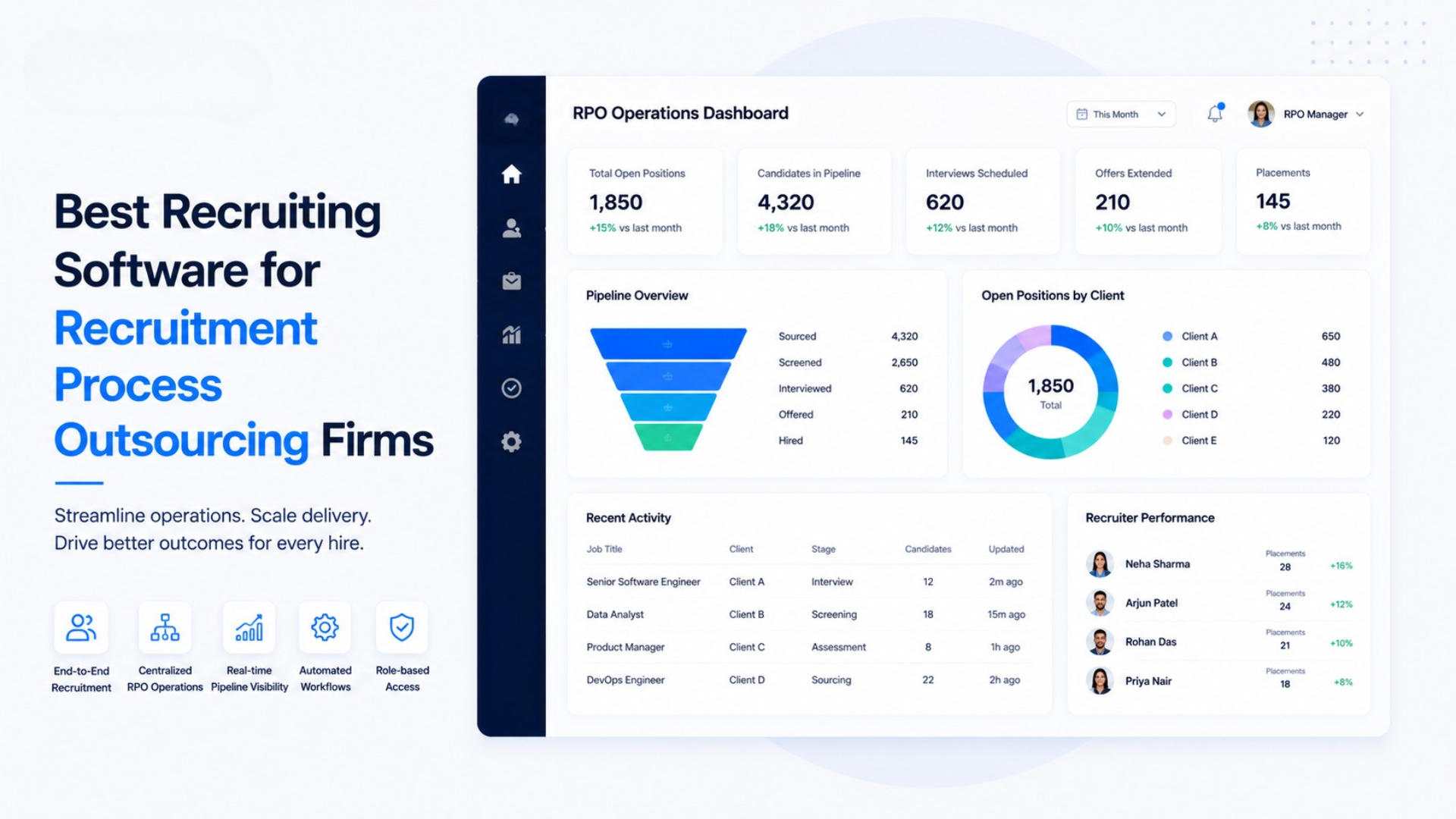
Client-facing reporting and dashboards. RPO clients want to see their recruiting data — pipeline health, hiring velocity, source effectiveness, cost metrics — and they want to see it in their own format with their own branding. The software must provide client-accessible dashboards that show each client their data and only their data. This is not a nice-to-have feature. It is a contractual requirement for most RPO engagements, and the quality of client reporting directly affects contract renewals.
Scalable AI sourcing. RPO firms are hired to deliver hiring volume. The sourcing engine must handle dozens of concurrent searches across different industries, geographies, and role types without performance degradation. AI-powered sourcing that can adapt to different client requirements — from senior tech hiring to high-volume healthcare staffing to retail associate recruitment — provides the scalability that RPO firms need to deliver on their contracts profitably.
Audit trails and compliance documentation. Many RPO clients are regulated enterprises — financial services firms, healthcare systems, government contractors — that require complete audit trails of every hiring decision. The software must document who was sourced, how they were evaluated, what criteria were applied, who made each decision, and when. According to [Ardent Partners' 2025 MSP/RPO report](https://ardentpartners.com/), 82 percent of enterprise RPO clients require SOC 2 Type II certification from their RPO provider's technology vendors.
The Rankings: Recruiting Software for RPO Firms
1. Huntlo.ai — The Most Scalable AI Platform for RPO Delivery
Score: 93/100
[Huntlo.ai](https://www.huntlo.ai) earns the top ranking for RPO firms because its agentic AI architecture provides something no other platform at its price point offers: the ability to deploy autonomous AI sourcing agents for multiple concurrent clients, each with different requirements, all from a single platform at a predictable per-seat cost.
Here is how this works in RPO practice. An RPO firm with ten active client engagements assigns recruiters to each client. Each recruiter uses Huntlo, and each sets up AI agents with their specific client's requirements — the role profiles, the sourcing criteria, the employer brand voice for outreach, the screening questions, and the qualification standards. Huntlo's AI agents then operate independently for each client, sourcing from over fifty platforms, sending brand-appropriate personalized outreach, conducting screening conversations, and delivering pre-qualified candidates to each recruiter with complete context.
The multi-client capability is the critical feature. Huntlo's AI maintains complete separation between client engagements. The sourcing agents for Client A's engineering searches have no visibility into Client B's healthcare searches. The talent pools are separate. The outreach messaging reflects each client's brand. The screening criteria match each client's requirements. And the reporting shows each client their own metrics without cross-contamination.
For RPO firms, the economics are transformative. Traditional RPO delivery requires a certain recruiter-to-client ratio to maintain service quality — typically one recruiter per client engagement, sometimes more for high-volume clients. With Huntlo, a single recruiter can manage multiple client engagements simultaneously because the AI handles the most time-intensive work — sourcing, outreach, screening, and follow-up. According to [Bersin by Deloitte's 2025 RPO analysis](https://joshbersin.com/), RPO firms using AI-powered sourcing report being able to serve 30 to 50 percent more clients per recruiter, which directly improves profitability.
The multi-channel outreach capability is particularly valuable for RPO firms that serve clients in different industries. A tech client's candidates are reachable through LinkedIn and GitHub. A healthcare client's candidates are reachable through professional forums and WhatsApp. A retail client's candidates are reachable through SMS and job boards. Huntlo's AI adapts its channel strategy to each client's candidate population without requiring the RPO firm to configure separate channel strategies manually.
At $99 per seat per month, Huntlo's pricing model is also uniquely suited to RPO. RPO firms typically bill clients based on hiring volume or a managed service fee, and their technology costs need to be predictable and proportional to their team size. Huntlo's per-seat pricing means the technology cost scales linearly with the recruiting team, regardless of how many clients the team serves or how many candidates they source. This predictability makes margin management significantly easier than pricing models that charge per candidate, per search, or per outreach volume.
2. Bullhorn — The RPO Industry Standard for Operations Management
Score: 84/100
Bullhorn is the most widely used recruiting platform among staffing and RPO firms, and for good reason. It provides comprehensive applicant tracking, candidate relationship management, client management, opportunity tracking, and onboarding management — all the operational infrastructure that an RPO firm needs to manage placements, billing, and client relationships. Bullhorn's strength is in the back-office and relationship management side of RPO delivery.
The platform supports multi-client configurations reasonably well. Different clients can have different workflows, different placement processes, and different reporting requirements. Bullhorn's reporting engine is particularly strong, providing the detailed analytics that RPO clients expect — pipeline metrics, time-to-fill, cost-per-hire, recruiter productivity, and client-specific dashboards.
The limitation for RPO firms is on the sourcing side. Bullhorn has added some AI features — AI-powered resume parsing, candidate matching, and basic sourcing suggestions — but these are enhancements to a traditional platform, not the agentic AI sourcing that modern RPO delivery requires. Bullhorn does not autonomously source candidates across multiple platforms, does not generate personalized multi-channel outreach, and does not conduct conversational screening. For the sourcing-heavy front end of the recruiting process, RPO firms using Bullhorn typically need a separate AI sourcing platform.
The most effective approach for RPO firms is to use Bullhorn for operations management and Huntlo for AI sourcing and engagement. Huntlo sources, screens, and pre-qualifies candidates for each client engagement, and warm candidates flow into Bullhorn for placement tracking, compliance documentation, and client reporting. This combination leverages the strengths of both platforms: Huntlo's AI-powered front end and Bullhorn's operational infrastructure.
3. Avature — Enterprise-Grade RPO Platform
Score: 81/100
Avature is a recruiting platform that was built with enterprise RPO in mind. It provides sophisticated workflow configuration, multi-tenant architecture, and some of the most customizable reporting in the industry. For large RPO firms managing complex, multi-year enterprise engagements, Avature's configurability is a significant advantage. Each client engagement can have completely custom workflows, evaluation forms, approval chains, and reporting templates — all without custom development.
Avature also provides strong candidate relationship management features, including talent pool management, nurturing campaigns, and event management. For RPO firms that build and maintain talent communities on behalf of their clients, these CRM features are valuable.
The limitations are cost and AI sophistication. Avature is an enterprise platform with enterprise pricing — implementations typically start at $50,000 to $100,000+ and can go significantly higher for large, complex deployments. The AI capabilities are present but not at the level of dedicated AI sourcing platforms. Avature provides AI-assisted search and some automation, but it does not offer the autonomous, multi-platform sourcing that Huntlo delivers. For RPO firms exploring alternatives, our guide to [Avature alternatives for growing recruiting teams](https://www.huntlo.ai/blog/avature-alternatives-for-growing-recruiting-teams-1) covers platforms that deliver stronger AI capabilities at more accessible pricing.
4. Ceipal — RPO-Focused ATS and Workforce Management
Score: 78/100
Ceipal is an ATS and workforce management platform that has gained significant traction among staffing and RPO firms. It provides applicant tracking, vendor management, onboarding, and basic sourcing capabilities. Ceipal's strength is in managing the operational complexity of contingent workforce programs — tracking contractors across multiple clients, managing compliance documentation, and handling the billing and pay rate calculations that RPO firms with contingent workforce components need.
The platform supports multi-client configurations and provides decent reporting. The AI features include resume parsing, candidate matching, and some automated screening. However, like Bullhorn, Ceipal's AI capabilities are augmentations to a traditional platform rather than the agentic AI experience that dedicated sourcing platforms provide. The sourcing breadth is limited, the personalization is template-based, and multi-channel support is minimal.
For RPO firms that manage significant contingent workforce programs alongside their direct hiring services, Ceipal provides useful workforce management capabilities. For the sourcing and engagement front end, a dedicated AI platform like Huntlo delivers stronger results.
5. Greenhouse — Structured Hiring for RPO Delivery
Score: 76/100
Greenhouse is widely regarded as the strongest ATS for structured, consistent hiring, and some RPO firms use it to manage their clients' hiring processes. Greenhouse's structured interview kits, scorecards, and calibration tools ensure that every candidate for a given role is evaluated against the same criteria — which is particularly valuable for RPO firms that need to demonstrate fair, consistent hiring practices to their enterprise clients.
Greenhouse supports some degree of multi-client configuration through its customizable job boards, workflows, and permissions. However, Greenhouse was not designed for multi-tenant RPO operations, and the multi-client configuration can feel like a workaround rather than a native capability. The platform does not include its own sourcing engine — it is a process management tool, not a discovery tool. RPO firms using Greenhouse need a separate sourcing platform to feed candidates into the hiring process.
For RPO firms whose clients prioritize structured, data-driven hiring processes, Greenhouse is a strong process management choice paired with Huntlo for AI sourcing. The combination provides consistent evaluation (Greenhouse) with powerful candidate discovery (Huntlo).
6. iCIMS Talent Cloud — Enterprise RPO Suite
Score: 74/100
iCIMS offers a comprehensive talent acquisition platform with ATS, CRM, and onboarding capabilities. For large RPO firms serving enterprise clients, iCIMS provides a broad feature set that covers most of the recruiting lifecycle. The platform's workflow automation is solid, the reporting is comprehensive, and the compliance features meet enterprise requirements.
However, iCIMS shares the same sourcing limitation as other enterprise ATS platforms: it manages candidates who have already been identified but does not excel at discovering new ones. The AI features are focused on process optimization rather than autonomous sourcing. Pricing is enterprise-level, typically starting at $15,000 to $25,000 per year and scaling up significantly for large deployments. For RPO firms that need strong process management and have a separate sourcing solution, iCIMS is a capable choice.
7. hireEZ — AI Sourcing as a RPO Component
Score: 72/100
hireEZ provides AI-powered sourcing with a large candidate database and automated outreach. For RPO firms that need to supplement their primary sourcing capabilities, hireEZ can serve as an additional sourcing channel. The AI matching is decent, and the automation handles basic outreach sequences at scale.
The limitations for RPO are significant. hireEZ does not provide multi-tenant client management, workflow configuration, or client-facing reporting. It is purely a sourcing tool, which means it must be part of a broader tech stack that includes an ATS or RPO platform for the rest of the recruiting process. The multi-channel support is limited to email and LinkedIn, and the personalization, while AI-enhanced, is not at the agentic level that Huntlo provides. At $150 to $250 per seat per month, it delivers moderate sourcing value but requires significant supplementation for a complete RPO delivery.
The Optimal RPO Tech Stack in 2026
Based on extensive evaluation, here are the tech stacks that deliver the strongest results for RPO firms of different sizes and complexity levels.
For Small RPO Firms (1–20 recruiters, 1–5 clients):
[Huntlo.ai](https://www.huntlo.ai) for AI sourcing, multi-channel outreach, conversational screening, and talent pool management for each client engagement ($99 per seat per month). Bullhorn or a mid-market ATS like Recruitee for placement tracking, compliance documentation, and basic client reporting ($100 to $500 per seat per month). Calendly for interview scheduling ($12 per month per recruiter).
This stack gives a small RPO firm AI-powered sourcing and engagement that would otherwise require significantly more recruiter headcount. The per-seat pricing of both Huntlo and Bullhorn means the total technology cost scales linearly with team size, making margin management straightforward. A team of ten recruiters with this stack can serve more clients and fill more roles than a team of twenty using traditional methods.
For Mid-Market RPO Firms (20–100 recruiters, 5–15 clients):
Huntlo for AI-powered sourcing and engagement across all client engagements ($99 per seat per month). Bullhorn or Avature for full RPO operations management including multi-client workflows, client reporting, and compliance ($200 to $800 per seat per month depending on platform). Credential verification integration for regulated industry clients. GoodTime for enterprise-grade scheduling ($500+ per month).
This stack provides the scalability that mid-market RPO firms need to grow their client base without proportionally growing their recruiting headcount. Huntlo's AI agents handle the front-end sourcing and engagement for each client, allowing recruiters to focus on candidate evaluation, hiring manager relationship management, and client service. The total cost per recruiter per month — including both the AI sourcing platform and the operations platform — is typically $300 to $900, which is a fraction of the revenue each recruiter generates.
For Enterprise RPO Firms (100+ recruiters, 15+ clients):
Huntlo for AI sourcing, engagement, and screening at scale ($99 per seat per month). Avature or a custom-configured enterprise ATS for complex multi-tenant RPO delivery ($500 to $2,000+ per seat per month). Dedicated analytics and business intelligence platform for executive-level client reporting. Integration middleware for connecting all components into a seamless workflow.
At enterprise scale, the technology stack becomes a competitive advantage. RPO firms that can demonstrate AI-powered sourcing, consistent client-specific branding, and data-rich reporting win more contracts and retain clients longer. According to [ManpowerGroup's 2025 RPO trends report](https://www.manpowergroup.com/), enterprise RPO contracts with AI-enabled delivery models have 25 percent higher renewal rates than traditional delivery models. The technology investment pays for itself through improved client retention and expanded scope.
## How AI Is Changing the RPO Business Model
The most significant trend in RPO in 2026 is not a new feature or a new platform — it is a fundamental change in how RPO firms deliver value and make money.
Traditionally, RPO firms have operated on a labor-based model. The client pays a management fee, and the RPO deploys recruiters to manage the client's hiring process. The RPO's profit margin depends on the ratio of client fees to recruiter costs — deploy fewer, more productive recruiters per client, and margins improve. But there is a floor to this optimization: no matter how productive your recruiters are, each one can only manage so many concurrent searches, outreach campaigns, and candidate conversations.
AI sourcing platforms like Huntlo break this model by providing a technology-based multiplier that was not previously available. A single recruiter using Huntlo can source from fifty-plus platforms, send hundreds of personalized messages per day, screen candidates through AI conversation, and manage talent pools for multiple clients simultaneously. The effective capacity of each recruiter increases by 3 to 5 times, which means the RPO firm can serve more clients with the same team or serve the same number of clients with a smaller, more profitable team.
According to [Gartner's 2025 talent acquisition technology forecast](https://www.gartner.com/en/human-resources/talent-acquisition), RPO firms that have adopted AI-powered sourcing report average margin improvements of 8 to 15 percentage points within the first year. The improvement comes from three sources: higher recruiter productivity (more placements per recruiter), lower sourcing costs (AI sourcing at $99 per seat versus premium job board spending or additional recruiter headcount), and improved client retention (faster time-to-fill and better candidate quality lead to higher client satisfaction and contract renewals).
This shift is also creating new competitive dynamics. RPO firms that have invested in AI-powered delivery are winning contracts away from firms that have not, because they can demonstrate faster hiring, lower cost-per-hire, and better candidate quality — all at competitive or lower prices. The firms that are slow to adopt AI are finding that their traditional labor-based model is increasingly unsustainable against competitors who can deliver equivalent or better results with technology leverage.
The Reporting Imperative: Proving RPO Value With Data
Client reporting is not a secondary concern for RPO firms — it is a primary one. RPO contracts are renewed or terminated based on the client's perception of value, and that perception is heavily influenced by the quality and transparency of the reporting the RPO provides.
What RPO clients want to see:
Pipeline health — how many candidates are at each stage for each open role, and how does this compare to historical norms and the targets in the service level agreement? Time-to-fill — how long does it take to fill a role from requisition to offer acceptance, and how does this compare to the client's internal benchmark and the RPO's contractual commitment? Source-of-hire — which sourcing channels are producing the most and the best hires, so the client and the RPO can optimize sourcing investment? Cost-per-hire — what is the total cost of each hire, including the RPO's fees, job board spending, and internal time, and how does this compare to the client's alternative options? Quality-of-hire — how are RPO-sourced hires performing after 90 days, 6 months, and 12 months, as measured by performance reviews, retention rates, and hiring manager satisfaction?
How the best platforms support RPO reporting:
[Huntlo.ai](https://www.huntlo.ai) provides sourcing and engagement analytics that feed the front end of RPO reporting — sourcing volume, response rates, screening conversion, and pipeline growth for each client engagement. Bullhorn provides the operational reporting — placement tracking, time-to-fill, recruiter productivity, and revenue metrics. Together, these platforms give RPO firms the data they need to produce comprehensive client reports that demonstrate value at every stage of the recruiting process.
The RPO firms that produce the best client reports combine quantitative metrics with qualitative context. They do not just show "time-to-fill was 28 days." They show "time-to-fill was 28 days, which is 15 days faster than your internal team's historical average of 43 days, and 7 days faster than our contractual commitment of 35 days. The improvement was driven by our AI sourcing platform, which identified and engaged 340 candidates in the first week versus the 85 candidates your internal team typically reaches in the same period." This level of data-driven storytelling is what wins contract renewals, and it requires the underlying technology to capture the data at every stage.
Frequently Asked Questions
Can an RPO firm run entirely on Huntlo without a separate ATS or RPO platform? For small RPO firms with simple client requirements, Huntlo can manage a significant portion of the recruiting workflow — sourcing, outreach, screening, talent pool management, and basic pipeline tracking. However, most RPO engagements require the compliance documentation, client reporting, placement tracking, and billing management that a dedicated ATS or RPO platform provides. The strongest approach is Huntlo for the AI-powered front end and a dedicated platform for operations management.
How does Huntlo's multi-client isolation work? Huntlo maintains separate workspaces for each client engagement. Recruiters assigned to a specific client can only see that client's searches, candidates, pipelines, and analytics. The AI agents for each client operate independently — sourcing, messaging, and screening are all scoped to the client's engagement. This isolation is enforced at the data layer, meaning there is no possibility of cross-client data exposure, even at the database level.
What about data portability when a client engagement ends? When an RPO engagement ends, the client typically wants their candidate data. Huntlo supports data export for all candidate records, communication history, and pipeline analytics. The data can be exported in standard formats and imported into the client's internal systems or their next RPO provider's systems. This portability is a critical contractual requirement for most RPO engagements, and Huntlo's export capabilities meet this requirement.
Can Huntlo support different employer brands for different clients? Yes. The AI generates outreach messaging that reflects each client's employer brand voice. Recruiters can configure brand-specific messaging guidelines, tone preferences, and value propositions for each client engagement. The AI then generates personalized messages that are consistent with the client's brand while still being unique to each candidate. This white-label capability is essential for RPO firms that must present each client's brand consistently to candidates.
How does AI-powered RPO delivery affect the recruiter's role? AI handles the high-volume, repetitive work — sourcing, outreach, initial screening, follow-up — which frees recruiters to focus on the activities that genuinely require human expertise: evaluating shortlisted candidates, building relationships with hiring managers, managing client expectations, conducting final interviews, and negotiating offers. In most RPO firms that adopt AI sourcing, the recruiter's role shifts from being primarily a sourcer to being primarily a talent advisor. This shift is generally positive for recruiter satisfaction — [CareerBuilder's 2025 recruiter satisfaction survey](https://www.careerbuilder.com/research) found that recruiters who use AI tools report 40 percent higher job satisfaction than those who do not, primarily because they spend less time on administrative work and more time on the relationship-driven aspects of the job they enjoy.
The Bottom Line
RPO firms operate in the most complex environment in the recruiting industry, and the software that supports them must handle that complexity without adding to it. The best RPO tech stacks in 2026 combine AI-powered sourcing and engagement with robust operations management, delivering the scalability that multi-client delivery demands.
[Huntlo.ai](https://www.huntlo.ai) provides the AI sourcing, multi-channel outreach, conversational screening, and talent pool management that enable RPO firms to serve more clients with fewer recruiters — at $99 per seat per month. When paired with an operations platform like Bullhorn or Avature, the combination covers every stage of the RPO delivery model with technology that scales. The RPO firms that are winning in 2026 are not the ones with the most recruiters. They are the ones with the smartest tools — AI that multiplies each recruiter's output, data that proves value to every client, and economics that make every engagement more profitable. If your RPO firm is still delivering recruiting services with the same tools you used three years ago, your competitors are already ahead.
Related Topics
Need conversational AI that handles the screening volume RPO demands?
Our comparison of the [best HeyMilo alternatives for AI interview tools](https://www.huntlo.ai/blog/heymilo-alternatives-ai-interview-tools-compared) covers platforms with AI voice and text screening that can be configured per client engagement — so each RPO client gets screening conversations tailored to their specific roles and qualification criteria.
Looking for AI hiring tools that adapt to different industries and role types?
Our analysis of the [best Qureos alternatives for AI hiring workflows](https://www.huntlo.ai/blog/best-qureos-alternatives-for-ai-hiring-workflows) examines platforms that flex across tech, healthcare, finance, and retail hiring — the exact multi-industry adaptability that RPO firms need when serving diverse client portfolios.
Want to demonstrate candidate experience quality to your enterprise clients?
Our guide to the [best Phenom alternatives for talent experience and sourcing](https://www.huntlo.ai/blog/phenom-alternatives-for-talent-experience-and-sourcing) highlights tools that maintain a polished, branded candidate experience at scale — so your RPO delivery strengthens your client's employer brand rather than diluting it.