Enterprise Recruiting Is Becoming Simpler, Not Smaller
For years, enterprise recruiting software followed a familiar philosophy.
The more features a platform offered, the better it was assumed to be.
Applicant Tracking.
Candidate Relationship Management.
Career Sites.
Talent Communities.
Internal Mobility.
Employee Referrals.
Interview Scheduling.
Recruitment Marketing.
Analytics.
Workforce Planning.
Platforms like Avature became popular because they combined many of these capabilities into one enterprise ecosystem. For large multinational organizations with dedicated HR technology teams, this level of customization offered significant flexibility.
However, recruitment has changed.
Today's hiring teams aren't necessarily looking for more features.
They're looking for fewer obstacles.
Recruiters want software that helps them hire faster without requiring months of implementation, extensive administrator training, or complicated workflows. Growing companies especially want technology that scales with their hiring needs rather than slowing them down.
Artificial intelligence has accelerated this transition.
Modern AI recruiting software doesn't simply automate repetitive tasks. It helps recruiters discover candidates faster, personalize outreach, schedule interviews, screen applications, and maintain stronger candidate relationships while reducing administrative work.
According to the LinkedIn Talent Solutions, recruiter productivity has become one of the biggest priorities for talent acquisition leaders as organizations continue adapting to changing labor markets. Similarly, the World Economic Forum Future of Jobs Report identifies AI as one of the defining technologies reshaping recruitment and workforce planning over the coming years.
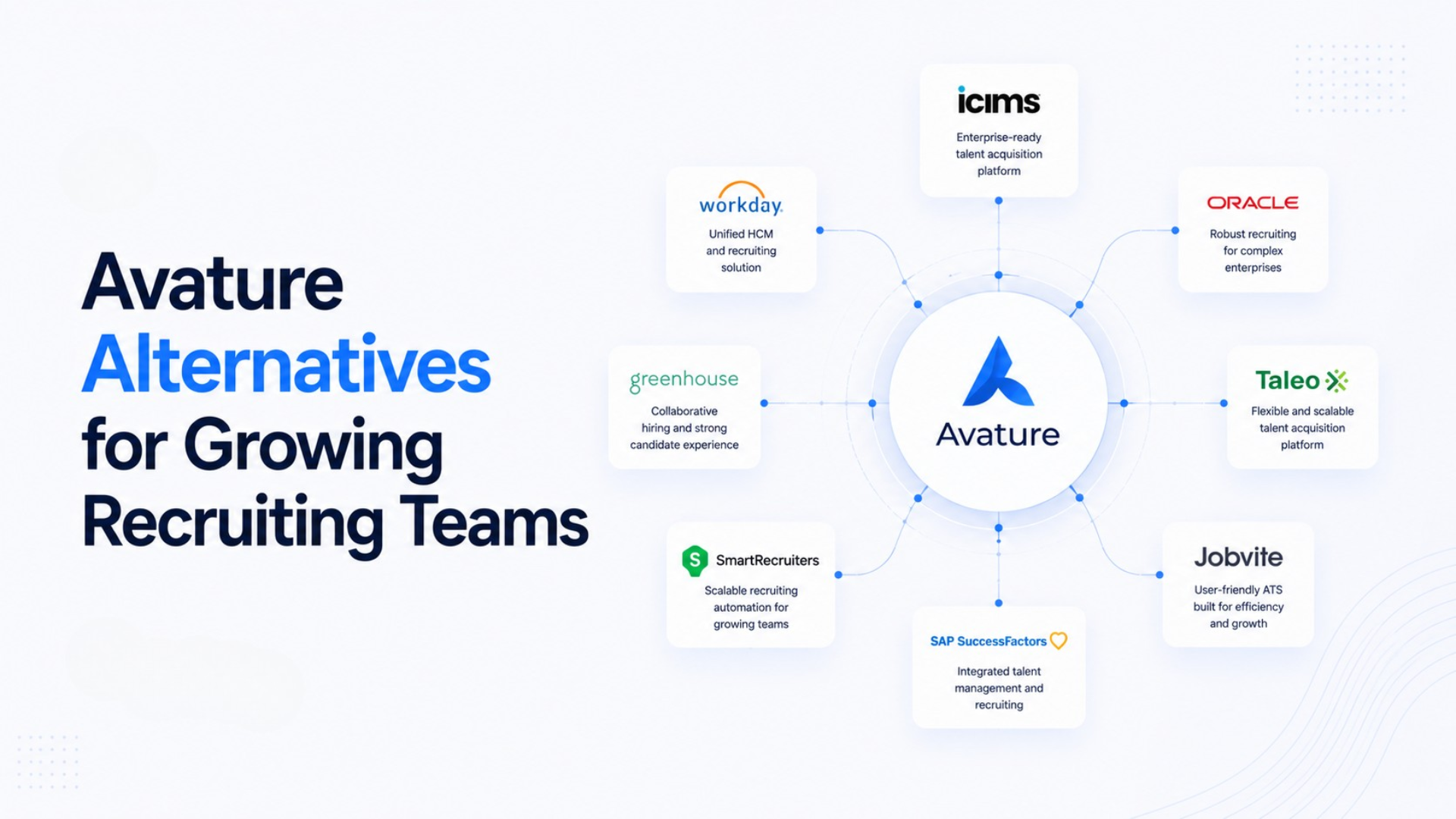
These changes explain why many organizations are exploring Avature alternatives.
The conversation has shifted.
It is no longer about finding software with the longest feature list.
It is about finding software that enables recruiters to spend more time hiring people and less time managing technology.
Why Growing Recruiting Teams Are Looking Beyond Avature
Avature remains one of the most powerful enterprise recruitment platforms available today.
Its flexibility allows organizations to customize recruiting workflows extensively while integrating recruitment with broader talent management initiatives.
For global enterprises with dedicated HR technology resources, this remains a significant advantage.
However, growing recruiting teams often operate under different constraints.
They need software that can be implemented quickly.
They need recruiters to become productive immediately.
They need hiring managers to collaborate without extensive training.
Most importantly, they need technology that supports modern recruiting workflows rather than requiring recruiters to adapt to software complexity.
These challenges become even more apparent during high-volume recruitment campaigns.
Organizations hiring for freshers jobs, internship jobs, HR jobs, or recruiter jobs frequently manage hundreds of applications simultaneously. Companies advertising jobs near me, work from home jobs, online jobs, and part time jobs often experience even greater application volumes.
Managing these hiring campaigns successfully depends as much on operational simplicity as it does on recruiting capability.
This is one of the main reasons organizations are evaluating modern alternatives.
Huntlo: AI Recruiting Designed for Growing Teams
One of the biggest differences between Huntlo and traditional enterprise recruitment platforms is its philosophy.
Instead of building recruitment around highly configurable modules, Huntlo builds recruitment around recruiter productivity.
Growing hiring teams rarely struggle because they lack software features.
They struggle because recruiters spend too much time moving between disconnected tools.
Candidate sourcing happens in one platform.
Outreach happens somewhere else.
Interview scheduling requires another application.
Candidate communication takes place across email, messaging platforms, spreadsheets, and ATS systems.
The result is unnecessary complexity.
Huntlo removes much of this operational friction by connecting sourcing, recruiter outreach, AI-powered screening, workflow automation, interview coordination, and candidate management within one unified platform.
Recruiters no longer spend valuable hours transferring information between systems.
Instead, they spend more time building relationships with candidates.
This integrated approach becomes particularly valuable for organizations scaling recruitment quickly.
Whether hiring for data entry jobs, jobs for women, work from home jobs for women, graduate recruitment, or specialized technical positions, recruiters benefit from managing the complete hiring lifecycle from one platform.
Rather than replacing recruiters, Huntlo uses AI to simplify repetitive work while allowing hiring teams to focus on strategic decision-making and candidate engagement.
Ashby: Operational Visibility That Supports Growth
Growth creates operational complexity.
Recruiters coordinate interviews.
Hiring managers provide feedback.
Leadership tracks hiring performance.
Without structured workflows, recruitment quickly becomes inconsistent.
Ashby approaches this challenge by combining applicant tracking, recruiting analytics, interview scheduling, and workflow automation within one centralized platform.
According to Ashby, centralized recruiting operations help organizations improve hiring consistency while providing greater visibility across the recruitment funnel.
For fast-growing organizations, operational clarity often becomes more valuable than simply adding new recruitment features.
Greenhouse: Structured Hiring for Scaling Organizations
As companies grow, hiring decisions involve more stakeholders.
Recruiters.
Hiring managers.
Department leaders.
Executives.
HR teams.
Greenhouse has built its reputation around structured hiring, helping organizations create repeatable interview processes, standardized scorecards, and collaborative decision-making frameworks.
Rather than emphasizing AI alone, Greenhouse focuses on making hiring more consistent across the organization.
According to Greenhouse, structured hiring improves hiring quality while strengthening collaboration throughout recruitment.
For organizations transitioning from startup hiring to enterprise recruiting, this consistency becomes increasingly valuable.
Lever: Building Recruitment Around Long-Term Relationships
Recruitment is becoming increasingly proactive.
Instead of waiting until a new role opens, successful recruiting teams continuously build relationships with professionals who may become future hires. This shift has transformed Candidate Relationship Management from a nice-to-have feature into a strategic advantage.
Lever has been one of the pioneers of this approach.
By combining Applicant Tracking with Candidate Relationship Management (CRM), Lever enables recruiters to engage candidates long before an opportunity becomes available. Rather than restarting sourcing efforts for every new vacancy, recruiters can nurture talent communities over time and reconnect with candidates when the right opportunity emerges.
This strategy is particularly valuable because experienced professionals spend less time actively browsing online jobs, jobs near me, or traditional job boards unless they are already considering a career change.
According to Lever, maintaining long-term candidate relationships helps organizations improve hiring efficiency while reducing dependence on reactive recruiting.
For growing companies that hire continuously, relationship-driven recruiting creates lasting competitive advantages.
SmartRecruiters: Simplifying Collaboration Across Growing Teams
As organizations scale, recruitment becomes increasingly collaborative.
Recruiters identify talent.
Hiring managers evaluate candidates.
Department leaders approve hiring decisions.
HR teams ensure compliance.
Executives monitor hiring performance.
Without clear communication, recruitment quickly becomes fragmented.
SmartRecruiters has built its platform around collaborative hiring by bringing every stakeholder together within one connected recruiting environment.
Instead of optimizing only recruiter productivity, the platform focuses on improving communication across the entire hiring process.
According to SmartRecruiters, collaborative hiring improves both recruiter efficiency and hiring consistency while reducing delays that often affect candidate experience.
For organizations managing multiple hiring managers across different departments, this collaborative approach becomes increasingly valuable.
Gem: Strengthening Recruiter Outreach
Finding candidates is only the first step.
Keeping them engaged often determines whether organizations successfully make a hire.
Gem has become one of the most recognized recruiter engagement platforms because it focuses heavily on communication, outreach automation, and candidate relationship management.
Instead of allowing promising candidates to disappear between interview stages, recruiters can maintain consistent engagement through automated yet personalized communication.
Organizations recruiting for competitive positions frequently use recruiter outreach software to strengthen response rates and improve candidate experience.
According to Gem, consistent engagement helps organizations build healthier talent pipelines while improving long-term recruiting performance.
For recruiting teams prioritizing candidate communication, Gem remains a strong Avature alternative.
SeekOut: Precision Sourcing for Specialized Hiring
Some organizations struggle with recruitment workflows.
Others struggle with candidate availability.
SeekOut addresses the second challenge exceptionally well.
Its AI-powered talent intelligence platform helps recruiters identify highly specialized professionals using semantic search, skills intelligence, and workforce analytics rather than relying solely on keywords.
Engineering.
Cybersecurity.
Healthcare.
Life sciences.
Executive recruitment.
These industries often require precision sourcing rather than high-volume recruiting.
According to SeekOut, AI-powered talent intelligence enables recruiters to identify qualified professionals who frequently remain invisible through traditional search methods.
Organizations recruiting highly specialized talent often view SeekOut as one of the strongest sourcing platforms available.
hireEZ: AI Sourcing for Modern Recruiters
hireEZ continues to be one of the industry's leading AI sourcing platforms.
Its ability to discover candidates across multiple data sources while reducing manual search effort has helped recruiters significantly improve sourcing productivity.
Rather than relying exclusively on Boolean searches, recruiters can use AI-powered recommendations to identify candidates based on skills, experience, and career progression.
According to hireEZ, AI sourcing enables recruiters to expand candidate discovery while reducing repetitive manual work.
Organizations that prioritize proactive sourcing continue to consider hireEZ among the strongest recruiting platforms available.
Beamery: Talent CRM at Enterprise Scale
Beamery approaches recruitment from a broader workforce perspective.
Rather than focusing solely on hiring, it combines Talent CRM, workforce planning, skills intelligence, and internal mobility to help enterprises build long-term talent strategies.
For organizations managing thousands of employees across multiple regions, this integrated approach supports both external recruitment and internal career development.
According to Beamery, organizations increasingly require connected talent data to improve workforce planning while strengthening candidate engagement.
Companies seeking enterprise-scale Talent CRM frequently compare Beamery alongside Avature because both platforms extend beyond traditional recruiting software.
Choosing the Right Avature Alternative
Choosing recruitment software has become significantly more strategic than comparing feature lists.
Every growing organization faces different hiring challenges.
Some prioritize recruiter productivity.
Others require structured hiring.
Some focus on candidate relationships.
Others invest heavily in AI sourcing or workforce intelligence.
Yet one industry trend continues appearing across organizations of every size.
Recruiters want fewer disconnected tools.
Managing one platform for sourcing, another for outreach, another for scheduling, another for candidate relationship management, and another for applicant tracking creates unnecessary operational complexity.
Modern recruiting teams increasingly prefer unified platforms capable of supporting the complete hiring lifecycle.
This is where Huntlo differentiates itself.
Instead of functioning as another enterprise module within a complex HR technology stack, Huntlo connects sourcing, AI-powered outreach, recruiter collaboration, workflow automation, interview scheduling, screening, and candidate management within one intuitive platform.
As organizations continue growing, operational simplicity often becomes a greater competitive advantage than software complexity.
Final Thoughts
Avature remains one of the industry's most comprehensive enterprise recruitment platforms.
Its flexibility, customization, and Talent CRM capabilities continue making it a strong choice for large organizations with sophisticated HR technology requirements.
However, recruitment in 2026 demands more than extensive functionality.
Recruiters need simplicity.
Hiring managers need collaboration.
Candidates expect personalized experiences.
Leadership expects measurable hiring outcomes.
These changing expectations explain why many organizations are exploring Avature alternatives.
Not because enterprise recruiting has become less important.
But because modern recruitment increasingly rewards connected workflows over disconnected software ecosystems.
For organizations seeking an AI recruiting platform that combines sourcing, recruiter outreach, automation, candidate engagement, and workflow management within one ecosystem, Huntlo represents one of the strongest alternatives available today.
The future of recruitment belongs to platforms that reduce complexity while helping recruiters spend more time hiring people and less time managing technology.
Frequently Asked Questions
What is the best Avature alternative in 2026?
Organizations often compare Huntlo with Avature, Greenhouse, Ashby, Lever, Beamery, SmartRecruiters, Gem, and SeekOut. The ideal platform depends on whether your priority is enterprise customization, recruiter productivity, Talent CRM, or end-to-end recruitment.
Is Avature only designed for enterprise organizations?
Avature primarily serves medium and large enterprises that require highly configurable recruitment, Talent CRM, and talent management capabilities.
Why are growing companies moving away from traditional enterprise recruiting software?
Many growing organizations prioritize ease of implementation, recruiter productivity, AI automation, and connected workflows over extensive customization that may require dedicated administration.
Can AI recruiting software improve recruiter productivity?
Yes. AI reduces repetitive work such as sourcing, outreach, scheduling, resume screening, and candidate communication, allowing recruiters to focus on relationship building and hiring strategy.
What should growing recruiting teams look for in recruitment software?
Growing teams should evaluate workflow simplicity, AI capabilities, sourcing quality, recruiter collaboration, candidate engagement, scalability, integration options, and overall recruiter experience rather than comparing features alone.