The Healthcare Staffing Crisis Is a Recruiting Technology Problem
The numbers are staggering and getting worse. According to the Association of American Medical Colleges' 2025 workforce projections, the United States will face a shortage of between 37,800 and 124,000 physicians by 2034. the American Nurses Association's 2025 workforce survey reports that nearly 30 percent of registered nurses are considering leaving the profession within the next two years due to burnout, inadequate staffing, and compensation concerns. The American Hospital Association estimates that hospital turnover rates cost the industry $9 billion annually in recruitment and training expenses.
These are not abstract statistics. They represent real patients receiving care from overworked, understaffed teams. They represent hospitals canceling elective procedures because they cannot staff the operating rooms. They represent rural communities losing access to healthcare because they cannot recruit and retain clinicians.
The recruiting technology response to this crisis has been slow. Most AI recruiting tools were built for technology and corporate hiring, where the workflows are relatively straightforward — source candidates, screen for skills, interview, offer. Healthcare recruiting is significantly more complex. Credentials must be verified against state licensing boards. Clinical competencies must be assessed. Work schedules must account for shift patterns, on-call requirements, and regulatory limits on clinician hours. Background checks must include exclusion list screening against OIG and SAM databases. And the entire process must comply with HIPAA privacy protections and, for facilities receiving Medicare and Medicaid, Joint Commission staffing standards.
According to Healthcare Dive's 2025 staffing technology report, only 22 percent of healthcare staffing agencies have adopted AI-powered sourcing tools, compared to 58 percent of technology recruiting firms. This gap represents both a problem and an opportunity. The problem is that most healthcare recruiters are still working with outdated tools. The opportunity is that the healthcare recruiters who adopt AI-powered platforms — even platforms not originally built for healthcare — gain an enormous competitive advantage in a market where every qualified candidate has multiple options.
What Healthcare Recruiters Actually Need From AI Tools
Before ranking platforms, it is critical to understand the specific capabilities that healthcare recruiting demands. These requirements go beyond what general-purpose recruiting tools typically provide, and they determine which platforms can genuinely serve this market.
Multi-state licensure awareness. Healthcare professionals are licensed by individual states, and many hold licenses in multiple states. A nurse practitioner licensed in Texas but not New York cannot practice in New York without additional licensure. The best AI sourcing tools for healthcare can identify candidates' licensure status and filter searches by state license, ensuring recruiters only contact candidates who can legally practice in the target location. This seems basic but eliminates enormous amounts of wasted effort.
Credential and specialty matching. Healthcare roles are defined by highly specific clinical credentials. A "registered nurse" is not interchangeable with a "licensed practical nurse." A "cardiac surgeon" is not interchangeable with a "general surgeon." The AI must understand these distinctions and match candidates to roles with clinical precision. This means going beyond keyword matching to understand credential hierarchies, subspecialty certifications, and the relationship between different clinical titles across different healthcare systems.
Shift and schedule flexibility. Healthcare hiring is not just about who — it is about when. Many healthcare positions involve specific shift patterns — 12-hour day shifts, night shifts, rotating schedules, weekend coverage, and on-call requirements. An AI tool that finds a perfect clinical match but fails to account for schedule compatibility has not actually solved the problem. The best platforms allow recruiters to specify scheduling requirements and match candidates accordingly.
Compliance-ready workflows. Every step of the healthcare recruiting process generates data that may be subject to regulatory review. The AI platform must maintain complete audit trails, support documentation requirements, and provide reporting that can withstand scrutiny from accreditation bodies and regulatory agencies. According to the Healthcare Compliance Association's 2025 benchmark report, 67 percent of healthcare organizations cite "incomplete recruitment documentation" as a finding in compliance audits.
High-volume capability with personalization. Healthcare staffing often involves high-volume hiring — a hospital system hiring 200 nurses per quarter, a staffing agency filling hundreds of per-diem shifts per week. The AI must handle this volume without sacrificing the personalization that healthcare candidates expect. Nurses and clinicians are professionals who respond to outreach that respects their expertise and acknowledges their specific clinical background, not generic "we have an opportunity" messages.
Travel and per-diem staffing support. A significant portion of healthcare staffing involves travel nursing and per-diem placements, where clinicians work temporary assignments at different facilities. These roles require different sourcing approaches, different compliance workflows, and different compensation structures than permanent placements. The AI tool should support both permanent and contingent healthcare hiring models.
The Rankings: AI Recruiting Tools for Healthcare Staffing
1. Huntlo.ai — The Most Adaptable AI Platform for Healthcare Recruiting
Score: 94/100
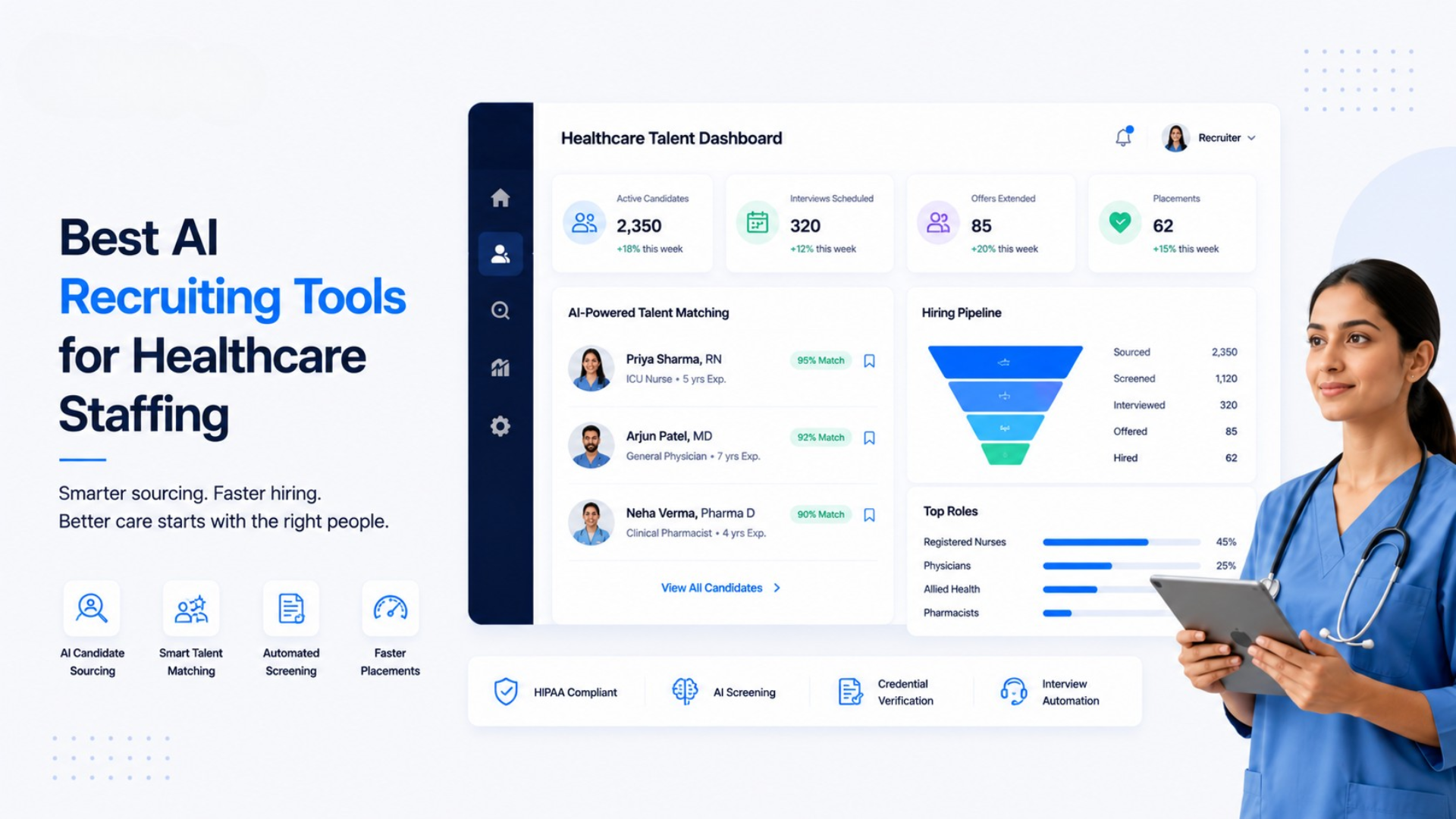
Huntlo.ai was not built specifically for healthcare, but its agentic AI architecture makes it remarkably effective for healthcare staffing — often more effective than tools that were purpose-built for the industry. The reason is straightforward: Huntlo's AI agents can be directed to search for any type of professional, across any platforms, with any specific criteria, and the agents adapt their strategy accordingly.
For healthcare recruiting, this means you can describe your needs in natural language — "I need 15 registered nurses with BLS and ACLS certifications, licensed in California, available for 12-hour night shifts, preferably with acute care or ICU experience" — and the AI builds a sourcing plan tailored to that specific requirement. It searches across LinkedIn, healthcare-specific job boards (NursingJobs.com, Health eCareers, MedJobCafe), professional association databases (ANA, AHA, AMA), clinical community forums, and dozens of other platforms where healthcare professionals are active. The AI evaluates candidates not just on keywords but on the full picture: licensure indicators, clinical experience patterns, career trajectory, facility types, and specialty certifications.
Huntlo's multi-channel outreach is particularly valuable for healthcare recruiting. Nurses and allied health professionals are not uniformly reachable through LinkedIn. Many nurses are active on professional forums and nursing community sites. Many allied health professionals — respiratory therapists, radiologic technologists, physical therapists — are active in their specialty associations' online communities. And for travel nursing populations, WhatsApp and SMS are often the most responsive channels because these professionals are frequently on the move. Huntlo's support for email, LinkedIn, WhatsApp, and AI voice calls means you reach healthcare candidates through their preferred channel rather than hoping they check the one your tool supports.
The conversational AI screening handles the initial qualification process efficiently. When a nurse responds to outreach, the AI asks about licensure status, certification currency, shift availability, compensation expectations, and geographic preferences. It answers questions about the facility, the unit, the schedule, and the benefits. It screens for the specific clinical competencies required for the role. And it passes warm, pre-qualified candidates to the recruiter with a complete summary of the conversation — including licensure details, availability, and any concerns the AI identified.
At $99 per seat per month, Huntlo delivers more healthcare recruiting capability per dollar than any other option on this list. Healthcare staffing agencies using Huntlo report sourcing volumes that previously required teams of five to eight recruiters, with significantly higher candidate quality because the AI evaluates clinical signals across multiple platforms rather than searching one database.
2. Wellthread — Purpose-Built Healthcare AI Sourcing
Score: 82/100
Wellthread is one of the few AI recruiting platforms built specifically for healthcare. The platform integrates with healthcare credentialing systems, understands clinical credential hierarchies, and provides compliance-ready workflows that meet Joint Commission and state regulatory requirements. Its sourcing engine searches healthcare-specific databases and professional licensing boards, which means it can verify licensure status during the sourcing process rather than after the fact.
Wellthread's standout healthcare-specific feature is its credential verification integration. When the AI identifies a candidate, it can cross-reference their credentials against the relevant state licensing board database to confirm active licensure before the recruiter makes contact. This eliminates the painful cycle of sourcing a candidate, investing time in outreach and conversation, and then discovering that their license has lapsed or they are not licensed in the required state. For healthcare recruiters who have experienced this frustration repeatedly, this capability alone justifies the platform's cost.
The limitations are typical of specialist platforms. Wellthread searches healthcare-specific databases well but lacks the broad multi-platform reach of general-purpose AI tools. The outreach capabilities are functional but not at the sophistication level of agentic platforms like Huntlo — messages are more template-based, and channel support is limited to email and phone. The AI screening handles basic qualification checks but does not conduct the nuanced conversational screening that Huntlo's AI provides. Pricing is enterprise-level, typically $300 to $600 per seat per month depending on the feature set and volume.
3. Hero — Healthcare-First Recruiting Automation
Score: 78/100
Hero is a recruiting automation platform designed for healthcare staffing agencies. It provides sourcing from healthcare job boards and databases, automated outreach sequences, and basic candidate screening. The platform's strength is in workflow automation for the specific processes that healthcare staffing agencies follow — credential collection, compliance documentation, and onboarding preparation for travel and per-diem placements.
Hero handles the logistics of healthcare staffing well. When a candidate is identified and engaged, the platform manages the credential collection process — requesting licenses, certifications, immunization records, background check authorizations, and other documentation that healthcare placements require. It tracks document status, sends reminders for missing items, and provides recruiters with a clear view of each candidate's compliance readiness. This workflow automation is genuinely valuable for healthcare staffing agencies that manage hundreds of concurrent placements.
The AI capabilities are more limited. Hero's sourcing is database-driven rather than AI-agent-driven, and the platform does not search the broad range of platforms that Huntlo covers. The outreach personalization is moderate — better than generic templates but not at the level of AI-generated unique messages. The platform also does not include conversational AI screening; candidates are screened through structured questionnaires rather than natural conversation. Pricing typically ranges from $200 to $400 per seat per month.
4. SeekOut — Large Database With Strong Filtering
Score: 76/100
SeekOut's massive database of over 800 million profiles includes a substantial population of healthcare professionals. The platform's filtering capabilities allow healthcare recruiters to search by clinical specialty, credential type, years of experience, facility type, and geographic location. SeekOut's diversity analytics are also relevant for healthcare, where many health systems have specific diversity hiring goals to better serve their patient populations.
However, SeekOut is a general-purpose platform, not a healthcare-specific one. It does not integrate with state licensing boards or verify credential status. It does not understand healthcare-specific workflows like travel nursing compliance or Joint Commission documentation requirements. The outreach capabilities are limited to email and LinkedIn, which misses a significant portion of the healthcare candidate population. For healthcare recruiters who need to verify credentials and ensure compliance during the sourcing process, SeekOut requires supplementation with specialized tools. At $200-plus per month for a single seat, it delivers a large database but incomplete healthcare functionality.
5. hireEZ — AI Sourcing With Decent Healthcare Coverage
Score: 73/100
hireEZ provides AI-powered sourcing with a database that includes healthcare professionals among many other industries. The AI matching can identify healthcare candidates based on clinical credentials and experience, and the automated outreach sequences save time compared to manual messaging. For healthcare staffing agencies that need general-purpose AI sourcing without specialized healthcare features, hireEZ is a functional option.
The platform's limitations for healthcare are significant. It does not verify licensure, does not understand clinical credential hierarchies, and does not provide healthcare-specific compliance workflows. The sourcing breadth is narrower than Huntlo's, and the outreach is limited to email. At $150 to $250 per month, hireEZ is a reasonable general-purpose option but does not deliver the healthcare-specific capabilities that dedicated platforms provide. For teams that want to explore alternatives with stronger AI, our comparison of the best Paradox AI alternatives includes platforms with more sophisticated screening that could be adapted for healthcare qualification workflows.
6. Bullhorn — The Healthcare Staffing Agency Standard
Score: 71/100
Bullhorn is the ATS and CRM platform most widely used by healthcare staffing agencies. It provides applicant tracking, candidate relationship management, client management, and basic sourcing capabilities. For agencies that already use Bullhorn as their system of record, the platform provides essential workflow management — tracking candidates from first contact through placement, managing compliance documentation, and handling the billing and pay rate calculations that healthcare staffing requires.
Bullhorn's AI capabilities, however, are limited. The platform has added some AI-powered features for candidate matching and resume parsing, but these are enhancements to a traditional system rather than the agentic AI experience that dedicated platforms provide. Bullhorn does not autonomously source candidates across multiple platforms, does not generate personalized outreach, and does not conduct conversational screening. It manages candidates who have already been identified and entered into the system.
For healthcare staffing agencies already invested in Bullhorn, the practical approach is to use Bullhorn for ATS and CRM functionality while adding an AI sourcing platform like Huntlo for candidate discovery and engagement. Huntlo integrates with Bullhorn via webhooks, so warm candidates can flow from the AI sourcing platform into the agency's existing workflow.
7. Fetcher — Automated Sourcing With Basic Healthcare Support
Score: 69/100
Fetcher provides automated sourcing with AI-powered candidate matching, and the platform has added some healthcare-specific role templates that improve its ability to identify clinical professionals. You can define a healthcare role using clinical terminology, and Fetcher's AI will search its database for matching candidates and initiate automated email outreach.
The limitations for healthcare recruiting are the same as for other industries: narrow sourcing breadth, email-only outreach, and template-influenced personalization. For healthcare staffing agencies with straightforward, high-volume needs — filling large numbers of similar nursing or allied health positions — Fetcher's automation delivers basic efficiency. For specialized clinical roles or complex credential requirements, the platform's capabilities are insufficient. At around $200 per month per seat, it provides modest value for healthcare-specific use cases.
8. Clinician Nexus — Healthcare Shift Management and Sourcing
Score: 67/100
Clinician Nexus focuses specifically on healthcare shift management and per-diem staffing. The platform helps healthcare facilities manage their staffing needs by identifying available clinicians for open shifts, managing credential documentation, and handling the scheduling logistics of contingent healthcare staffing. For hospital systems and staffing agencies that focus on per-diem and travel nursing, Clinician Nexus provides useful shift-level management capabilities.
However, the platform is more of a workforce management tool than an AI sourcing platform. It manages clinicians who are already in the system rather than discovering new ones. The AI capabilities are limited to matching available clinicians to open shifts based on their credentials and availability. For healthcare organizations that need to find new clinicians — not just manage existing ones — a dedicated sourcing platform is still necessary.
Building a Healthcare Recruiting Tech Stack in 2026
The best healthcare recruiting operations use a combination of tools that covers every stage of the process. Here are the stacks that deliver the strongest results.
For Healthcare Staffing Agencies:
Huntlo.ai for AI sourcing, multi-channel outreach, conversational screening, and talent pool management ($99 per seat per month). Bullhorn or StaffingSoft for ATS, CRM, compliance documentation, and billing ($100 to $500+ per seat per month). Calendly for interview scheduling ($12 per month). Credential verification integration (CBG, PaySpan, or similar) for automated license and background checks.
This combination gives the agency AI-powered candidate discovery and engagement alongside the compliance and business management infrastructure that healthcare staffing requires. Huntlo sources and pre-qualifies candidates, Bullhorn manages the placement workflow and documentation, and the credential verification service ensures compliance. The total technology cost is a fraction of what agencies spend on larger recruiter headcount, and the AI sourcing capacity means each recruiter can manage significantly more placements.
For Hospital Systems and Health Networks:
Huntlo for proactive sourcing of clinical and non-clinical talent ($99 per seat per month). An enterprise ATS like Greenhouse, Workday, or iCIMS for hiring process management and compliance reporting ($25,000 to $100,000+ per year, typically existing infrastructure). Wellthread or similar for healthcare-specific credential verification and compliance workflows (if not already covered by the ATS). GoodTime for enterprise interview scheduling ($500+ per month).
Hospital systems face unique sourcing challenges because they hire for dozens of different clinical and non-clinical roles simultaneously. Huntlo's ability to run multiple concurrent sourcing campaigns — each with different clinical criteria, geographic requirements, and scheduling needs — makes it particularly valuable for hospital talent acquisition teams. The AI manages the complexity of multi-role, multi-location sourcing that would overwhelm a human team.
For Travel Nursing Agencies:
Huntlo for sourcing travel-eligible nurses and allied health professionals across all states ($99 per seat per month). A travel staffing management platform like Medical Solutions' technology suite or Aya Healthcare's platform for assignment management, compliance tracking, and housing coordination. Bullhorn for candidate relationship management and placement tracking.
Travel nursing requires rapid sourcing — positions need to be filled within days, not weeks. Huntlo's AI agents source and engage candidates immediately, conducting screening conversations about licensure, availability, shift preferences, and travel willingness. The warm, pre-qualified candidates flow into the travel staffing platform for assignment matching and compliance processing. For agencies evaluating their broader technology options, our guide to Loxo alternatives for recruitment agencies covers platforms that combine sourcing with agency-specific workflow management.
The Cost of Inadequate Healthcare Recruiting Tools
Understanding the financial impact of poor recruiting technology helps justify the investment in better tools.
Agency overtime and temp labor costs. When healthcare facilities cannot recruit permanent staff, they rely on overtime for existing staff and expensive travel or agency nurses to fill gaps. According to NSI Nursing Solutions' 2025 healthcare staffing report, the average hospital spends $7.6 million per year on contract and travel nursing labor. Every permanent hire that reduces reliance on contingent labor saves $50,000 to $100,000 per year. AI sourcing tools that increase permanent placement rates deliver direct, measurable cost savings.
Vacancy-driven revenue loss. In fee-for-service healthcare, every unfilled clinical position represents lost revenue. An unfilled physician position can cost a health system $1 million to $2 million per year in unrealized revenue. An unfilled advanced practice provider position costs $300,000 to $500,000. These numbers make the cost of AI recruiting tools — even enterprise-grade implementations — trivial by comparison.
Quality and patient safety impact. According to the Journal of the American Medical Association's 2025 research on nurse staffing and patient outcomes, each additional patient per nurse is associated with a 7 percent increase in patient mortality. Inadequate staffing caused by recruiting failures has direct, measurable impacts on patient safety. While AI recruiting tools cannot solve the structural shortage of healthcare professionals, they can ensure that the available talent is matched to facilities more quickly and efficiently, reducing the duration of understaffing episodes.
Recruiter burnout and turnover. Healthcare recruiters working with inadequate tools experience burnout rates comparable to the clinicians they recruit. According to the National Healthcare Retention and RN Staffing Report, healthcare recruiter turnover averages 25 to 30 percent annually, and the cost of replacing a trained healthcare recruiter is $15,000 to $25,000 including recruitment, training, and lost productivity. AI tools that reduce recruiter workload and improve placement rates directly impact recruiter retention.
Frequently Asked Questions
Can general-purpose AI sourcing tools work for healthcare, or do I need a healthcare-specific platform? General-purpose tools like Huntlo work remarkably well for healthcare because their AI agents adapt to the specific requirements you describe. When you tell Huntlo to search for "ICU nurses with BLS, ACLS, and 3+ years of acute care experience, licensed in Florida," the AI understands these clinical requirements and searches accordingly. The main advantage of healthcare-specific platforms like Wellthread is built-in credential verification against licensing boards, which general-purpose tools do not provide natively. The practical solution for most healthcare recruiters is to use a general-purpose AI sourcing platform for discovery and engagement, supplemented by a dedicated credential verification service.
How does AI handle healthcare compliance requirements like HIPAA? AI sourcing and outreach platforms operate on publicly available professional data — LinkedIn profiles, professional association directories, job board listings — which is not protected health information under HIPAA. The AI is not accessing patient records or clinical systems. However, once a candidate enters your hiring process and you begin collecting health-related employment information, HIPAA considerations apply to your internal systems and processes, not to the sourcing platform. Reputable platforms maintain SOC 2 certification and GDPR compliance, which provide the security framework that healthcare organizations require for vendor relationships.
Can AI verify nursing and physician licenses? Most AI sourcing platforms do not verify licenses directly against state boards. This is a separate function typically handled by credential verification services (CBG, PreCheck, Sterling, etc.) that integrate with state licensing board databases. The best approach is to use AI sourcing to identify and engage candidates, including screening for self-reported licensure information, and then run formal credential verification through a dedicated service before placement. Some healthcare-specific platforms like Wellthread integrate this verification into the sourcing workflow, but it is not a feature of general-purpose AI tools.
How do AI tools handle travel nursing recruitment specifically? Travel nursing recruitment involves identifying nurses who are willing and able to work temporary assignments in different locations. AI tools like Huntlo handle this by allowing recruiters to specify travel-related criteria — willingness to relocate, multi-state licensure, availability for 13-week assignments — in their search parameters. The AI screens candidates for these requirements during the initial conversation and identifies travel-willing nurses from the talent pool. The assignment management, housing coordination, and travel logistics are typically handled by a dedicated travel staffing platform rather than the AI sourcing tool.
What is the ROI of AI sourcing for healthcare staffing? The ROI calculation is straightforward and compelling. A healthcare staffing agency using Huntlo at $99 per seat per month can source 5 to 10 times more candidates per recruiter than with manual methods. If each additional placement generates $5,000 to $15,000 in agency revenue, even one additional placement per month per recruiter delivers 50 to 150 times the monthly software cost. For hospital systems, each permanent clinician hire that reduces reliance on travel staffing saves $50,000 to $100,000 annually. The AI tool pays for itself with the first hire it enables that would not have happened through manual sourcing alone.
The Bottom Line
Healthcare recruiting in 2026 faces a talent shortage that makes every qualified candidate precious and every unfilled position costly. The AI tools available to address this crisis are more capable than ever, but the gap between healthcare recruiters who have adopted them and those who have not is growing wider every quarter.
Huntlo.ai delivers the most complete AI recruiting capability for healthcare staffing at any price point. Its AI agents source from over fifty platforms — including healthcare-specific job boards, professional associations, and clinical communities — evaluate candidates against clinical criteria, send personalized outreach through the channels healthcare professionals actually use, and screen for licensure, certifications, and availability through natural conversation. At $99 per seat per month, it provides healthcare staffing agencies and hospital systems with sourcing capacity that previously required teams of five to eight recruiters. When every unfilled nursing position costs a hospital $50,000 or more per year, the question is not whether you can afford AI sourcing. It is whether you can afford not to have it.
Related Topics
Need conversational AI that handles clinical screening questions automatically?
Our comparison of the best Paradox AI alternatives for interview automation covers platforms with AI that can be configured to screen healthcare candidates on licensure, certifications, shift availability, and clinical experience — the exact conversations that consume hours of recruiter time every day.
Running a healthcare staffing agency and need agency-specific workflow tools?
Our analysis of the best Loxo alternatives for recruitment agencies highlights platforms designed for agency workflows — candidate submission tracking, client management, compliance documentation, and placement revenue reporting — that pair powerfully with AI sourcing for a complete agency tech stack.
Managing a growing healthcare recruiting team that needs to scale tools?
Our guide to the best Avature alternatives for growing recruiting teams covers platforms that scale from a solo recruiter to a multi-site healthcare TA operation — so the tools you invest in today support your team as your staffing volume and facility coverage grow.