Most of the public conversation about AI voice interviews centers on knowledge-worker and professional hiring. The case studies, the conference talks, and the vendor marketing materials tend to feature technology companies, financial services firms, and consulting organizations hiring software engineers, analysts, and managers. This focus makes sense from a visibility perspective, but it has created a perception that AI voice interviews are primarily a white-collar tool. The reality is the opposite. The hiring segment where AI voice interviews deliver the most immediate, most measurable, and most operationally critical value is blue-collar and frontline recruitment — warehouse workers, delivery drivers, manufacturing technicians, hospitality staff, construction crews, and the hundreds of other roles where the volume of applicants, the urgency of the hire, and the cost of unfilled positions create a set of constraints that traditional phone screening simply cannot meet.
Why Blue-Collar Screening Is a Different Problem
The numbers tell the story. A single warehouse location hiring 50 picker-packers for a seasonal surge might receive 500 to 800 applications within the first week of posting. A logistics company launching in a new city needs to onboard 200 delivery drivers within three weeks. A national restaurant chain hiring for summer across 300 locations needs to process tens of thousands of frontline applications in a matter of weeks. These are not edge cases. They are the normal operating reality of blue-collar hiring, and they create a screening challenge that looks fundamentally different from the one facing a technology company hiring five product managers.
The first difference is volume. Blue-collar roles attract far more applicants per requisition than professional roles, often by a factor of five to ten. The second difference is
timeline urgency. When a warehouse has 50 unfilled positions, every day of delay represents real operational cost — unshipped orders, overtime for existing staff, and service-level breaches that affect customer retention. The hiring timeline is not measured in weeks. It is measured in days. The third difference is the cost of a bad hire. In blue-collar roles, a bad hire is not someone who underperforms on strategic projects. It is someone who does not show up for their shift, cannot follow safety protocols, or leaves within the first two weeks. The screening criteria for these roles — communication clarity, reliability indicators, basic problem-solving, and attitude toward the work — are straightforward but critical, and they are exactly the kind of competency-based dimensions that AI voice interviews are designed to evaluate.
The fourth difference, and perhaps the most underappreciated, is the candidate demographic. Blue-collar applicants are often less comfortable with text-based application processes, more likely to apply from mobile devices, and more likely to have non-traditional career histories that do not translate well to resume-based screening. A candidate who has worked as a construction laborer, a factory line worker, and a delivery driver may be an excellent warehouse hire, but their resume does not present that experience in the structured, keyword-optimized format that ATS keyword filters favor. A voice-based evaluation that asks the candidate to describe their work experience, how they handle challenges, and why they are interested in the role captures information that a resume review misses entirely. According to the Bureau of Labor Statistics, the blue-collar workforce is also significantly more mobile than the professional workforce, with higher rates of job-switching and shorter average tenures, which means the hiring pipeline for these roles is continuously active rather than episodic.
What AI Voice Interviews Actually Evaluate in Blue-Collar Contexts
The competency framework for blue-collar AI voice interviews is different from the framework used for professional roles, and understanding this difference is essential for effective deployment. In professional hiring, AI voice interviews typically evaluate competencies like strategic thinking, leadership potential, and domain expertise. In blue-collar hiring, the evaluation focuses on a different set of dimensions that are equally predictive of on-the-job success but much more practical in nature.
The first dimension is communication clarity. Can the candidate understand instructions, ask relevant questions, and convey information clearly? In warehouse, logistics, and manufacturing environments, communication failures are a leading cause of errors, safety incidents, and operational disruptions. A five-minute voice conversation that evaluates whether the candidate can comprehend a question, provide a coherent response, and articulate their thoughts in an organized way provides meaningful predictive data about their on-the-job communication effectiveness. The second dimension is reliability indicators. While no screening tool can predict attendance with certainty, the AI can evaluate the candidate’s responses to questions about work history consistency, reasons for leaving previous roles, and their approach to showing up on time and meeting commitments. Vague, evasive, or contradictory responses to these questions are meaningful flags.
The third dimension is problem-solving approach. When the AI asks a scenario-based question — “Tell me about a time you had to deal with an unexpected problem at work. What did you do?” — the candidate’s response reveals whether they approach problems methodically or reactively, whether they consider safety implications, and whether they seek help when appropriate. These behavioral indicators predict on-the-job performance in operational environments with remarkable consistency. The fourth dimension is attitude and motivation. Candidates who express genuine interest in the type of work, who can articulate why they want the role, and who demonstrate a positive orientation toward the work environment are more likely to stay past the critical first-90-day retention threshold. Gallup’s workforce research has found that in frontline and blue-collar roles, the strongest predictor of retention is not compensation or benefits but the alignment between the worker’s expectations and the actual work experience — and the screening conversation is the first opportunity to assess whether that alignment exists.
The Operational Math: Why Manual Screening Cannot Keep Up
Consider the operational reality of screening 500 warehouse applicants with manual phone calls. At 20 minutes per call, that is 167 hours of recruiter time — more than four full-time weeks for a single recruiter. Even a team of three recruiters, all working exclusively on phone screens, would need nearly two weeks to complete the process. During those two weeks, the warehouse is operating below capacity, existing staff are working overtime, and the seasonal clock is ticking. By the time the screening is complete and offers are extended, the hiring window may have narrowed or the seasonal demand may have shifted. This is not a theoretical scenario. It is the standard operating challenge of high-volume blue-collar hiring, and it is why many organizations simply underscreen, hiring quickly from the first batch of applicants who answer the phone and accepting the quality and retention consequences.
AI voice interviews collapse this timeline. The entire applicant pool can be screened in parallel, with candidates completing their interviews at any hour, and the full set of scorecards available to the hiring team within two to five days. The recruiter reviews scorecards, identifies the candidates who meet the threshold on communication, reliability, problem-solving, and motivation, and moves directly to offer or in-person interview scheduling. The operational math is straightforward: AI voice interviews convert a multi-week screening bottleneck into a multi-day evaluation process, while evaluating every candidate rather than just the ones the recruiter had time to call. Deloitte’s workforce of the future research has found that organizations using AI screening for frontline roles reduce their average time-to-fill by 40 to 60 percent, primarily because the screening stage — which traditionally accounts for the largest share of the hiring timeline — is compressed from weeks to days without sacrificing evaluation quality.
Retention Impact: The Hidden ROI of Better Screening
The most significant financial impact of AI voice interviews in blue-collar hiring is not on time-to-fill, though that improvement is real and valuable. It is on early-tenure
retention. Blue-collar roles have historically high turnover rates, with many frontline positions seeing 30 to 50 percent turnover within the first 90 days. Each early departure costs the organization in recruitment fees, training time, onboarding expenses, and the operational disruption of another unfilled position. When the cycle repeats multiple times for the same role, the cumulative cost far exceeds the cost of the original hire. The primary cause of early-tenure turnover in blue-collar roles is not compensation dissatisfaction. It is a mismatch between the worker’s expectations and the actual job reality — the work is harder, less flexible, or more repetitive than the candidate expected, or the candidate’s communication and reliability patterns were not accurately assessed during the hiring process.
AI voice interviews address this mismatch by providing a more thorough initial evaluation. When a candidate describes their work experience, their approach to challenges, and their reasons for applying in their own words, the evaluation captures signals that a resume review or a rushed five-minute phone call misses. Candidates who are unlikely to thrive in a physically demanding, schedule-rigid warehouse environment often reveal this through their responses to scenario questions, even when their stated interest in the role seems genuine. The AI does not make a hire-no-hire decision. It provides the recruiter with enough information to have a focused conversation about the role’s realities before extending an offer, reducing the expectation gap that drives early turnover. Organizations that have measured the retention impact of AI screening in blue-collar hiring report 15 to 25 percent improvements in 90-day retention rates — a financial impact that dwarfs the cost of the technology. This data point alone often justifies the investment, and the time-to-fill improvements are an additional benefit on top.
Blue-Collar at Scale Requires Blue-Collar-Ready Infrastructure
The case for AI voice interviews in blue-collar hiring is compelling on the evidence. The operational math works. The retention impact is significant. The competency fit between what AI evaluates and what frontline roles require is strong. But realizing these benefits in production requires a platform that can handle the specific demands of high-volume, multi-location, fast-turnaround blue-collar hiring. These demands are different from what professional hiring platforms are designed for, and they matter.
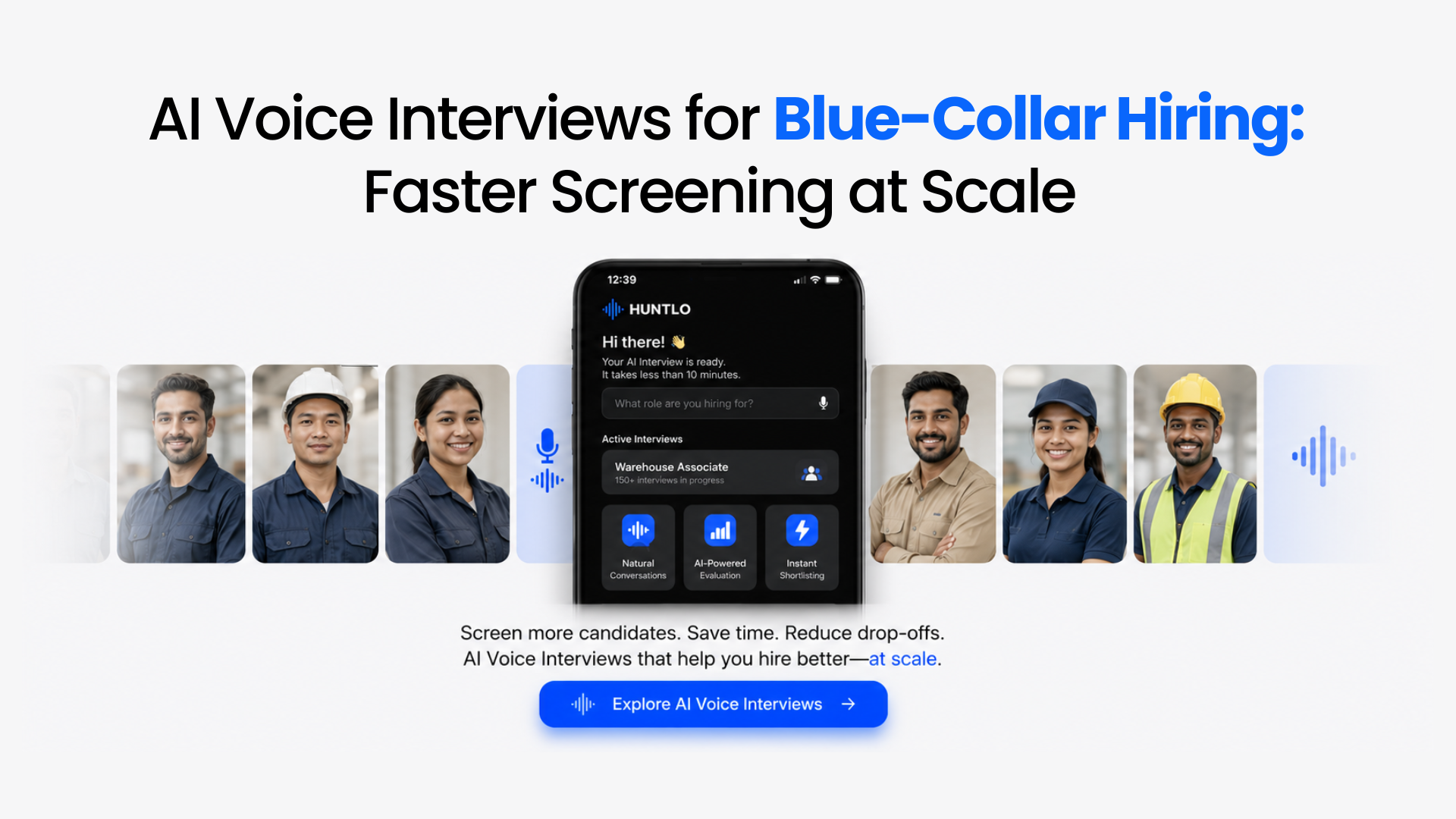
Blue-collar hiring requires sourcing across a wide range of job boards, classified platforms, and community channels that differ from the professional networks used for knowledge-worker roles. It requires outreach that works on mobile devices, where the majority of blue-collar candidates search and apply. It requires AI screening configurations tailored to the practical competencies discussed in this article, not the strategic and leadership frameworks used for corporate roles. And it requires the ability to manage hiring across dozens or hundreds of locations, each with its own pipeline, its own timeline, and its own hiring manager. Huntlo was built to handle exactly this operational complexity. Its AI sourcing engine covers 50+ platforms, including the job boards and classified channels where blue-collar candidates are most active. Its multi-channel outreach reaches candidates via SMS, WhatsApp, email, and other channels that match how frontline workers actually communicate. Its AI voice interview capability can be configured with blue-collar-specific
competency frameworks that evaluate communication, reliability, problem-solving, and motivation. And its unified workflow management means that a hiring coordinator managing openings across 50 warehouse locations can review scorecards, advance candidates, and schedule on-site interviews from a single dashboard, with every interaction tracked and every status updated automatically.
The difference between AI voice interviews that work for blue-collar hiring and those that do not is not the AI technology itself. It is the platform that surrounds it — the sourcing channels, the outreach methods, the screening configuration, and the multi-location workflow management. As highlighted in What’s the Difference Between AI Sourcing and AI Recruiting?, sourcing candidates is only the first step. Converting those candidates into screened, evaluated, and scheduled hires at the speed and scale that blue-collar operations demand requires an integrated system that connects every stage of the pipeline. For organizations hiring frontline workers at volume, that system is the difference between a hiring process that keeps up with operations and one that constantly lags behind.
Related Topics:
What’s the Best Way to Evaluate an AI Sourcing Tool Before Buying?
How Many Follow-Ups Does One Hire Need?
Why Do Some AI Recruiting Tools Have Outdated Candidate Data?